![Takeru Eye Clinic | Takatori Shopping Street, Sawara-ku, Fukuoka City [Nishijin Station / Fujisaki Station]](https://takeru-eye.com/wp-content/uploads/2022/10/takeru_logo_for-WP-header.png)
Upneeq® Mini ophthalmic solution 0.1% is Japan’s first eye drop treatment for acquired blepharoptosis (drooping eyelid) in adults (launched May 2026, self-pay). One drop a day lifts the eyelid, but the effect lasts only while you are using the drops and varies between individuals. It is not indicated if the eyelid has suddenly started to droop or a nerve disease is suspected; in those cases a diagnosis through insured care comes first.
| Target age | Purpose | Approval status | Effect measure | Duration | Main risks | Visits and management | Cost and insurance | Date checked |
|---|---|---|---|---|---|---|---|---|
| Adults (aponeurotic blepharoptosis from aging or long-term hard contact lens wear, mild to moderate) | Lifting the eyelid (improving the upper visual field) | Approved in Japan; launched May 2026 (not yet on the NHI drug price list) | MRD-1 mean +1.09 mm (Japanese phase III, 2 hours after instillation; placebo group +0.50 mm) | From about 15 minutes after instillation for roughly 8–12 hours. The effect lasts only while using the drops | Conjunctival redness, mydriasis, increased blood pressure. Risk of acute glaucoma attack in people with narrow angles | Visit at about 1–2 weeks → 1 month → 3–6 months after starting | Self-pay (revisit ¥2,200 + ¥4,890 for a box of 30). The first visit is insured | August 19, 2026 |
“When I look in the mirror, my eyes seem smaller than they used to be.” “My eyelids feel heavy in the evening.” Many people notice such changes but hesitate to come in, thinking “it isn’t bad enough for surgery.”
Upneeq® Mini ophthalmic solution 0.1% (generic name: oxymetazoline hydrochloride) is the first drug approved in Japan as an eye drop treatment for acquired blepharoptosis. Takeru Eye Clinic has prescribed it since its launch in May 2026.
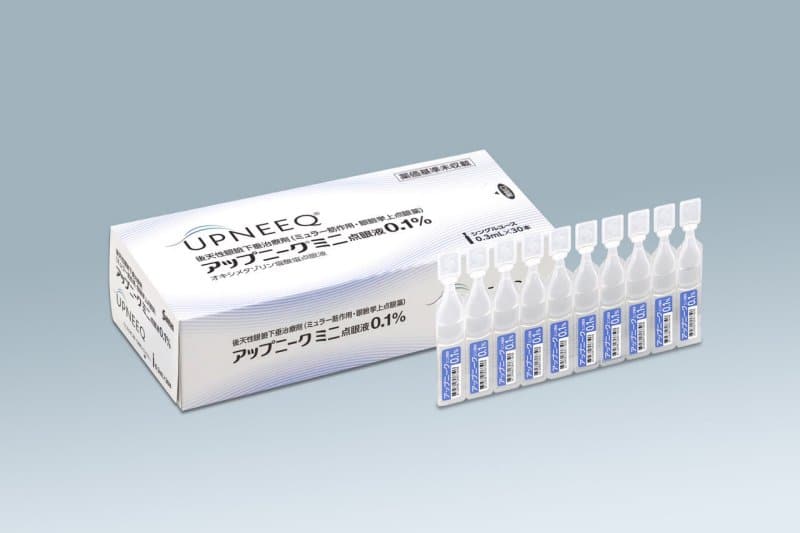
The first visit is insured care, in which we diagnose blepharoptosis and rule out other diseases. No appointment is necessary.
What Is Acquired Blepharoptosis?
Blepharoptosis is a condition in which the upper eyelid sits lower than normal. In most cases it is “aponeurotic blepharoptosis,” caused by the tendon of the muscle that lifts the eyelid (the levator muscle) stretching or loosening with age. Long-term hard contact lens wear can also be involved.
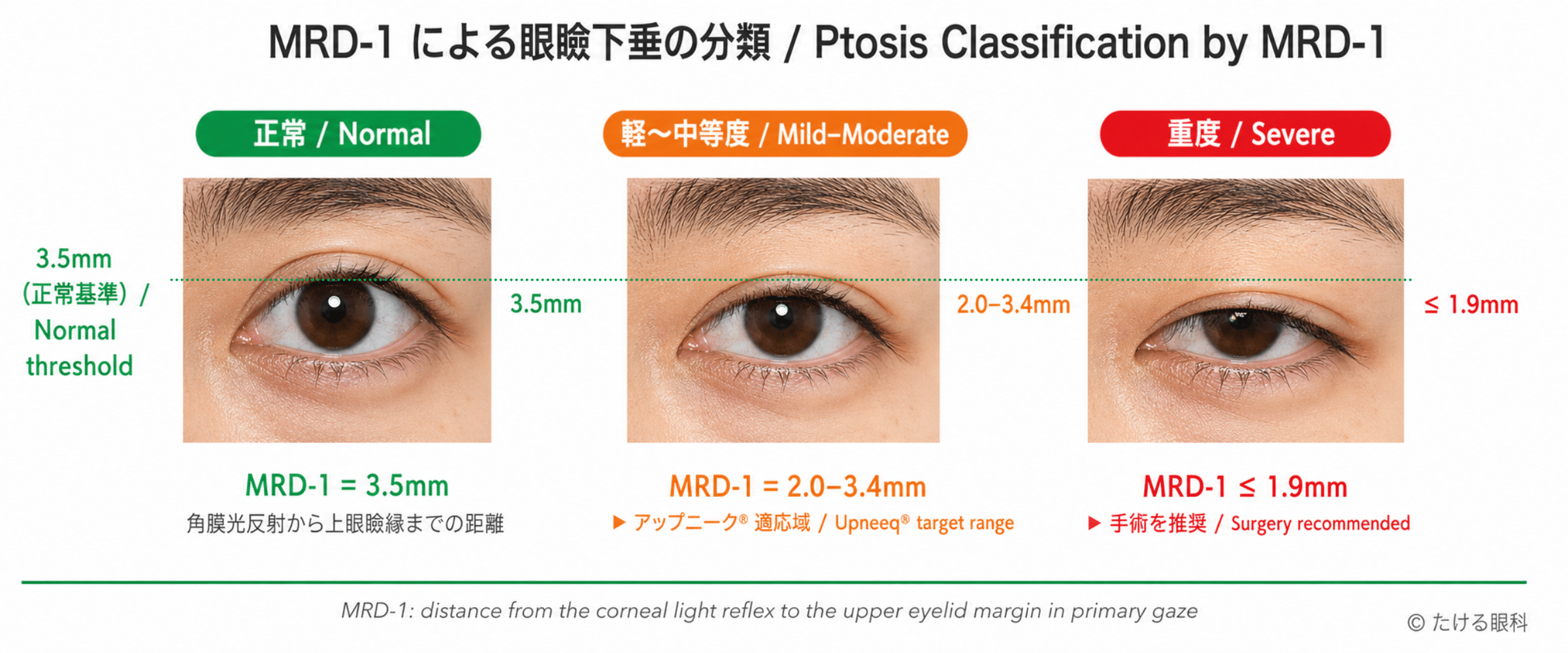
When the eyelid droops, the upper part of the visual field becomes hard to see. People often raise their eyebrows unconsciously to open their eyes, which can lead to headaches and stiff shoulders. Severity is evaluated by measuring the distance from the center of the pupil to the upper lid margin (MRD-1).
How Eye Drops Lift the Eyelid
Besides the levator muscle, the muscles that lift the eyelid include a small muscle called Müller’s muscle. Oxymetazoline, the active ingredient of Upneeq®, acts on Müller’s muscle, makes it contract, and lifts the eyelid.
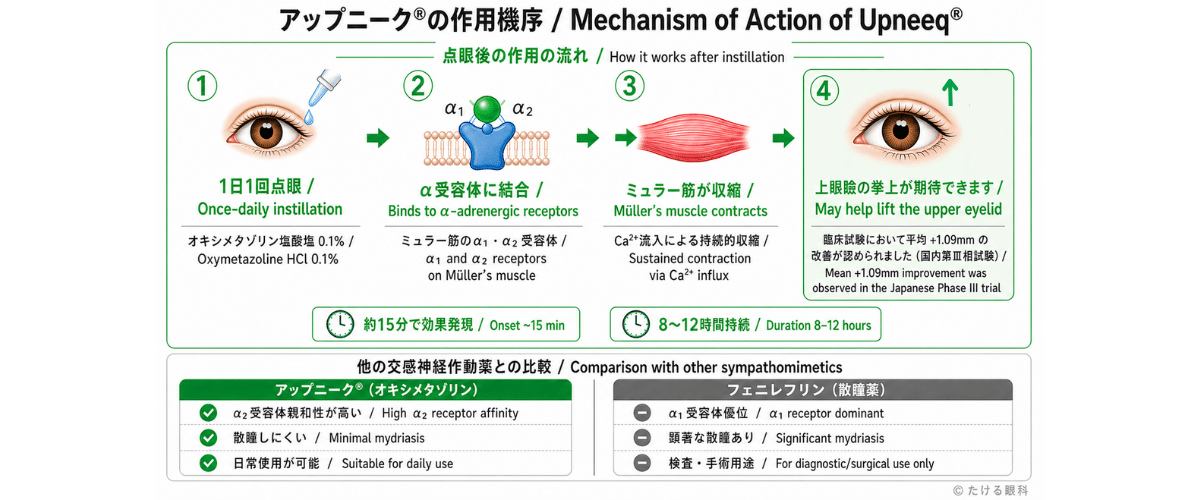
The effect is reported to begin about 15 minutes after instillation and to last roughly 8–12 hours. It is a single-use eye drop used once a day. The effect lasts only while you are using the drops, and the eyelid returns to its original state when you stop.
How Much Effect Can Be Expected?
In a Japanese phase III trial (112 people with acquired blepharoptosis), MRD-1 2 hours after instillation improved by a mean of +1.09 mm from baseline, a statistically significant difference compared with the placebo group (+0.50 mm). Clinical trials in the United States have also confirmed improvement in the upper visual field.
“1 mm” may sound small, but a 1 mm change in MRD-1 is said to widen the upper visual field by about 10 degrees, which is a change that matters for everyday vision in people with mild to moderate blepharoptosis. On the other hand, the effect varies between individuals, and not everyone gets the same improvement. At our clinic we do a trial drop before prescribing, and we ask you to consider it after seeing your actual response.
Who Is and Is Not a Candidate
The main target is mild to moderate aponeurotic blepharoptosis related to aging or long-term hard contact lens use. It is an option for people who do not want surgery, are undecided, or want to experience the effect first before deciding. Using the post-instillation appearance to preview how things might look after surgery has also been reported.
This drug is not indicated in cases such as the following.
- Sudden drooping of the eyelid (acute onset), double vision, unequal pupil size, or abnormal eye movement: these may indicate a different disease and may need urgent work-up. Please see an eye doctor first
- Congenital blepharoptosis, or blepharoptosis due to a neuromuscular disease such as myasthenia gravis, Horner syndrome, or oculomotor nerve palsy (diagnosing and treating the underlying disease comes first)
- Use for cosmetic purposes only, in people with no diagnosis of blepharoptosis (clearly prohibited by the societies’ treatment guidelines)
Safety and Precautions
The rate of side effects in the Japanese trial was low (conjunctival redness: 1 of 112 people). On the other hand, overseas post-marketing reports include mydriasis (dilated pupil) and increased blood pressure at a certain frequency. In particular, in people with narrow angles (such as untreated angle-closure glaucoma), there is a risk of acute glaucoma attack, so we check anterior chamber depth before prescribing. For people with high myopia or cardiovascular disease, we follow them carefully, including evaluation of the fundus and blood pressure.
For people taking MAO inhibitors (such as selegiline, mainly used to treat Parkinson’s disease), our clinic puts safety first and does not prescribe in principle. Please be sure to tell us beforehand about any medicines you take.
Cost (Tax Included, Self-Pay)
| Item | Cost (tax included) |
|---|---|
| First visit (insured care) | Insurance points (your co-payment depends on your insurance rate) |
| Revisit and exam fee (prescription fee included) | ¥2,200 |
| Drug cost (one box of 30) | ¥4,890 |
| Total at a revisit (guide) | ¥7,090 |
* The first visit is insured care, so it is not included in the total above. Upneeq® Mini ophthalmic solution is not on the NHI drug price list and is self-pay at full cost. A first prescription of 10 drops (10 days’ supply) is also possible.
According to the views of the Japanese Ophthalmological Society and the Japan Ophthalmologists Association, if self-pay treatment with Upneeq® is started, an interval of 6 months or more is needed before eyelid surgery for blepharoptosis can be received under insurance. If you may want surgery, please talk to us beforehand. We can also accommodate a same-day visit for insured care such as glaucoma or cataract (separate charts are made; please tell the reception).
Our Process
| Step | Details |
|---|---|
| First visit (insured care) | Measure MRD-1 with anterior segment photographs and check levator function. We evaluate the degree and cause of the blepharoptosis and rule out other diseases |
| Trial drop | We instill one drop on the spot and check the response (Müller’s muscle reactivity) after 15–30 minutes |
| Prescription (self-pay) | We consider it after you have felt the effect. A prescription starting from 10 drops is also possible |
| Follow-up | We check progress at about 1–2 weeks, 1 month, and 3–6 months after starting |
Relationship to Surgery
Upneeq® is not a substitute for surgery; it is one option. When the droop is severe, an improvement of about 1 mm from the drops is often not enough to restore the visual field and function, and surgical treatment is generally given priority. After evaluating your condition at the exam, we explain the role of the drops and of surgery.
What Is Known and What Is Not Known
- What is known:In a Japanese phase III trial (112 people with acquired blepharoptosis), MRD-1 2 hours after instillation improved significantly compared with placebo. Side effects were infrequent in the Japanese trial (conjunctival redness: 1 of 112 people).
- What is not known:Efficacy and safety of use beyond 6 months were not evaluated in the Japanese trial. It is also difficult at present to accurately predict in advance how much the effect will vary from person to person.
- What we can explain at our clinic:Your actual response to a trial drop, how to think about choosing between drops and surgery, and precautions if you also have a condition such as glaucoma.
Primary Sources
- Santen Pharmaceutical news release (Upneeq® Mini ophthalmic solution 0.1%)
- PMDA Search for Prescription Drugs (please check the latest package insert here)
Date checked: August 19, 2026 (this content will be reviewed as approval status and package inserts are revised)
Background, clinical trials, and references are collected in our explanatory article.
If you are concerned about changes in your eyelids, please let us know at your exam.

