![Takeru Eye Clinic | Takatori Shopping Street, Sawara-ku, Fukuoka City [Nishijin Station / Fujisaki Station]](https://takeru-eye.com/wp-content/uploads/2022/10/takeru_logo_for-WP-header.png)
For Those Who Want Orthokeratology and First-Time Visitors
No appointment is necessary. Please allow plenty of time when you visit.
First we perform a visual acuity test under insurance coverage and talk with you in detail.
After a general overview at the clinic, we arrange a later date for the fitting exam.
Please ask us everything you would like to know when you visit.
Please also use the online questionnaire.
We look forward to seeing you.
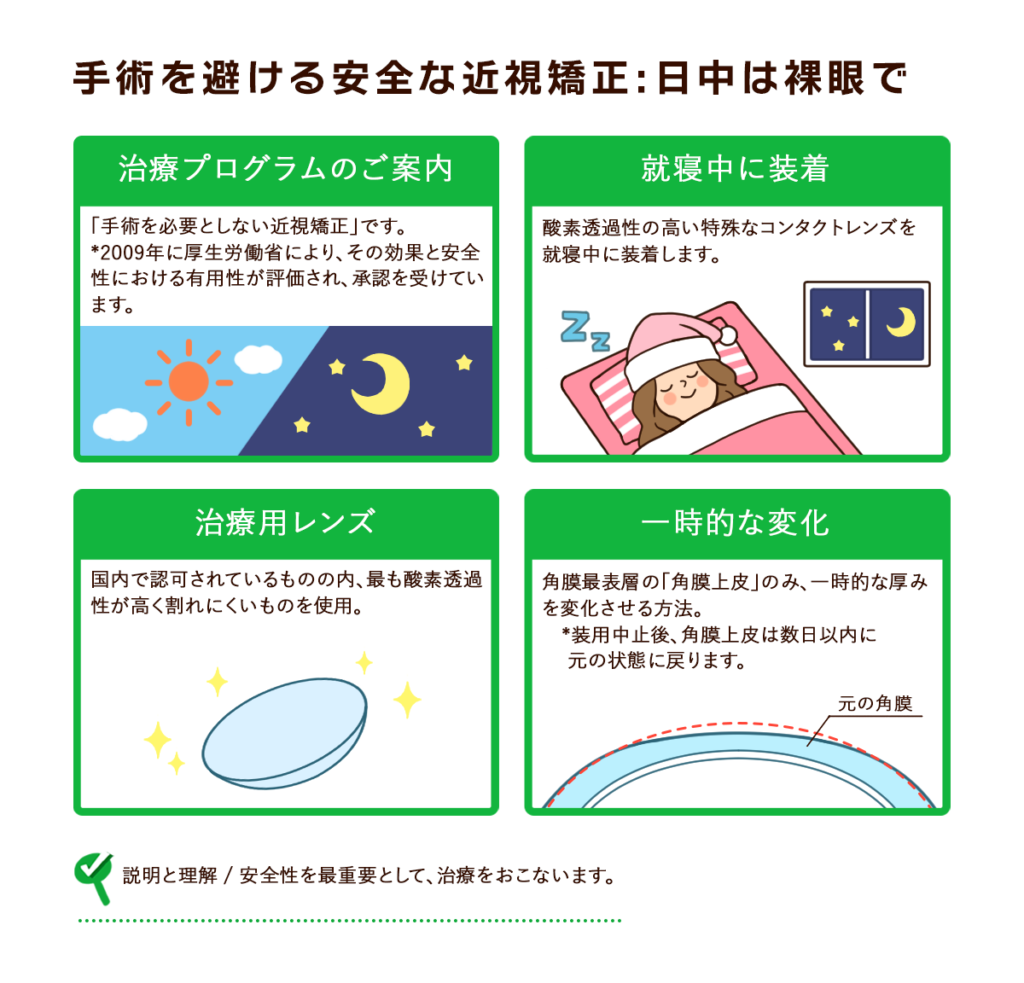
[Myopia Correction Without Surgery: Clear Vision Without Glasses During the Day]
◯ This is an introduction to our treatment program for “myopia correction without surgery.”
* In 2009, its effectiveness and safety were evaluated and approved by Japan’s Ministry of Health, Labour and Welfare.
◯ You wear special, highly oxygen-permeable contact lenses while you sleep.
◯ Treatment lenses:We use the lens with the highest oxygen permeability and the greatest resistance to breaking among those approved in Japan.
○ This method temporarily changes the thickness of only the “corneal epithelium,” the outermost layer of the cornea.
* After you stop wearing the lenses, the corneal epithelium returns to its original state within a few days.
✔ We give treatment with explanation, understanding, and safety as the top priorities.
年々進む「子どもの視力低下」寝ている間に防げる!?【シリタカ!】
2024.5.20放送 KBC NEWS in JAPAN 出演:
https://youtu.be/JbLoxDcXwR4?si=Hi9HQVjA7HpNg8zJ&t=269
(未成年のかたは、定期検査も含め 必ず保護者と一緒の来院をお願いしています)
オルソケラトロジーは、必ず定期検査を受けていただくことを前提とした治療プログラムの提供となっています。
* In 2009, its effectiveness and safety were evaluated and approved by Japan’s Ministry of Health, Labour and Welfare.
(If you are moving to Fukuoka, for example, and would like to continue orthokeratology treatment you started elsewhere, please ask us.)
Children’s myopia: the measured power may fluctuate temporarily because of accommodative tension (pseudomyopia).
As needed, we evaluate with an “accommodation analyzer”
: this leads to accurate power selection for the orthokeratology lens.


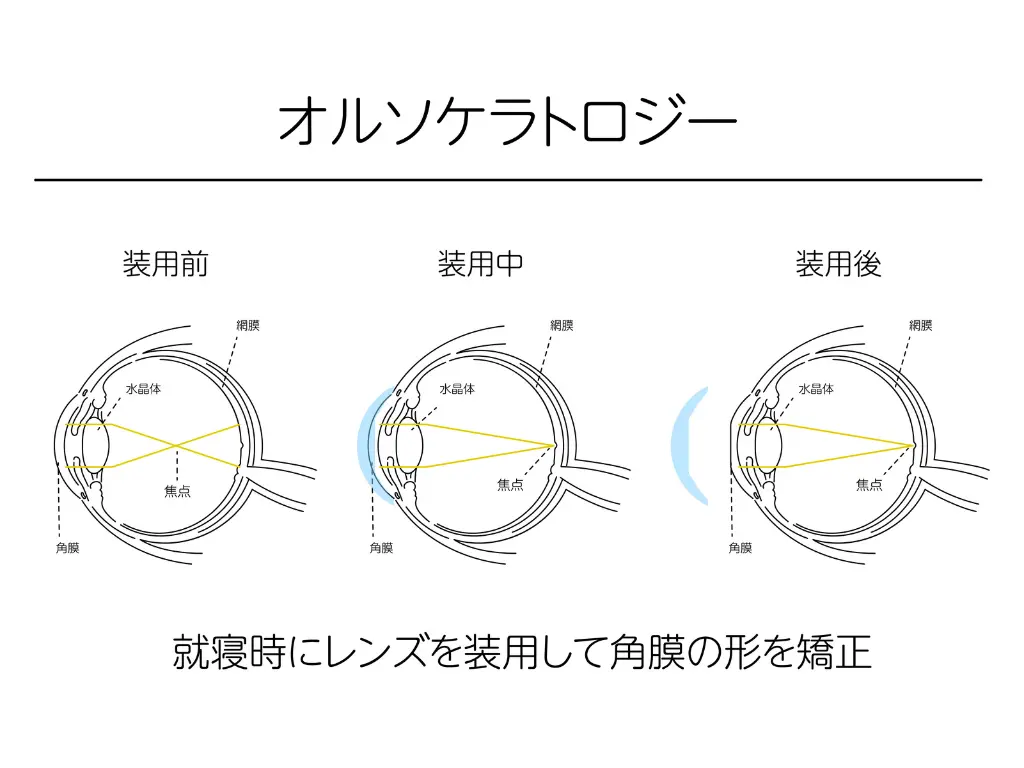
How Orthokeratology Works
Lenses with high oxygen permeability, worn during sleep, change the thickness of the corneal epithelium so that images focus on the retina during the day without glasses.
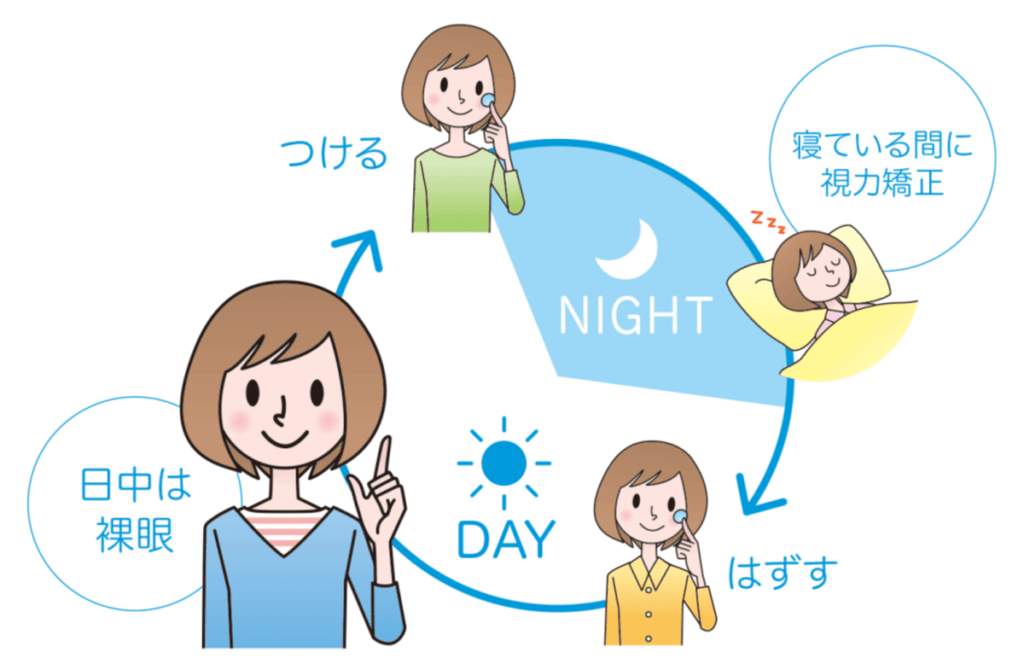
We provide a complete treatment program.
This is not a sale of lenses.
In 2009, its effectiveness and safety were evaluated and approved by Japan’s Ministry of Health, Labour and Welfare.
We provide treatment in strict accordance with the Orthokeratology Guidelines, 2nd edition (Journal of the Japanese Ophthalmological Society, vol. 121, no. 12).
Ortho: correction, Kerato: cornea, Logy: method

Myopia: a state in which the focus falls in front of the retina.
In an eye without refractive error, light is focused on the retina by the refractive power of the cornea and lens.
In a myopic eye, the focus falls in front of the retina, so images look blurred.

The shape of the cornea is changed temporarily.
A special inner curve changes and flattens the front of the cornea so that light focuses on the retina and vision is clear.
* Unlike the illustration, strictly speaking only the thickness of the corneal epithelium changes.

During the day, the image is focused on the retina.
The cornea whose epithelium alone has changed shape keeps that shape for a certain time even after the lens is removed.
That is why uncorrected vision improves during the day.

Lens shape: applies slight pressure to the center of the cornea.
It affects the corneal epithelium (described later).
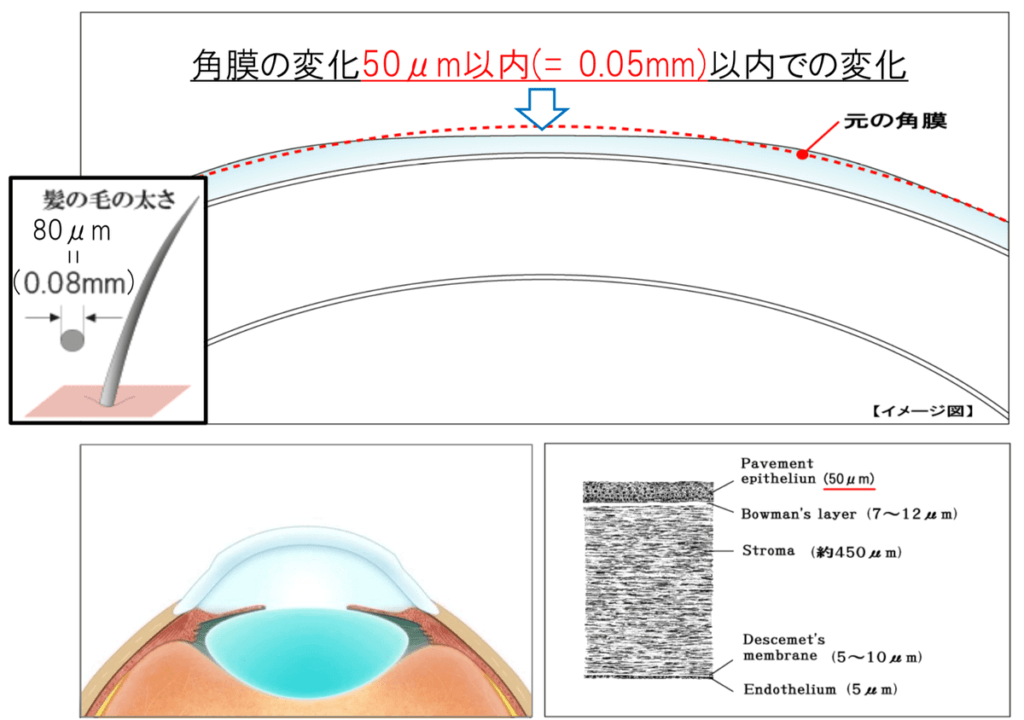
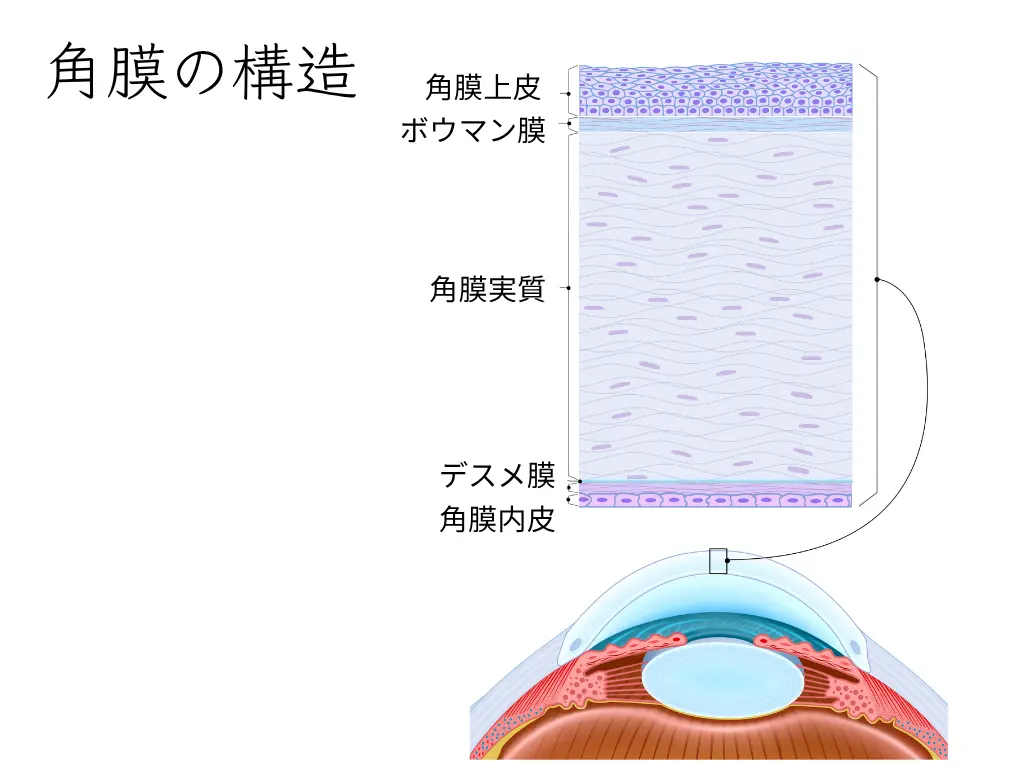
The five-layered cornea:
The thickness of the central corneal epithelium changes.
After you stop wearing the lenses, the thickness of the central epithelium returns (redistribution of the epithelium).
Advantages of Orthokeratology
- Unlike LASIK and ICL, no surgery is needed
-
If you stop, the cornea returns to its original state (about 2 weeks to 1 month).
- You can live without glasses during the day
-
・People for whom glasses are inconvenient because of their work
・People who find contact lenses uncomfortable
・People who cannot wear contact lenses because of hay fever, allergies, or dry eye
・People who play sports
It is suitable for people like these. - Because this is a “treatment program” approved by the Ministry of Health, Labour and Welfare, medical expense deduction is available
-
“Medical expense deduction for the cost of myopia treatment by orthokeratology (corneal refractive therapy)”
* Please submit your receipt at year-end adjustment or when filing your tax return.
Disadvantages of Orthokeratology
- There is a risk of complications
-
Incorrect use can lead to serious complications such ascorneal infection.
People who cannot reliably come for regular checkups are not suitable.
* The designated care products (Ophtecs) contain povidone-iodine and are the only products that also disinfect against Pseudomonas aeruginosa and Acanthamoeba infection. We also replace the orthokeratology lens case every time. - Effects vary between individuals
-
It generally takes about one week for the treatment effect to appear, but this varies between individuals.
Light may blur at night (halos and glare). - It may not be suitable for people with high myopia or strong astigmatism
-
Suitable for myopia up to −4.0 D and astigmatism up to −1.50 D:
(* The exact power is determined by a corrected visual acuity test)
We use domestically made correction lenses suited to Japanese eyes

Characteristics of Japanese corneas: less protrusion.
“Breath-O Correct®” is designed with a controlled reverse curve length and curve and a shallow sagittal depth so that it can be prescribed safely even for the flat, spherical corneas with little central protrusion that are common among Japanese people.
フラットな球形角膜にも安全に処方するため、リバースカーブの長さとカーブをコントロールし、サジタルデプスを浅く設計しています。
This prevents the lens from sticking to the cornea and is designed so that the lens’s movement allows good exchange of tears.
(From Toray)
References
Comparison of corneal shape between Japanese and Americans using the TMS-1
糸井素純 ; 西巻賢一 ; 小淵輝明 ; 金井淳 ; James V Aquavella
Journal of the Japan Contact Lens Society 38(1), p9-13, 1996

Lens material:
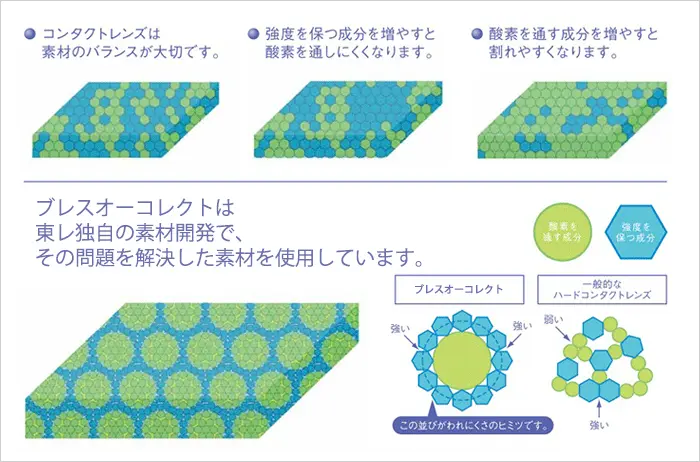
High oxygen permeability, with almost no worry of breakage.
(From Toray)
Made with a flexible material born of Toray’s original polymer technology.
The strength-retaining components are tightly bonded, so the lens bends flexibly against external impact and is protected from cracking.
It realizes a lens that overturns the common belief that “the higher the oxygen permeability, the easier it breaks.”
Constituent monomers: fluorine-containing methacrylate compounds and silicon-containing methacrylate compounds
Colorant: phthalocyanine colorant
Lens color: blue

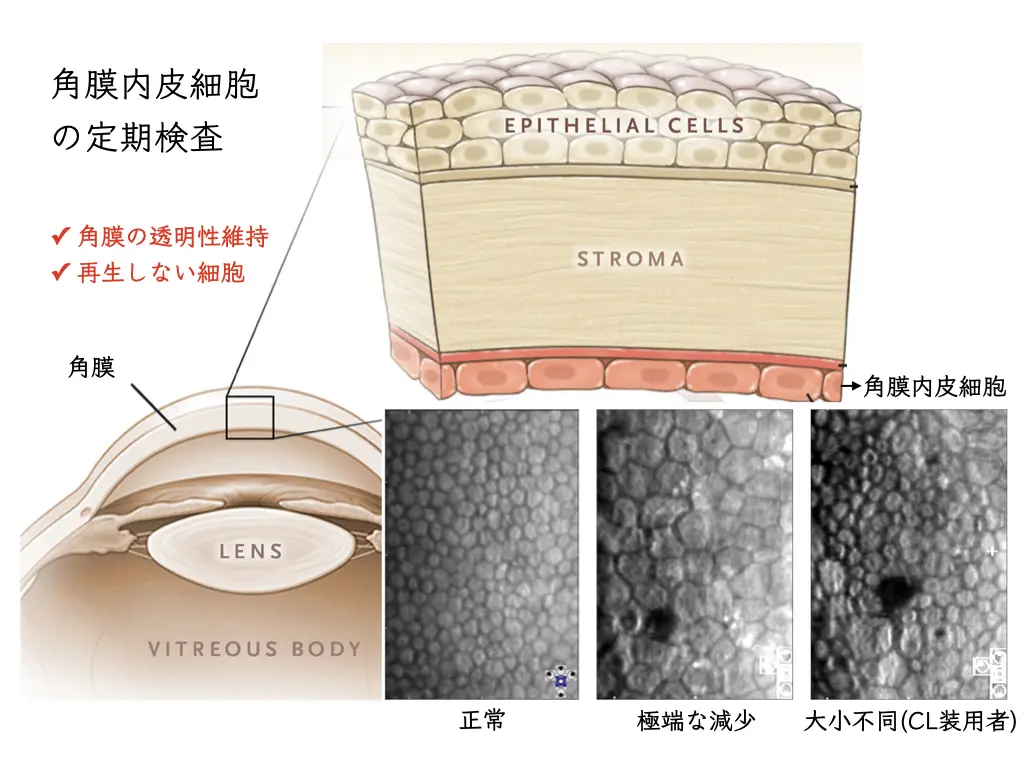
Oxygen permeability has the greatest effect on the corneal endothelium.
Among lenses currently approved in Japan, this has the highest oxygen permeability coefficient.
At regular checkups we always check for any effect on thecorneal endothelial cells.
Breath-O Correct® by Toray
Treatment Schedule
Only people who can reliably come to visits are eligible for treatment.
(including people already attending)
- We provide general myopia care. We cover what is known in ophthalmology today.
Children’s myopia: our approach to explanation - On request, we give a general explanation of orthokeratology.
- For children, we alsodecide whether to proceed to the orthokeratology fitting exam.
※ If you use contact lenses, you need to stop wearing them for a period to let the cornea return to its original shape.- Disposable soft contact lenses: 3 days
- Continuous-wear soft contact lenses: 1 week
- Hard contact lenses: 2 weeks
- Other orthokeratology lenses: 1 month
[Booking the Orthokeratology Fitting Exam (First Visit)]
(For people who have already received an overview under insurance-covered care)
Through a LINE message, please tell us
your ID, name, and preferred dates (fitting exam day, the next day, and 1 week later).
In some cases, we may not recommend the fitting exam.
We decide carefully with the safety of your eyes in mind.
We will reply after checking your medical record.
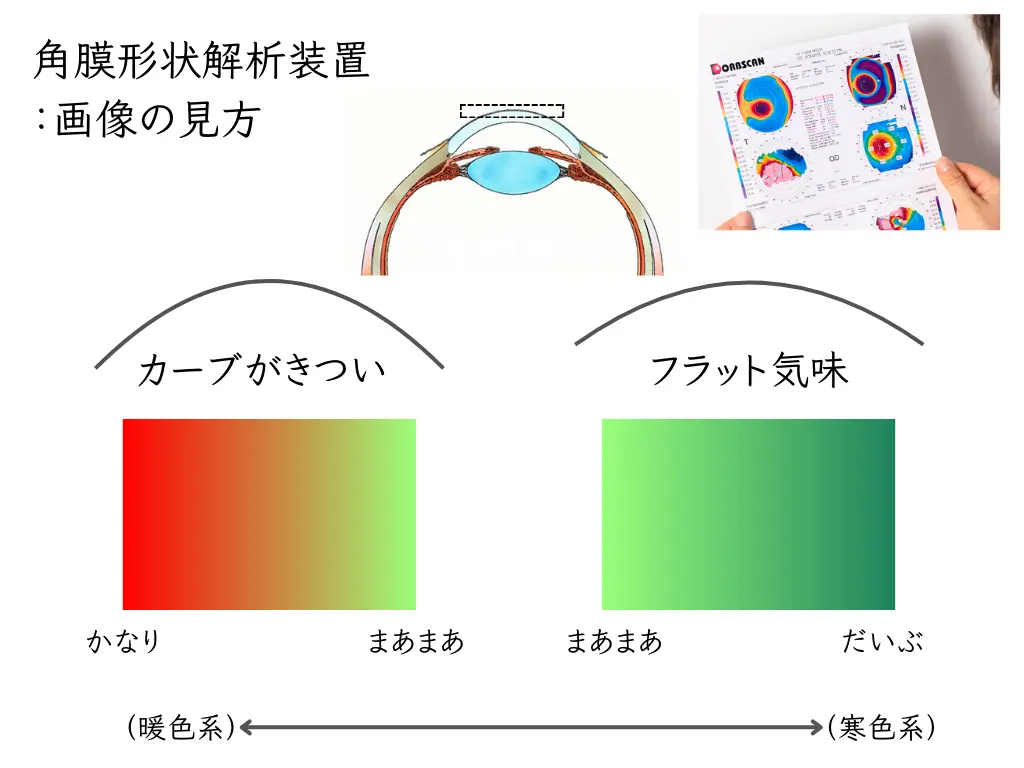
After suitability tests such as corneal topography and corneal endothelial cell imaging, we select an appropriate trial lens using the trial lens specification program (Fitting Master). We carefully check the fit using the over-refraction after wear and a slit-lamp microscope.
We give an explanation tailored to each person.
* Fitting and practice wearing may take 2 hours or more at the longest.
* Eyedroppersare also given to you free of charge.
(The night before your visit, you wear a loaner trial lens to sleep)
The day after trying it for one night, we examine the state of your cornea in detail.
* Schedules can be arranged, for example wear on Sunday and visit on Monday.
A period in which the treatment effect can be judged to some extent.
If there are no problems, the treatment lens is ordered (the trial lens is returned)
Please choose one: lump-sum payment or monthly plan
(start of wear)
We give you a new lens case every time.
We also judge whether the treatment lens needs replacing (usually about 2 years).
Using a medical index called “axial length”, we scientifically monitor the growth of the child’s eyes.
Orthokeratology Treatment: Fee Structure
Self-pay (prices include tax)
First-year total ¥165,000
Included in exams: visual acuity, corneal topography,axial length measurement(for children), slit-lamp microscope examination, corneal endothelial cell measurement
From the fitting exam to week 1 (common fee)
- Fitting exam only: ¥5,500
If wear is stopped on the same day. - Fee up to week 1:
- Both eyes ¥55,000 / one eye ¥33,000 (cash only)
- Included: exam and consultation fees up to week 1, deposit, trial lens use fee, initial starter set and care products
- If treatment is stopped by week 1: ¥30,000 refunded for both eyes / ¥15,000 for one eye
When moving on to the main treatment
1. Lump-sum plan
- First year:
- Both eyes ¥110,000 / one eye ¥66,000 (includes the lenses, one year of exams and consultations, and management fees)
- From the second year(per year):
- Both eyes / one eye ¥23,100 (includes one year of exams and consultations, and management fees)
- Lens replacement: about every 2 years (both eyes ¥66,000 / one eye ¥33,000)
- Warranty:
- Power change or breakage replacement: within 12 months of the purchase date, 2 times in total (for breakage, more than half of the lens is required)
- If lost: ¥33,000 (1 lens)
- Additional exam (when needed): ¥3,300
2. Monthly plan (discontinued)
Because the monthly plan costs more in the long run, we ended it to put your benefit first
- Monthly fee:
- Both eyes ¥8,800 / one eye ¥5,500 (debited monthly by credit card)
- Included: use of the treatment lenses and exams and consultations every 3 months
- First payment: 2 months’ worth, paid at the clinic
- Warranty:
- Power change or breakage replacement: within 12 months of the purchase date, 2 times in total (for breakage, more than half of the lens is required)
- The above warranty is renewed every year from the start of the main treatment
- If lost: ¥16,500 (1 lens) (paid at the clinic)
- Cannot be canceled for 1 year.
(Except on a doctor’s diagnosis, for example for prescribing reasons) - Additional exam (when needed): ¥3,300
| Item | Lump-sum plan | Monthly plan |
|---|---|---|
| Fitting exam | Both eyes: ¥55,000 One eye: ¥33,000 (cash only) | |
| First-year cost | Both eyes: ¥110,000 One eye: ¥66,000 |
Monthly, both eyes: ¥8,800 Monthly, one eye: ¥5,500 (first 2 months paid in advance) |
| From the second year (per year) | Both eyes / one eye: ¥23,100 | Monthly fee continues |
| Included | Lens cost + exam, consultation, and management fees | Lens use fee + exam and consultation every 3 months |
| Lens replacement | About every 2 years Both eyes: ¥66,000 One eye: ¥33,000 |
Included in the monthly fee (up to twice a year per eye) |
| Power change / breakage replacement | Within 12 months of purchase, 2 times in total (more than half of the lens is required) |
Within 12 months of purchase, 2 times in total (more than half of the lens is required) Warranty renewed every year |
| If lost | ¥33,000 (1 lens) | ¥16,500 (1 lens) |
| Payment method | Paid at the clinic reception | Debited monthly by credit card |
| Cancellation terms | No restriction | Cannot be canceled for 1 year (except on a doctor’s diagnosis) |
Advantages of the monthly plan
- Lower upfront cost makes it easy to start
- Regular checkups (exams) and lens replacement are included in the fee
- A constant monthly cost is easy to manage
Disadvantages of the monthly plan
- For long-term use (3 years or more), the total cost can be higher than a lump-sum payment
※ At the start of treatment, you need to refrain from wearing contact lenses so that the condition of the cornea can be measured accurately (disposable: 3 days; hard contact lenses: 2 weeks)
◎ This is eligible for “medical expense deduction for the cost of myopia treatment by orthokeratology (corneal refractive therapy).”
https://www.nta.go.jp/law/shitsugi/shotoku/05/66.htm
Lam, A.K.C., et al. Association between long-term orthokeratology responses and corneal biomechanics. Sci Rep 9, 12566 (2019). https://doi.org/10.1038/s41598-019-49041-z
[About Ending the Monthly Plan and Unifying to the Lump-Sum Plan] Updated January 19, 2026
We had offered a “monthly plan,” but after simulating long-term costs, we concluded that “if you continue for a year or more, the lump-sum plan greatly lightens your burden.”
Rather than short-term cheapness, we want you to receive treatment in the way that is least burdensome for people who attend for a long time. We have therefore unified to the “lump-sum plan,” which keeps the total cost lowest.
For the lump-sum plan, which greatly reduces maintenance costs from the second year, please see the fee table.
Myopia Control in Children: Pursuing the Principle
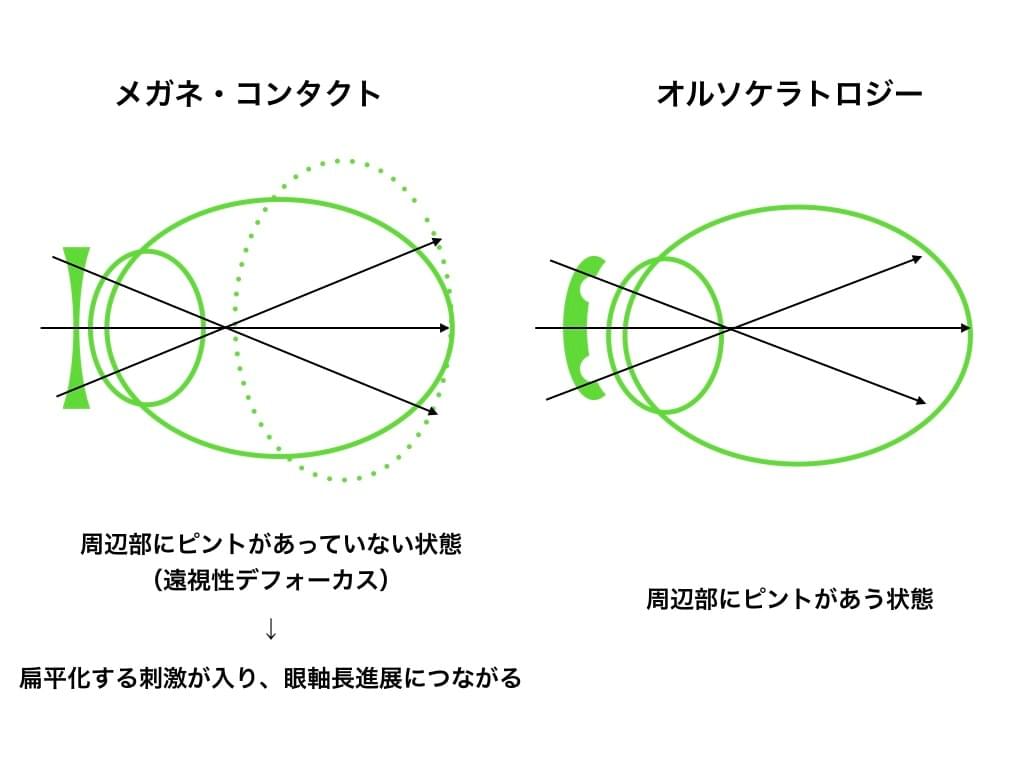
The concept of “peripheral aberration”
Defocus in the peripheral retina may promote the growth of axial length in children (that is, the progression of myopia).
Myopia control effect of orthokeratology: many high-level evidence reports, including meta-analyses, have been published.
Si, J.-K., et al. 2015. Orthokeratology for Myopia Control: A Meta-analysis. Optometry and Vision Science 92, 6.
Swarbrick, H.A., 2018. Orthokeratology for myopia control: an optometrist’s view. Ann. Eye Sci 3, 17–17. https://doi.org/10.21037/aes.2018.02.01
Under 20 is a “careful prescription” category. We give treatment with a particular emphasis on safety.
Compliance with the Orthokeratology Guidelines
Excerpts from the Orthokeratology Guidelines, 2nd edition (Journal of the Japanese Ophthalmological Society, vol. 121, no. 12)
The physician meets the following two conditions.
A board-certified ophthalmologist.
A board-certified ophthalmologist is a physician who meets the following:
(1) A member of the Japanese Ophthalmological Society and the Japan Ophthalmologists Association.
(2) Has trained in clinical ophthalmology for 5 years or more.
(3) Has passed the specialist certification exam given by the Specialist System Committee.
The qualification must be renewed every 5 years.
5年ごとにその資格を更新しなければなりません。
Has attended specialist courses on orthokeratology and received a certificate of completion or attendance for each.
・Orthokeratology course designated by the Japanese Ophthalmological Society
Learn general knowledge about orthokeratology treatment.
・Orthokeratology course held by the manufacturer and distributor (Universal View)
Learn the lens-specific design structure, principles, and fitting methods.
Learn the specialized knowledge to select the lens best suited to each patient and carry out treatment.
Pre-Prescription Screening Tests
Before prescription, the following tests must be performed to carefully evaluate whether orthokeratology is indicated.
1) Visual acuity test: uncorrected and corrected
2) Refraction test: subjective and objective
3) Corneal curvature measurement
4) Slit-lamp microscope examination
5) Fluorescein staining test
6) Corneal topography
7) Corneal endothelial cell count
8) Schirmer I test
9) Fundus examination
10) Eye pressure measurement
11) Pupil diameter measurement (bright and dark)
Indications for Orthokeratology
1) Age
20 or older. Under 20, careful prescription.
2) Target
Myopia and astigmatism with stable refraction.
3) Amount of refractive correction
1. In principle, myopia up to −4.00 D and astigmatism of −1.50 D or less. For clear with-the-rule or oblique astigmatism, prescribe after sufficient consideration.
2. Central corneal refractive power from 39.00 D to 48.00 D.
3. The goal is that the refraction after treatment is not overcorrected.
4) Healthy eyes without eye disease that also meet the following 1 and 2.
1. No marked fluorescein staining of the cornea or conjunctiva, and a Schirmer I test of 5 mm or more in 5 minutes.
2. Corneal endothelial cell density of 2,000 cells/mm2 or more.
Contraindications to Orthokeratology (People Who Cannot Use It)
1) Patients who do not meet the indications above.
2) Patients from whom informed consent cannot be obtained.
3) Patients who have difficulty coming for regular checkups.
4) Women who are pregnant, breastfeeding, or planning a pregnancy.
5) Patients with immune disease (for example acquired immunodeficiency syndrome [AIDS] or autoimmune disease) or diabetes.
6) Patients who may develop or worsen an allergic reaction of the ocular surface or adnexa from wearing contact lenses or using care products.
7) Patients with acute or subacute inflammation of the anterior segment, or active corneal infection (bacterial, fungal, viral, and so on).
8) Patients with diseases of the cornea, conjunctiva (such as vernal keratoconjunctivitis), or eyelids, or with injuries or malformations affecting them.
9) Patients with severe decreased tear secretion (dry eye).
10) Patients with decreased corneal sensation.
11) Patients who drive a car or motorcycle during treatment, or who do work in which a change in vision could endanger body or mind, and for whom it is difficult to use another refractive correction method even temporarily.
12) Patients with unstable corneal refractive power (radius of curvature) measurements, or with markedly irregular mires (irregular astigmatism).


 ポチップ
ポチップ
 ポチップ
ポチップ
Seed Web seminar (for medical professionals)
https://www.seed.co.jp/topics/mt_asset/230502_oshirase.pdf
「オルソケラトロジーの安全性と費用に関する詳細公開」
※医療広告ガイドラインの「限定解除要件」に基づき、リスクや費用を透明化して掲載しています。
| 項目 | 内容 |
| 治療内容 | 就寝中に特殊な高酸素透過性コンタクトレンズ(ブレスオーコレクト)を装用し、角膜上皮の厚みを一時的に変化させることで日中の視力を改善し、近視進行の抑制(眼軸長進展の管理)を目的とする治療です。 |
| 標準的な費用 | 初年度総額:165,000円(税込) 2年目以降:23,100円/年 ※詳細な内訳・返金規定は上記料金表をご参照ください。 |
| 治療期間・回数 | 良好な視力維持のため毎晩の装用が必要です 9。定期検査は翌日、1週、2週、1ヶ月、3ヶ月、以降は3ヶ月毎の受診が不可欠です。 |
| 主なリスク・副作用 | 角膜感染症(重篤な場合は視力障害の恐れ)、角膜上皮障害、ハロー・グレア(夜間に光がにじむ現象)、一時的な視力の不安定化などが生じる可能性があります。 |
【重要な注釈:安全性に関する遵守事項】
- 20歳未満への処方について: 日本眼科学会ガイドラインに則り「慎重処方」対象となります 。当院では安全性を最優先し、専門医が適応を厳格に判断します 。
- 定期検査の義務: 本治療は定期検査の受診が継続の条件です 。受診が困難な場合は、眼の安全確保のため治療を継続いただけません 。

