![Takeru Eye Clinic | Takatori Shopping Street, Sawara-ku, Fukuoka City [Nishijin Station / Fujisaki Station]](https://takeru-eye.com/wp-content/uploads/2022/10/takeru_logo_for-WP-header.png)
Myopia progression control in children differs in target age, approval status, and cost among myopia control glasses, eye drops (Ryjusea® Mini), and contact lenses (MiSight®, orthokeratology). We choose based on your child’s age, axial length, lifestyle, and risks as confirmed at the eye clinic. Please see the comparison table and each page below.
Comparison of Myopia Progression Control Treatments (2026)
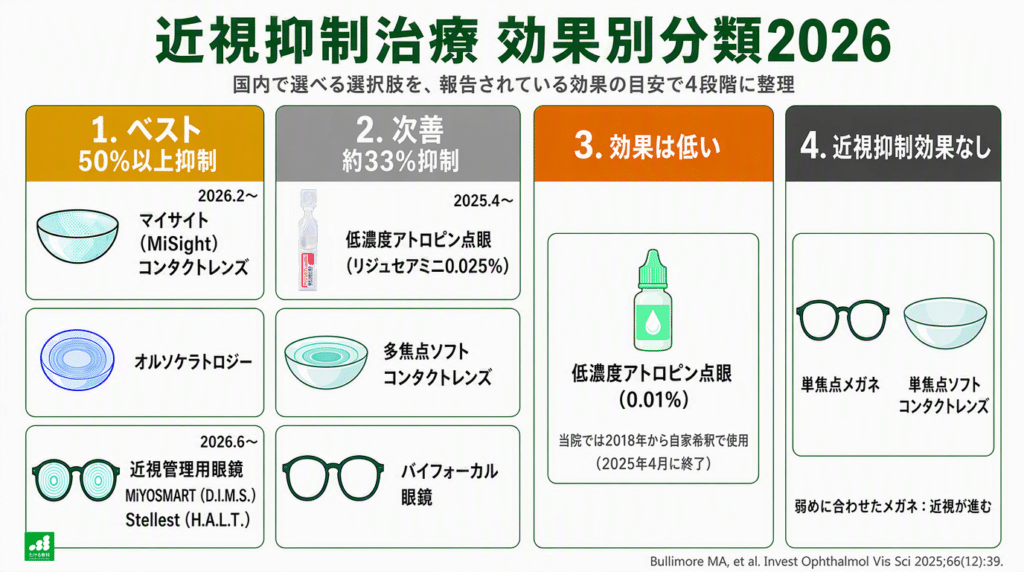
| Treatment | Target age | Purpose | Approval status | Effect measure | Duration | Main risks | Visits and management | Cost and insurance | Date checked |
|---|---|---|---|---|---|---|---|---|---|
| Myopia control glasses (MiYOSMART® / Stellest®) | MiYOSMART® ages 5–18 / Stellest® ages 7–18 | Slows axial length growth + corrects vision | Released in Japan in June 2026 | About 50–60% less progression than single-vision glasses (average of 55–59% as stated in the Japanese Society of Myopia guidelines) | All-day wear (morning to night). Consider continuing until around age 18 | A treatment that does not touch the eye directly. Some children need time at first to get used to the way things look | Four regular exams per year | Self-pay: pre-prescription exam ¥5,500 + annual management fee ¥17,600 + actual lens cost | August 19, 2026 |
| MiSight® 1day | Children (after a suitability assessment; myopia beyond −4.00 D is not eligible) | Slows progression of axial length and refraction + daytime vision correction | Approved in Japan in 2025 as the country’s first soft contact lens for myopia progression control | In a 3-year international clinical trial, refraction progression was slowed by 59% and axial length growth by 52% (axial elongation of 0.30 mm over 3 years vs. 0.62 mm in controls) | Daytime wear, daily disposable | Corneal damage and corneal infection (if poorly managed), halos and glare. Effects vary between individuals | Detailed exams every 3 months (our clinic’s program) | Self-pay: initial setup ¥55,000 + annual management fee ¥17,600 (includes 4 detailed exams) + lenses ¥6,800 per box (purchased at each 3-month visit) | September 22, 2026 |
| Ryjusea® Mini 0.025% eye drops (low-concentration atropine) | Children (indication and starting age are confirmed from the package insert and at the exam) | Pharmacological control of myopia progression | Approved in December 2024 and launched in April 2025 (Japan’s first eye drops for myopia progression control). Covered under the “selected medical treatment” (sentei ryoyo) system since June 2026 | In a Japanese phase II/III trial (ages 5–15, 24 months), progression of myopic refraction was about 40% lower than with placebo (between-group difference 0.64 D, package insert) | One drop once daily, continued use | Glare, difficulty with near vision, and others. Management takes rebound after stopping into account | Prescription management with regular visits | The national system is selected medical treatment (exams and tests are insured; the drug cost is out of pocket). Our clinic continues self-pay care in order to measure axial length every 3 months. When combined with MiSight®, a prescription fee of ¥1,100 + ¥13,140 for 3 months of medication is added every 3 months | September 22, 2026 |
| Orthokeratology | At our clinic, many children start around age 8 | Overnight wear for daytime uncorrected vision + slowing of axial length growth (reported in studies) | Approved in Japan for myopia correction (no approved indication for progression control) | Studies report a progression-slowing effect (outside the approved indication) | Worn during sleep (about 8 hours), continued use | Corneal infection (adherence to lens care is most important) | Regular checkups are essential | Self-pay (see the orthokeratology page for details) | August 19, 2026 |
* The control rates in the table are values reported in trials that differ in population, duration, and comparison conditions.The figures cannot be lined up side by side to judge which treatment is better.In addition, outdoor activity (playing outside) for 2 hours or more a day also has strong evidence for preventing myopia. We explain which treatment suits your child based on the results of exams, including axial length measurement.
Primary sources:Japanese Society of Myopia, “Flow of myopia progression control care”/PMDA Search for Prescription Drugs (Ryjusea® Mini package insert)(Information checked: August 19, 2026)
Cost and Insurance for Myopia Control Treatment (as of September 2026, tax included)
| Treatment | Cost at our clinic | Estimated first year | Second year onward (per year) | Health insurance | Medical expense deduction |
|---|---|---|---|---|---|
| Myopia control glasses (MiYOSMART® / Stellest®) | Pre-prescription exam ¥5,500 + annual management fee ¥17,600 | About ¥100,000 plus frame (includes lens cost of about ¥77,000–79,000 *1) | ¥17,600 (plus lens cost when lenses are replaced for a prescription change) | Only the first exam and explanation are insured. Everything from the pre-prescription exam on, and the lenses, are self-pay | No clear guidance has been issued *3 |
| MiSight® 1day | Initial setup ¥55,000 (includes the first month of lenses) + annual management fee ¥17,600 + lenses ¥6,800 per box | About ¥220,000 | About ¥180,000 (annual management fee + lenses, 24 boxes for both eyes) | Self-pay (a two-step approach starting with insured wear practice is available) | No clear guidance has been issued *3 |
| Ryjusea® Mini (low-concentration atropine eye drops) | ¥3,300 at start + annual management fee ¥17,600 + medication ¥4,380 per month | About ¥73,000 | About ¥70,000 | The national system is selected medical treatment (exams and tests are insured; the drug cost is out of pocket). Our clinic offers self-pay care in order to measure axial length every 3 months | Expected to qualify (approved drug) *2 |
| Orthokeratology | First-year total ¥165,000 | ¥165,000 | ¥23,100 | Self-pay | Eligible (the National Tax Agency has published a Q&A) |
- *1 Lens cost is paid at the optical shop. Listed prices at major optical chains are ¥77,000 for MiYOSMART® and ¥79,200 for Stellest® (tax included, frame extra; confirmed September 2026). Prices may differ by store.
- *2 The final decision rests with the tax office. Please keep your receipts.
- *3 At present, no clear guidance has been issued as to whether myopia control glasses and MiSight® qualify for the medical expense deduction (as far as our clinic could confirm). Please check with the tax office before filing your return.
- If you combine MiSight® with Ryjusea® Mini, a prescription fee of ¥1,100 + ¥13,140 for medication is added every 3 months, with no additional annual management fee. Combining myopia control glasses with Ryjusea® Mini also carries no additional management fee.
You do not have to choose a treatment by cost alone. After the first (insured) exam, we explain which method suits your child’s age, pattern of axial length growth, and lifestyle.
Guide to the Pediatric Myopia Control and Continuing Management Program
Overview of the myopia progression management app:
https://takeru-eye.com/myopia-app-introduction
Since 2025, myopia progression control treatment has begun in earnest in Japan.
We are rolling out as follows.
* Orthokeratology: Approved only for myopia correction. Studies show a progression-slowing effect, but it has no approved indication for this in Japan.
Responsible management by orthoptists and ophthalmology specialists
Eye examinations, explanations, and wear instruction are performed by a certified orthoptist (CO) .
Two of our board-certified ophthalmologists have received the “MiSight® 1day Prescribing Facility Certification (CooperVision Japan).”
Certified physicians monitor your child’s myopia progression continuously and from multiple angles.
Myopia control only makes sense if it is continued. In research, the dropout rate differed by treatment, and it was higher for soft contact lenses. At our clinic, orthoptists check how your child is wearing the lenses together with you four times a year.
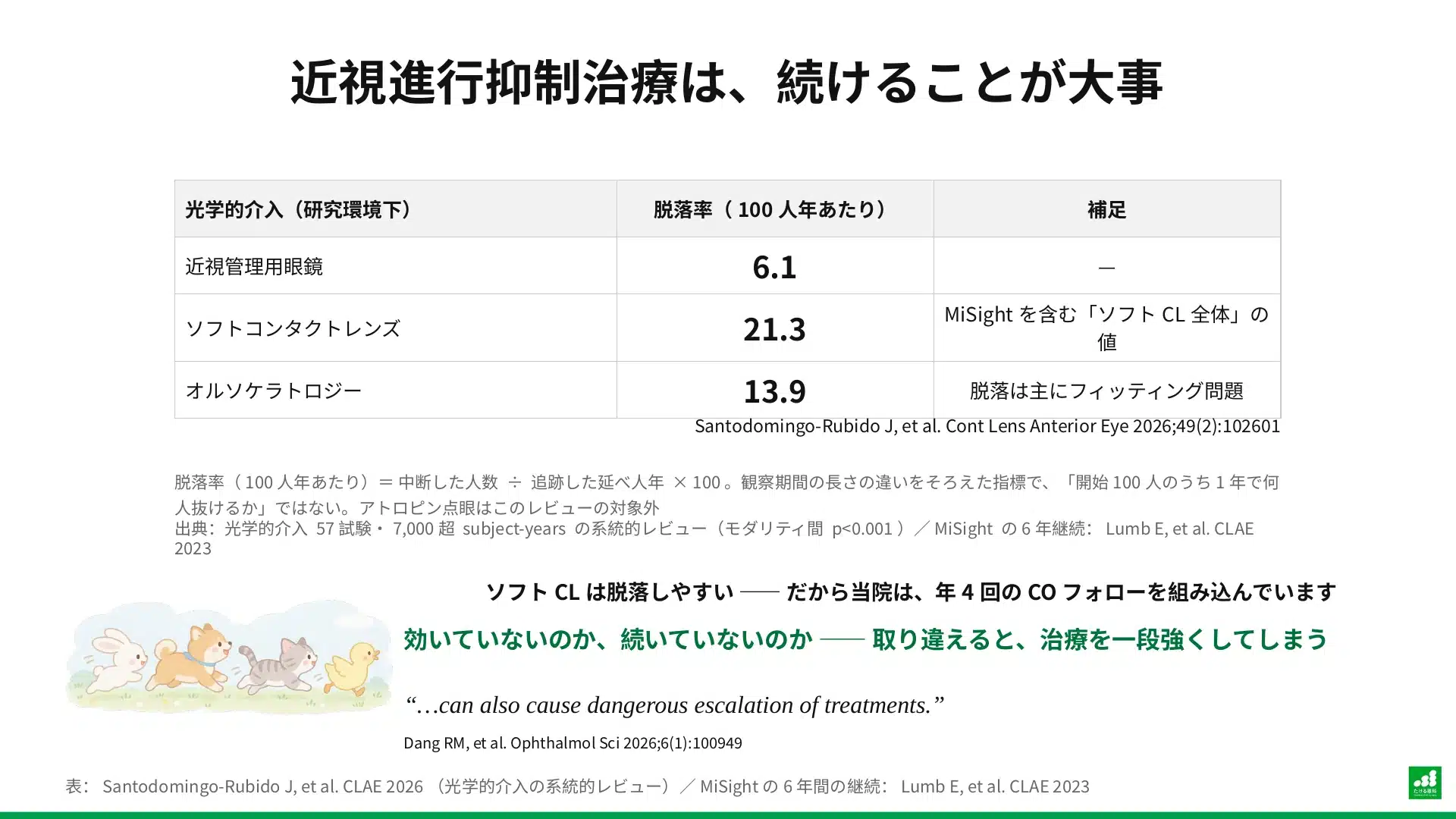
Myopia is not just reduced vision; it is a progressive condition that raises the future risk of blindness (glaucoma, retinal detachment, myopic macular disease, and others).
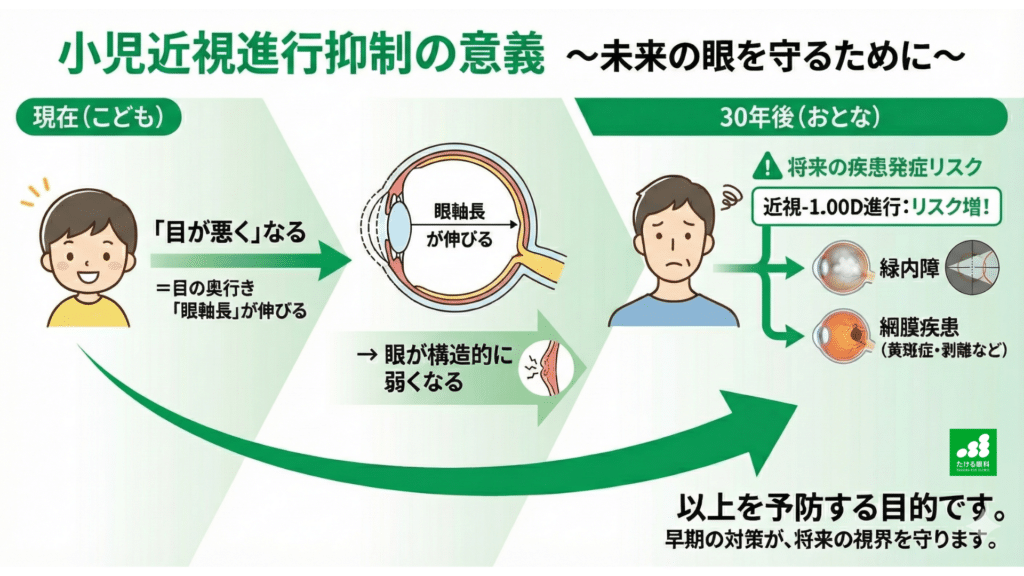
As a specialty clinic aimed at “managing eye health 20–30 years from now,”
we provide advanced, evidence-based continuing care.
2-1-1024x576.png)
1. Basic policy: contact lens prescription for elementary school children
Takeru Eye Clinic has not prescribed contact lenses to elementary school children.
https://takeru-eye.com/contactlens/
Use by elementary school children carries specific medical risks, such as the following.
- Less pain sensation: Children may keep wearing lenses without noticing corneal damage.
- Risk of oxygen deprivation: the cornea can become seriously short of oxygen just from dozing off (napping) while wearing the lenses.
- Serious infection: With poor management, the risk of serious infection is far higher than in adults.
[Medical significance of introducing MiSight® 1day]
Even so, we offer this program in order to minimize future disease risk.
Only when the medical value outweighs the above risks, we provide it as a “special medical program” with thorough management and instruction by our clinic.
2. Myopia Control Management Programs (Four)
We offer the following options to suit your child’s condition and lifestyle.
(Tax included)
Payment has been changed to an annual management fee (once a year) plus lens cost (purchased at each 3-month visit). For current contract holders, we explain the switch individually at your visit.
A. MiSight® 1day
An approach from both optical control (lenses) and pharmacological control (eye drops).
- Initial setup cost: ¥55,000 (divided into 3 or 2 visits)
Day 1(about 2 hours):
Exam under cycloplegia and determination of lens power, followed by a short first practice session (certified orthoptist )
Prediction analysis of future myopia progression
Suitability assessment: ophthalmology specialist
Day 2(about 1 hour): when the effect of the cycloplegic has worn off (3–7 days later)
Second wear instruction session (up to about 60 minutes)
First month of MiSight® 1day lenses (2 boxes)
* Practicing contact lens wear under cycloplegia is expected to be difficult, so we set up two visits.
In some cases it may be finished in one day.
After 1 week:
Regular exam (first)
We treat the first month as an “evaluation period” in which suitability is carefully assessed.
After confirming continuation at the 1-month checkup, we move to management by an annual management fee and lens payments every 3 months.
- Annual management fee: ¥17,600 (tax included, once a year)
Includes 4 detailed exams every 3 months (axial length measurement, AI analysis report, and so on).
Lenses: ¥6,800 per box (tax included). Three months’ worth = 6 boxes for both eyes = ¥40,800, paid at the front desk at each 3-month visit.
When combined with Ryjusea® Mini: the exam and tests are completed once at the MiSight® visit, so there is no additional annual management fee or consultation fee. At each 3-month visit, a prescription fee of ¥1,100 + 3 months of medication at ¥13,140 (tax included) are added (total ¥55,040 every 3 months).
- Additional exam/instruction fee: ¥3,300
B. Management with myopia control contact lenses (MiSight® 1day alone)
An approach using optical control (lenses).
- Initial setup cost: ¥55,000
- Annual management fee: ¥17,600 (tax included, once a year)
Includes 4 detailed exams every 3 months (axial length measurement, AI analysis report, and so on).
Lenses: ¥6,800 per box (tax included). Three months’ worth = 6 boxes for both eyes = ¥40,800, paid at the front desk at each 3-month visit.
- Additional exam/instruction fee: ¥3,300
What the initial setup fee of ¥55,000(tax included) covers
This fee bundles everything from detailed exams and wear instruction before starting to support during the adjustment period, so that children trying contact lenses for the first time can start without strain.
Detailed exam and suitability assessment
Exam under cycloplegia to measure the true refraction, with a detailed look at the eye including axial length (the front-to-back length of the eye). The suitability assessment is made by an ophthalmology specialist who holds the “MiSight® 1day Prescribing Facility Certification (CooperVision Japan).”
Wear instruction (over 2 days)
A certified orthoptist (CO) teaches your child one-on-one how to insert, remove, and handle the lenses. To avoid the effect of the test eye drops, it is split into day 1 and day 2 (3–7 days later).
AI future prediction report
Based on axial length data, we show the outlook for myopia progression in an easy-to-read graph, to help your family make decisions at home.
Focused support during the adjustment period (about 2 weeks)
We check insertion and removal, hygiene, how things look, and fitting lenses into school life in particular, and take your questions about any difficulties.
One-month evaluation period
The first month is an evaluation period in which suitability is carefully assessed. At the 1-month checkup we confirm whether your child can keep going in daily life, and you then decide whether to continue.
First month of lenses
Includes 2 boxes of lenses for both eyes for one month (equivalent to ¥13,600). There is no separate lens charge for the starting month.
From the start to continuing management
The first 2 weeks or so are an important period for your child to get used to the lenses. The initial setup fee includes a system to check this adjustment period with particular care.
To help you decide carefully
- You decide whether to continue at the 1-month checkup. After confirming continuation, we start management by an annual management fee and lens payments every 3 months.
- We begin only after your child and parents fully understand and agree to the content, cost, and daily wear.
- A two-step program that starts with insured contact lenses to check suitability and insertion/removal, (Step 1: insured care → Step 2: self-pay care)is also available.
- In case wearing contact lenses is difficult, other options such as eye drops (Ryjusea® Mini) and myopia control glasses are also available.
* This program is self-pay (not covered by public health insurance). All prices include tax, are as of September 2026, and may be revised in the future.
* Continuing treatment requires a regular visit every 3 months. Additional exams or re-instruction cost ¥3,300 per visit (tax included).
* We explain the treatment, the usual period and number of visits required, main risks and side effects, and other treatment options in detail at the exam.
* “Equivalent to ¥…” is our own breakdown to help you understand the cost structure.
[ 👇 初めてのコンタクトで、適応できるか不安な方へ ]
C. Management with eye drops (Ryjusea® Mini alone)
The first choice for children who find contact lenses difficult and for younger children.
An approach using pharmacological control (eye drops).
For details and the latest information, see the page “Handling of Ryjusea® Mini 0.025% eye drops.”
https://takeru-eye.com/blog/ryjusea-mini-myopia-control/#ryjusea-price
* Our fee structure was not changed after the shift to “selected medical treatment” in June 2026 (see Ryjusea Mini cost and selected medical treatment).
D. Management with myopia control glasses (MiYOSMART® / Stellest®)
We started prescribing at our clinic in line with the Japanese release in June 2026. These are daytime myopia control glasses. The fine structure in the periphery of the lens is thought to create a signal that slows axial elongation, and progression has been reported to be about 50–60% lower than with single-vision glasses (average control rate of 55–59% as stated in the Japanese Society of Myopia guidelines). Because nothing touches the eye, they are an easy option to start for younger children who still find inserting and removing contact lenses difficult (MiYOSMART® from age 5). The lenses assume “wearing them from morning until bedtime (all-day wear).”
Pre-prescription exam (first): ¥5,500
Annual management fee (4 visits): ¥17,600
Lenses: We give you a prescription. Actual cost at a partner optical shop
* Children already enrolled in the Ryjusea® Mini management program pay no additional management fee.
Details such as how they work, target ages, the visit schedule, and comparison with other treatments are on the dedicated page.
Go to the myopia control glasses (MiYOSMART® / Stellest®) page
[Notes on Fees]
The pricing of this program may be revised without notice as medical system reforms or social conditions change. Thank you for your understanding.
If your child moves to a distant school, continuing management with regular exams (axial length measurement) timed to visits home is also possible.
🛡️ About choosing how to start
For those who “would first like to try practicing with ordinary contact lenses”:
We now offer a two-step (step-up) start.
Step 1: Detailed suitability evaluation and wear training (insured care)
First, a period to build “the foundation for treatment” using ordinary contact lenses.
- Contents:
- Cycloplegic refraction test: Eye drops relax the eye’s focusing so that the true refraction can be measured precisely.
- Axial length measurement (AL): Measures the length of the eye in units of 0.01 mm.
- First contact lens practice: A certified orthoptist (CO) carefully teaches your child to insert and remove the lenses on their own.
- Time required: About 2 hours (we allow ample time for detailed exams and practice)
- Cost: Insured care (eligible for children’s medical expense subsidies, etc.)
- Purpose: To carefully judge your child’s willingness to wear lenses, suitability, and safety.
Contact lenses are dispensed in the clinic as usual.
(Notes)
After cyclopentolate drops, near vision may become blurry, which can make the first contact lens practice harder.
Several practice sessions on separate days may be needed.
Even then, insurance coverage applies.
Contact lenses are dispensed in the clinic once your child can remove them on their own.
Step 2: Moving to the detailed myopia management program (self-pay)
When wear has become independent in Step 1 and continuing treatment is judged possible, we move to MiSight®.
- Price at transition: ¥44,000
- * The initial instruction fee is adjusted based on the proficiency gained in Step 1.
- Includes preparation of the AI future prediction report, MiSight®-specific instruction, and the first month of lenses.
- Ongoing cost: annual management fee ¥17,600(once a year) +lenses ¥6,800 per box(purchased at each 3-month visit)
- The annual management fee includes regular detailed exams every 3 months. If combined with Ryjusea® Mini, a prescription fee of ¥1,100 + ¥13,140 for 3 months of medication is added every 3 months.
⚠️ Notes:
Under Ministry of Health, Labour and Welfare rules (ban on mixed billing),Step 1 (insured care) and Step 2 (self-pay care) cannot be done on the same day. To confirm medical safety as well, Step 2 is scheduled on a separate day, about one week after Step 1.
◀️ Back to the Myopia Control Management Programs (Four)
3. Our original “Myopia Prognosis and Future Prediction Management”
📱 We offer a “Myopia Management Report” app for parents
A smartphone app that shows the change in axial length measured at each visit as a graph. It also shows percentile comparison with international standard data (BHVI / Donovan 2012) and an automatic progression-speed rating. Data is stored only on your own phone.
* For parents participating in our myopia management program. We explain it in the exam room.
In all of the above programs, we also carry out advanced monitoring in common, beyond lens prescription.
- Precise axial length measurement:
Every 3 months,
we measure the length of the eye with the optical interferometry axial length device “AL-Scan M” and the myopia management software “MV-1,” and record growth. - Future prediction analysis (AI assessment): our own analysis tool (AI prediction) drawing on the data accumulated by
BHVI, visualizing future risk in a graph.
Your doctor discusses the best treatment strategy as your child grows.
4. Operating Rules
- Regular visits:
For proper safety management, we ask you to visit once every 3 months.
If visits lapse, we temporarily suspend supplying lenses for safety reasons. - Re-instruction:
For safety, the first wear practice is limited to about 60 minutes at most.
If it is hard to master, we do not force it; we gladly support you again later in a “re-instruction (¥3,300)” session.
The following has been on this page since our opening.

From April 2023: we began using new equipment.
From April 21, 2025: we can use the myopia control eye drops approved in Japan.
From February 2026: we plan to introduce MiSight®, a myopia control contact lens already used around the world
[Researchfrom around the worldon myopia: explaining current trends]
○ As children grow, the axial length (the front-to-back length of the eye) increases, and when myopia progresses to a high degree, the risk of glaucoma and retinal disease later in life rises: “pathologic myopia.”
○ Myopia control: preventing the axial length (the length of the eye) from growing during the growth years.
○ In the past few years, treatments with evidence (a scientific basis) have been established for myopia progression in children.
1. Outdoor play for 2 hours or more
2. Low-dose atropine eye drops (low-concentration atropine)
3. Orthokeratology
are currently regarded as the treatments with high-level evidence.
-2-1024x979.webp)
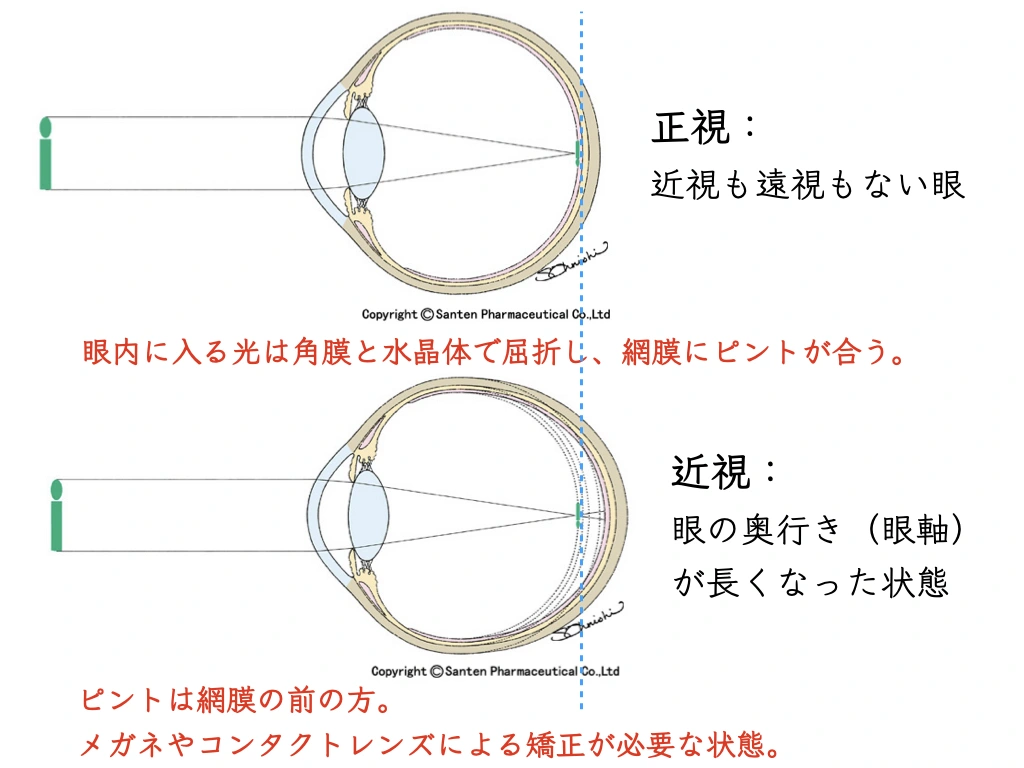

* Refractive surgery such as LASIK / ICLdoes not affect axial length.

○ Outdoor play for 2 hours or more1
○ Low-dose atropine eye drops2
○ Orthokeratology3
Meta-analyses have been published for all of them.
(= the highest level of evidence)
1. Xiong, S., Sankaridurg, P., Naduvilath, T., Zang, J., Zou, H., Zhu, J., Lv, M., He, X., Xu, X., 2017. Time spent in outdoor activities in relation to myopia prevention and control: a meta-analysis and systematic review. Acta Ophthalmol 95, 551–566. https://doi.org/10.1111/aos.13403
2. Gong, Q., Janowski, M., Luo, M., Wei, H., Chen, B., Yang, G., Liu, L., 2017. Efficacy and Adverse Effects of Atropine in Childhood Myopia: A Meta-analysis. JAMA Ophthalmol 135, 624. https://doi.org/10.1001/jamaophthalmol.2017.1091
3. Si, J.-K., Tang, K., Bi, H.-S., Guo, D.-D., Guo, J.-G., Wang, X.-R., 2015. Orthokeratology for Myopia Control: A Meta-analysis. Optometry and Vision Science 92, 6.
Based mainly on the above, we explain a treatment policy that puts safety first.
Myopia-slowing effect of diluted atropine

Keep myopia away, go outdoors and play!
(Let’s play outside and keep myopia away!)
/ Our eyes are very precious, so let’s take care of them!

Singapore National Myopia Programme/Health Promotion Board.
Orthokeratology

During the day, focusing the image on the retina suppresses growth of the axial length.

