![Takeru Eye Clinic | Takatori Shopping Street, Sawara-ku, Fukuoka City [Nishijin Station / Fujisaki Station]](https://takeru-eye.com/wp-content/uploads/2022/10/takeru_logo_for-WP-header.png)
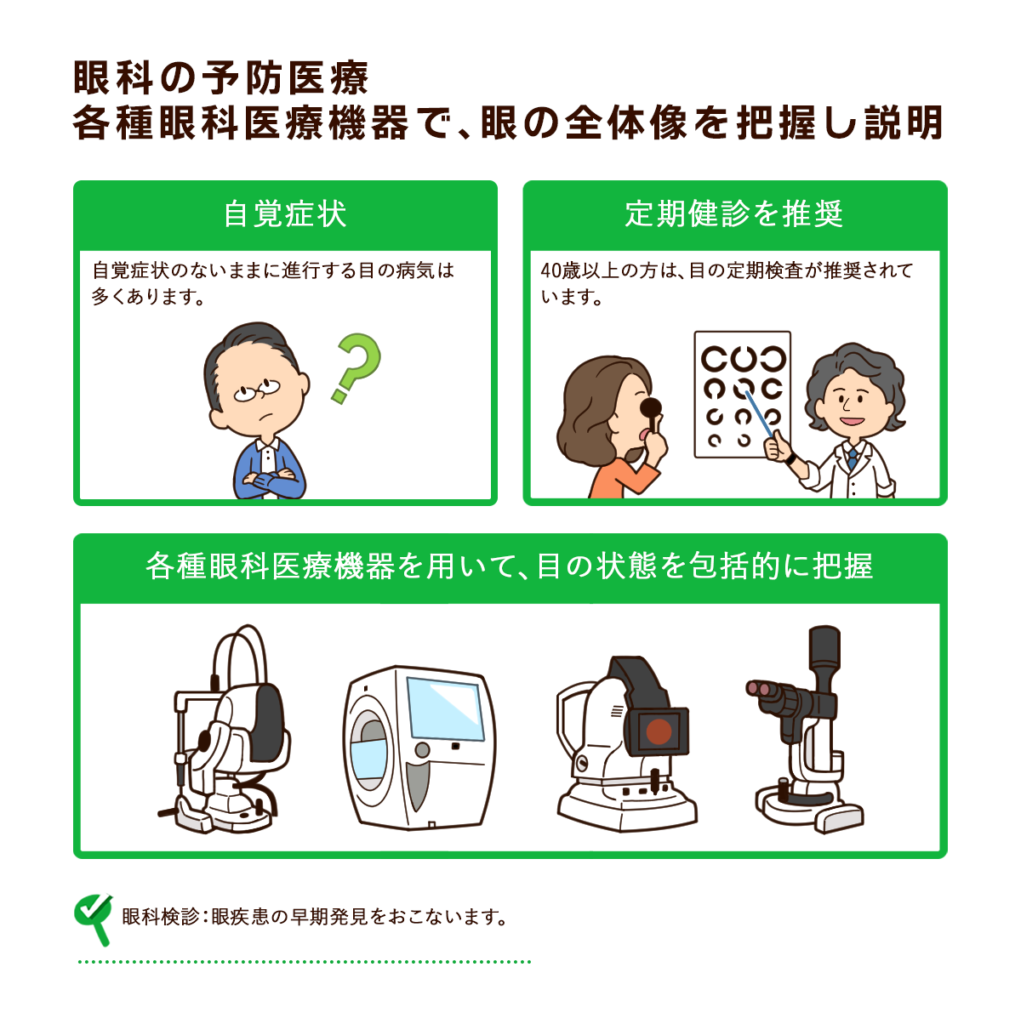
[Preventive eye care: we use a range of ophthalmic instruments to assess and explain the overall condition of your eyes]
◯ Many eye diseases progress without any noticeable symptoms.
◯ For people aged 40 and older, regular eye examinations are recommended.
✔ Eye screening: for the early detection of eye disease.
The “Ganka Dock” is a self-pay (not covered by health insurance) comprehensive eye check-up.
Early detection is especially important for glaucoma:
Many studies have identified who is more likely to develop glaucoma (risk factors)1.
◯ Poor eyesight (= high myopia)
◯ Age 40 or older (about 1 in 20 people aged 40 and older has glaucoma)
◯ A blood relative with glaucoma
◯ Low or high blood pressure
◯ Migraine
◯ Diabetes
◯ Smoking
◯ Cold hands and feet, etc. (Flammer syndrome)2
Please be sure to bring your health insurance card:
• If you have eye symptoms
• If an abnormality is found
your visit may be switched to insurance-covered care.
Duration: about 30–60 minutes.
By appointment only, so there is no waiting time.
(Weekday morning and 2:00 PM slots only; not available on Saturdays or weekday evenings)
Please book via the “Eye Check-up (Ganka Dock)” item on the appointment page.
Comprehensive Eye Examination: Examination Courses
| Item |
(1)
Comprehensive Eye Checkup ¥22,000
|
(2)
Basic Eye Checkup ¥11,000
|
(3)
Glaucoma Early Detection Checkup ¥16,500
|
(4)
Presbyopia & Age-Related Eye Disease Checkup ¥16,500
|
(5)
Children & Students Eye Checkup ¥11,000
|
(6)
Eye Strain & Dry Eye Checkup ¥11,000
|
Additional
Eye Checkup
(please ask)
|
What it shows |
|---|---|---|---|---|---|---|---|---|
| Eye tests | ||||||||
| Objective refraction (autorefraction) | Approximate eye prescription measured by a machine | |||||||
| Corrected visual acuity (distance) | How far you can see with glasses or contact lenses | |||||||
| Corrected visual acuity (near) | How well you can see up close with glasses or contact lenses | |||||||
| Visual acuity with current glasses | How well you see with the glasses you use now | |||||||
| Glasses prescription measurement | The prescription of your current glasses | |||||||
| Intraocular pressure test | Firmness of the eye (a lifestyle-disease check for the eyes) | |||||||
| Axial length measurement | Front-to-back length of the eye (linked to myopia progression) | |||||||
| Eye alignment test | Direction of the eyes (whether there is strabismus or early signs of it) | |||||||
| Eye movement test | How the eyes move (whether they move smoothly) | |||||||
| Convergence test | How the eyes turn inward when looking at something close | |||||||
| Binocular vision test | How well both eyes work together | |||||||
| Accommodation analysis | Focusing ability of the eye (checks for presbyopia and eye strain) | |||||||
| Wavefront aberration & corneal topography | Distortion of the cornea and the lens | |||||||
| Corneal endothelial cell test | Number and shape of the cells on the back surface of the cornea (especially important for contact lens wearers) | |||||||
| Anterior segment 3D imaging (OCT) | Detailed 3D examination of the front of the eye (whether there is anything to watch for regarding glaucoma) | |||||||
| Posterior segment 3D imaging (OCT) | Detailed 3D examination of the back of the eye (signs of glaucoma and retinal disease) | |||||||
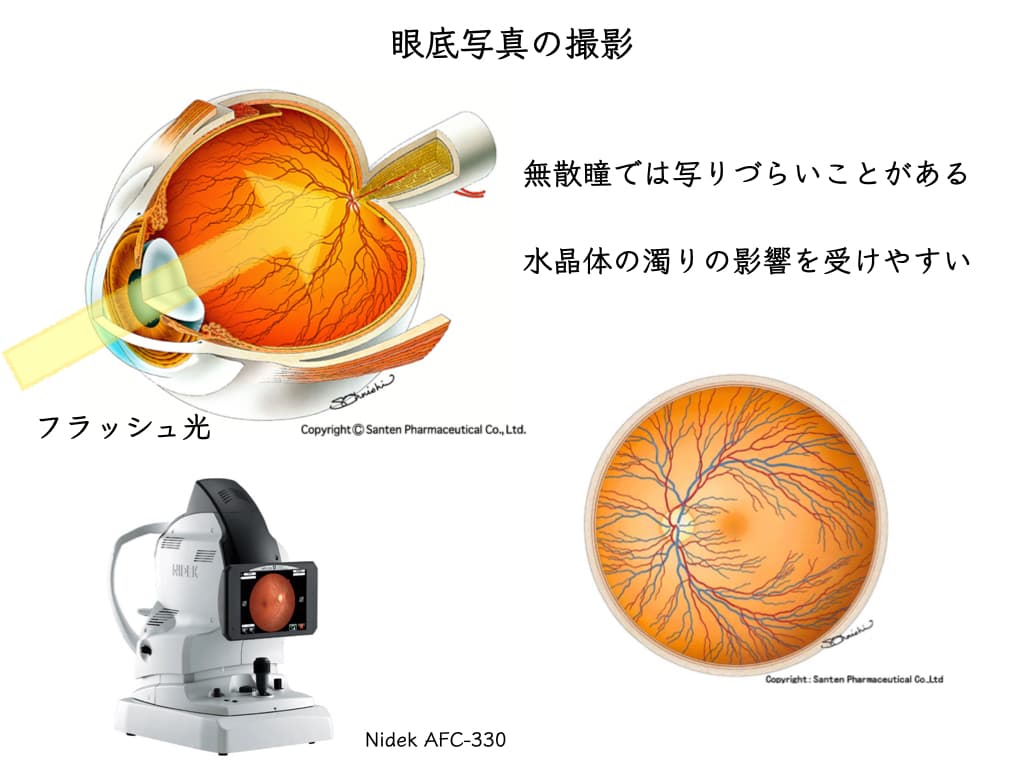
| Wide-field fundus photography | Photograph of a wide area inside the eye | |||||||
| Optical coherence tomography angiography (OCTA) | Examines the state of the blood vessels inside the eye | |||||||
| Add-on tests | ||||||||
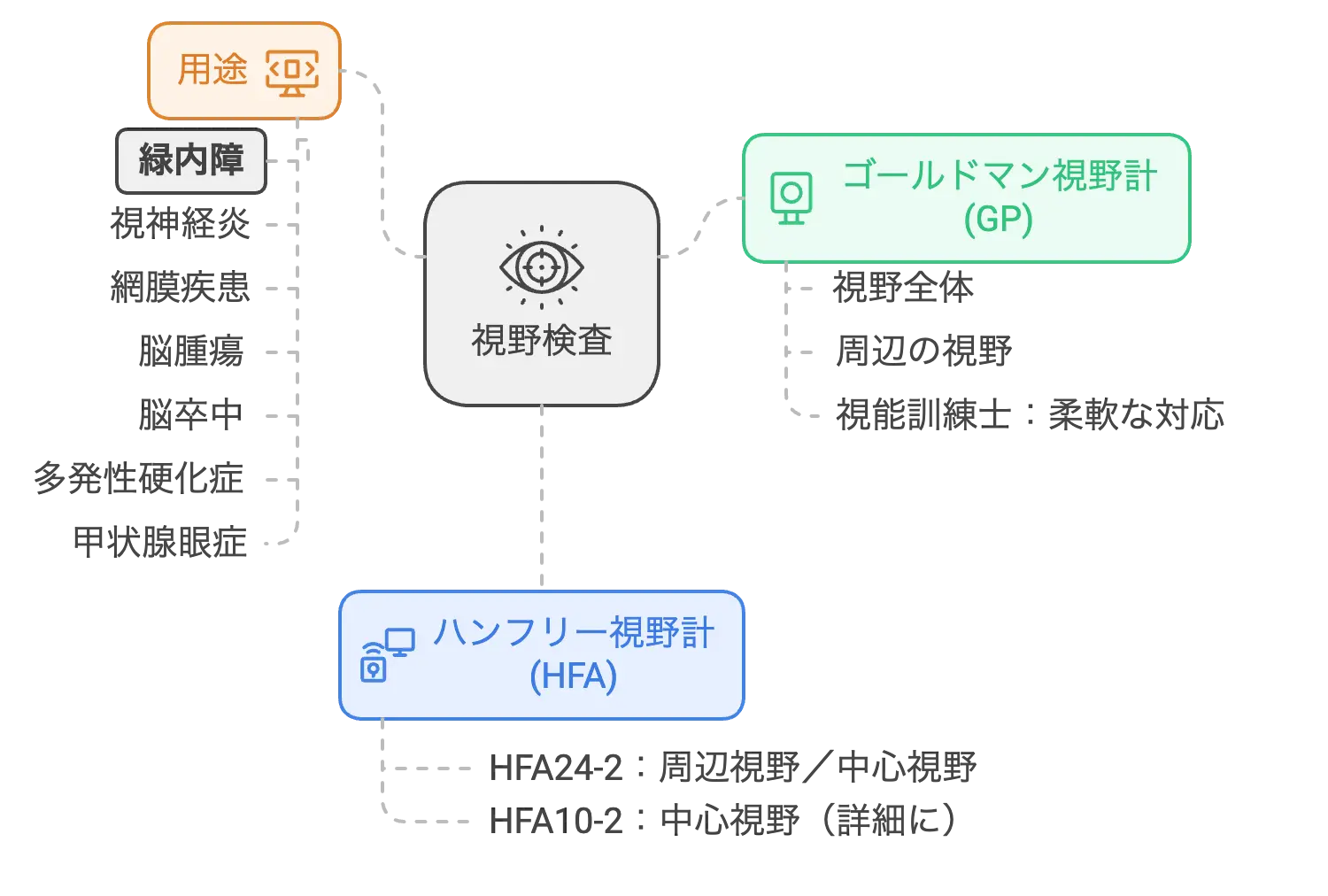
| Visual field test | The size of the area you can see | |||||||
| Dilated eye exam | Eye drops widen the pupil so the inside of the eye can be examined in detail | |||||||
| Tear secretion test (Schirmer test) | Evaluation of the amount of tears (Schirmer test) | |||||||
| Examination by an ophthalmologist | ||||||||
| Slit-lamp examination | Magnified examination from the surface of the eye to the inside | |||||||
| Tear film break-up time (BUT) | Evaluation of tear quality and quantity |
* The tests listed are those included in each course. Additional eye checkups can be added to any course.
* All eye tests are performed by orthoptists, who hold a national qualification.
* Prices include tax.
* All of the Comprehensive Eye Examinations above are by appointment only.
Subsidies from health insurance societies and employers
Depending on your workplace’s health insurance society, the subsidy for a full medical checkup (ningen dock) may also be usable for the Comprehensive Eye Examination. However, most health insurance societies require you to take the basic items of the full checkup (such as stomach tests and abdominal ultrasound), and in most cases an eye examination on its own is not eligible. A subsidy may be available only when you take the Comprehensive Eye Examination as an add-on test on the same day at the same medical institution as your full checkup, or when it is treated as a “specialty checkup.”
Protecting the eyesight you rely on for life:
a new kind of eye health check
Protecting your precious eyes from abnormalities that cause no symptoms —
Takeru Eye Clinic’s Comprehensive Eye Examination.
“Seeing well” and
“having healthy eyes” are two different things
Many eye diseases progress gradually without any noticeable symptoms.
Finding them before symptoms appear: we believe this is the best “treatment.”
Many causes of blindness are preventable
* Proportion of causes of acquired blindness in Japan (estimates)
1Morizane, Y. et al. Jpn J Ophthalmol 63, 26–33 (2019).
Common eye diseases
with few early symptoms
Glaucoma, the leading cause of blindness in Japan, isGlaucomaestimated to affect about 1 in 20 people aged 40 and older1, and causes the visual field to be lost little by little. However, there are almost no symptoms from the early to the middle stages. Very often, by the time something feels wrong, the disease has already progressed considerably.
The eye tests in a general health check consist mainly of simple checks of vision and eye pressure, which are not enough to detect these conditions early. That is why a detailed examination with specialized equipment is essential.
Takeru Eye Clinic’s Comprehensive Eye Examination
The Comprehensive Eye Examination is a detailed examination of the eyes
aimed at early detection and early treatment of abnormalities.
Certified orthoptists with specialized knowledge examine the health of your eyes in detail using a wide range of instruments.
General health check
- ✅Visual acuity and eye pressure
- ✅Fundus photograph (optic nerve and macula)
- ❌Fundus examination
- ❌Retinal tomography (OCT)
- ❌Corneal examination
Comprehensive Eye Examination
- ✅Visual acuity and eye pressure
- ✅Ultra-widefield fundus imaging (no pupil dilation needed)
- ✅Retinal tomography (OCT)
- ✅Wavefront aberration and corneal topography
- ✅Axial length measurement
- ✅Binocular vision tests (eye alignment, eye movements, convergence)
- ✅Accommodation analysis
- ✅Corneal endothelial cell count
- ✅Others
Eye screening in Fukuoka City
Fukuoka City currently has no public health-screening program that provides eye checkups on their own, including visual acuity and eye pressure. Even in the city’s specific health checkups (such as Yoka Dock), eye tests are not a required item; a fundus examination is performed as an option only when a doctor judges it necessary based on blood pressure or blood sugar results1,2.
| Municipality | Program name and cost (approx.) | What eye screening actually involves |
|---|---|---|
| Fukuoka City | Yoka Dock About ¥500 |
Referral to an eye clinic only when the doctor judges it necessary based on internal-medicine checkup results. |
| Kitakyushu City | Genki Hakkutsu! Specific Health Checkup Free Program details |
Free of charge, but you must meet criteria such as blood sugar and blood pressure to be eligible. |
| Omuta City | Hospital checkups, etc. Cost depends on the institution Program details |
At core hospitals, an eye-pressure test may be performed in addition to the fundus exam. |
| Nakama City | Specific health checkup Cost depends on the institution Program details |
Checkups are often done within hospitals; if judged necessary, you are referred to the eye department on the spot. |
| Onojo City | Specific health checkup ¥700 Program details |
A young-adult checkup for ages 15–39 is offered, but the criteria for eye tests are the same as for other checkups. |
| Hisayama Town | Resident checkup ¥500 (cancer screening, etc.) Program details |
A region where a world-renowned epidemiological study (the Hisayama Study) is conducted; resident checkup participation is high. |
Glaucoma can be missed even when your vision is good
A large-scale Japanese survey (the Tajimi Study) found that about 70% of people with glaucoma have eye pressure within the normal range (21 mmHg or below)3. Ordinary health checkups that only measure visual acuity and eye pressure miss most cases of glaucoma.
Glaucoma causes almost no symptoms in the early to middle stages. Even if the visual field of one eye is lost, the other eye compensates, so it is hard to notice yourself. Overseas it is also called the “silent thief of sight”4.
Fundus photography vs. OCT
The “fundus photograph” taken at company checkups records the back of the eye as a two-dimensional image. OCT (optical coherence tomography), used in the Comprehensive Eye Examination, analyzes cross-sections of the retina. One study reported that the sensitivity for detecting glaucoma was about 55% with fundus photography alone, rising to over 80% when OCT was added5.
1. Tokyo Metropolitan Government Bureau of Social Welfare. Survey on the status of eye screening in Tokyo (in Japanese). 2024.
2. Fukuoka City. Yoka Dock (specific health checkup) and Yoka Dock 30 (in Japanese). 2024.
3. Iwase A, Suzuki Y, Araie M, et al. The prevalence of primary open-angle glaucoma in Japanese: the Tajimi Study. Ophthalmology. 2004;111(9):1641-8.
4. National Eye Institute. Glaucoma: The ‘silent thief’ begins to tell its secrets. 2014.
5. Sanchez-Pulgarin N, et al. Study of Diagnostic Accuracy: Fundus Photography vs. Optical Coherence Tomography. Appl Sci. 2024;14(12):5314.
Eye concerns by age group
Eye concerns change with age.
Click your age group
to see what to watch for.
Please select an age group above.
How it works
The Comprehensive Eye Examination is by appointment only.
You can easily book through our website.
Booking
Please book online.
Your visit
Please come at your booked time and bring your health insurance card.
Detailed examination
Certified orthoptists perform a detailed examination using a wide range of instruments.
Explanation of results
A board-certified ophthalmologist explains your results carefully.
Report by mail
A report summarizing your results is mailed to your home. You can also view it on your smartphone via a QR code.
Frequently asked questions
How we examine
- By appointment only: we set aside enough time for the examination and the explanation.
- Nationally certified orthoptists carry out the tests.
- We evaluate a wide area of the fundus using instruments such as an ultra-widefield fundus camera and OCT (optical coherence tomography).
- If an abnormality is found, we switch to insurance-covered care and, when necessary, coordinate with a referral hospital.
(Reference)
- McMonnies, C.W., 2017. Glaucoma history and risk factors. J Optom 10, 71–78. https://doi.org/10.1016/j.optom.2016.02.003
- Konieczka, K., Ritch, R., Traverso, C.E., Kim, D.M., Kook, M.S., Gallino, A., Golubnitschaja, O., Erb, C., Reitsamer, H.A., Kida, T., Kurysheva, N., Yao, K., 2014. Flammer syndrome. EPMA J 5, 11. https://doi.org/10.1186/1878-5085-5-11
The importance of eye screening[1 min 11 sec]
• Our eyes are our window on the world, and they sometimes need care.
• Cloudy vision (cataract), areas that cannot be seen (diabetic retinopathy), difficulty seeing the periphery (Glaucoma), difficulty seeing the center (macular degeneration)
None of these cause any symptoms at first.
• Without early detection and treatment, vision can be severely impaired.
• An ophthalmologist can detect even very small changes in the eye.
• Even without symptoms, regular eye check-ups are very important.
• Especially for those over 40, when changes in the eyes begin to appear.
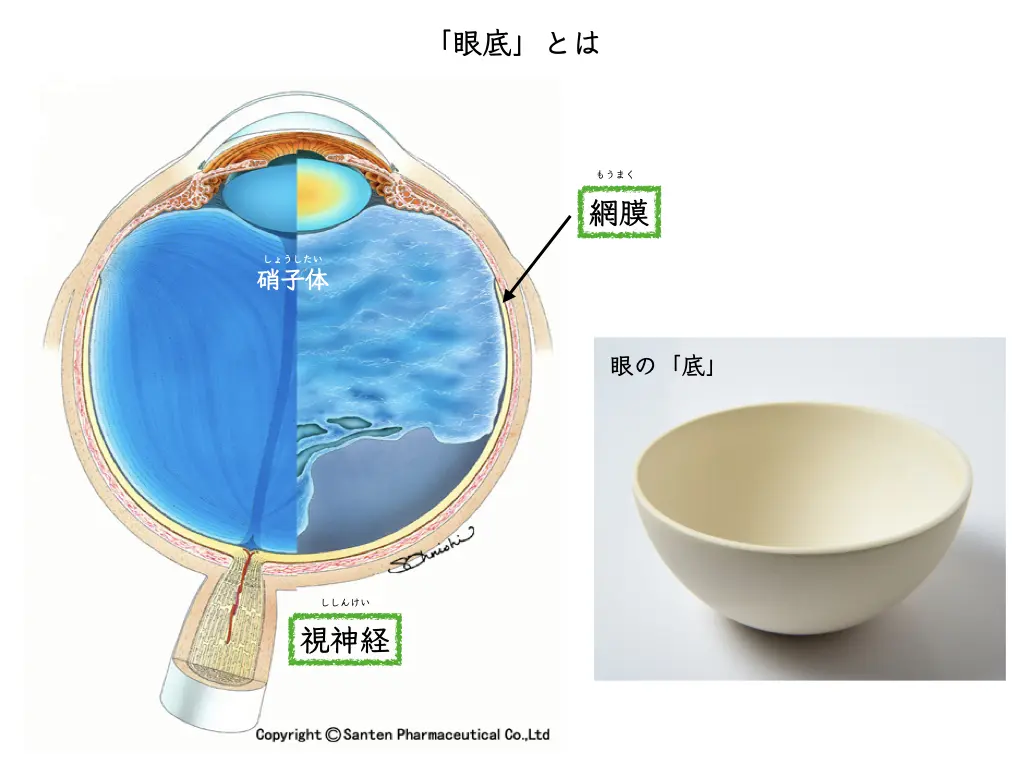
Left: the optic nerve seen from the side
Right: the optic nerve seen from the front
Optic Nerve Fibers[34 sec]
• A normal optic nerve is made up of about one million nerve fibers.
• As glaucoma progresses, the optic nerve is damaged and the cupping (hollow) of the optic disc enlarges.
• The areas that cannot be seen (scotomas) then expand.
• A visual field test at an eye clinic can detect scotomas that cause no symptoms.

