![Takeru Eye Clinic | Takatori Shopping Street, Sawara-ku, Fukuoka City [Nishijin Station / Fujisaki Station]](https://takeru-eye.com/wp-content/uploads/2022/10/takeru_logo_for-WP-header.png)
Ocular inflammatory diseases may be less well known than diseases such as glaucoma and cataract.
“Inflammation” is a term with a very broad meaning.
[“A doctor experienced in treating uveitis”: a setting where you can visit easily whenever you feel uneasy]
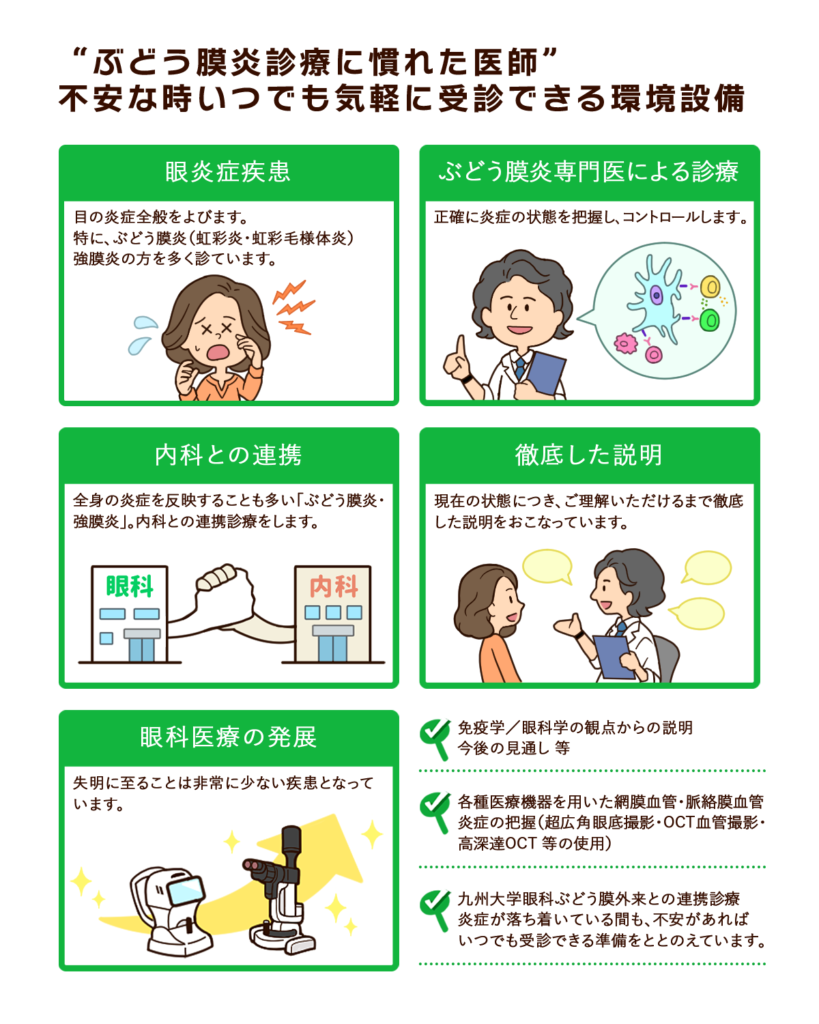
◯ Inflammation of the eye in general is called “ocular inflammatory disease”: ocular immunology
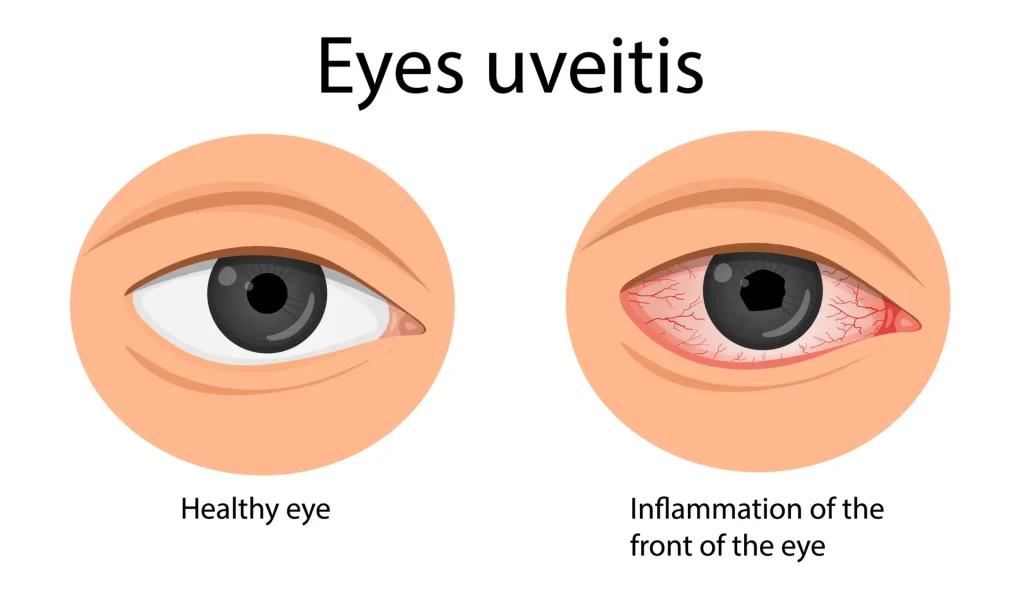
We see many people with uveitis (iritis and iridocyclitis) and scleritis in particular.
◯ Care by a uveitis specialist:
We accurately assess the state of inflammation and bring it under control.
○ Uveitis and scleritis often reflect inflammation throughout the body: we provide care in cooperation with internal medicine.
◯ We explain your current condition thoroughly until you understand it.
○ Thanks to advances in ophthalmology, these have become diseases that only very rarely lead to blindness.
✔ Explanation from the viewpoints of immunology and ophthalmology, the outlook ahead, and so on
✔ Assessing inflammation of the retinal and choroidal vessels with various medical devices (usingultra-widefield fundus imaging, OCT angiography, deep-penetration OCT, and so on)
✔ Cooperative care with the Uveitis Clinic of the Department of Ophthalmology, Kyushu University:
Even while inflammation is quiet, we are prepared so that you can visit at any time if you feel uneasy.
What are ocular inflammatory diseases? Causes, symptoms, and treatment

Besides inflammation confined to the eye, there are many cases linked to systemic disease.
Systemic disease can appear as eye symptoms,and systemic disease is sometimes discovered through the eyes.
Sarcoidosis, Behçet’s disease, Vogt-Koyanagi-Harada disease, rheumatoid arthritis, systemic lupus erythematosus (SLE), inflammatory bowel disease (IBD) such as ulcerative colitis and Crohn’s disease, diabetes, hyperthyroidism, multiple sclerosis, myasthenia gravis, granulomatosis with polyangiitis (Wegener’s granulomatosis), relapsing polychondritis, HLA-B27-associated seronegative spondyloarthropathies (ankylosing spondylitis, reactive arthritis, psoriatic arthritis, juvenile idiopathic arthritis), and others
Below we give general information on what ocular inflammatory diseases are (causes), their symptoms, how they are diagnosed, and treatment options.
What Are Ocular Inflammatory Diseases?
“Inflammation” is a factor common to many diseases, and ocular inflammatory diseases are no exception.
The first focus of treatment for ocular inflammatory diseases iscontrolling the inflammation.
The causes of ocular inflammatory diseases fall mainly into two groups: infectious and non-infectious.
Deciding whether the cause is infectious or non-infectious requires an ophthalmologist, because the approach to treatment is completely different.
The exact cause of many ocular inflammatory diseases is unknown.
Some are associated with other medical problems, and a systemic work-up may be needed at onset.
Left untreated, inflammation can lead to serious eye damage, so it is important to deal with it promptly.
Inflammation in the eye must be treated while keeping the eye transparent.
Common Symptoms of Ocular Inflammatory Diseases
Applying the four classic signs of inflammation to the eye:
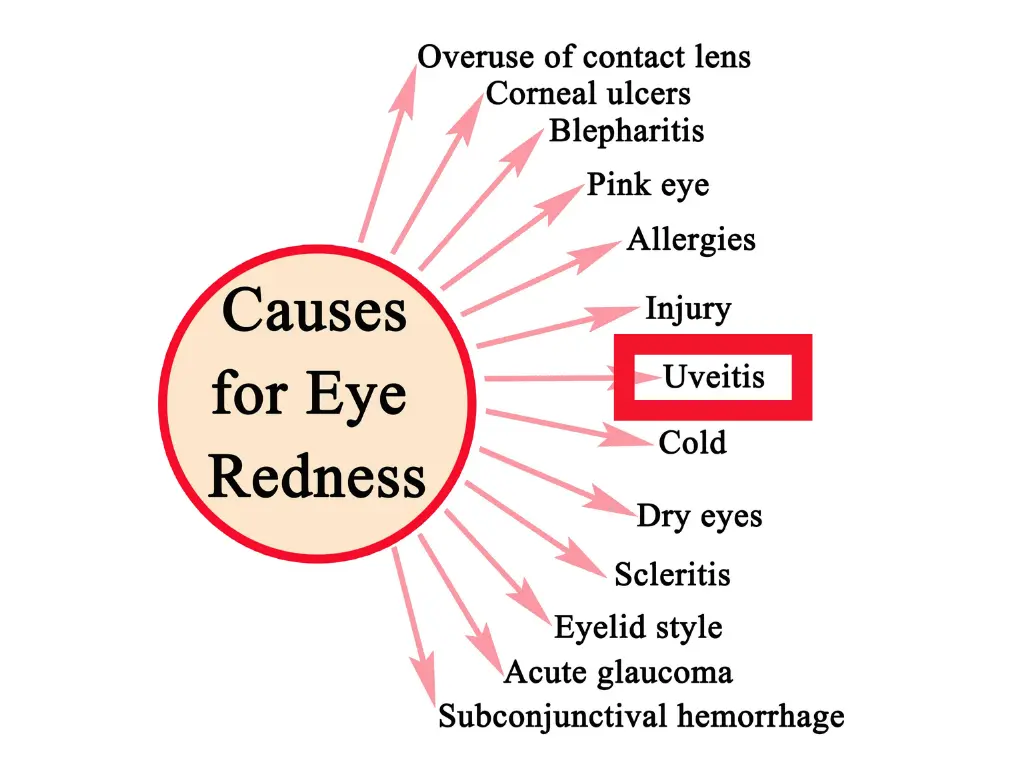
Redness:
- Red eyes, bloodshot eyes
- Caused by dilation of small blood vessels
Conjunctivitis: this probably has a much broader meaning than the word suggests.

From the chief complaint of a red eye, including further questioning,
a doctor instantly considers many diseases.
Heat:
- Eye discomfort, a heavy feeling in the eyes
- Due to increased blood flow and chemical mediators
Dry eye is also seen as an inflammatory disease, not just “dryness.”
Swelling:
- Swollen eyes
- Mainly caused by fluid accumulating outside the blood vessels
Pain:
- Eye pain
- Caused by tissue distortion from edema and by chemical mediators
Loss of function:
- Sometimes added as the fifth sign of inflammation.
- In ophthalmology, the main problem is abnormal visual function
such as reduced vision, constricted visual field, and (acquired) color vision deficiency.
Diabetic retinopathy is also related to inflammation of the eye.
Specific symptoms:
- Red eyes: seen in most ocular inflammatory diseases. The white of the eye may look pink or red.
- Eye discomfort and pain: can cause discomfort or pain. In scleritis, pain is a prominent symptom.
- Vision problems: may include a hazy view, glare, reduced vision, floaters, and blurred vision.
Diagnosis and Tests for Ocular Inflammatory Diseases
- Visual acuity test: Measures the sensitivity of the center of the retina (the macula). Evaluates corrected vision.
- Eye pressure test: Measures the pressure (firmness) of the eye. It may rise temporarily because of inflammation.
- Gonioscopy and fundus examination: Evaluates the drainage angle (the pathway for fluid in the eye) and the fundus to identify the main site of inflammation.
- Wide-field fundus imaging: Useful for evaluating peripheral vasculitis in uveitis.
- OCT and OCT angiography: Evaluates cross-sectional images of the retina and provides detailed information on the structure and function of the eye. The state of blood vessels can be observed without a contrast agent.
As needed, more detailed tests (contrast imaging, blood tests, systemic tests such as CT) may be performed at a general hospital or university hospital.
Treatment of Ocular Inflammatory Diseases
The choice of treatment depends on the cause and severity:
Infectious cases:
- Treat the causative pathogen
- Mainly antibiotics are used
Non-infectious cases:
- Steroid therapy is the mainstay (eye drops, oral medication, local injections)
- Immunosuppressants: used together when steroids alone are not enough
- Biologics: have brought revolutionary change to treatment, making diseases once hard to treat controllable
The stages of treatment from eye drops to biologics, and their side effects, are explained in detail in the following article.
Long-term management:
- Because the course tends to be chronic, ongoing management is necessary
- Managing complications such as cataract and steroid-induced glaucoma is important