![Takeru Eye Clinic | Takatori Shopping Street, Sawara-ku, Fukuoka City [Nishijin Station / Fujisaki Station]](https://takeru-eye.com/wp-content/uploads/2022/10/takeru_logo_for-WP-header.png)

When you are told “it’s conjunctivitis,”
• I may have to keep my child home from school, daycare, or kindergarten
• Can they go to the pool?
• Do they have to skip their lessons and activities?
• What about the daycare’s negative-test certificate (permission-to-attend form)?
All of these may flash through your mind in an instant.
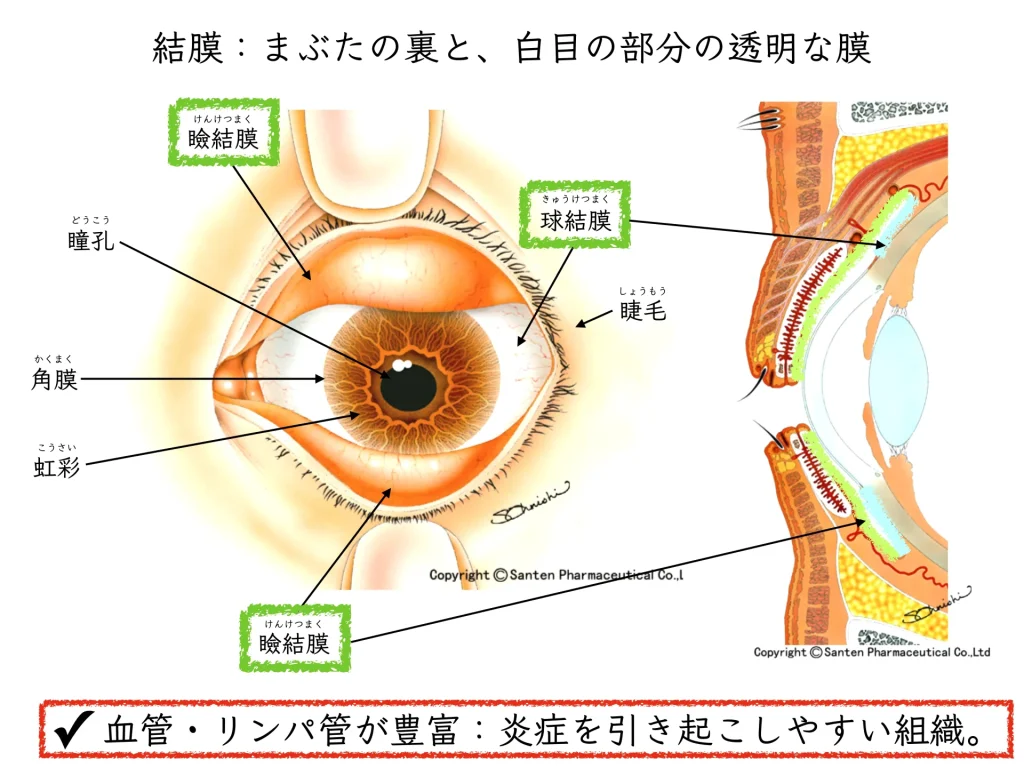
The “conjunctiva” refers to
the transparent membrane that runs from the inside of the eyelid to the white of the eye.
It is a tissue rich in blood vessels and lymphatic vessels1.
The conjunctiva has the characteristic of reacting to all kinds of things.
Reacting to things that come in from outside: “inflammation”
The general term for inflammation of the conjunctiva is conjunctivitis.
(In other words, “conjunctivitis” is a broad term that refers to all inflammation occurring on the inside of the eyelids and the white of the eye.)
All kinds of things can get onto the surface of the eye and cause inflammation.
• Did germs get in? → Germs are naturally present all over the body
(“resident bacteria” such as Staphylococcus epidermidis and Staphylococcus aureus)
• With a common cold, Streptococcus pneumoniae can also cause conjunctivitis
• Pollen
• Yellow sand (kosa)
• PM2.5
• House dust
• Something seasonal?
Any of these can be a cause of conjunctivitis.
“Even if symptoms are mild now, conjunctivitis symptoms often get worse later.”
Most cases of conjunctivitis are not contagious to other people.
It is also a different condition from a “stye.”
The reasons conjunctivitis keeps recurring are:
• The conjunctiva (the white of the eye) is a tissue that reacts easily to begin with
• The surface of the eye is in contact with the outside world, so it is always reacting to all kinds of things
This is the general explanation.
When you are told “you have conjunctivitis,”
whether there are precautions to take or things you must not do
is something your ophthalmologist will explain.
What Is Contagious Conjunctivitis (“Hayari-me”)?
Most cases are viral conjunctivitis.
Adenovirus invades the conjunctiva and causes inflammation.
After the inflammation subsides, it can sometimes leave cloudiness in the cornea (the black of the eye).
Conjunctivitis: Criteria for Judging Whether It Is Contagious or Not
This article is limited to general information from everyday practice.
Contagious Conjunctivitis: What It Looks Like and Its Symptoms
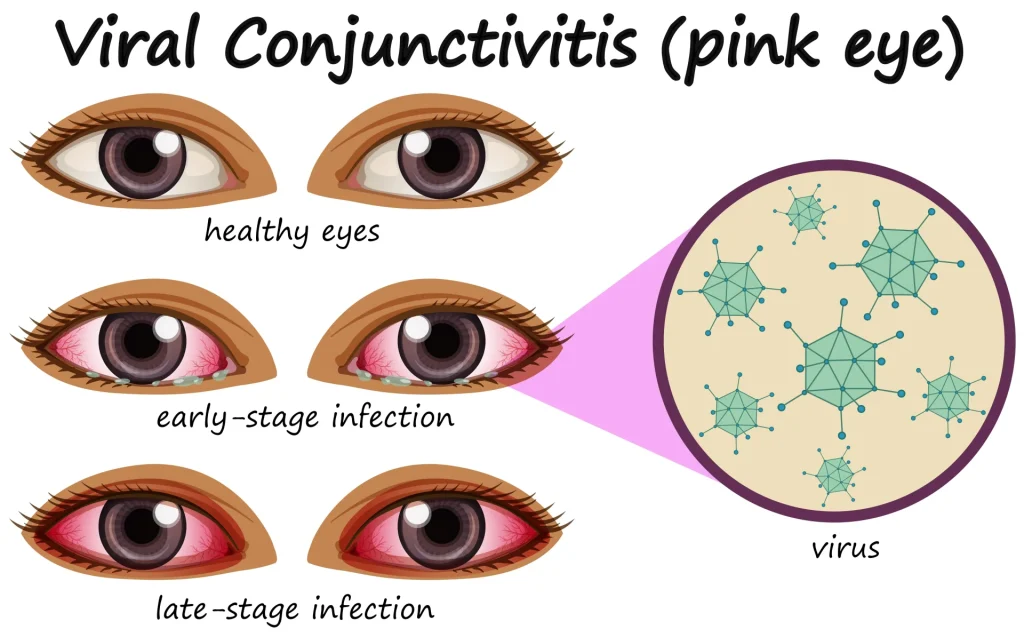
When the conjunctiva becomes inflamed, the blood vessels dilate.
The white of the eye visibly changes: “redness (hyperemia)”
The Cause of Contagious Conjunctivitis: Most Is Caused by “Adenovirus”
Most viral conjunctivitis is caused by adenovirus: “epidemic keratoconjunctivitis”
Epidemic keratoconjunctivitis (“hayari-me”) is said to be caused by adenovirus types 8, 19, 37, 53, 54, and 56.
The lymph node in front of the ear may swell or become painful.
In addition,
• Herpes simplex virus
• Varicella-zoster virus
• The novel coronavirus (COVID-19)
can also cause viral conjunctivitis.
All of these are highly contagious forms of conjunctivitis.
Caution is needed.
Symptoms of “Epidemic Keratoconjunctivitis”
• Redness
• Tearing
• A gritty sensation
• Itching, discomfort, a feeling of heat
• Discharge, and so on
Contagious conjunctivitis (“hayari-me”):
In many cases it is difficult to tell apart from non-contagious conjunctivitis by symptoms alone.
How Contagious Conjunctivitis Spreads
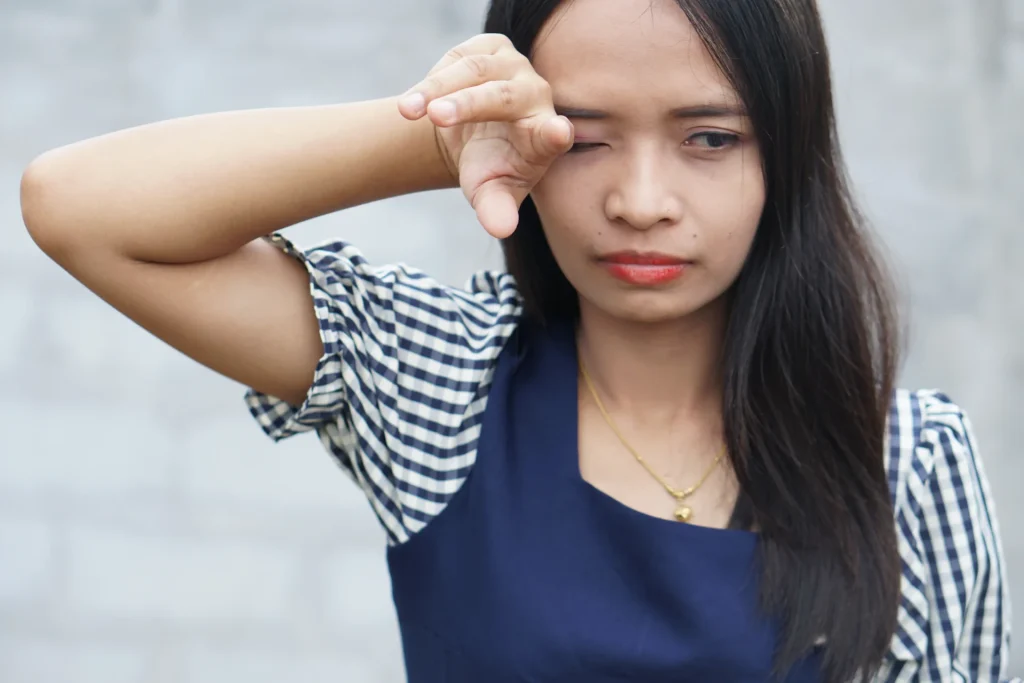
If you touch something that has the virus on it,
→ then touch your own eye with that hand
→ 5 to 10 days later (about a week), viral conjunctivitis develops
• Books, magazines
• Toys
• Towels
• Contact lenses
• Contact lens cases
and similar items can become sources of infection.
Judging Whether Conjunctivitis Is Contagious: What Is Done at the Eye Clinic
First,
the judgment is made by “appearance.”
This is an examination using a slit-lamp microscope.
Photo:
https://eyewiki.aao.org/Epidemic_Keratoconjunctivitis
Even to the naked eye, you can check to some extent for the following:
• Whether the swelling is severe
• Whether there are follicles (small bumps) on the lower eyelid
• Whether there is redness of the white of the eye (bulbar conjunctiva)
If epidemic keratoconjunctivitis is suspected,
a test may be performed.
It is a kit that detects adenovirus antigen.
At present, I use Quick Chaser® Adeno.
Tears are collected by absorbing them onto a thin strip of paper, and the test is performed.
There is almost no pain during collection.
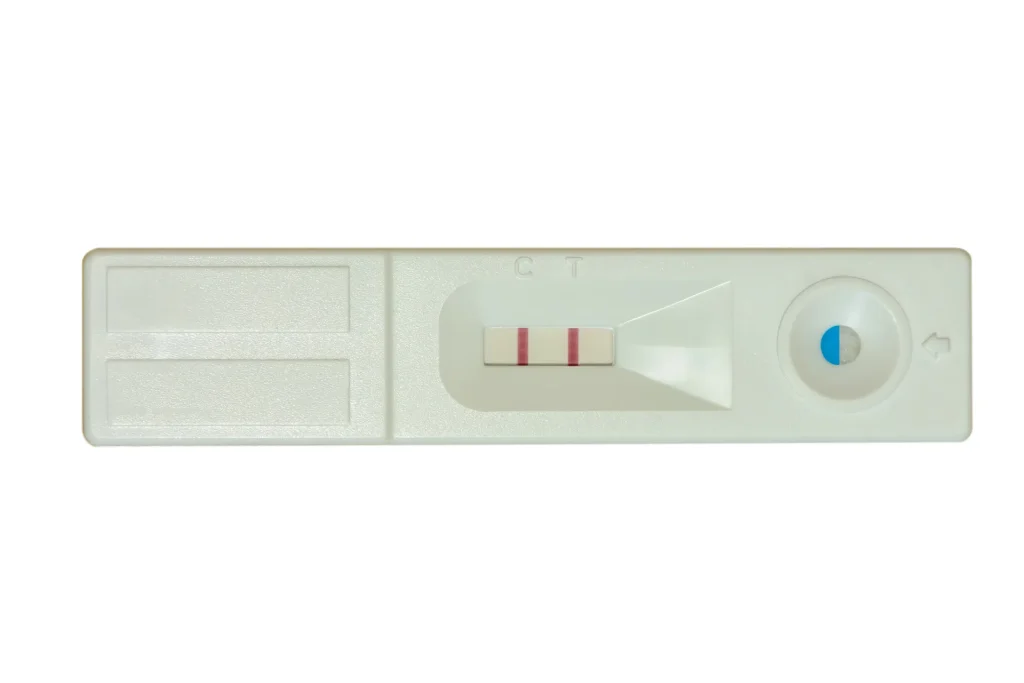
If two clear lines appear, the result is definitely positive (strongly positive).
If the lines are faint, it is also positive.
If the result is positive, without hesitation
it is judged to be “epidemic keratoconjunctivitis.”
(EKC: Epidemic Keratoconjunctivitis)
The judgment becomes less certain
when the test is negative.
A negative result does not settle that it is truly negative.
A false negative is possible, and
“when in doubt…”
I advise you to live with care on that basis (described later).
There are no eye drops that work against the virus.
After the inflammation lasts about two weeks (14 days),
the symptoms of epidemic keratoconjunctivitis (“hayari-me”) ease on their own.
Eye drops that suppress inflammation (steroid eye drops) are commonly prescribed.
Conjunctivitis: Diagnostic Treatment
Is it contagious conjunctivitis or non-contagious conjunctivitis?
There is one more way to decide.
Judge by whether the eye drops worked or did not work.
There is a term, “diagnostic treatment.”
- Antibiotics,
- steroids, and similar eye drops
If the inflammation settles with the eye drops,
it was not epidemic keratoconjunctivitis
is the judgment.
Causes of conjunctivitis suggested when it was not epidemic keratoconjunctivitis:
• Allergic conjunctivitis
• Bacterial conjunctivitis
• Conjunctivitis caused by chemical substances
and other non-contagious conjunctivitis
Compared with viruses,
other pathogens and allergens differ in size.
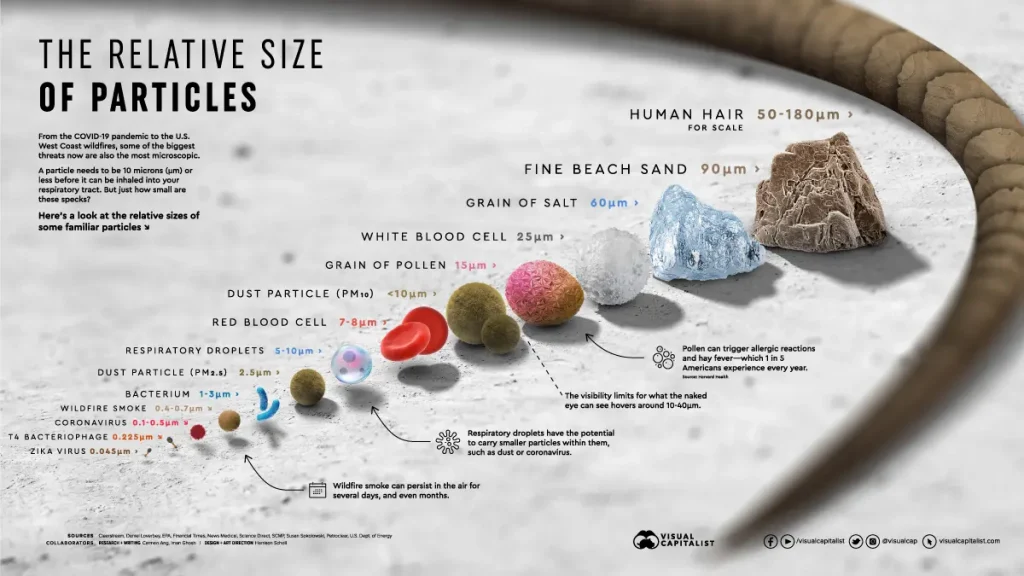
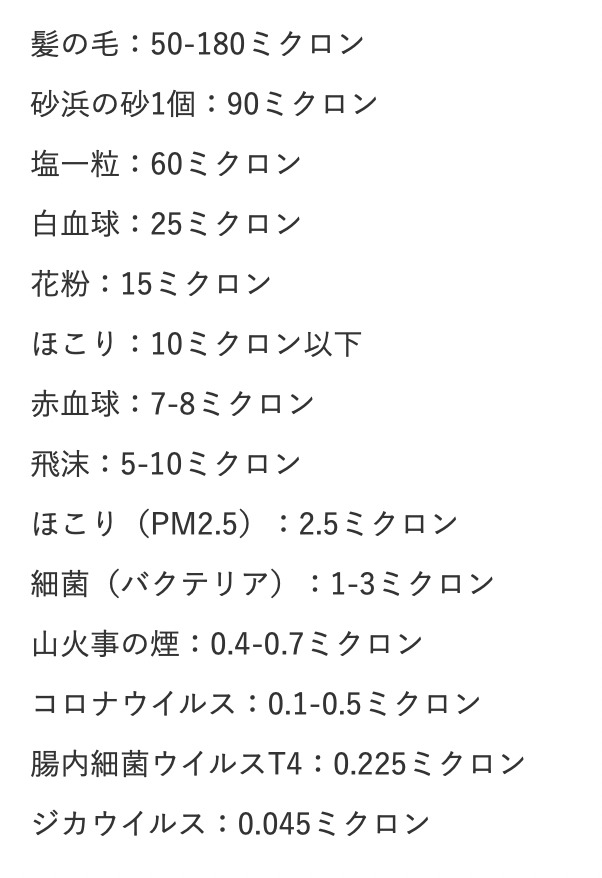
Each requires its own treatment approach, different from viral conjunctivitis.
Viral Conjunctivitis (Epidemic Keratoconjunctivitis): How to Avoid Spreading It
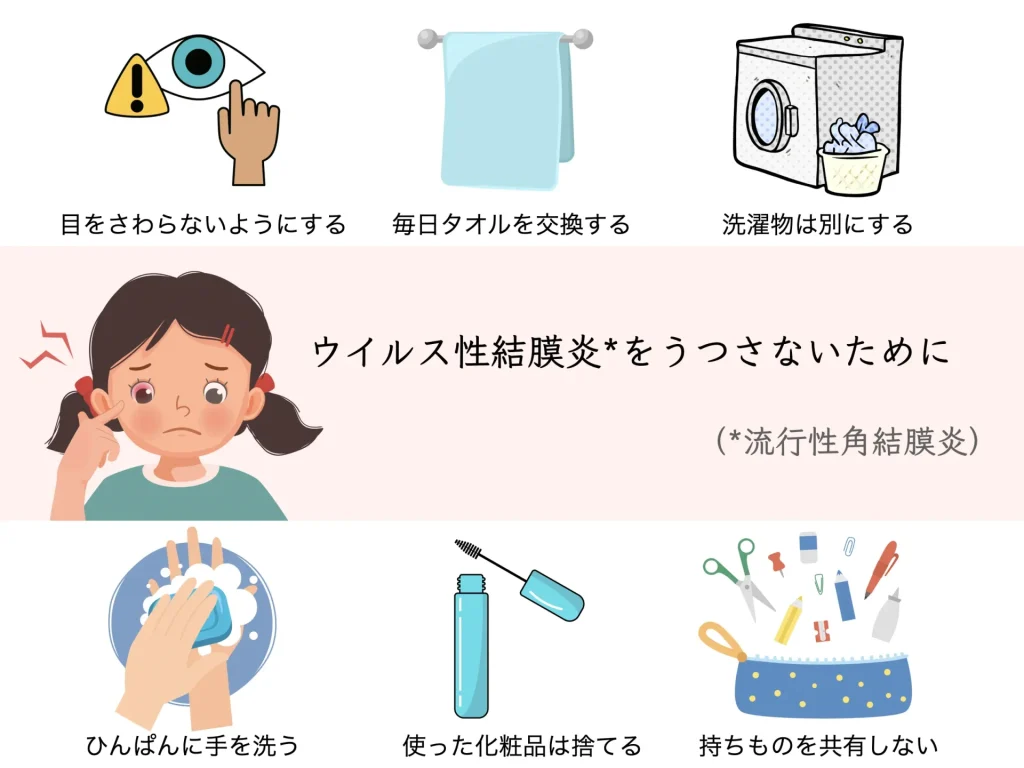
Epidemic keratoconjunctivitis (“hayari-me”): points to keep in mind
- Avoid touching your eyes
- Change towels every day
- Wash laundry separately
- Wash your hands frequently
- Throw away any cosmetics you used
- Do not share personal belongings
Conjunctivitis: When Can You Use Contact Lenses Again After Recovery?
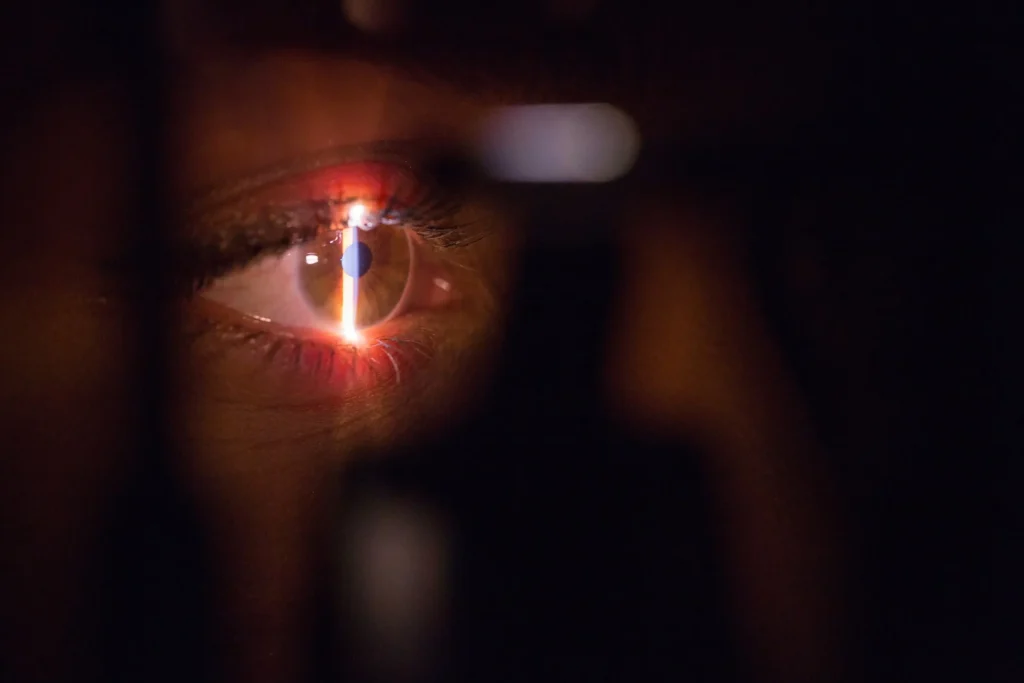
After epidemic keratoconjunctivitis, cloudiness may appear in the cornea (the black of the eye).
It is thought that inflammation from the virus is still continuing.
If epidemic keratoconjunctivitis was diagnosed,the condition of the cornea after recoveryis important.
It is best to resume contact lens wear after the examination confirms that the cornea has no cloudiness.
References
- Nakao, S., Hafezi-Moghadam, A., Ishibashi, T., 2012. Lymphatics and Lymphangiogenesis in the Eye. Journal of Ophthalmology 2012, e783163. https://doi.org/10.1155/2012/783163