![Takeru Eye Clinic | Takatori Shopping Street, Sawara-ku, Fukuoka City [Nishijin Station / Fujisaki Station]](https://takeru-eye.com/wp-content/uploads/2022/10/takeru_logo_for-WP-header.png)
Glaucoma is a disease in which the optic nerve is gradually damaged by factors such as eye pressure, and the area you can see (the visual field) narrows. There are no symptoms until it is quite advanced. If it is found early, eye drops or laser treatment (SLT) can be expected to slow its progression. If you are nearsighted or over 40, an eye exam is important even without symptoms.
Contents: definition, tests, treatment, daily life
- Definition:The broad meaning of “glaucoma”: a gradient of the word / Definition of “glaucoma” and how it is tested
- Tests:What an enlarged optic disc cup means / What “eye pressure” means / How to do a self-check
- Treatment: classification of eye drops (lower on this page) / Video explanation of SLT (laser treatment) / Evidence review of SLT
- Daily life and special situations:Management during pregnancy and breastfeeding / Drugs that cannot be used in glaucoma / Cold sensitivity and glaucoma (Flammer syndrome) / Risk of an acute glaucoma attack after a dilated exam
Comparing Treatments: Eye Drops and Laser (SLT)
| Treatment | Who it is for | Purpose | Approval status | Outcome measure | Duration | Main risks | Visits and management | Cost and insurance | Date information was checked |
|---|---|---|---|---|---|---|---|---|---|
| Eye drops | Open-angle glaucoma, ocular hypertension, and others (indications and contraindications differ by drug) | Lowering eye pressure (the only treatment target with evidence in glaucoma care) | Each drug is approved in Japan | Varies by drug; for example, prostaglandin analogs lower eye pressure by 25–33% | Continued daily use (combination drops can reduce the number of drops) | Side effects differ by drug (redness, eyelash changes, effects on the whole body, and so on) | Regular eye pressure, visual field, and OCT tests | Covered by insurance | August 19, 2026 |
| SLT (selective laser trabeculoplasty) | Open-angle glaucoma and ocular hypertension. For people who find eye drops difficult or whose drops are not enough. Reports of SLT as first-line treatment are increasing. | Lowers eye pressure by improving the outflow of aqueous humor | An established laser treatment performed in Japan | Lowering eye pressure (the effect and how long it lasts differ between individuals, and pressure may not fall) | Performed as an outpatient. How long the effect lasts varies between individuals. | Temporary rise in eye pressure, swelling of the iris, glare, eye pain, and so on | Regular tests continue after treatment | Covered by insurance (details are explained at the visit) | August 19, 2026 |
What is known and what is not
- What is known: lowering eye pressure is the only treatment target with evidence. Early detection and treatment have made visual impairment less common. Studies showing the effectiveness of SLT before eye drops (as first-line treatment) are increasing.
- What is not known: accurately predicting the speed of progression for each person (the involvement of factors other than eye pressure, such as blood flow and constitution). How long the effect of SLT lasts for each individual.
- What we can explain at our clinic: an explanation of your condition according to the gradient of the word “glaucoma” (from suspect to severe), how we choose between eye drops and SLT, management during pregnancy and breastfeeding, and monitoring progression with visual field tests and OCT.
Primary sources:Japan Glaucoma Society(Clinical Practice Guidelines for Glaucoma) (information checked: August 19, 2026)
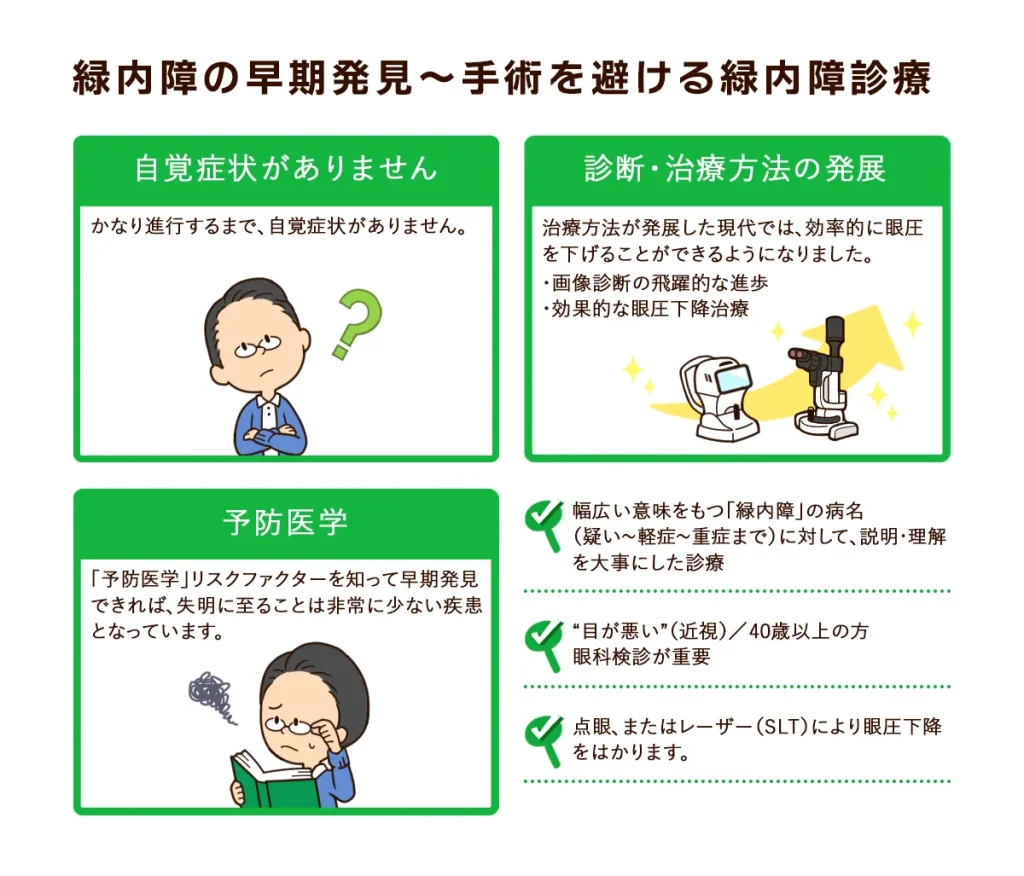
[Early Detection of Glaucoma and Glaucoma Care That Avoids Surgery]
◯ There are no symptoms until the disease is quite advanced.
◯ With today’s advances in treatment, eye pressure can be lowered efficiently.
○ Preventive medicine: if you know the risk factors and detect it early, this has become a disease that very rarely leads to blindness.
✔ If you are nearsighted (“poor eyesight”) or over 40, an eye exam is important
✔ Care that values explanation and understanding for the broad disease name “glaucoma” (from suspect through mild to severe)
✔ We lower eye pressure with eye drops or laser (SLT).

The difference between central and peripheral visual fieldis also described.
For an enlarged optic disc cup, we measure the thickness of the retinal nerve fiber layer: this is a detailed write-up.


It also gives one way of thinking about why glaucoma progression varies so much between individuals.

○ Changes in the circulation of fluid inside the eye appear as “eye pressure.”
Aqueous humor produced by the “ciliary body” around the lens fills the space behind the cornea (the anterior chamber), passes through the mesh-like “trabecular meshwork,” and flows to the blood vessels outside the eye.
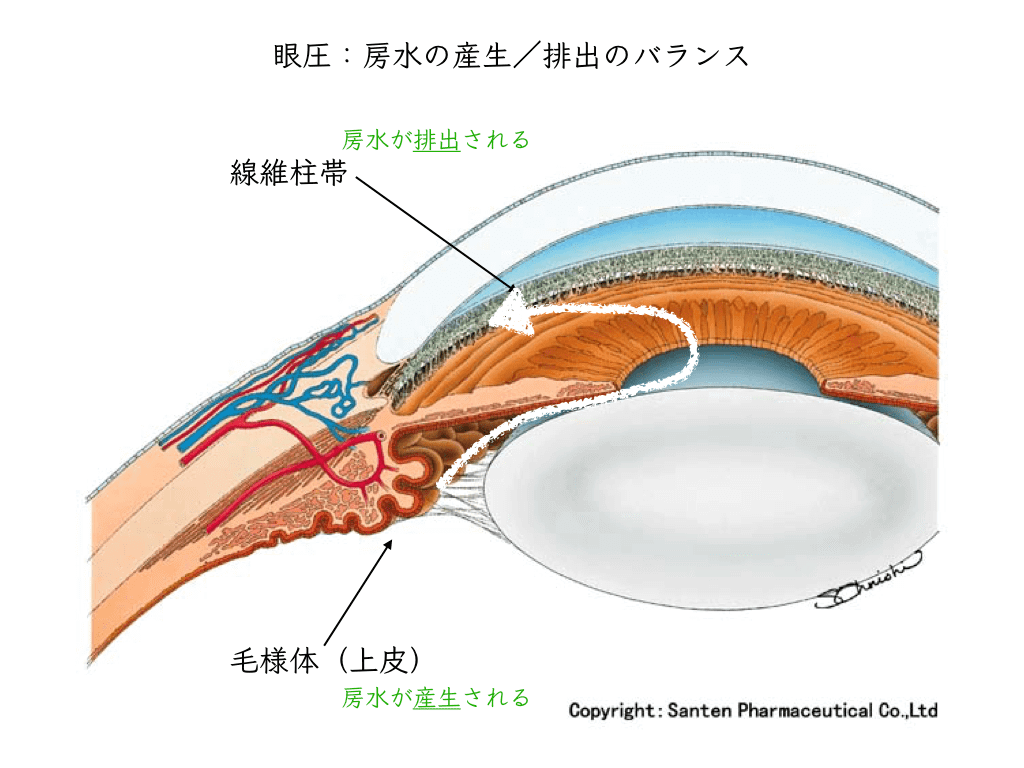

○ When the balance of this flow is disturbed, eye pressure rises and, over a long time, damages the nerve at the back of the eye. This is “glaucoma.”
As it progresses, it affects the area you can see (the visual field).
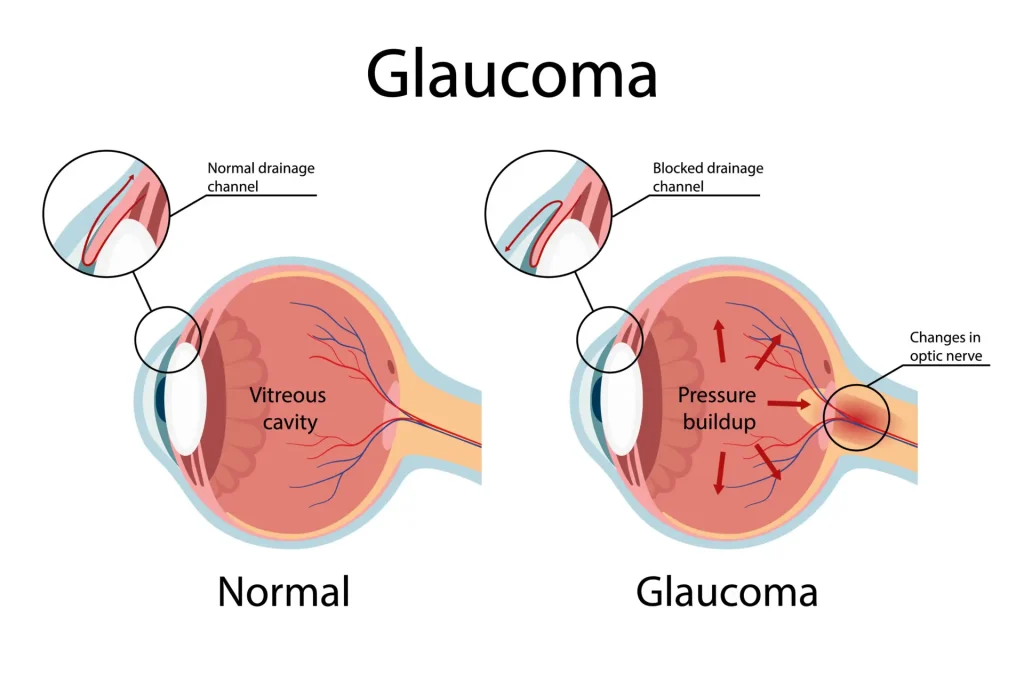
○ Worrisome glaucoma or not:
The word “glaucoma” covers a gradient.
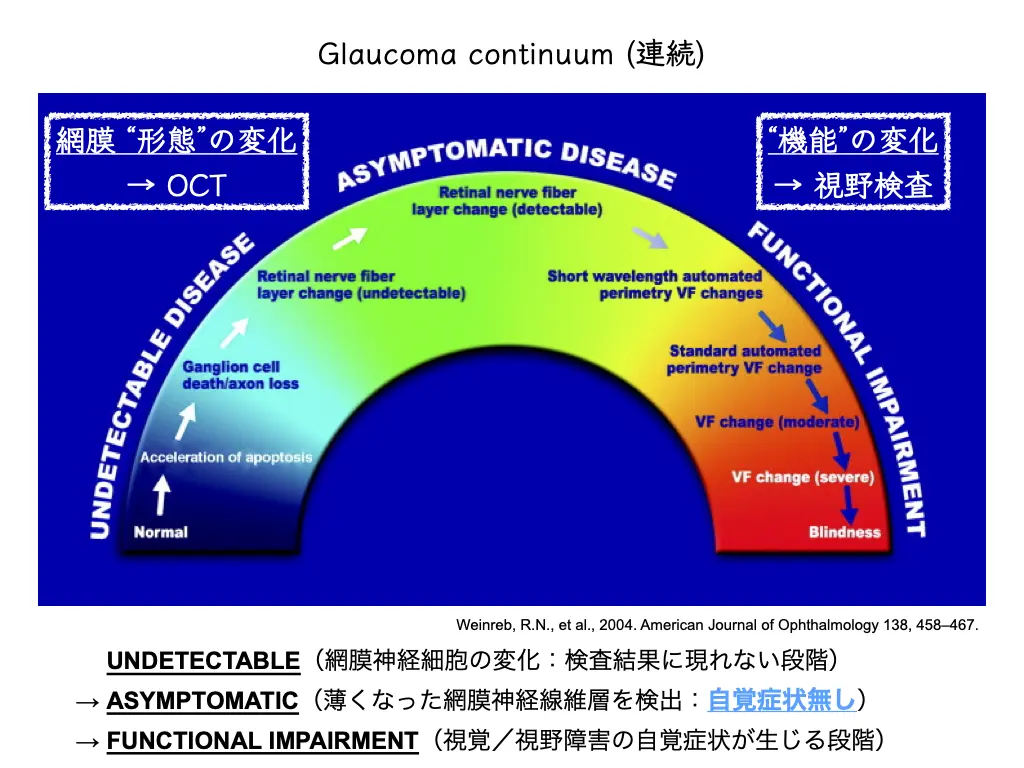
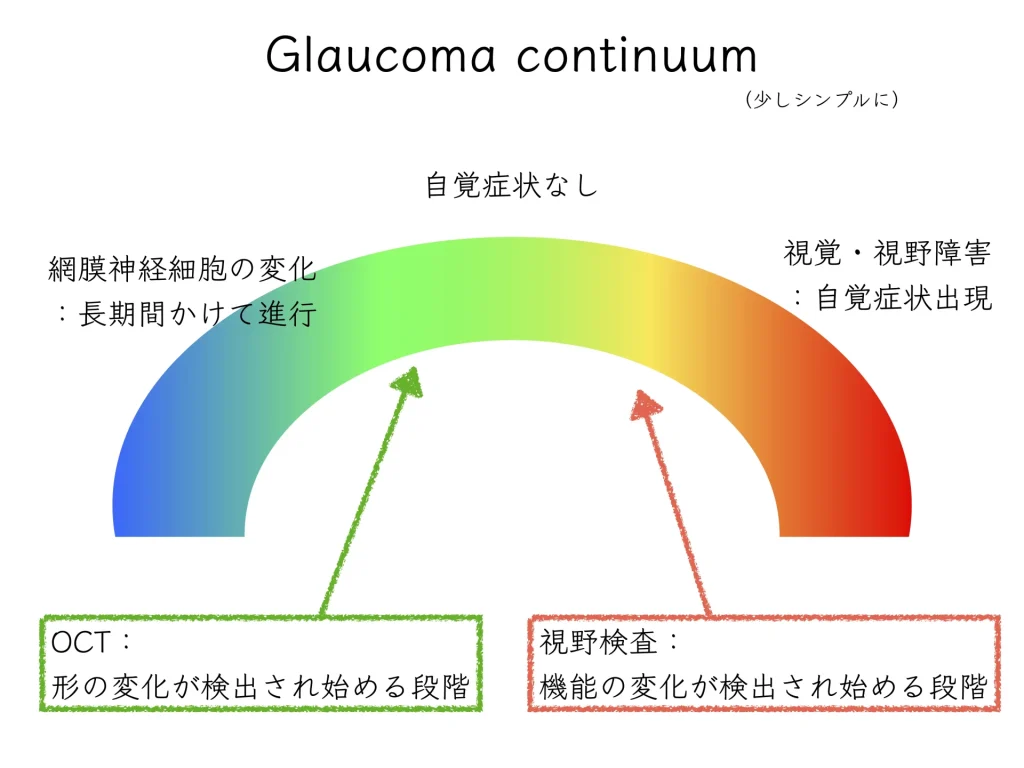
○ Factors other than eye pressure that are involved in glaucoma progression include
・Blood flow around the optic nerve
・Oxidative stress
・Systemic diseases (sleep apnea, high blood pressure, low blood pressure, diabetes, and so on)
・Smoking
and others.
○ The only target of glaucoma treatment with evidence is lowering “eye pressure.”
Lowering eye pressure with eye drops is the basis of glaucoma care.
Today, improving the outflow pathway of aqueous humor with a laser may also be considered.
(SLT, selective laser trabeculoplasty)
✔ Research showing that SLT before using anti-glaucoma eye drops (SLT as first-line treatment) is effectiveis also increasing.
What Is Glaucoma?
Explained with diagrams:
✔ Open-angle glaucoma
There is resistance in the aqueous outflow pathway, and eye pressure rises.
* Most glaucoma is in this state.
“Normal-tension glaucoma” is also important.
・Circulatory disturbance
・Flammer syndrome
and so on
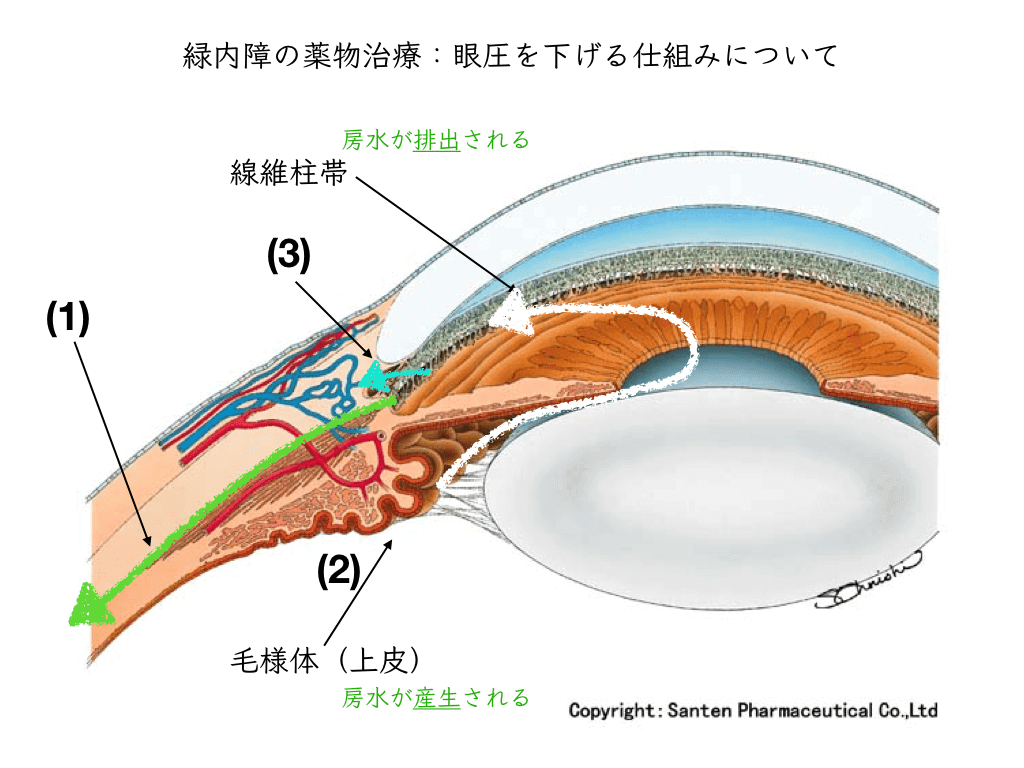
(1) Acting on the uveoscleral outflow pathway (the secondary route) to drain aqueous humor
: Prostaglandin analogs
Xalatan®, latanoprost, Tapros®, Travatans®, Lumigan®
・Effective drugs that lower eye pressure by 25–33%
(2) Slowing the production of aqueous humor (suppressing aqueous production)
: (2a) Beta-blockers
Mikelan®LA, Timoptol®, Timoptol®XE
: (2b) Carbonic anhydrase inhibitors
Azopt®, Trusopt®
: (2c) Alpha agonists
Brimonidine (Aiphagan®)
Has a dual effect of suppressing aqueous production and promoting outflow
(3) Acting on the trabecular meshwork and Schlemm’s canal (the main route) to drain aqueous humor
: ROCK inhibitors
Glanatec®
: Cholinergic agents / miotics
Pilocarpine (Sanpilo®)
→ Once the mainstay, but now used less because of side effects and the need for frequent dosing
Combination drops that combine these are also used.
Their main advantage is a smaller number of drops per day.
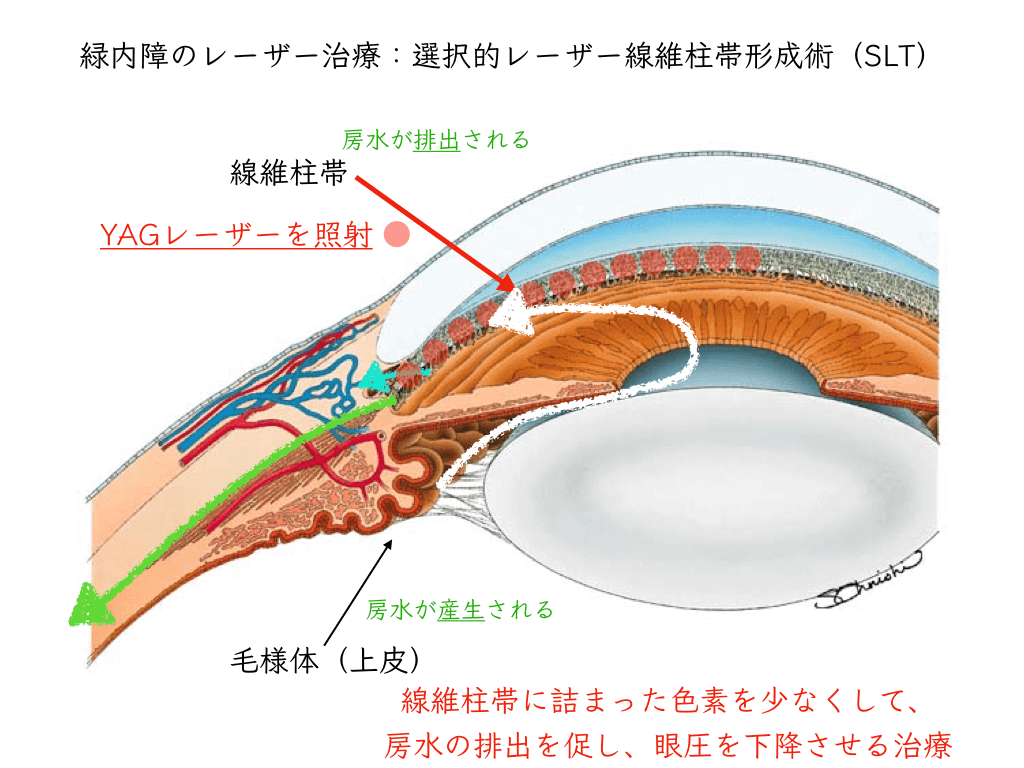
✔ Open-angle glaucoma and ocular hypertension
A low-energy YAG laser is applied to the aqueous outflow pathway (the trabecular meshwork):SLT
→ Selectively reduces pigment to lower eye pressure.
* It does not damage the trabecular meshwork or other tissue.
・People who find eye drops difficult (side effects, irregular work hours, pregnancy or breastfeeding, forgetting drops, and so on)
・People whose eye pressure does not fall enough with eye drops, and so on
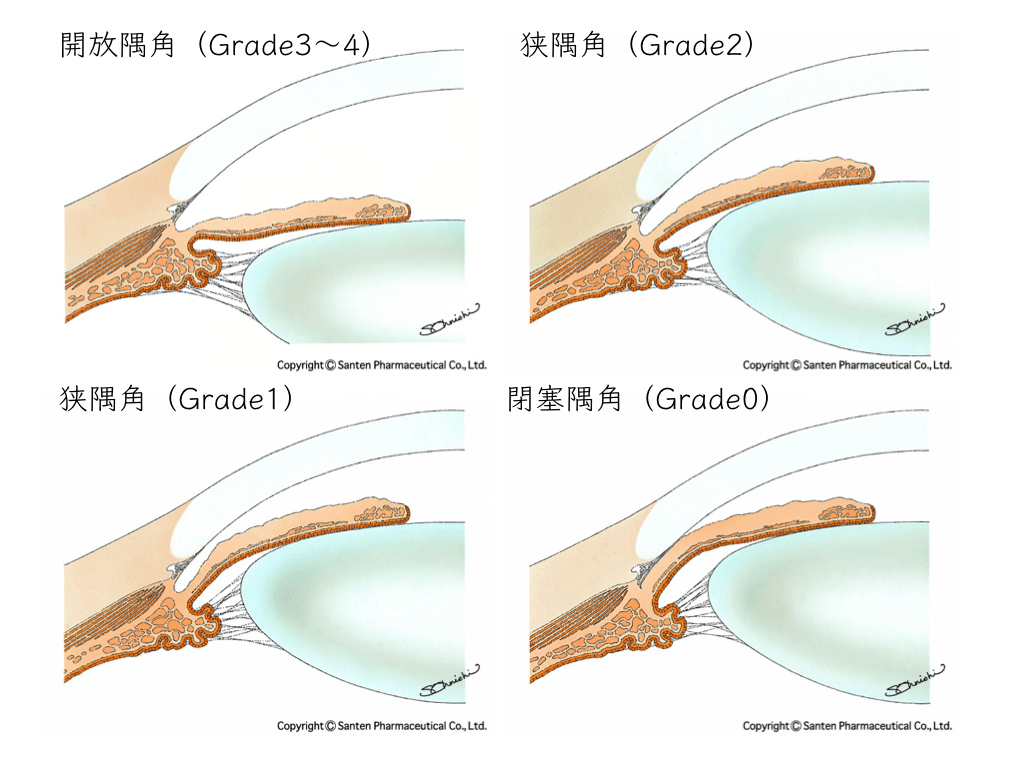
Types of glaucoma: open-angle and angle-closure
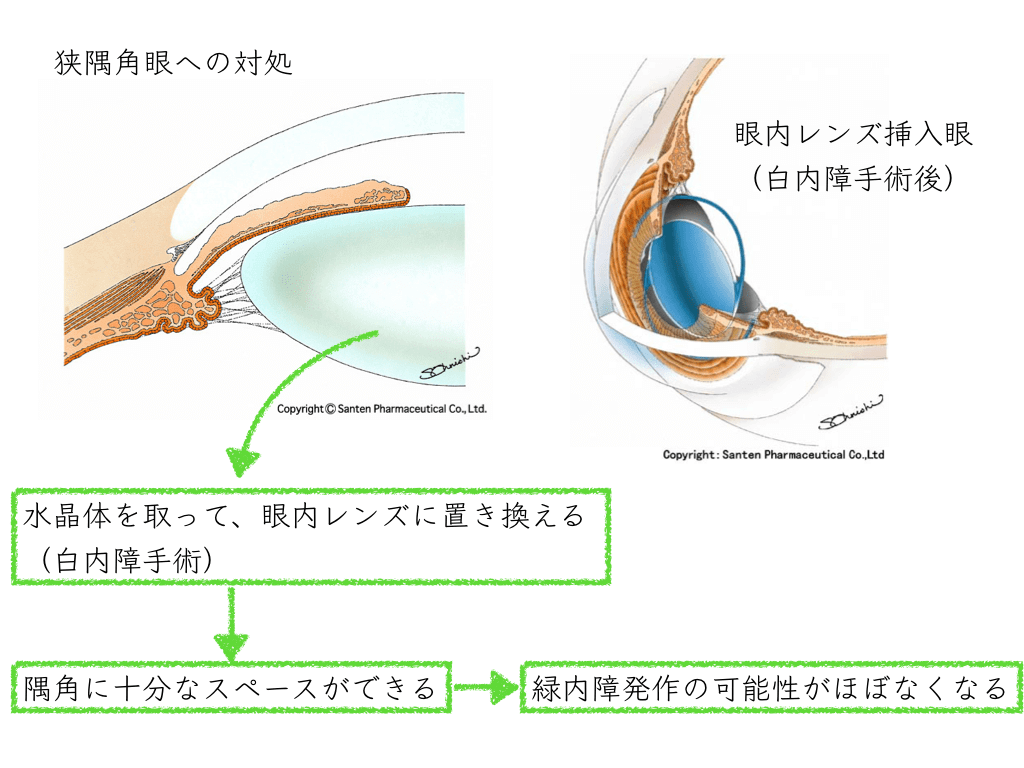
Why we perform cataract surgery on an eye with glaucoma:
To widen the angle (the pathway for fluid) and lower eye pressure.
Optic Nerve Fibers [34-second video]
・A normal optic nerve is made of 1 million nerve fibers.
・As glaucoma advances, the optic nerve is damaged and the optic disc cup (the hollow) grows larger.
・Areas that cannot be seen (scotomas) then spread.
・A visual field test at an eye clinic can detect scotomas that you do not notice.
About glaucoma [56-second video]
・Light passes through the cornea, pupil, lens, and vitreous and reaches the retina.
・In the center of the retina, the “macula,” and the surrounding retina, light is converted into signals, which travel through the optic nerve to convey information to the brain.
・In a healthy eye, a clear fluid called aqueous humor circulates through the front half of the eyeball and maintains a constant pressure.
・Aqueous humor drains through a mesh-like tissue called the trabecular meshwork.
・Sometimes aqueous humor does not drain properly through the trabecular meshwork. Eye pressure rises and, over time, damages the optic nerve at the back of the eye.
Open-angle glaucoma [38-second video]
・In a healthy eye, a clear fluid called aqueous humor circulates through the front half of the eyeball and maintains a constant pressure.
・Aqueous humor drains through a mesh-like tissue called the trabecular meshwork.
・Sometimes aqueous humor does not drain properly through the trabecular meshwork. Eye pressure rises and, over time, damages the optic nerve at the back of the eye.
Angle-closure glaucoma [44-second video]
・In a healthy eye, a clear fluid called aqueous humor circulates through the front half of the eyeball and maintains a constant pressure.
・Aqueous humor drains through a mesh-like tissue called the trabecular meshwork. The place where the fluid drains is called the “angle.”
・Sometimes the angle is narrow and aqueous humor has difficulty draining.
This is called “angle-closure glaucoma,” but it is not common.
・People of Asian descent and people with hyperopia (“good eyesight” since youth) are at higher risk.
About glaucoma [2 minute 20 second video]
・Glaucoma is a disease that damages the “optic nerve,” which carries information to the back of the brain.
・Fortunately, if it is found early there are many treatment options, and vision can be protected.
・In a healthy eye, a clear fluid called aqueous humor circulates through the front half of the eyeball and maintains a constant pressure.
・Aqueous humor drains through a mesh-like tissue called the trabecular meshwork.
・Sometimes aqueous humor does not drain properly through the trabecular meshwork. Eye pressure rises and, over time, damages the optic nerve at the back of the eye.
・Glaucoma has no symptoms in its early stages. Appropriate treatment can stop or slow progression and prevent visual impairment from advancing.
・People aged 60 and over, African Americans, and people with high eye pressure especially need glaucoma evaluation at an eye exam.
・Once glaucoma has progressed and the optic nerve is damaged, it cannot be reversed.
・If glaucoma is diagnosed and appropriate eye drop treatment can be given, visual impairment has become less common.
・People with high eye pressure also seem to benefit from treatment that lowers eye pressure.
・People with risk factors must have regular eye exams.
Laser surgery for glaucoma [3 minute 12 second video]
・Selective laser trabeculoplasty (SLT) is sometimes recommended to treat glaucoma.
・As eye pressure rises, the condition of glaucoma worsens.
・SLT improves the flow of fluid in the eye and lowers eye pressure.
・Aqueous humor is produced in the front of the eye and normally drains appropriately through a mesh-structured tissue called the trabecular meshwork.
・In glaucoma, aqueous humor does not drain well through the mesh-like trabecular meshwork, eye pressure rises, and this leads to damage of the optic nerve at the back of the eye.
・SLT uses a special laser to improve the outflow pathway.
・It can be done as an outpatient, and you can go home once you are settled afterward.
・With anesthesia, the pain is only about the feeling of the eye being pressed a little.
・A special contact lens is placed on the eye, and the laser is applied to the exact position.
After laser treatment, aqueous humor is expected to drain normally.
As a result, eye pressure goes down.
・Complications include
temporary or permanent rise in eye pressure, swelling of the iris, glare, corneal opacity, rise in eye pressure from iris adhesions, scar tissue, eye pain, reduced vision, the need for additional treatment or surgery, and so on.
Many are the same as those that accompany surgery in general.
・Alternative treatments are
eye drop treatment and glaucoma surgery.
・Your ophthalmologist will explain thoroughly why laser treatment is needed.
・Even with laser treatment, eye pressure may not fall as hoped.
If left untreated, or if treatment is inadequate,
glaucoma can lead to blindness.
・If anything is unclear, please do not hesitate to ask your ophthalmologist.
We will explain the risks and effects in detail.
・Please also ask anything else about eyes in general.
Ophthalmologists have a mission to protect everyone’s vision.

