![Takeru Eye Clinic | Takatori Shopping Street, Sawara-ku, Fukuoka City [Nishijin Station / Fujisaki Station]](https://takeru-eye.com/wp-content/uploads/2022/10/takeru_logo_for-WP-header.png)
[Explaining the “Cause” of Dry Eye: From the Viewpoint of Immunology]
○ In many cases the problem is not simply “fewer tears”: at the root of the cause is “inflammation of the ocular surface.”
◯ The tear film that forms on the eye surface with every blink:
We check the state of the three-layered “tear film” with a slit-lamp microscope.
◯ “Instability of the tear film” brings a variety of symptoms, such as eye discomfort and difficulty seeing
Dry eyes, a gritty feeling, eye pain, redness, a heavy feeling in the eyes, watery eyes, tears that come on their own, tears when you go outside, blurred vision, sensitivity to light, and so on
✔ “Calming inflammation of the ocular surface”is the main focus of the treatment we provide.
✔ Diseases other than dry eye are sometimes found.
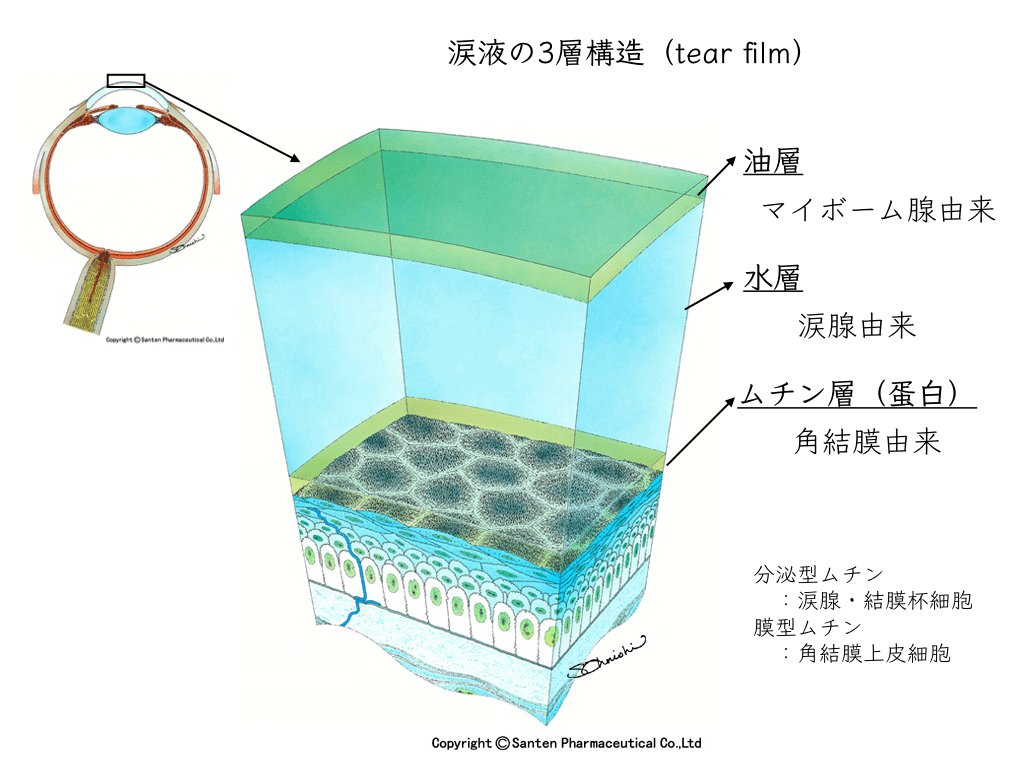
Layered structure of the tear film: components of each layer
The state of the tear film is observed by a fluorescein staining test using a slit-lamp microscope.
Eye tissues (ocular surface) related to dry eye

* Dry eye in Sjögren’s syndrome: a state in which strong autoimmune inflammation affects the lacrimal gland.
Tear Layers [30-second video]
・Tears keep the surface of the eye lubricated and let you see the outside world clearly.
・When you blink, the tear film forms on the surface of the eye.
・It is divided into three layers.
The outer layer is oil
The water layer is what we usually call “tears”
The mucin layer spreads the water evenly over the surface of the eye.
・To keep the eye surface lubricated, it is important that the three-layer structure is intact.

Definition of dry eye:
“A disease in which the stability of the tear filma)is reduced by various factors, which may cause eye discomfortb)and visual dysfunctionc), accompanied by damage to the ocular surfaced)” (2016)
Japanese Ophthalmological Society, Clinical Practice Guidelines for Dry Eye (May 2019)
About dry eye: from the Journal of the Japanese Ophthalmological Society
○ Core mechanisms of dry eye:
・Tear film instability (the tear film that forms on the eye surface with every blink becomes unstable)
・Increased friction during blinking (blinking rubs the surface of the clear front part of the eye, the cornea)
○ About the examination:
a) Stability of the tear film
We stain the surface of the eye with a fluorescein strip and measure the tear film breakup time (BUT) to assess the stability of the three-layer structure of the tear film (oil layer / water layer / mucin layer).
b) Eye discomfort
Judged from your account of symptoms. Please tell us how you feel now without hesitation.
A questionnaire (the Dry Eye related Quality of life Score, DEQS) can also be used.
c) Visual dysfunction
As needed, we perform visual acuity tests, corneal topography, wavefront aberration analysis, and so on.
d) Ocular surface damage
Assessed at the same time as a).
For example, corneal epithelial damage associated with Sjögren’s syndrome.
(The Schirmer test can also be performed as needed.)
Three-layer structure of tears [25-second video]
・Tears keep the surface of the eye lubricated and let you see the outside world clearly.
・When you blink, the tear film forms on the surface of the eye.
・It is divided into three layers.
The outer layer is oil
The water layer is what we usually call “tears”
The mucin layer spreads the water evenly over the surface of the eye.
・To keep the eye surface lubricated, it is important that the three-layer structure is intact.
○ How common is dry eye?
In a large epidemiological study of residents aged 40 and over in Japan (the Koumi Study), the prevalence was 12.5% in men and 21.6% in women.
○ How do external factors (region, race, age, season, sex) affect the onset of dry eye?
Region: no clear evidence
Race: prevalence is higher in Hispanic and Asian women than in white women
Season: prevalence is higher from winter to spring
Sex: prevalence is higher in women
Age: aging is a risk factor
○ How does lifestyle (smoking, VDT work, contact lens wear) affect the onset of dry eye?
Smoking: a risk factor for dry eye
Long hours of VDT work / a higher intake of omega-6 than omega-3 fatty acids
: risk factors for dry eye
Contact lens wear
: unclear whether it is a risk factor
○ Diseases related to dry eye
・Drug-induced corneal epithelial disorder
Preservatives in various eye drops can have an effect. Other causes include the effects of glaucoma medications.
We may reduce or stop eye drops, or use preservative-free eye drops.
・Meibomian gland dysfunction
An allergy to infection with acne bacteria (Cutibacterium acnes) may be present at the lid margin.
There is also a relationship with eyelash mites.

・Superior limbic keratoconjunctivitis
For example, associated with thyroid eye disease.
・Neurotrophic keratopathy
Trigeminal nerve damage, for example after neurosurgery or after corneal herpes.
・Filamentary keratitis
・Conjunctivochalasis
A state in which the conjunctiva is loose: we see many cases in daily practice.
・Lid-wiper epitheliopathy
Damage to the conjunctiva on the inner surface of the eyelid. It occurs often in people who wear soft contact lenses.
* As needed, we also consider treatments such as punctal plugs and diquafosol sodium eye drops.
Dry Eye [60-second video]
・Let’s talk about “dry eye,” which troubles many people.
・Symptoms differ quite a lot from person to person:
You may have discomfort,watery eyes, redness, a stabbing pain, or a burning feeling.
・There are also many causes:
Allergies, air pollution, taking asthma medication, long hours of computer use, and so on.
・Sometimes you can solve it yourself, but sometimes you cannot. When that happens, see an eye doctor early.
・Dry eye can also be a sign of other symptoms in the body.
EyeSmart — American Academy of Ophthalmology

