![Takeru Eye Clinic | Takatori Shopping Street, Sawara-ku, Fukuoka City [Nishijin Station / Fujisaki Station]](https://takeru-eye.com/wp-content/uploads/2022/10/takeru_logo_for-WP-header.png)
MiYOSMART® (HOYA) and Stellest® (Nikon-Essilor) are myopia control glasses that cannot be made without a prescription from an eye doctor. At the eye clinic we check the state of the myopia and whether the glasses are suitable, and the lenses are then made at a participating optical shop from the prescription. Takeru Eye Clinic has prescribed both lenses since the first day of their release in Japan in June 2026.
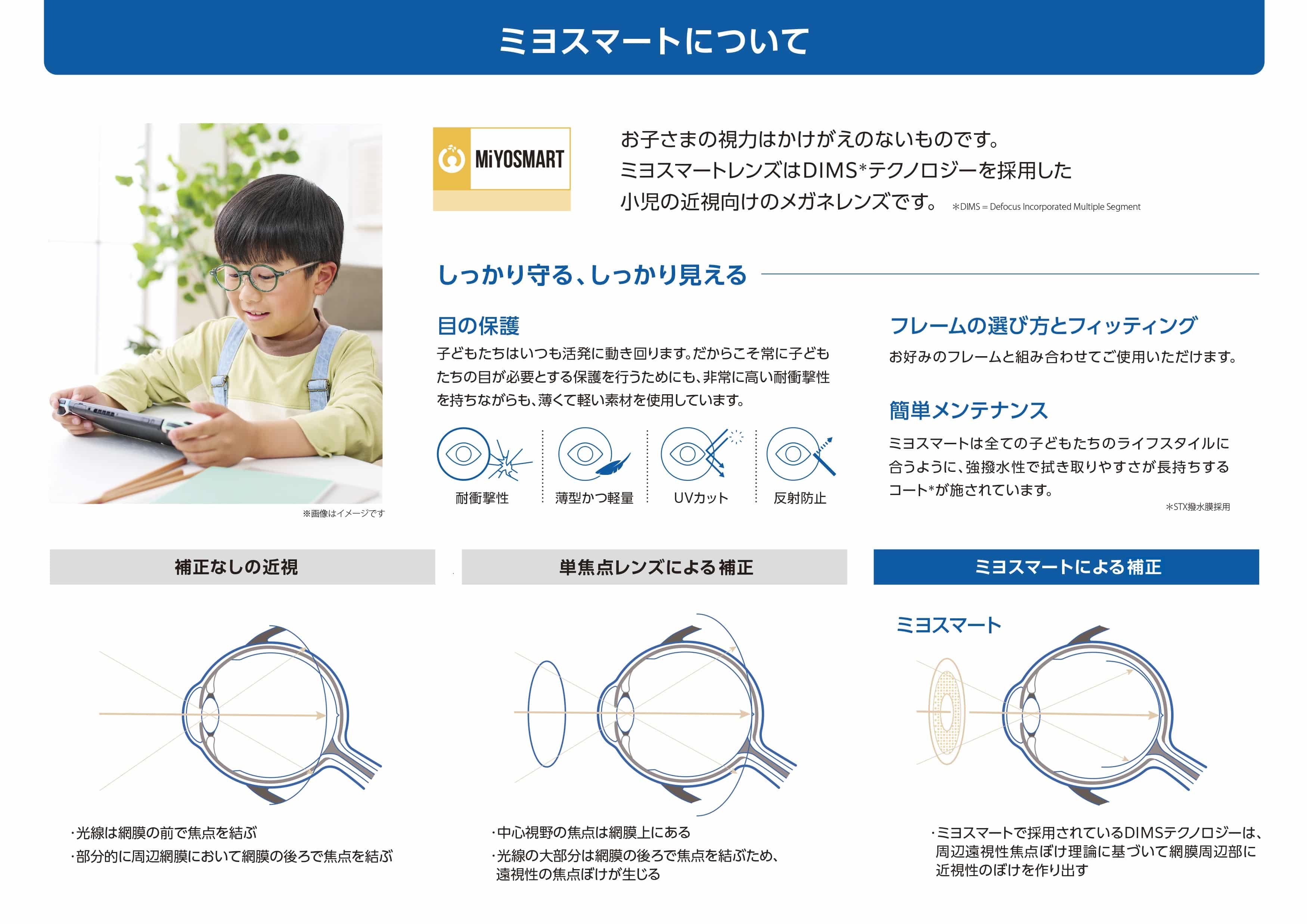
Because they can be started simply by “wearing glasses,” they are a low-barrier option for children and families who are uneasy about treatments that touch the eye directly. This page covers what the eye exam involves, costs and insurance, the flow of visits, how the glasses work, and how they compare with other treatments.
The first exam and explanation are covered by insurance. No appointment is necessary.
Roles of the Eye Clinic and the Optical Shop
| Eye clinic | Optical shop | |
|---|---|---|
| What they do | Judging suitability (including checking contraindications), cycloplegic refraction test, axial length measurement, issuing the prescription | Frame selection, lens making, fitting |
| After the glasses are made | Axial length measurement and power check every 3 months, judging the effect, deciding when to replace the lenses | Adjusting the fit, repairing the frame |
The reason they cannot be made just by measuring power at an optical shop is that myopia control glasses are a “treatment that manages how myopia progresses,” and axial length must be measured to confirm the effect. A frame with a vertical height of 30 mm or more is recommended.
What Happens at the Eye Exam
- First visit (insured): tests of visual acuity, refraction, and eye alignment, and an explanation of the current state of the myopia. You take this home and talk it over as a family.
- Pre-prescription exam (self-pay): a cycloplegic refraction test with cyclopentolate drops (please allow about 1 hour after the drops) and axial length measurement, after which we issue the prescription.
- On the day of the drops: glare and blurred near vision remain for half a day to a day after the drops. Please plan your visit with afternoon lessons or homework in mind.
What Are Myopia Control Glasses?
Children’s myopia progresses as the axial length (the front-to-back length of the eye) grows too long. Ordinary single-vision glasses are meant to “make things visible” and do not slow the progression of myopia itself.
Myopia control glasses keep the center of the lens clear, as in ordinary glasses, and build a fine lens structure into the periphery. This structure creates “myopic defocus (focus falling in front of the retina)” in the peripheral retina, which is thought to act as a signal that slows the growth of axial length.
| Product | Manufacturer | Technology | Structural features |
|---|---|---|---|
| MiYOSMART® | HOYA | DIMS | 396 tiny convex lenses arranged in a honeycomb around a 9.4 mm single-vision center |
| Stellest® | Nikon-Essilor | HALT | 1,021 aspheric microlenses arranged in 11 concentric rings |
In October 2025, the Japanese Society of Myopia published the “Guidelines for Myopia Management Spectacles (Multi-segment Lenses), 1st edition,” which lists MiYOSMART® and Stellest® as recommended products. The prescribing framework is defined as “prescribed by an ophthalmologist and made by a certified spectacle-making technician.”
How Much Can Progression Be Slowed?
Randomized controlled trials overseas report that myopia progression (refraction and axial length) was slowed by about 50–60% compared with single-vision glasses (the average control rate stated in the Japanese Society of Myopia guidelines is 55–59%). Long-term follow-up data of 6–8 years have accumulated, and no clear rebound (a reversal of progression) after stopping wear has been reported.
The effect varies between individuals and depends greatly on wearing time. These are lenses designed on the premise of “wearing them from morning until bedtime (all-day wear).” If wearing time is short, the effect to be expected may be smaller. Before prescribing, we check with the parents how many hours a day your child can realistically wear them.
Details of the clinical trial data and references are collected in our explanatory article.
Children Who Are Eligible
- Target age: MiYOSMART® ages 5–18, Stellest® ages 7–18
- Children whose cycloplegic refraction test (cyclopentolate drops) shows myopia of −0.50 D or more in spherical equivalent in both eyes
- Please also talk to us if there is a family history of high myopia or if you or your child have a wish for treatment
Binocular vision abnormalities such as strabismus, amblyopia, and nystagmus, accommodation abnormalities (including pseudomyopia), symptomatic or secondary myopia, keratoconus, and similar conditions are contraindications under the guidelines. We confirm suitability at the first exam.
Cost and Insurance (as of September 2026, tax included)
| Item | Cost |
|---|---|
| First exam and explanation | Insured care |
| Pre-prescription exam | ¥5,500 |
| Annual management fee (4 visits) | ¥17,600 |
| Lens cost (paid at the optical shop) | MiYOSMART® ¥77,000 / Stellest® ¥79,200 (listed prices at major optical chains, frame extra; may differ by store) |
| Estimated first year | About ¥100,000 plus frame |
Everything after the pre-prescription exam is self-pay. The annual management fee is paid in one sum at the first check 2 weeks after you start wearing the glasses. Children already enrolled in the Ryjusea® Mini management program pay no additional management fee.
Is it covered by insurance?
As of September 2026, myopia control glasses are not covered by health insurance. The first exam and explanation are insured, but exams and management after the pre-prescription exam, and the lens cost at the optical shop, are out of pocket. At present no clear guidance has been issued as to whether they qualify for the medical expense deduction (as far as our clinic could confirm). Please check with the tax office before filing your tax return.
A cost and insurance comparison with MiSight®, Ryjusea® Mini, and orthokeratology is collected in “Cost and Insurance for Myopia Control Treatment” on the page “Myopia Control (Prevention).”
Where Can I Buy the Lenses?
MiYOSMART® and Stellest® are not lenses you can freely buy at an optical shop. Following the Japanese Society of Myopia guidelines, they are made at a participating optical shop (one with a certified spectacle-making technician) based on the exam and prescription from an eye clinic. After the pre-prescription exam, our clinic issues the prescription and tells you about participating optical shops. You can also consult the optical shop about frame selection (a vertical height of 30 mm or more is recommended) and fitting.
Flow of Visits
| When | What happens |
|---|---|
| First visit (insured) | Exam by an orthoptist and explanation of the current state of the myopia. You talk it over with your family at home |
| Pre-prescription exam | Cycloplegic refraction test, axial length measurement → prescription issued |
| After 2 weeks | Axial length measurement, power check, payment of the annual management fee |
| After 3 months | Axial length measurement, power check, graph explanation |
| After 6 months | Axial length measurement, power check, judging the effect |
| After 9 months | Axial length measurement, power check, graph explanation |
Because the alignment between the lens center and the pupil directly affects the result, regular axial length measurement and power checks are done as a set. If equivalent spherical power progresses by more than −0.50 D at a 6-month exam, we recommend replacing the lenses (guidelines, 1st edition). For the first 2 weeks after starting to wear them, take care with vigorous sports, ball games, and cycling (the adjustment period to the new lenses).
Comparison With Other Myopia Control Treatments
Myopia control glasses are one of the myopia progression control options we offer. There is no single “best” answer; the right choice changes with your child’s age, how the axial length grows, lifestyle, and your family’s values.
| Treatment | Method | Features | Points to note |
|---|---|---|---|
| Myopia control glasses (MiYOSMART® / Stellest®) | Glasses worn during the day | Nothing touches the eye, so they are easy to start at a young age. Low dropout rate | Designed for all-day wear. Please ask about how things look during sports |
| Orthokeratology | Special hard lenses worn during sleep | You can go through the day without glasses. Good for sports and swimming | Lens care is needed every night |
| MiSight® 1day | Daily disposable soft lenses worn during the day | Daily disposable type. Long-term clinical data have accumulated | Practice inserting and removing lenses and hygiene management are needed |
| Ryjusea® Mini (low-concentration atropine eye drops) | One drop once daily before bed | Little effort, and it can be started at a young age | Eye drops must be continued |
| Watchful waiting (doing nothing) | Ordinary glasses and so on | This is also an important option | We check progress with axial length measurement every 3 months |
At our clinic, we set out the options, including “doing nothing (watchful waiting),” neutrally, and we value the process of deciding together with your family (SDM: shared decision-making). You do not have to decide on the spot at the first visit.
If the Effect Is Not Enough: Combination as an Option
If the axial length has grown by 0.10 mm or more at the 6-month evaluation, we evaluate together the effect of the glasses alone, and discuss combining them with Ryjusea® Mini (low-concentration atropine eye drops) or switching to another treatment. For combination therapy (DIMS + 0.025% atropine), a clinical trial has reported that axial length growth was slowed further than with either alone.
Frequently Asked Questions
Will my child’s myopia be cured?
Myopia control glasses do not “cure” myopia. They are a treatment that aims to slow future progression and lower the risk of becoming highly myopic. The effect varies between individuals.
How long do we continue?
Myopia progression generally tends to settle around age 18. If the axial length measured every 3 months shows that progression has stopped, stopping wear can be considered. No clear rebound after stopping has been reported.
Which should we choose, MiYOSMART or Stellest?
They differ in how the periphery is designed to look, and the way discomfort appears can differ in children who play sports that demand dynamic vision. The target ages also differ (MiYOSMART®: from age 5, Stellest®: from age 7). We decide at the exam, after asking about your child’s lifestyle.
Can we buy them directly at an optical shop?
No. MiYOSMART® and Stellest® are lenses made at a participating optical shop based on a prescription from an eye clinic.
Can you follow the progress of glasses made from another eye clinic’s prescription?
Yes. Please bring the details of the prescription and any records of axial length so far.
If the power changes, do we have to remake the lenses?
If equivalent spherical power progresses by more than −0.50 D at the exam every 6 months, we recommend replacing the lenses (Japanese Society of Myopia guidelines, 1st edition). The lens cost is charged again in that case.
You can also check the trend of axial length in the “Myopia Management Report” app for parents. For the overall guide to myopia progression control, please see the page below.
The first visit is covered by insurance. No appointment is necessary. If you are interested, please let us know at your exam.

