![Takeru Eye Clinic | Takatori Shopping Street, Sawara-ku, Fukuoka City [Nishijin Station / Fujisaki Station]](https://takeru-eye.com/wp-content/uploads/2022/10/takeru_logo_for-WP-header.png)
If you fall asleep with contact lenses in, even for one night, there is a risk of “corneal infection” that can lead to blindness.
The main cause of corneal infection is that, with the eyelids closed, the cornea suddenly becomes short of oxygen.
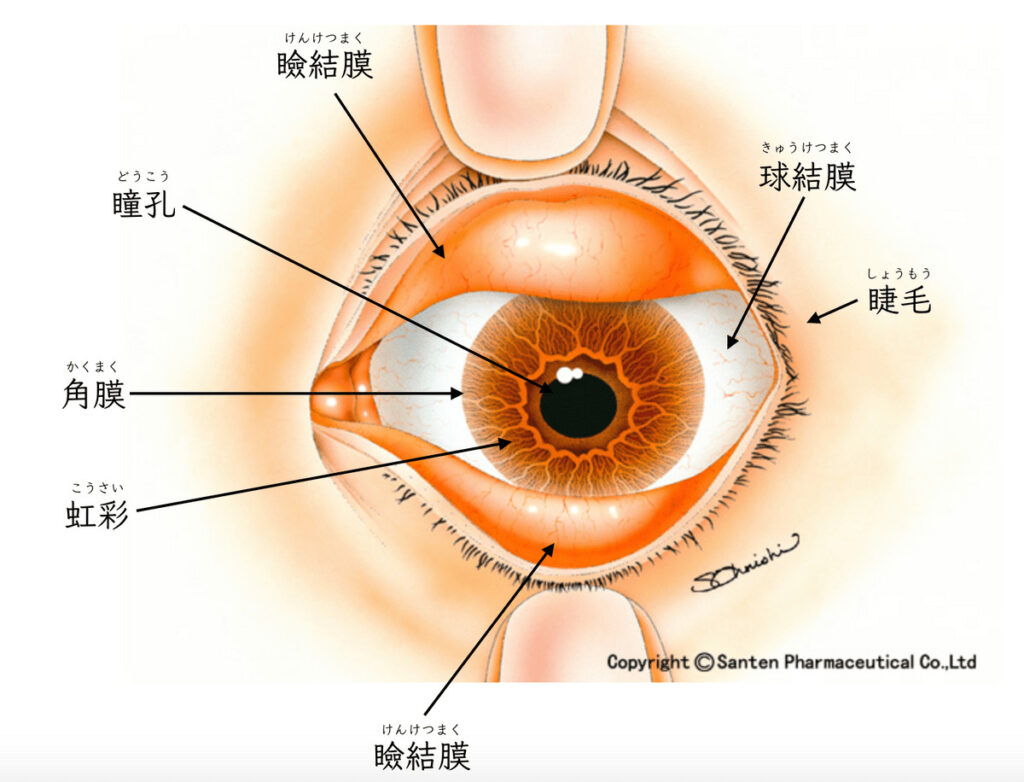
The “ocular surface,” made up of the cornea and the white of the eye, is in contact with the outside world, and all kinds of things, including microorganisms, can easily get in.
Oxygen on the ocular surface (tear film, corneal epithelium, conjunctiva) is a prerequisite for the immune system that fights microorganisms.
In other words, when oxygen is lacking, the eye cannot fight microorganisms well enough.
Falling asleep with the eyelids closed creates a favorable environment for microorganisms (bacteria, fungi, amoebae, and others) to multiply.
Contact lenses are safe medical devices as long as they are used correctly, but incorrect use can cause serious eye damage.
For this reason, contact lenses are classified as Class III highly controlled medical devices under the Pharmaceuticals and Medical Devices Act (formerly the Pharmaceutical Affairs Law).
Sleeping with a contact lens lost inside the eye is equally dangerous.
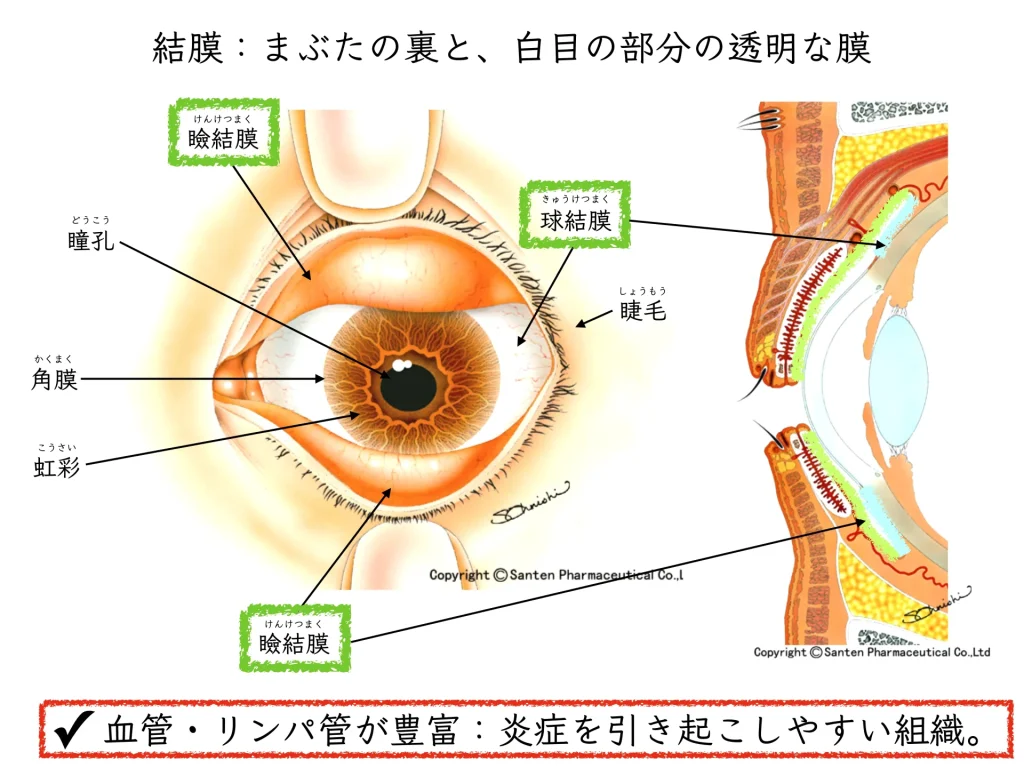
The reason a contact lens cannot go behind the eye is that the conjunctiva (palpebral and bulbar conjunctiva) is folded back on itself.
If a contact lens lost in the eye cannot be found, it is best to see an eye doctor promptly.
The “Danger” of Sleeping with Contact Lenses: The Reasons and 6 Real Cases

Why the risk of corneal infection rises
✔ Bringing in microorganisms attached to the contact lens
✔ An environment suited to microbial growth
✔ Lack of oxygen
When you sleep with contact lenses in,
the risk of corneal infection rises mainly because of these three points.
When inflammation occurs in the body, depending on its severity, the tissue is left with scarring after it heals.
Inflammation of the eye is special, and it is important that it heals while preserving transparency as much as possible.
If the eye tissue heals with scarring, it affects vision for life.
I believe it is important to see an ophthalmologist early when you notice anything unusual, and to heal the eye with as little scarring as possible.
» How to think about inflammatory disease
From a review by the Centers for Disease Control and Prevention (CDC)
Corneal Infections Associated with Sleeping in Contact Lenses — Six Cases, United States, 2016–2018
https://www.cdc.gov/mmwr/volumes/67/wr/mm6732a2.htm
✔ Sleeping while wearing contact lenses raises the risk of contact lens–related eye infection 6 to 8 times.
✔ One in three contact lens wearers does not remove their lenses when sleeping
Contact lens–related eye infection
Case 1
A 34-year-old man. He had worn soft contact lenses since age 17.
He saw an eye doctor because his left eye became red and hard to see with.
3 to 4 times a week, heslept with his contact lenses in, and did not remove them even when swimming in a pool.
At a nearby eye clinic, he was diagnosed with bacterial and fungal keratitis and treated for 2 months without improvement.
At a university hospital, confocal microscopy led to a diagnosis of Acanthamoeba keratitis.
After more than half a year of disinfectant eye drops every hour, his corrected vision recovered to (0.5).
Case 2
A 59-year-old man. He did not remove his contact lenses all day while out hunting, and noticed eye pain on the 3rd day.
Over-the-counter eye drops did not help.
At a nearby eye clinic he was treated for corneal epithelial erosion (peeling of the surface of the black of the eye) with a therapeutic contact lens and antibiotic eye drops 4 times a day, but his symptoms worsened.
The antibiotic was changed and used every 2 hours.
During treatment, when he took a shower and wiped his face with a towel, he heard a popping sound from his left eye and felt severe pain right afterward.
He saw an eye doctor immediately and was diagnosed with corneal perforation (a hole in the black of the eye).
He had an emergency corneal transplant and continued antibiotic eye drops after surgery.
A year later he had cataract surgery and, miraculously, his corrected vision recovered to (0.8).
Case 3
A 34-year-old woman. She came in with right eye pain lasting 3 days.
She had worn her contact lenses for longer than the prescribed continuous-wear period,and always slept with them in.
She had not seen an eye doctor for several years, and for more than 5 years had boughther contact lenses over the internet.
The right eye had a 1.5 mm infiltrate (a round white lesion within the black of the eye) and slight anterior chamber cloudiness (inflammation behind the black of the eye).
Her symptoms improved with antibiotic eye drops, but she did not show up for the follow-up scheduled one week later.
Case 4
A 57-year-old man. He came to the emergency room with decreased vision and pain in both eyes. He had worn the same softcontact lenses for about 2 weeks.
He did not do dailycontact lens care, alwaysslept with his contact lenses in, and did not replace them.
At presentation, vision was light perception only (able to tell light) in the right eye and hand motion only (able to tell hand movement) in the left.
The right eye had a central corneal infiltrate and corneal perforation (the black of the eye turned white from inflammation and developed a hole). The left eye also had a corneal infiltrate and hypopyon (very severe inflammation behind the black of the eye).
He was diagnosed with bacterial keratitis in both eyes and treated with strong antibiotics. A corneal transplant was performed on the right eye.
The left eye responded to eye drops and recovered to corrected vision (0.5), leaving a central scar (the center of the black of the eye turned white).
Case 5
A 17-year-old woman. She wore softcontact lenses bought at a store without an eye doctor’s examination, and slept in them; her right eye was diagnosed with a corneal ulcer caused by Pseudomonas aeruginosa.
Vision in the right eye was light perception only, and inflammation was very severe.
The inflammation settled after strong antibiotic treatment, but corneal scarring and thinning remained (the black of the eye turned white).
Case 6
An 18-year-old man. He came to the emergency room because pain, redness, light sensitivity, and tearing in his left eye did not stop for 3 days.
One year earlier he had bought colored contact lenses at a store in a busy shopping district without an eye doctor’s examination and kept wearing them. He did not remove them when sleeping either.
He was immediately prescribed antibiotic eye drops and attended a nearby eye clinic. Corrected vision was right (0.8), left (0.4). After strong antibiotic treatment his symptoms improved in 10 days.
The left eye also recovered to corrected vision (0.8), but corneal stromal scarring remained (the black of the eye turned white).
Grown bacteria were detected in his contact lens case.