![Takeru Eye Clinic | Takatori Shopping Street, Sawara-ku, Fukuoka City [Nishijin Station / Fujisaki Station]](https://takeru-eye.com/wp-content/uploads/2022/10/takeru_logo_for-WP-header.png)

What matters to patients:
○ How you are right now
○ What to expect going forward
We now live in an age when you can look up how to do almost anything.
In English, “Google” has become a verb. In Japanese, it is “guguru.”
People say, “Ok, just google it!”
This website is also homemade; even a non-expert in IT could build it by doing a lot of Google searches.
For moving the website, too, I owe a great deal to Professor Google.
When it comes to illness, on the other hand:
「searching by symptoms can lead you in unexpected directions” is the point.
There are Nordic doctors who have made this into an easy-to-follow and very enjoyable song.
The Pros and Cons of “Googling” Symptoms: How to Get Along with Medical Information
A warning set to rock lyrics: “Don’t Google your symptoms”
Dr. Henrik Daniel Widegren is an ear, nose, and throat doctor in Sweden who also plays in a rock band.
https://sv.wikipedia.org/wiki/Henrik_Widegren
The band members all seem to be doctors, too.
(Explanation of the lyrics)
A father has become depressed, thinking he is a goner..
Every symptom leads to something serious.
Cough, diagnosis
→ tuberculosis
Fever, redness
→ Ebola hemorrhagic fever
Runny nose
→ water leaking from the brain (cerebrospinal fluid leak)
Itching, prognosis (outlook)
→ anaphylactic shock, psychosis
Pain in the left arm
→ a warning sign of a heart attack
Difficulty with strength
→ ALS (amyotrophic lateral sclerosis)
Told you have anemia
→ leukemia
A bit restless
→ ADHD (attention-deficit/hyperactivity disorder)
One evening, my father said: My son
I’m dying and soon I’ll be gone
But before my final farewell:
Hear me. And hear me well
Do whatever you want to do
Have a plan or roll the dice
But one thing is strictly taboo
Please, follow my advice
Never google your symptoms
That is my only prescription
You get a hundred diagnoses
And medieval prognoses
Every sign is a serious condition
If you google “cough” and “diagnosis”
You have got tuberculosis
And if you google “fever and red”
You’ve got Ebola and soon will be dead
And if you google “I’ve a runny nose”
It’s CSF. Your brain is leaking juice!
And if you google itch and prognosis:
Anaphylactic chock or psychosis
So never google your symptoms
Seldom it brings any wisdom
You want to discover
But you might uncover
That you have an extra chromosome
So this is what I heard my father say
And then he closed his eyes and passed away
The autopsy report was very clear
Death from hypochondric fear
Which is custom
When you google
Your symptoms
Never google your symptoms
The hit list is never awesome
Pain in your left arm?
Heart attack alarm!
Do you feel a little weak? Yes,
You’ve got ALS!
If you have a slight anemia
You’ve got leukemia!
Are you a little crazy?
You’ve got ADHD
So never, ever google
Your symptoms!
Never Google Your Symptoms
by Henrik Widegren
Japanese title: “Never, ever Google your symptoms”
One of my favorite songs is “Never Google Your Symptoms” by a Swedish ear, nose, and throat doctor.
— Baku, psychiatrist 📕 serializing in The21! (@DrYumekuiBaku) April 20, 2021
If you google, everyone is seriously ill.
The singing is good too, and this really is the kind of song that helps (even medical students who have started specializing get better).https://t.co/HYTfxu55un pic.twitter.com/z3MbxzVj1r
“It might be glaucoma”
Doctors examine with every possible disease in mind.
For people with strong myopia, we often look at the state of the nerve with OCT.
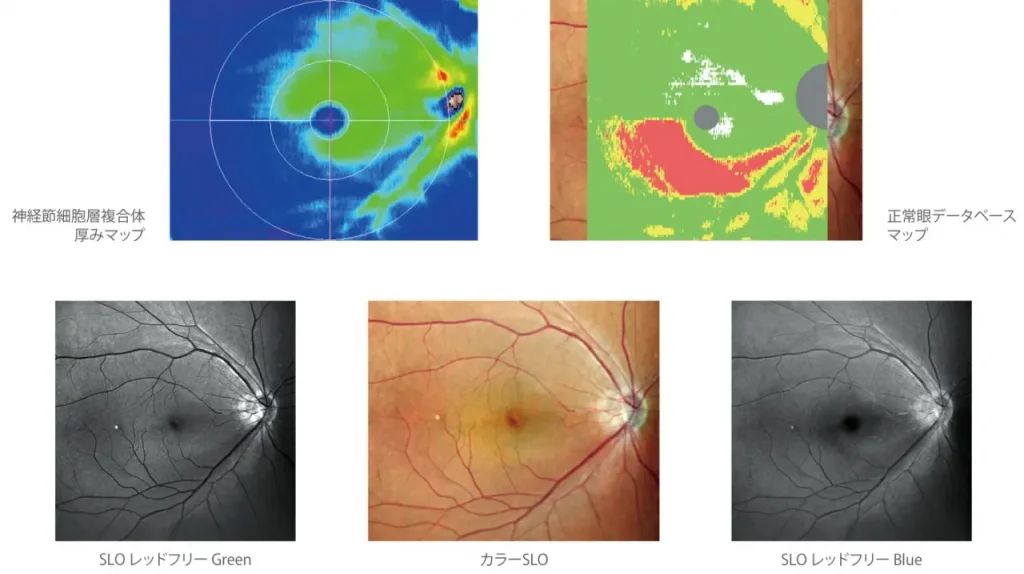
Many people come after a health checkup points out “enlarged optic disc cupping.”
If we judge it necessary, we may also do a visual field test.
Because it can lead to excessive worry, we often do it on the same day.
Whenever I mention the word “glaucoma” in an exam, even briefly, I always explain the following.
“Glaucoma” is a very broad term.
It ranges from the point of deciding whether it is glaucoma at all, to very advanced glaucoma.
But as a search word, it is just one: “glaucoma.”
Google it, and a great many results come up.
If you search more widely and deeply,
・Am I going to go blind?
・What about my family’s future?
・What should I do about work?
and you end up heading in a very negative direction.
Beyond that, there may even be a path leading to alternative medicine.
I think it is a loss to worry about things you do not need to worry about.
Today I am telling you how Mr./Ms. ○○ is doing at this point in time!
“What state am I in right now?”: from now on, too, I will show you all the images and explain.
Please ask anything right now.
If anything worries you afterward, please ask at each visit.
Who is putting out the medical information?
Aggregator sites, I hear, are called curation sites.
In 2016, I was told, there was an uproar known as the WELQ problem.
There also seems to be a lot of medical information put out anonymously.
When I was at a university and research institutes, I was soaked in an enormous amount of writing every day.
When citing or peer-reviewing a paper as well, the author’s and affiliation’s information (background) is considered important.
When I search for medical information on my own,
I think to myself, “Which doctor is saying this?”
When medical information is put out broadly or in general, it has to be comprehensive.
I think that is why people end up reaching excessive information.
What matters to patients:
○ How you are right now
○ What to expect going forward
The information each person needs is probably quite different.
I practice with the hope that you will understand each piece of information.
Dr. Henrik Daniel Widegren’s music activities
Self-introduction video (YouTube):
https://youtu.be/778IoKY9FCM
Music streaming (Spotify):
https://open.spotify.com/artist/2d6Hj6hYKdKuUx00Q60lgr?si=HvCO52cMT2WIC2hJ9sckbw
I Am Corona:
https://youtu.be/TTyaB41BIUk