![Takeru Eye Clinic | Takatori Shopping Street, Sawara-ku, Fukuoka City [Nishijin Station / Fujisaki Station]](https://takeru-eye.com/wp-content/uploads/2022/10/takeru_logo_for-WP-header.png)

Long-term hard contact lens wearers can develop early-onset ptosis (drooping of the eyelid).
This is a contact lens complication that has been reported for nearly 40 years.1, 2。
Contact Lenses Can Make the Eyelid Droop

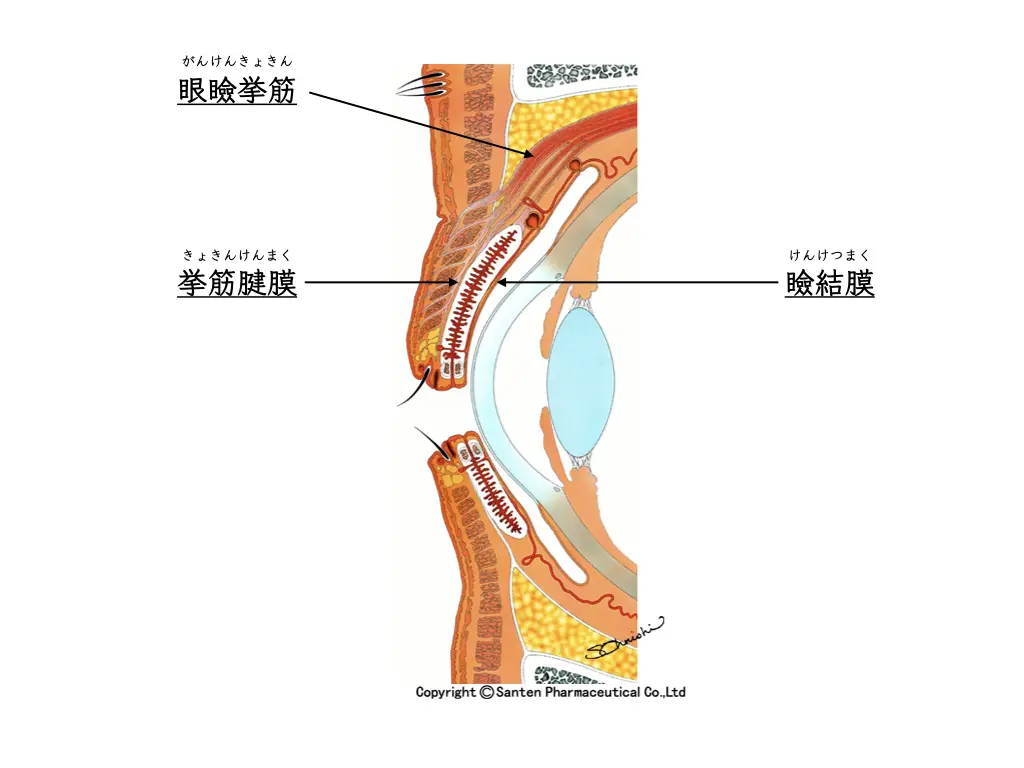
The “tendon” connecting the muscle that lifts the eyelid and the eyelid’s supporting framework (the tarsal plate) comes loose
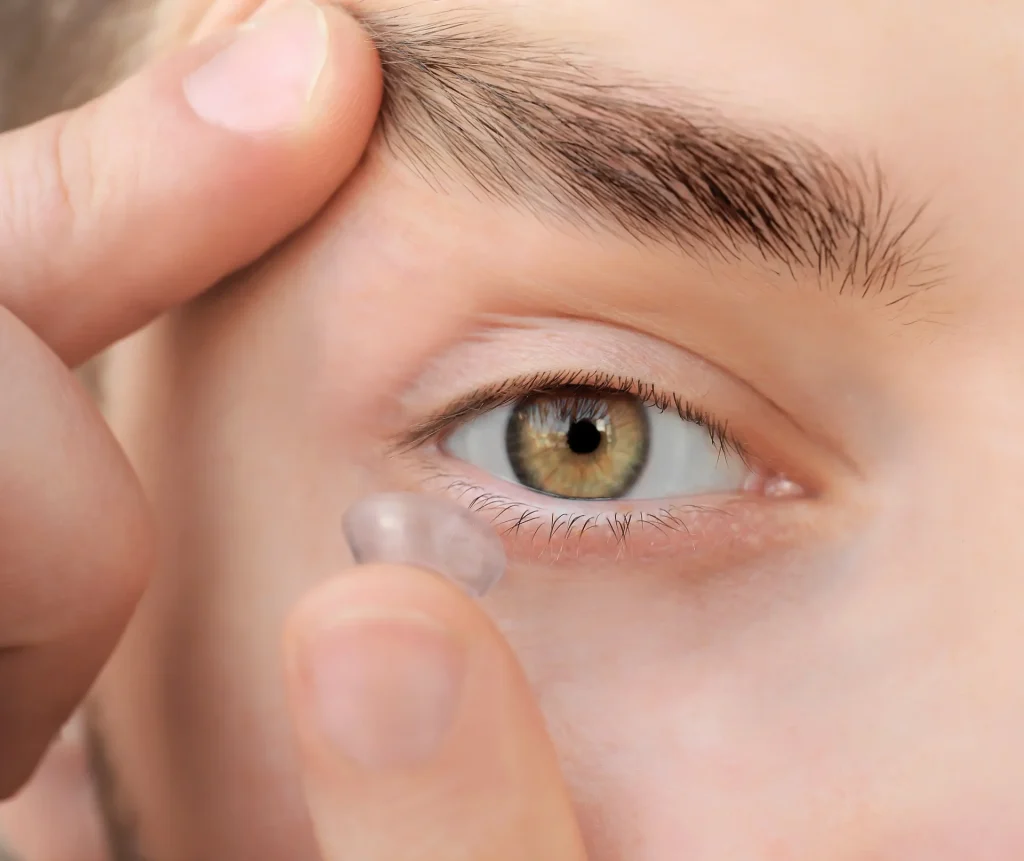
When removing hard contact lenses,
people pull the upper eyelid outward and blink.
Doing this over many years leads to levator aponeurosis dehiscence.3。
(= the tendon (levator aponeurosis) connecting the muscle that lifts the eyelid and the eyelid’s supporting framework (the tarsal plate) comes loose)
Blepharoptosis in RGP and PMMA hard contact lens wearers
Soft (disposable) contact lenses can also cause ptosis
It has been shown that soft contact lenses can also cause ptosis.4。
[A study of 35 people aged 18–50 in the Netherlands, 2002–2005]
Risk compared with people who do not use contact lenses (odds ratio):
Ptosis in hard contact lens wearers → 97.8 times
Ptosis in soft contact lens wearers → 14.7 times
Ptosis from soft contact lenses is less frequent than ptosis from hard contact lenses.
Contact lenses and ptosis: introducing the literature
Many studies also show a relationship between contact lenses and ptosis.5。
[An analysis (meta-analysis) of 5 papers that met the criteria, out of 393 papers previously published on “contact lenses and ptosis”]
Risk compared with people who do not use contact lenses (odds ratio):
Ptosis in hard contact lens wearers → 17.38 times (from 5 papers)
Ptosis in soft contact lens wearers → 8.12 times (from 1 paper)
The Risk of Blepharoptosis in Contact Lens Wearers
Difference in the cause of ptosis: hard versus soft
Regarding ptosis during contact lens wear,
the pathophysiology (how the condition arises) appears to differ between hard and soft contact lenses (including daily disposables).
○ Hard contact lenses:ptosis frommechanical stimulation
(the eyelid droops from being rubbed by the lens)
○ Soft contact lenses:ptosis frominflammatory change
(the eyelid droops as a result of allergic conjunctivitis caused by the lenses)
Why allergic conjunctivitis can lead to ptosis
When we look at the inner surface of the upper eyelid (the conjunctiva) of soft contact lens wearers, we sometimes find allergic inflammation.
• The lenses cloud up quickly
• Strong itching or discomfort while wearing lenses
If you have symptoms like these,
discharge from the inflamed conjunctiva often builds up on the lens and causes further inflammation, a vicious circle.
Depending on the condition, the eye doctor may need to stop contact lens wear and calm the inflammation on the inner surface of the upper eyelid (mainly with eye drops).
Because the conjunctiva and the levator aponeurosis lie very close together,
“inflammatory change in the conjunctiva during soft contact lens wear may contribute to ptosis through changes in the levator aponeurosis,”
which seems possible.
If ptosis persists, surgery becomes the only option.
Surgery is a burden, so we would like to avoid it as much as possible.
“I have worn hard contact lenses for years and don’t want to change now.”
→ Unlike in the past, there are now many kinds of good contact lenses, and you can choose one that suits your eyes.
Points to watch
○ Avoid pulling the upper eyelid as much as possible
Remove hard contact lenses using a dedicatedplunger.
When putting in or taking out soft contact lenses, touch only the lower eyelid as much as possible.
○ Pay attention to itching, discomfort, and other symptoms while wearing disposable soft contact lenses.
○ People with strong allergies should prefer daily disposable lenses over 2-week lenses.
○ Avoid rubbing your eyes as much as possible.
If you are concerned about your eyelid drooping from contact lenses,
please feel free to consult us.




(References)
1. Epstein, G., Putterman, A.M., 1981. Acquired Blepharoptosis Secondary to Contact-Lens Wear. American Journal of Ophthalmology 91, 634–639. https://doi.org/10.1016/0002-9394(81)90065-9
2. Fonn, D., Holden, B.A., 1986. Extended Wear of Hard Gas Permeable Contact Lenses Can Induce Ptosis. Eye & Contact Lens 12, 93.
3. Thean, J.H., McNab, A.A., 2004. Blepharoptosis in RGP and PMMA hard contact lens wearers. Clinical and Experimental Optometry 87, 11–14. https://doi.org/10.1111/j.1444-0938.2004.tb03139.x
4. Bleyen, I., Hiemstra, C.A., Devogelaere, T., van den Bosch, W.A., Wubbels, R.J., Paridaens, D.A., 2011. Not only hard contact lens wear but also soft contact lens wear may be associated with blepharoptosis. Can. J. Ophthalmol. 46, 333–336. https://doi.org/10.1016/j.jcjo.2011.06.010
5. Hwang, K., Kim, J.H., 2015. The Risk of Blepharoptosis in Contact Lens Wearers. J Craniofac Surg 26, e373-374. https://doi.org/10.1097/SCS.0000000000001876
(Addendum)
For orthokeratologyhard contact lenses, we always remove them with a plunger.