![Takeru Eye Clinic | Takatori Shopping Street, Sawara-ku, Fukuoka City [Nishijin Station / Fujisaki Station]](https://takeru-eye.com/wp-content/uploads/2022/10/takeru_logo_for-WP-header.png)

Hydroxychloroquine, the standard treatment for systemic lupus erythematosus and cutaneous lupus erythematosus, can cause retinal damage (hydroxychloroquine retinopathy) with long-term use.
There are no symptoms until the damage is quite advanced.
Complications of Drugs for Connective Tissue Disease: Chloroquine Retinopathy
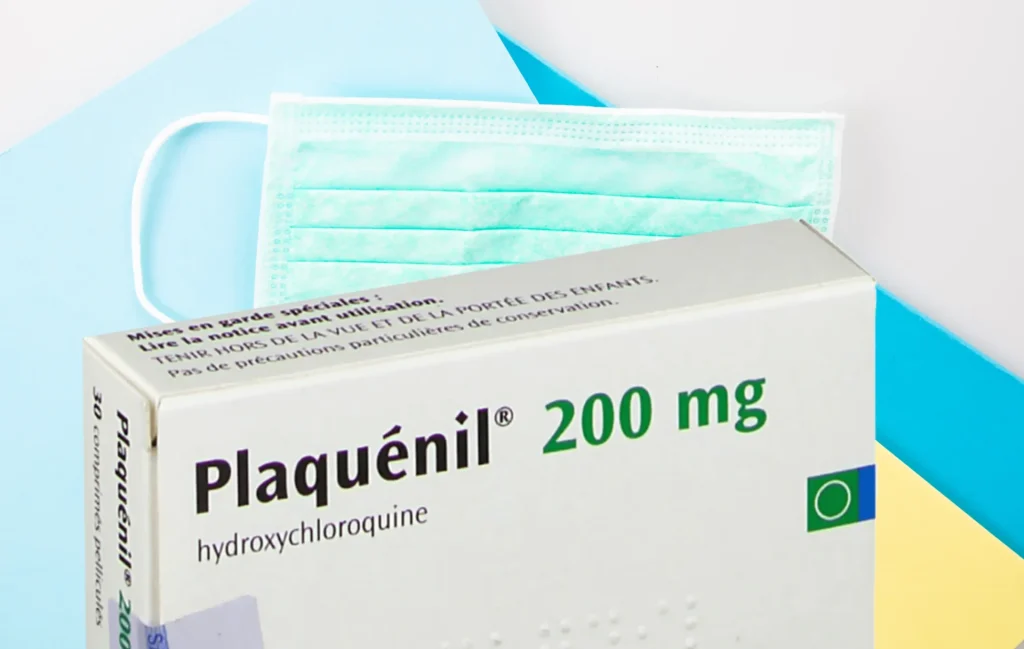
Hydroxychloroquine (HCQ): Plaquenil® (Sanofi K.K. → Asahi Kasei Pharma Corporation)
The American Academy of Ophthalmology has issued a retinopathy screening guideline based on 60 years of clinical experience1,2, and
drawing on it, the Japanese Ophthalmological Society has also issued the “Guidelines for the Appropriate Use of Hydroxychloroquine3”.
- When the drug is started, the examination is performed to confirm that the patient does not fall under the contraindications (a history of, or concurrent, retinopathy or maculopathy other than SLE retinopathy) and to accurately record the condition of the eyes before treatment.
- After the drug is started, eye examinations are performed regularly, at least once a year.
- Patients with the following risks of eye damage from this drug should be examined more often than once a year (for example, every six months, depending on the patient’s condition).
- Patients whose cumulative dose of the drug exceeds 200 g
- Older adults
- Patients with liver or kidney dysfunction; patients with visual impairment, patients with SLE retinopathy, and patients who develop abnormal findings on eye examination after starting the drug
“When the drug is given over a long period, these eye examinations should be performed at least once a year.”
We can perform all of the following examinations.
(They are all completed on the same day.)
- Visual acuity test
- Slit-lamp microscopy
- Eye pressure
- Fundus examination
- Color vision test
- SD-OCT (spectral-domain OCT)
- Visual field test (Humphrey® static perimetry: HFA 10-2 / HFA 24-2C)
- Fundus autofluorescence
✔ Before prescribing hydroxychloroquine
✔ At least once a year after prescribing hydroxychloroquine
The most important are the following.
We pay attention to changes in the central part of the retina (the macula).
✔ OCT: shows cross-sections of the retina
✔ Humphrey® visual field test: shows retinal sensitivity
Plaquenil® is a very effective drug for systemic lupus erythematosus, but its eye complication, “hydroxychloroquine retinopathy,” is greatly feared.
A yearly examination reliably prevents blindness.
(References)
1. Marmor, M.F., Kellner, U., Lai, T.Y.Y., Lyons, J.S., Mieler, W.F., 2011. Revised Recommendations on Screening for Chloroquine and Hydroxychloroquine Retinopathy. Ophthalmology 118, 415–422. https://doi.org/10.1016/j.ophtha.2010.11.017
2. Marmor, M.F., Kellner, U., Lai, T.Y.Y., Melles, R.B., Mieler, W.F., 2016. Recommendations on Screening for Chloroquine and Hydroxychloroquine Retinopathy (2016 Revision). Ophthalmology 123, 1386–1394. https://doi.org/10.1016/j.ophtha.2016.01.058
3. Kondo M, Shinoda K, Matsumoto S, Yokokawa N, Terasaki H. 2016. Guidelines for the appropriate use of hydroxychloroquine [in Japanese]. Nippon Ganka Gakkai Zasshi 120: 419–428.