![Takeru Eye Clinic | Takatori Shopping Street, Sawara-ku, Fukuoka City [Nishijin Station / Fujisaki Station]](https://takeru-eye.com/wp-content/uploads/2022/10/takeru_logo_for-WP-header.png)

I have started receiving the question, “Can I get cataracts from using my smartphone too much?”
After seeing the term “smartphone cataract” in online news and on social media, it seems that more people have become worried.
When I searched the literature,
scientific evidence that smartphone use directly causes cataracts had not been confirmed at present.
In fact, smartphones are not a cause of cataracts, and research has shown their potential use as a tool for detecting cataracts (Askarian et al. 2021).1。
Does “Smartphone Cataract” Exist? Understanding Early-Onset Cataract

Effects of digital devices on the eyes:
Digital Eye Strain (DES)
Many of the symptoms that make you think “this might be a cataract” may be temporary changes caused by the use of digital devices.
The main symptoms of digital eye strain (DES) include the following:2:
- Tired eyes
- Dry eye
- Temporary blurred vision
- Stiff shoulders and headache
- Progression of myopia (especially in children during growth)
Many of these symptoms can be expected to improve with appropriate usage habits and rest.
If necessary, a detailed examination at an eye clinic may be followed by a prescription of eye drops.
Digital Eye Strain (DES):“Smartphone presbyopia” is a similar condition.
Blue-light cut was not necessary.
The views are as follows.
- Digital eye strain is not caused by blue light.
- There is no basis for recommending that children wear blue-light-cut glasses, and wearing them may rather adversely affect development.
Cataract symptoms, on the other hand, tend not to improve even with rest and are characterized by gradual progression.
Actual Causes of Cataract

Cataracts are generally thought to be common in older people, but they can also develop in younger people.
A cataract occurs when the lens inside the eye becomes cloudy and light can no longer enter normally.
The following factors have been identified as the main causes of early cataract before the age of 40 (early-onset cataract):
- Poor management of underlying diseases such as diabetes and hypertension
- Chronic diseases such as atopic dermatitis
- Long-term use of steroid medications
- Eye injury or strong impact to the eye
- Metabolic diseases such as hyperparathyroidism and hyperthyroidism
- Genetic factors
- Occupations with long-term exposure to ultraviolet light, such as pilots
- Chronic exposure to radio waves or radiation
In congenital cataract, the cause may be a gene mutation or an infection of the mother during pregnancy (measles, influenza, rubella, and others).
Common Symptoms of Cataract
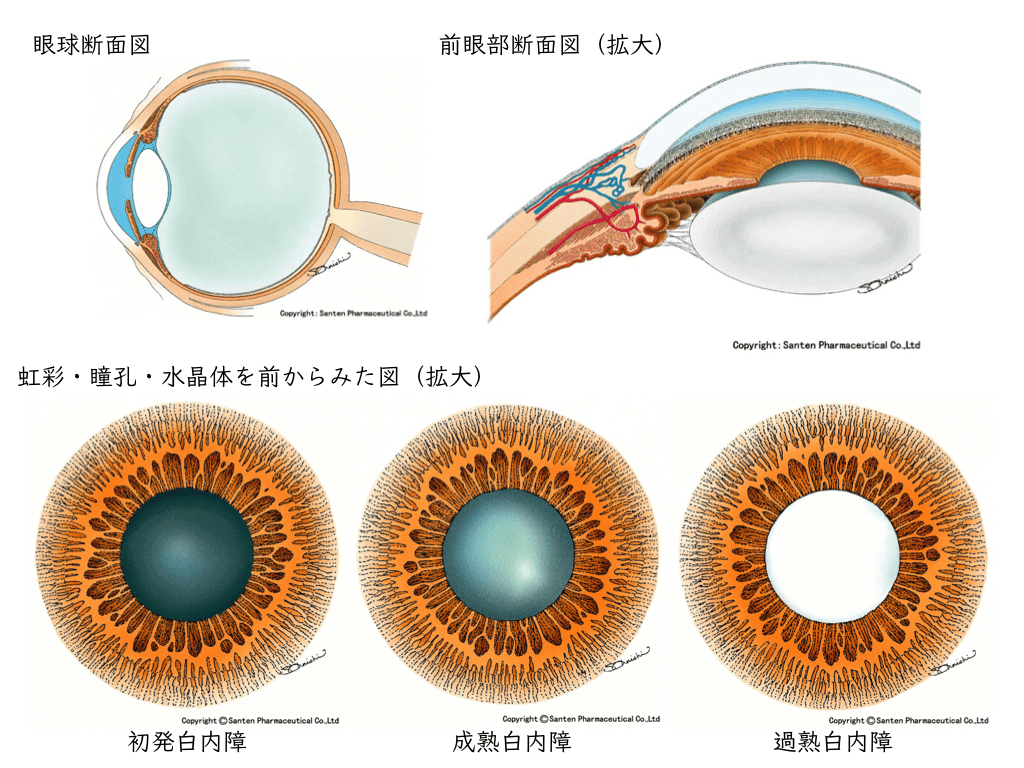
Changes in vision from a cataract have the following characteristics:
- Vision feels hazy or blurred
- Glare increases
- Vision takes on a yellowish tint
- Contrast decreases
- Vision at night becomes especially poor
These symptoms usually appear in both eyes, but may start in one eye.
Before Considering Cataract Surgery

Cataract surgery is an established treatment that restores visual function.
However, because it is a treatment that cannot be undone, it is recommended to consider the following points comprehensively when deciding on surgery:
- How much the current decline in vision affects daily life
- Changes in lifestyle after surgery
- After surgery, accommodation is lost, so more careful judgment is needed in cataract that develops at a young age
- After surgery, a sense of discomfort may continue
- The presence of other eye diseases (such as glaucoma and diabetic retinopathy)
- Age and general health
It is important to decide the best timing for surgery through sufficient consultation with the doctor, taking into account the patient’s lifestyle and the degree of inconvenience.
If there is no need to hurry with surgery, managing progression with regular follow-up is also one option.
Using Digital Devices Safely

Here are basic measures to protect eye health:
Basic rules when using devices

- 20-20-20 rule: every 20 minutes, look at something 20 feet (about 6 m) away for 20 seconds
- Keep the screen 30 to 40 cm from your eyes
- Adjust the screen brightness and contrast appropriately
Setting up the environment

- Keep the brightness of the room appropriate
- Adjust the position and angle of the screen
- Take regular breaks
If you look at near objects for an extremely long time, the eyes may stay turned inward (“crossed eyes”) and not return.
Eye Diseases: The Value of Early Detection

Changes in vision often progress gradually and are characterized by being hard to notice.
People in the following groups especially need to pay attention to changes in vision:
- People who use digital devices for long hours
- People with underlying diseases such as diabetes and hypertension
- People who feel blurred vision or discomfort in the eyes
- People with a family history of eye disease
It is important to cover one eye and look with the other.
References
- Askarian B, Ho P, Chong JW. Detecting Cataract Using Smartphones. IEEE J Transl Eng Health Med. 2021 Apr 20;9:3800110. doi: 10.1109/JTEHM.2021.3074597. PMID: 34786216; PMCID: PMC8580365. https://doi.org/10.1109/JTEHM.2021.3074597
- Pucker, A.D., Kerr, A.M., Sanderson, J., Lievens, C., 2024. Digital Eye Strain: Updated Perspectives. Clinical Optometry 16, 233–246. https://doi.org/10.2147/OPTO.S412382