![Takeru Eye Clinic | Takatori Shopping Street, Sawara-ku, Fukuoka City [Nishijin Station / Fujisaki Station]](https://takeru-eye.com/wp-content/uploads/2022/10/takeru_logo_for-WP-header.png)

Compared with a few years ago, the number of smartphone users has increased sharply.
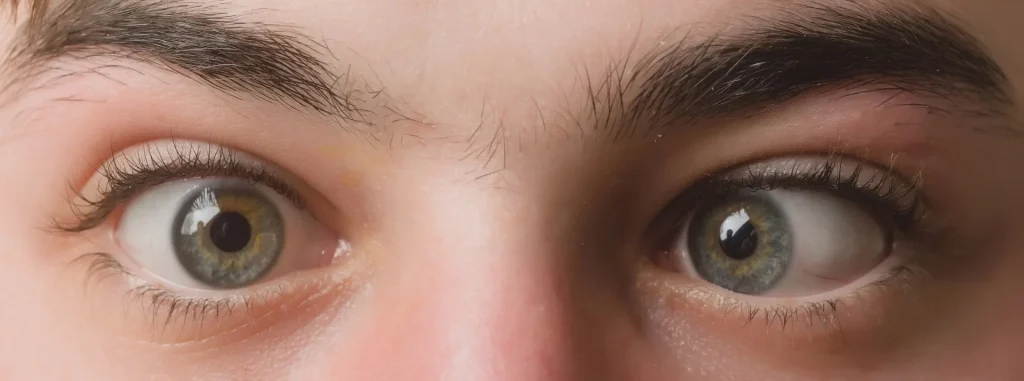
Overuse of smartphones and VDT work strains the muscles that turn the eyes inward (the medial rectus), causing the eyes to turn in (esotropia): “acute esotropia.”
How to treat smartphone esotropia:
If acute esotropia caused by long smartphone use does not go away, strabismus surgery may be needed.
Surgery is a heavy burden.
When looking at near objects, the eyes converge and the focusing muscle is tense (convergence / accommodative tension from the ciliary muscle).
People with “good eyesight” who see far well in particular have strong accommodative tension.

“Smartphone Esotropia”
(Eyes turning inward from overuse of smartphones)
“Acute esotropia”:
Acute acquired comitant esotropia (AACE) has been a disease concept for 30 years, but was considered rare.1。
This introduces a paper from Chonnam National University in Korea.2。
Smartphone use rose from 5.8% in 2010 to 36.2% in 2011,
and by 2013, 81.5% of people used smartphones.
A study of 12 patients from the 2009–2014 records of the pediatric ophthalmology department at Chonnam National University:
○ Age 7–16 years: mean 13.33 (±3.31) years.
○ They came in a mean of 5.83 (±2.89) months after onset.
○ Smartphone use averaged 6.08 (±1.78) hours a day, for 10.5 (±5.13) months.
○ All patients used smartphones at a distance of 30 cm or less.
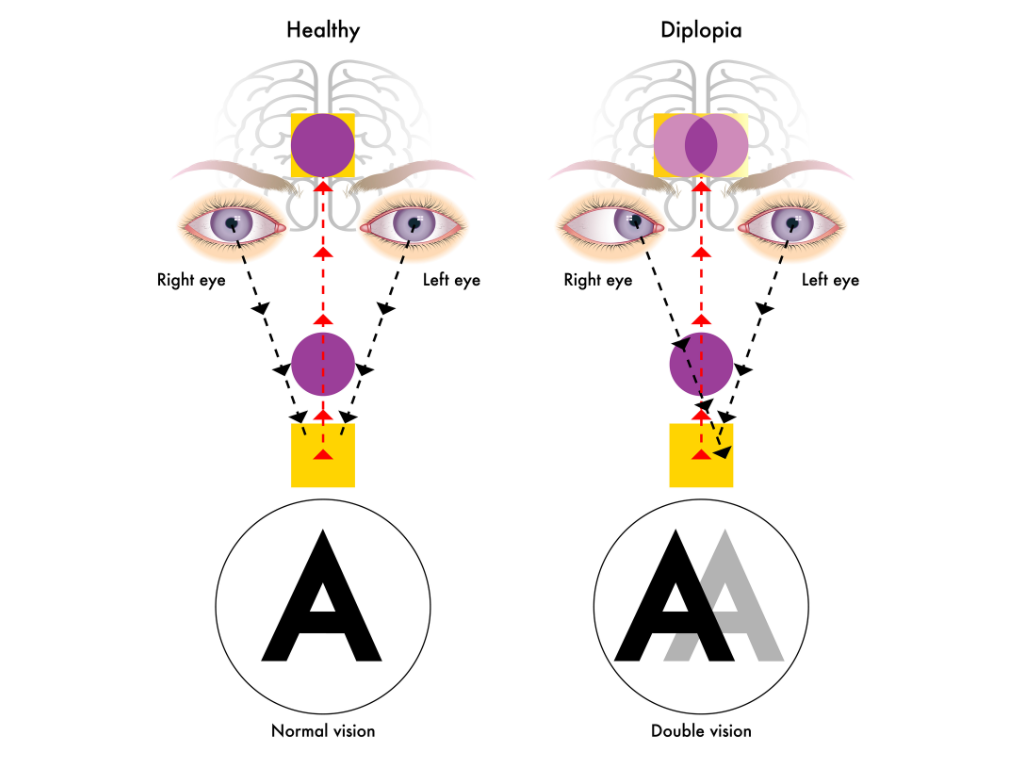
○ 9 had horizontal diplopia (double vision).
○ Of those, 5 sometimes had diplopia when looking far.
○ None had a serious impairment of daily life.
✔ Limiting smartphone use improved the esotropia in all patients.
✔ For the 5 patients with residual esotropia after limiting use, strabismus surgery was recommended, and 3 underwent surgery, with improvement of the esotropia.
* Because there are still few cases, more evidence needs to be accumulated. (from the same paper)
Acute acquired comitant esotropia (AACE)
(1) Swan type:
esotropia due to the disruption of fusion (precipitated by monocular occlusion or loss of vision in one eye);
Esotropia with loss of stereopsis
Covering one eye brings relief / one eye is not seeing (suppression)
(2) Burian-Franceschetti type:
esotropia characterized by minimal hypermetropia and diplopia, often associated with physical or psychological stress;
Esotropia characterized by hyperopia and diplopia, often occurring in people under physical or mental stress
(3) Bielschowsky type:
esotropia that occurs in adolescents and adults with varying degrees of myopia, and shows equal deviation at distance and near fixation
Esotropia occurring in adolescents and adults
Mild to high myopia, with the two eyes balanced the same when looking far and near
Examination and Treatment of Smartphone Esotropia
In the examination for smartphone esotropia,orthoptistsevaluate eye alignment through the following steps.
Examination steps
- Medical interview
First, the orthoptist asks in detail about the patient’s visual symptoms and smartphone use.
We confirm how long the patient uses the smartphone, when the symptoms began, and what symptoms they have. - Visual acuity test
Next, a basic visual acuity test is performed.
This is a very important test to check that the decrease in vision is not related to other visual abnormalities. - Eye alignment test / evaluation of the eye muscles
The orthoptist closely observes the position and movement of the patient’s eyeballs.
This evaluation of the eye muscles confirms whether eye movement is normal.
The eye alignment test is important for identifying the type of strabismus, such as exotropia or esotropia.
We track the movement of the eyes as the patient looks at a specific target,
and take photographs of the eyes in 9 directions (up, down, left, right, straight ahead, and diagonals).
We use the 9Gaze app:
https://apps.apple.com/jp/app/9-gaze/id1173442389?l=en-US - Evaluation during smartphone use
To evaluate eye alignment while the patient is actually using a smartphone, we have the patient operate the smartphone in the usual way. At this time, we check for changes in eye movement and position. - Additional vision tests
If necessary, we may perform more detailed tests of visual function. Examples include tests of stereopsis and depth perception, and evaluation of the visual field.
Coping with and Treating Smartphone Esotropia
1. Limiting smartphone use time
We recommend limiting smartphone use time and taking regular breaks.
Practicing the “20-20-20 rule,” looking at something far away for about 20 seconds every 20 minutes, is effective.
2. Fitting appropriate glasses or contact lenses
If needed, we consider appropriate prescription of vision correction devices such as glasses and contact lenses.
We use an accommodation analyzer (Accommoref).
3. Improving the environment
It is also important to improve the environment in which the smartphone is used.
This includes appropriate lighting, adjusting screen brightness, and keeping a distance from the screen.
We recommend turning off smartphone notifications.
4. Other treatments
When the strabismus is severe or does not improve, surgical treatment, “strabismus surgery,” may be considered.
References
1.Clark, A.C., Nelson, L.B., Simon, J.W., Wagner, R., Rubin, S.E.. Acute acquired comitant esotropia. Br J Ophthalmol. 1989 Aug; 73(8): 636–638.
2.Lee, H.S., Park, S.W., Heo, H., 2016. Acute acquired comitant esotropia related to excessive Smartphone use. BMC Ophthalmol 16.
https://doi.org/10.1186/s12886-016-0213-5
» “The Effects of Digital Devices on Children and Young People”