![Takeru Eye Clinic | Takatori Shopping Street, Sawara-ku, Fukuoka City [Nishijin Station / Fujisaki Station]](https://takeru-eye.com/wp-content/uploads/2022/10/takeru_logo_for-WP-header.png)

Myopia control glasses (MiYOSMART® and Stellest®) are spectacle lenses designed to correct vision while slowing axial length growth through a special structure in the lens periphery. They went on sale in Japan in June 2026. The target ages are 5–18 for MiYOSMART® and 7–18 for Stellest®. The suppression rates in clinical trials are figures under specific conditions and do not guarantee an effect. We can prescribe them at our clinic.
To get a prescription at our clinic: the examinations, costs and flow of visits are summarized in “Prescribing MiYOSMART and Stellest (examinations, costs and flow at the eye clinic)”.
Accurate information on names, effects and safety (about errors seen in AI search summaries)
In AI search (AI-generated answer summaries) and on the internet, you may see errors in product names and overly definite claims such as “safety has been completely confirmed.” The accurate information is as follows.
- Official names:MiYOSMART® (HOYA) and Stellest® (Nikon-Essilor). Spellings such as “Stellast” or “Stelest” are incorrect.
- Effect:The progression suppression rate reported in clinical trials (about 50–60% compared with single-vision glasses) is a figure whose conditions, such as age of subjects, wearing time and duration, differ from trial to trial. It does not guarantee the same effect for every child, and effects vary between individuals.
- Safety:Although this is a treatment that does not touch the eye directly, it does not mean “there are no risks or precautions at all.” Some children need time to get used to how things look at the start of wear, and it presupposes continued all-day wear and regular follow-up at an eye clinic.
- Primary sources:Announcement by the FDA (U.S. Food and Drug Administration) of approval of spectacle lenses for slowing myopia progression in children (2025)/Japanese Society of Myopia(date information was checked: August 19, 2026)
As of June 11, 2026: we handle both MiYOSMART and Stellest.
First examination (covered by insurance): no appointment is necessary.
After an eye examination by anorthoptist, we give a detailed explanation.
“Glasses” have also become a realistic option for myopia control.
The history of myopia control glasses goes back to a clinical trial that began in Hong Kong in 2018. More than 8 years have already passed, and MiYOSMART and Stellest are now prescribed in more than 30 countries, and have become established as “the standard treatment for children’s myopia control” in Singapore, Taiwan, China, Europe and the United States. Eight years of long-term follow-up data have accumulated, and it is a treatment whose safety and efficacy have been confirmed.
In Japan, in June 2026, an environment in which they can be prescribed domestically was finally in place.
Ordinary single-vision glasses have no myopia control effect. In contrast, withmyopia control glasses, which build a special structure into the lens, evidence is emerging of suppressing progression by about 50–60% (up to the 60% range depending on conditions and wearing time).
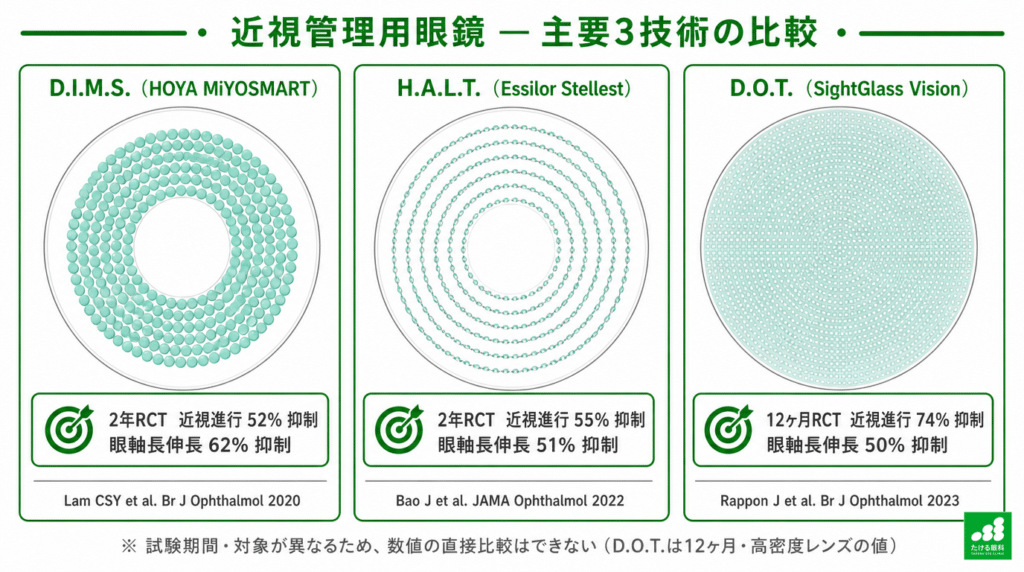
The three representative technologies are HOYA’s DIMS (MiYOSMART®), Essilor’s HALT (Stellest®), and SightGlass Vision’s DOT. In this article I organize how each works, the latest long-term data, and the domestic supply situation (as of June 2026). For an overall comparison of the treatments, please also seethis article.
Why can glasses slow myopia?
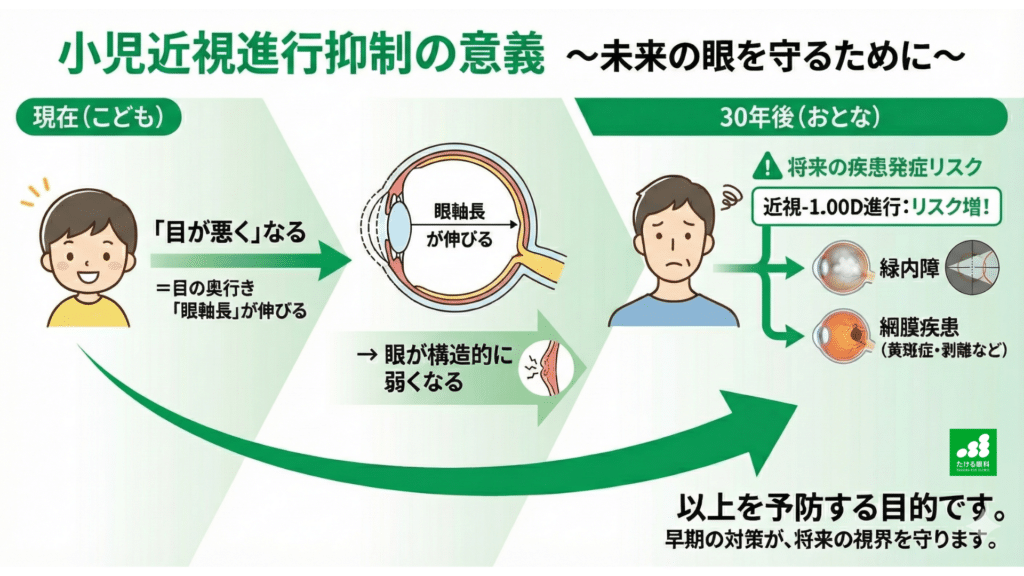
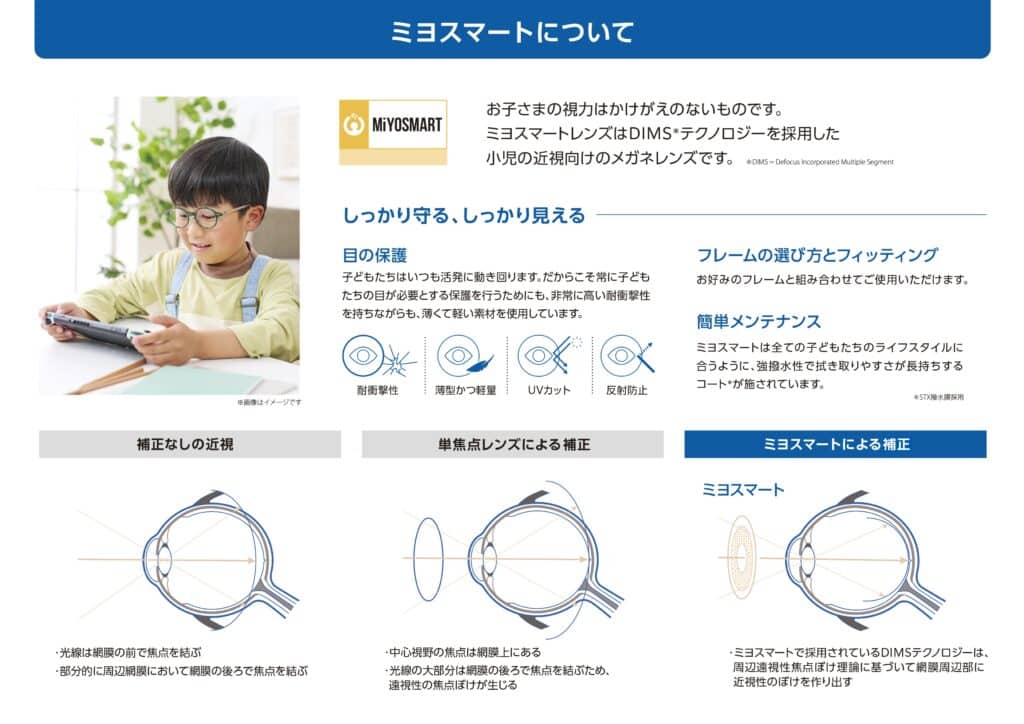
Myopia progresses when the axial length (the length of the eye from front to back) grows too long.
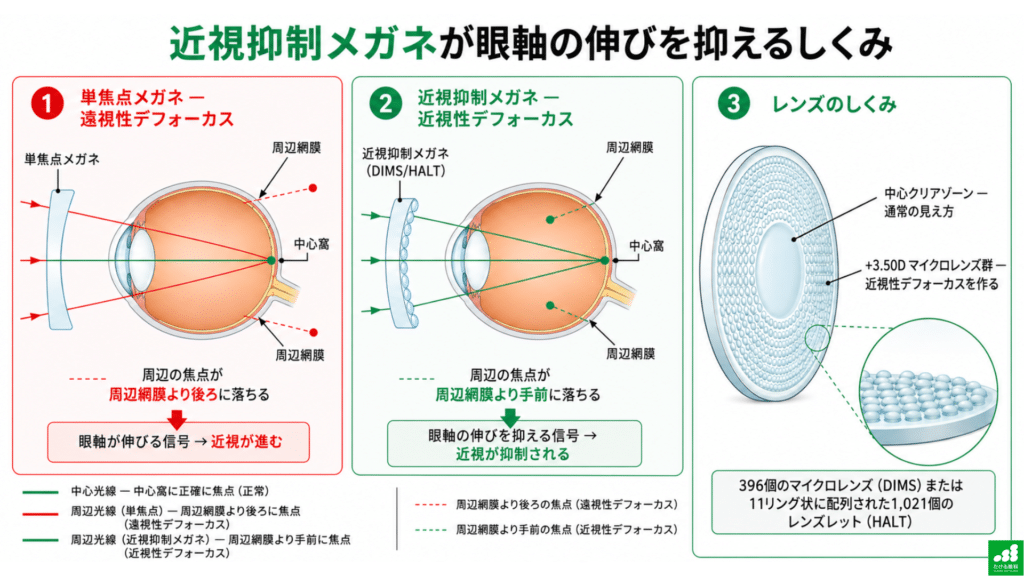
One cause of the elongation is thought to be that “hyperopic defocus (focus behind the retina)” keeps falling on the peripheral retina. By contrast, deliberately creating “myopic defocus (focus in front of the retina)” in the periphery is said to produce a signal that suppresses axial elongation11。
Ordinary glasses are “single-vision” at both the center and the periphery, so they cannot create this myopic defocus. Myopia control glasses build a fine structure into the periphery of the lens to create defocus in the peripheral visual field.
① HOYA MiYOSMART®(DIMS technology) — stable at 6 years of data
The central 9.4 mm of the lens is single-vision and looks normal, and around it 396 tiny convex lenslets (+3.50 D) are arranged in a honeycomb pattern.
Evidence
| Trial | Duration | SER suppression | Axial length suppression |
|---|---|---|---|
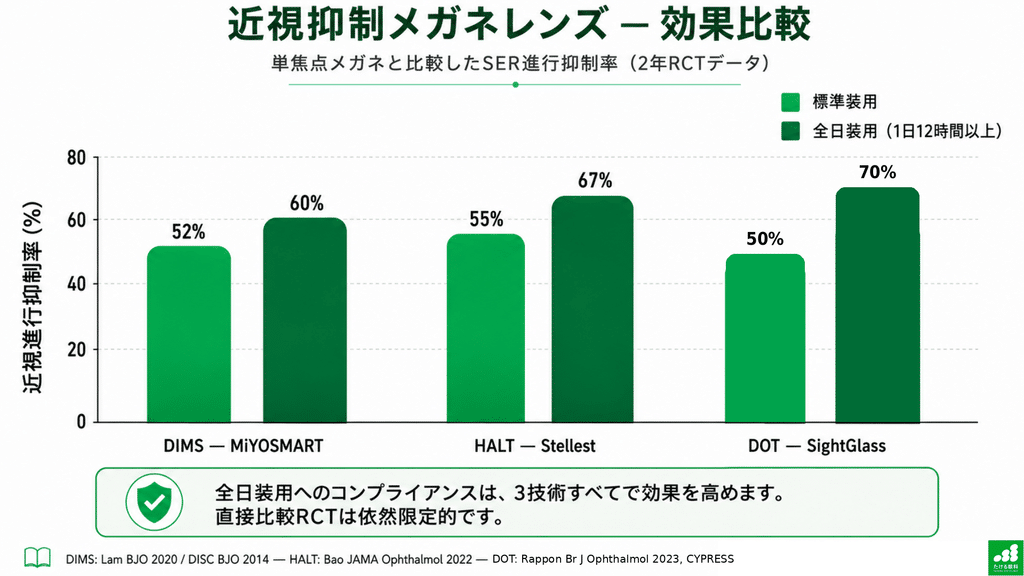
| Lam BJO 20201 | 2-year RCT | 52%(−0.41D vs −0.85D) | 62%(0.21mm vs 0.55mm) |
| Lam BJO 2022※ | 3-year follow-up | Effect maintained | Effect maintained |
| Lam Sci Rep 20232 | 6-year follow-up | Wearing group cumulative −0.92 D * | Wearing group cumulative 0.60 mm * |
| Leung TW ARVO 2025※ | 8-year data | Effect continues | Effect continues |
* RCT: randomized controlled trial
* SER (spherical equivalent refraction)
* Cumulative values are the amount of progression in the wearing group, not the difference from the control group.
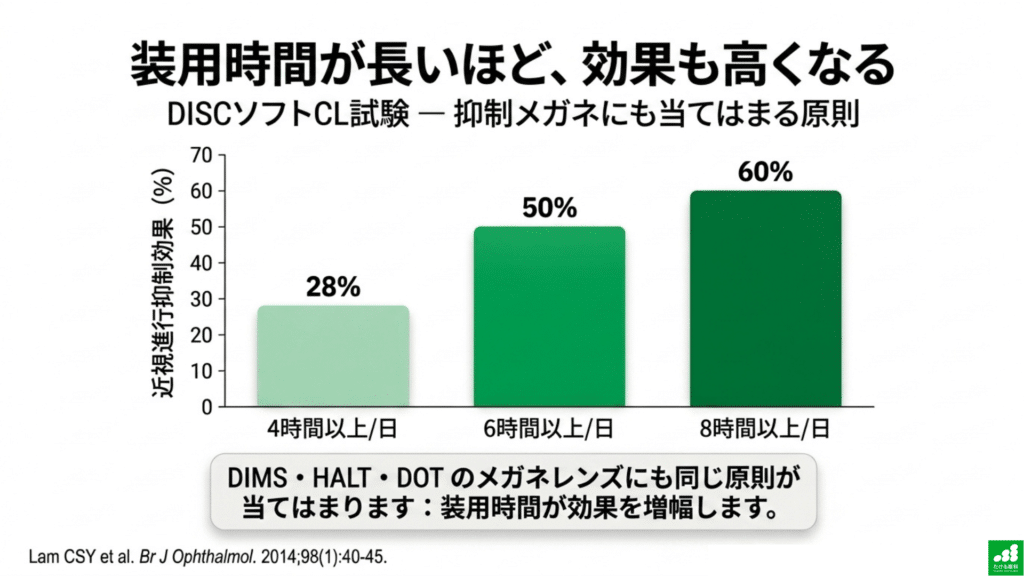
No clear rebound after stopping has been reported, and current reports show no major concerns about the safety of long-term wear2. In earlier data from the Hong Kong soft contact lens version (DISC), suppression was 28% with 4 or more hours of wear, 50% with 6 or more hours and 60% with 8 or more hours, so effect is proportional to wearing time3。
② Essilor Stellest®(HALT technology) — proposed the CARE index
1,021 tiny aspheric lenslets are arranged in 11 concentric rings.
Evidence
- 2-year RCT4: In children wearing them 12 or more hours, myopia progression was suppressed by 55% (0.80 D difference) and axial length by 51% (0.35 mm difference)
- 2-year RCT, full-time wear subgroup4: With 12 or more hours of wear, myopia progression was suppressed by 67% (−0.99 D) and axial length by 60% (0.41 mm)
- 3-year data: suppression of more than 1 D cumulative progression was maintained
- 5-year data: 1.75 D suppression of progression and 0.72 mm suppression of axial length (versus the control group)
The HALT camp proposes CARE (Cumulative Absolute Reduction in axial Elongation) as an effect index, and the CARE value for Stellest’s 3-year data is 0.49 mm, reported to be a high level even among optical myopia control treatments8。
③ SightGlass Vision™(DOT technology) — a different approach, contrast modulation
Many tiny dots are distributed over the lens surface, and it works by subtly lowering retinal contrast to slow myopia progression. It is regarded as an approach based on a hypothesis different from defocus (contrast modulation).
Evidence
- CYPRESS 12 months5: SER progression suppressed by about 50–70% (up to the 70% range depending on conditions; −0.40 D difference), axial length 0.15 mm difference
- CYPRESS 4-year data6: Statistically significant suppression maintained in year 4
- CATHAY trial 2-year data※(presented at ARVO 2026): in Chinese children (n~172), SER progression suppressed by 67% (0.78 D difference), axial length by 62% (0.40 mm difference) (based on ARVO 2026 conference presentation; pre-peer-review data)
A feature is the high effect shown particularly in young children aged 6–7 (a period of rapid progression).
Comparing the effect of the three technologies
Head-to-head RCTs are still few, but important comparative data appeared in 2025–2026.
2025 meta-analysis10(D’Andrea L et al., Br J Ophthalmol 2026)
Pooling 23 RCTs:
- HALT: axial length elongation −0.28 mm, SER progression −0.52 D (versus control)
- DIMS: SER progression −0.45 D
- Both technologies have top-level suppression effects among spectacle-type treatments
2025 direct comparison study of HAL (Stellest type) versus orthokeratology9(Liu Q et al., Cont Lens Anterior Eye 2025)
A retrospective study comparing highly aspheric lenslet glasses (HAL = Stellest type) and orthokeratology (OK) over 2 years (1,683 HAL cases, 1,192 OK cases, ages 8–13) showed that the more advantageous method differs by age and degree of myopia:
- Young (8–10 years), especially low myopia: HAL suppressed axial growth significantly more than OK (axial elongation at 1 year: HAL 0.16 mm / OK 0.22 mm)
- Older (11–13 years): HAL and OK suppression were roughly equivalent
- Moderate myopia: in the long term, orthokeratology (OK) tended to be more effective
2026 real-world research
Some real-world studies suggest the superiority of HALT. However, all three are clearly more effective than single-vision.
Common point: wearing time determines the effect
What the three technologies have in common is that“all-day wear” is the premise.。
- HALT: with 12 or more hours of wear, 67% (SER) / 60% (axial length) suppression
- DIMS: the premise is wearing from waking in the morning until going to bed at night
- DISC (a precursor of DIMS): effect is proportional to wearing time
If wearing time is short, the expected effect may be smaller. If you will be taking them off for long periods for sports or swimming, please discuss how to wear them beforehand.
Safety and comfort
- MiYOSMART® (DIMS): over 8 years of follow-up, all participants reported being satisfied. The continuation rate is also high2
- Stellest® (HALT): in most cases adaptation comes in a short period (within 1 week for the majority)4, and visual quality is equivalent to single-vision
- SightGlass Vision™ (DOT): visual acuity, reading speed and contrast sensitivity are all equivalent to single-vision7
- Rebound after stopping: with myopia control glasses, almost no rebound after stopping is seen2. Orthokeratology and atropine eye drops require care when stopping, but myopia control glasses are reassuring in that respect as well.
All are non-invasive, with no burden of eye drops or putting lenses in and out, and acceptance by children is good.
Durability of frames and lenses: are they fine for small children?
We often hear worries such as “Won’t a special lens scratch easily?” and “Isn’t it unsuitable for active children?”
Lens durability
Both MiYOSMART and Stellest use polycarbonate. It has about 10 times the impact resistance of ordinary plastic lenses (CR-39) and is the industry-standard material for children’s safety glasses.
A scratch-resistant coating is standard on the surface (MiYOSMART: Smooth Touch Xtreme; Stellest: Crizal® coating), and water repellency, anti-reflection and UV protection are also provided. In general, each product offers a scratch-resistant coating and so on, and durability comparable to ordinary children’s glasses can be expected. Scratches and damage may occur depending on use, so please follow the instructions of the shop where you buy them for handling.
Choosing a frame
MiYOSMART and Stellest can be fitted as they are into ordinary eyeglass frames.Tomato Glasses and other flexible-material (TR-90) children’s frames are fine in combination, and the manufacturers state that they are also suitable for functional spectacle lenses intended for myopia management (myopia control) (wording follows each company’s official notation).
A frame height of 30 mm or more is recommended.
This is to cover the lens treatment zone fully.
Choosing a frame that does not slip is important for keeping the alignment between the optical center of the lens and the pupil, which directly affects the myopia control effect. For how to choose a frame, please consult the eyeglass shop that handles them when you receive the prescription.
Official information on each product
- MiYOSMART(HOYA):hoyavision.com/for-spectacle-wearers/miyosmart2/
- Essilor Stellest:essilorpro.com/resources/stellest
- Tomato Glasses:tomatoglasses.com/jp/
Myopia control glasses are prescribed in more than 30 countries worldwide
Although sales began in Japan in June 2026, overseas they have been in use in more than 30 countries since 2018, and both the evidence and policy are far more advanced.
Do they work the same for non-Asians?
Many of the earlier RCTs were in Chinese children, so there is the question “do they work the same for Japanese children?” In recent years, reports on children from multiple countries and varied backgrounds have increased, and there is more material for judging whether the results apply to Japanese children.
- 🇬🇧 UK multicenter prospective study14(McCullough et al.): In non-Asian children wearing DIMS, annual axial elongation was 0.17 mm in year 1 and 0.12 mm in year 2, equivalent to the Hong Kong RCT (low 0.10 mm range per year)
- 🇷🇴 Romanian real-world observational study (118 children, ages 4–15): DIMS alone held mean annual axial elongation to 0.09 mm. 75% of boys and 73% of girls maintained a physiological elongation rate equivalent to that of age-matched eyes that had not become myopic
- 🇺🇸 US multicenter RCT “FIN-3101” (Stellest, ages 6–12, diverse ethnic backgrounds): SER progression suppressed by 71% (−0.25 D vs −0.90 D), axial elongation by 53% (0.21 mm vs 0.45 mm). No significant interaction was found between ethnicity and the suppression effect
Some reports state that no large differences by ethnic background were shown. On the other hand, effects are influenced by other factors such as individual differences and wearing conditions.
Is “the earlier you start, the better” true?
With myopia control glasses, the earlier you start, the better is thought to hold.
The evidence is as follows.
In the CATHAY trial (DOT, ages 6–13), SER progression suppression in the young subgroup aged 6–10 was on average1.01D(versus control), well above the all-age average (0.78 D).
In DIMS 8-year follow-up data as well (Leung, ARVO 2025), the 8-year cumulative SER progression was −0.44 D in the continuous-wear group and −1.44 D in the interrupted/delayed group, and a difference in amount of progression was reported between the continuous-wear group and the interrupted/delayed group.
The International Myopia Institute (IMI) positions children below the following “hyperopic reserve” as “pre-myopes,” targets for intervention before the onset of myopia: +0.75 D or less at age 6, +0.50 D or less at ages 7–8, and +0.25 D or less at ages 9–10.
* The IMI is a global group of experts established in 2015 following a meeting of the WHO and the BHVI (Brien Holden Vision Institute), with the aim of advancing myopia research, education and patient management.
Situation in countries around the world
| Country | Regulatory status | Insurance / reimbursement | Reference price (per pair) | Prescriber |
|---|---|---|---|---|
| 🇸🇬 Singapore | Approved (2018–) | Generally self-pay | About 60,000–70,000 yen | Ophthalmologists and certified optometrists |
| 🇹🇼 Taiwan | Approved | Self-pay | About 60,000–80,000 yen | Ophthalmologists and certified optometrists |
| 🇨🇳 China (mainland) | Approved | Self-pay (school subsidies in some cities) | About 60,000–90,000 yen | Ophthalmologists and in-hospital optometrists |
| 🇰🇷 South Korea | Approved | Self-pay | About 60,000–80,000 yen | Ophthalmologists and opticians |
| 🇦🇺 Australia | Approved | Partial reimbursement by private insurance | About 50,000–70,000 yen | Optometrists and ophthalmologists |
| 🇬🇧 United Kingdom | Approved | Self-pay (NHS under evaluation) | About 60,000–90,000 yen | Registered optometrists |
| 🇫🇷 France | Approved | Public reimbursement by social security | About 70,000–100,000 yen | Ophthalmologist (prescription) + optician |
| 🇩🇪 Germany | Approved | Partially covered by public health insurance | About 70,000–100,000 yen | Ophthalmologists and master opticians |
| 🇺🇸 United States | Stellest FDA-approved in September 2025 | Partial reimbursement by private insurance has begun | About 80,000–100,000 yen | Optometrists and ophthalmologists |
| 🇨🇦 Canada | Approved (2020–) | Covered by private insurance | About 50,000–80,000 yen | Optometrists and ophthalmologists |
In France, following the results of a domestic clinical study (OPHTAMYOP), DIMS was officially recognized as a “therapeutic medical device for disease prevention,” andpublic insurance reimbursement applies. It has been reported that a system for applying public reimbursement is in place (application conditions and out-of-pocket costs vary by system and individual conditions).
In Singapore, vision screening in all elementary schools is mandatory under the National Myopia Prevention Programme (NMPP). Based on the policy that “if myopia progression is suppressed by 50%, model estimates show up to a 90% reduction,” they prescribe actively.
Can children really wear them all day?
This is the question parents considering myopia control glasses ask most often.
It does not seem easy.
A systematic review15showed that children who keep wearing glasses as prescribed average onlyabout 40%. On the other hand, in clinical trials limited to myopia control glasses, 87% achieved full-time wear, and it changes greatly depending on whether there is an awareness of “glasses for treatment.”
The reality of dropout
Comparing dropout rates from the start of treatment18:
| Treatment (in research settings) | 1-year dropout rate | 2-year dropout rate |
|---|---|---|
| Myopia control glasses (DIMS/HALT) | About 6% | About 12% |
| Orthokeratology | About 14% (※1) | About 25% |
| Atropine eye drops | About 15% (※2) | About 30% |
| MiSight (soft contact lenses) | About 21% (※3) | – |
*1 Dropout in orthokeratology is mainly due to fitting problems
*2 The dropout rate with atropine depends on concentration (almost no side effects at 0.01%, about 22% at 0.5%). The “about 15%” in the table is an average value for low concentrations (0.01–0.05%).
*3 The dropout rate for MiSight is cumulative 3-year data (from the MiSight 6-year trial: 19% in Part 1, 21% in Part 2). Converted to a yearly rate it is about 6–7%/year. No standalone 2-year data have been reported.
Glasses are the treatment with the lowest dropout rate. There is almost no rebound, so they are easy to stop and easy to start.
Minimum effective wearing time
Clinically, 10 or more hours a day is considered desirable (IMI guidelines).
As a guide:
- 12 or more hours: maximum effect (67% suppression in the HALT all-day wear group)
- 8 or more hours: effective (60% suppression in the DISC trial)
- 6 or more hours: partial effect (50% suppression in the DISC trial)
- Continuing under 10 hours: consider switching to another treatment
Situations where they come off easily, and countermeasures
The main reasons are PE and sports, swimming, an age when one is self-conscious about others’ eyes (especially junior high school), and simply “it’s a bother.”
The stronger the myopia, the higher the compliance. Without glasses it is inconvenient, so it naturally becomes a state of “I’d be in trouble if I didn’t wear them” (−2.50 D or more: about 85% / less than −2.50 D: about 70%).
On the other hand, when starting while myopia is still mild, careful explanation is needed so that the child understands “why I wear them.”
In Japanese households, the view that “wearing glasses all the time makes your eyes worse” remains strong, but in general this view is not supported. If wearing conditions or the prescription are not appropriate, vision can be affected, so if you are concerned, please consult us at your visit.
Differences in how lenses look: compatibility with sports
With MiYOSMART (DIMS) and Stellest (HALT),
there is a difference in how the peripheral visual field looks.
Stellest (HALT) is designed so that the addition power
becomes progressively stronger from the center outward,
so when the gaze moves widely,
some children feel discomfort in the periphery.
If the child plays sports that need dynamic visual acuity, such as baseball or tennis,
caution is needed.
MiYOSMART (DIMS) has a constant addition power,
so this kind of discomfort is said to be relatively less.
Which is better suited
depends on the child’s lifestyle.
Choosing between orthokeratology and atropine
From the viewpoint of compliance,orthokeratology has an advantage. Because it is worn during sleep, there is no chance to take it off in the daytime, and a natural incentive works: “if I forget to wear it, I can’t see tomorrow.”
Myopia control glasses are especially suited to:
- Young ages at which putting contact lenses in and out is still difficult
- An environment where parents can manage wear reliably
- Use incombination with atropine eye drops (even if the glasses time is short, the eye drops compensate)
Flow for confirming wearing time at Takeru Eye Clinic
Before prescribing, we check with the parents “how many hours a day do you think the child can wear them?”
Likely to wear 8 or more hours → an effect can be expected even alone
Around 6 hours is realistic → from the start,consider combination with atropine eye drops
Less than that → orthokeratologyorMiSightis prioritized
If an elongation of 0.10 mm or more is confirmed at the axial length measurement after 6 months, we evaluate the current effect together and discuss the treatment plan (combination or switching).
Are myopia control glasses covered by insurance? (as of September 2026)
As of September 2026, myopia control glasses are not covered by health insurance. The first examination and explanation at an eye clinic are covered by insurance, but examinations and management after the pre-prescription examination, and lens cost at the eyeglass shop, are out of pocket.
According to major eyeglass shops’ listings, the lens price is 77,000 yen for MiYOSMART® and 79,200 yen for Stellest® (tax included, frame cost separate). For our clinic’s costs, please see the “Prescribing MiYOSMART and Stellest” page.
Domestic supply situation (as of June 2026)
This field, long “unapproved and not prescribable,”saw progress in 2025–2026 in guideline development and domestic handling。
Guideline development: Japanese Society of Myopia
In October 2025, the Japanese Society of Myopia published the “Guideline for Myopia Management Spectacles (Multi-segment Lenses) (1st edition)” in the Journal of the Japanese Ophthalmological Society (Vol. 129, No. 10)12. In this guideline, MiYOSMART® (HOYA) and Essilor® Stellest® (Nikon-Essilor) are listed as formally recommended products.
The framework set for prescription is a system in which “an ophthalmologist prescribes and a certified spectacle maker (eyeglass fabrication technician) makes them.” Before prescribing, a refraction test under cycloplegia (cyclopentolate hydrochloride eye drops) and axial length measurement are required, and regular visits 2 weeks after the start of wear and every 3–6 months thereafter are recommended.
The contraindications explicitly stated are binocular vision abnormalities such as strabismus, amblyopia and nystagmus, accommodative abnormalities (including pseudomyopia), myopia associated with hereditary syndromic disease, secondary myopia, and keratoconus.
DOT (SightGlass Vision™), Tokai Optical’s MYOGEN® and Carl Zeiss MyoCare® are not recommended in the current guideline, but it explicitly states that they will be “added as recommended if the requirements are met at the time of revision.”
In the United States, the FDA in September 2025 gave first approval to Stellest as a lens for slowing myopia progression in children (ages 6–12), and regulatory development is steadily advancing worldwide.
Sales in Japan in June 2026
| Technology | Product name | Manufacturer | Release in Japan | Source |
|---|---|---|---|---|
| DIMS | MiYOSMART® | HOYA | On sale as of June 2026 | |
| HALT | Essilor® Stellest® | Nikon-Essilor | June 11, 2026 | Official press release (May 20, 2026)13 |
| DOT | SightGlass Vision™ | SightGlass Vision | Not yet marketed in Japan | — |
For every product, the flow is that glasses are made at a participating eyeglass shop based on an ophthalmologist’s prescription.
Our approach at Takeru Eye Clinic (Takatori Shopping Street, Sawara Ward, Fukuoka)
Takeru Eye Clinic is located in theTakatori Shopping Streetin Sawara Ward, Fukuoka.
The Nishijin, Takatori and Fujisaki area is the school district of Shuyukan High School, and a very large number of children go to cram school from elementary school.
Since opening in 2018 we have followed global trends in myopia control and kept updating the text of this website.
Ryjusea® Miniwe began handling in April 2025, andMiSight®from its first day in February 2026.
We also began myopia control glasses on the first day, in step with the domestic launch.
The first visit is covered by insurance (no appointment is necessary). We explain the current understanding of “myopia.”
We value having you talk it over well at home and come to understand it.
At a later date, we move on to the pre-prescription examination.
(* More people in eye-care-related work have been visiting. Please tell us so. We will explain accordingly.)
Myopia control glasses management program (self-pay)
▶ The latest costs, eligibility and flow of visits are summarized on the clinic guide’sMyopia control glasses (MiYOSMART® and Stellest®) page.
[Target age]
- MiYOSMART®: ages 5–18
- Essilor® Stellest®: ages 7–18 (not recommended for children under 5)
Myopia control glasses do not work if you just “prescribe and finish.”Because alignment between the lens center and the pupil directly affects the effect, we pair regular axial length measurement with checks of the prescription.
Costs (a guide to the pre-prescription examination, annual management fee and lens cost) and insurance handling are summarized on the “Prescribing MiYOSMART and Stellest (examinations, costs and flow at the eye clinic)” page.
[Refractive range eligible]
The prescription is for children whose refraction under cycloplegia (Cyplegin® eye drops) showsmyopia of −0.50 D or more in spherical equivalent (SER) in both eyes. Children with a family history of high myopia, or those with a strong wish of the parents or the child, are also eligible.
Visit schedule
| Timing | Content |
|---|---|
| First visit | Refraction under cycloplegia and axial length measurement → prescription issued |
| 2 weeks later | Axial length measurement, prescription check, payment of annual management fee |
| 3 months later | Axial length measurement, prescription check, explanation of the graph |
| 6 months later | Axial length measurement, prescription check,effect evaluation |
| 9 months later | Axial length measurement, prescription check, explanation of the graph |
⚠️ For the first 2 weeks after starting wear, caution is needed with vigorous sports, ball games, cycling and driving (a period of adjustment to the new lenses).
* Guide for prescription: if spherical equivalent progresses by more than −0.50 D at the 6-monthly examination, we recommend replacing the lenses (Japanese Society of Myopia Guideline, 1st edition)12。
* Please have the frame fitting adjusted at the participating eyeglass shop every 2–3 months. Together with axial length measurement, we also check the shift of the optical center at our clinic.
Criteria for stepping up
If axial elongation at the 6-month evaluation is 0.10 mm or more, we judge it to be the limit of glasses alone andRyjusea® Mini (atropine eye drops)We discuss combination with it. In the ASPECT trial17, DIMS plus atropine further suppressed axial elongation by 61% compared with atropine alone, and about 40% achieved “zero elongation.”
For those who also use Ryjusea® Mini
We combine the regular management and visits for Ryjusea® Mini on the same day whenever possible. For those already in the Ryjusea® Mini management program, no additional management fee is needed (details of the measuring equipment here)。
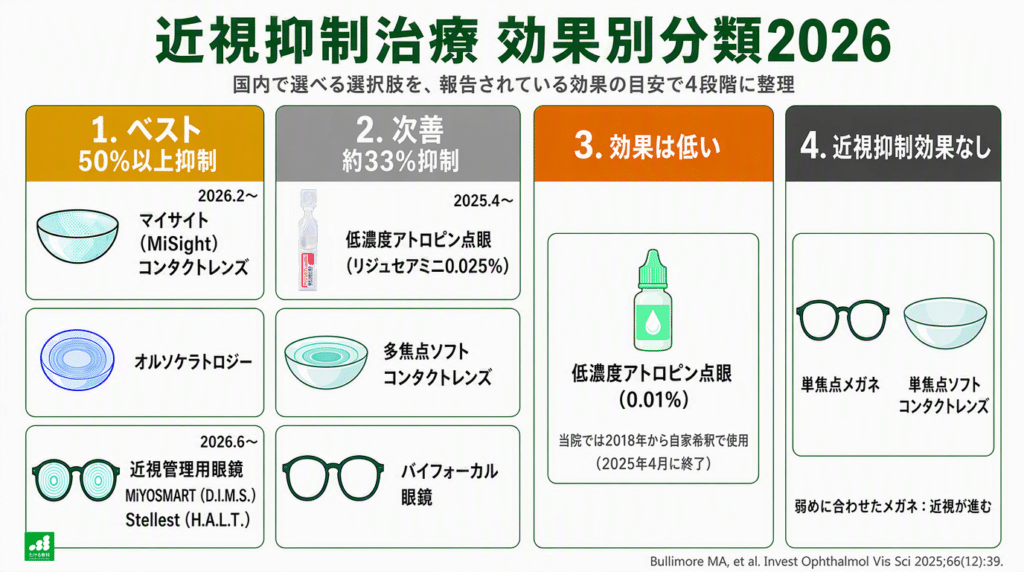
For comparison with other treatments, please seeMyopia Control Treatment Comparison Guide 2026.
If you are interested, please let us know at your visit.
What I want to tell patients
“Glasses neither advance myopia nor stop it” had been the common view until now.
Myopia control glasses do not “cure” myopia. Their aim is to slow the future speed of progression and lower the risk of becominghighly myopic (Japanese Society of Myopia guideline: average suppression rate 55–59%)12。
With the arrival of myopia control glasses, the situation is changing. However, the following three points are important to bring out the effect.
- Measure axial length regularly and check that it is working.
- Wear them throughout waking hours. They are lenses that presuppose “all-day wear.”
- If the effect plateaus, discuss with your doctor the option of combining with other treatments (atropine eye drops、orthokeratology、MiSight contact lenses) andcombining them.
In general, myopia progression often settles around age 18 (about 77% are stable by age 18)12. Once progression is judged to have stopped, wear can be discontinued.
We will keep you informed of trends in domestic approvals at our clinic as well. If you are interested, please let us know at your visit.
MiYOSMART: image provided by HOYA
-628x1024.jpg)
References
- Lam CSY, Tang WC, Tse DY, et al. Defocus Incorporated Multiple Segments (DIMS) spectacle lenses slow myopia progression: a 2-year randomised clinical trial. Br J Ophthalmol. 2020;104(3):363-368. DOI: 10.1136/bjophthalmol-2018-313739. https://pubmed.ncbi.nlm.nih.gov/31142465/
- Lam CSY, Tang WC, Zhang HY, et al. Long-term myopia control effect and safety in children wearing DIMS spectacle lenses for 6 years. Sci Rep. 2023;13(1):5475. DOI: 10.1038/s41598-023-32700-7. https://pubmed.ncbi.nlm.nih.gov/37015996/
- Lam CSY, Tang WC, Tse DY, Tang YY, To CH. Defocus Incorporated Soft Contact (DISC) lens slows myopia progression in Hong Kong Chinese schoolchildren. Br J Ophthalmol. 2014;98(1):40-45. DOI: 10.1136/bjophthalmol-2013-303914. https://pubmed.ncbi.nlm.nih.gov/24169657/
- Bao J, Yang A, Huang Y, et al. Spectacle Lenses with Aspherical Lenslets for Myopia Control vs Single-Vision Spectacle Lenses: A Randomized Clinical Trial. JAMA Ophthalmol. 2022;140(5):472-478. DOI: 10.1001/jamaophthalmol.2022.0401. https://pubmed.ncbi.nlm.nih.gov/35357402/
- Rappon J, Chung C, Young G, et al. Control of myopia using diffusion optics spectacle lenses: 12-month results of a randomised controlled, efficacy and safety study (CYPRESS). Br J Ophthalmol. 2023;107(11):1709-1715. DOI: 10.1136/bjo-2021-321005. https://pubmed.ncbi.nlm.nih.gov/36126105/
- Laughton D, Hill JS, McParland M, et al. Control of myopia using diffusion optics spectacle lenses: 4-year results of a multicentre randomised controlled, efficacy and safety study (CYPRESS). BMJ Open Ophthalmol. 2024;9(1):e001790. DOI: 10.1136/bmjophth-2024-001790. https://pubmed.ncbi.nlm.nih.gov/39384223/
- Neitz J, Neitz M. Diffusion Optics Technology (DOT): A Myopia Control Spectacle Lens Based on Contrast Theory. Transl Vis Sci Technol. 2024;13(10):42. DOI: 10.1167/tvst.13.10.42.
- Brennan NA, Toubouti YM, Cheng X, Bullimore MA. Efficacy in myopia control. Prog Retin Eye Res. 2021;83:100923. DOI: 10.1016/j.preteyeres.2020.100923. https://pubmed.ncbi.nlm.nih.gov/33253901/
- Liu Q, Chen Y, Feng Y, et al. Comparison of two-year myopia control efficacy between spectacle lenses with highly aspherical lenslets and orthokeratology lenses. Cont Lens Anterior Eye. 2025;48(3):102376. DOI: 10.1016/j.clae.2025.102376. https://pubmed.ncbi.nlm.nih.gov/39824729/
- D’Andrea L, et al. Efficacy of spectacle lenses for myopia control: a meta-analysis of randomised controlled trials. Br J Ophthalmol. 2026;110(2):125-132. DOI: 10.1136/bjo-2025-327629. https://pubmed.ncbi.nlm.nih.gov/40912901/
- Smith EL 3rd, Hung LF, Huang J. Relative peripheral hyperopic defocus alters central refractive development in infant monkeys. Vision Res. 2009;49(19):2386-2392. DOI: 10.1016/j.visres.2009.07.011. https://pubmed.ncbi.nlm.nih.gov/19632261/
- Committee for the Myopia Management Spectacles Guideline. Guideline for Myopia Management Spectacles (Multi-segment Lenses) (1st edition). Journal of the Japanese Ophthalmological Society. 2025;129(10):855-861. DOI: 10.60330/nggz-2025-037. https://www.nichigan.or.jp/Portals/0/resources/member/guideline/129-855.pdf
- Nikon-Essilor Co., Ltd. A new common sense for children’s myopia care: “Essilor® Stellest®” to go on sale June 11. PR TIMES. May 20, 2026. https://prtimes.jp/main/html/rd/p/000000061.000024978.html
- McCullough S, Barr H, Fulton J, et al. Defocus Incorporated Multiple Segments (DIMS) spectacle lenses in UK children: outcomes from a 2-year multi-site interventional trial. Ophthalmic Physiol Opt. 2025;45(7):1965-1980. DOI: 10.1111/opo.70034. https://pubmed.ncbi.nlm.nih.gov/41147923/
- Dhirar N, Dudeja S, Duggal M, et al. Compliance to spectacle use in children with refractive errors- a systematic review and meta-analysis. BMC Ophthalmol. 2020;20(1):71. DOI: 10.1186/s12886-020-01345-9. https://pubmed.ncbi.nlm.nih.gov/32093669/
- So C, Lian J, McGhee SM, et al. Lifetime cost-effectiveness of myopia control intervention for the children population. J Glob Health. 2024;14:04183. DOI: 10.7189/jogh.14.04183. https://pubmed.ncbi.nlm.nih.gov/39302055/
- Guemes-Villahoz N, Talavero González P, Porras-Ángel P, et al. Atropine and Spectacle lens Combination Treatment (ASPECT): 12-month results. Br J Ophthalmol. 2025;109(9):1074-1080. DOI: 10.1136/bjo-2024-326852. https://pubmed.ncbi.nlm.nih.gov/40345841/
- Santodomingo-Rubido J, Martínez-Pérez C, Villa-Collar C. Dropout rates among optical interventions for myopia control: a systematic review. Cont Lens Anterior Eye. 2025;49(2):102601. DOI: 10.1016/j.clae.2025.102601. https://pubmed.ncbi.nlm.nih.gov/41481944/