![Takeru Eye Clinic | Takatori Shopping Street, Sawara-ku, Fukuoka City [Nishijin Station / Fujisaki Station]](https://takeru-eye.com/wp-content/uploads/2022/10/takeru_logo_for-WP-header.png)

It has become clear that the side effects of various oral medicines can affect the eye’s focusing.
“My eyes tire easily,” “my eyes hurt during computer work,” “text on my smartphone is hard to see.”
We see many patients who complain of eye strain like this.
Recently, with the increase in working from home, more people seem to have such symptoms.
In fact, it is not uncommon for the medicines a person is taking to be affecting these symptoms.
For example, hay fever medicines, sleep medicines, and treatments for overactive bladder,
among other everyday medicines, include some that can affect the eye’s focusing ability.
Especially in people aged 40 and over, with aging eyes (presbyopia),
recent research has shown that, on top of the decline in focusing ability (presbyopia), the effects of such medicines tend to appear more strongly¹.
In fact, more than 600 medicines have been reported to have anticholinergic effects, and these may affect focusing.
* Anticholinergic effect:
An action that suppresses the neurotransmitter “acetylcholine,” affecting autonomic functions such as eye focusing and saliva secretion.
When there is a focusing disorder, it is also important to consider whether it is a side effect of a medicine.
Oral medicines can make it hard for the eyes to focus

Why medicines affect the eye’s focusing
Interaction between aging and medicines

The decline in focusing ability with age (presbyopia) is one of the most common symptoms in ophthalmic practice.
When medicine side effects are added to this natural age-related change, more serious symptoms may result¹.
There are four especially important points:
- Even a slight pharmacological effect can have a major impact
- For example: even a quarter of the usual dose of an antiallergy medicine can cause symptoms
- Specific case:
- After taking an over-the-counter hay fever medicine at bedtime, the next morning’s newspaper is hard to read
- During computer work, characters on the screen look blurrier than usual
- Reason: sensitivity to medicines may be higher because of aging
- What to do: understand that the same medicine can have different effects depending on age, and consult your doctor
- In aging eyes, the effects on pupil dilation and the ciliary muscle are stronger
- As an analogy:
- A young eye works like “the autofocus of a brand-new camera.”
- An aging eye responds like “the autofocus of a well-used camera,” more slowly and less accurately.
- Specific examples:
- Adjustment is slower when going from a dark place to a bright place
- It takes time to focus when looking at nearby text
- What to do:
- Ensure sufficient lighting
- Take frequent breaks during work
- As an analogy:
- Stronger effects from interactions between multiple medicines
- As an analogy:
- The effect of one medicine is like “a small wave.”
- When multiple medicines overlap, the “waves add up and become large.”
- Specific example:
- A combination of a hay fever medicine, an anti-anxiety medicine, and a sleeping pill
- Each may be fine on its own, but combined they can cause marked difficulty seeing
- Points to note:
- If you have different prescribing doctors, tell each doctor about all the medicines you take
- Always tell your doctor about over-the-counter medicines too
- As an analogy:
- Worsening of symptoms by the presence of cataract
- As an analogy:
- A normal aging eye is “a camera whose autofocus has declined.”
- With cataract added, it is “a camera whose autofocus has declined and whose lens itself is clouded.”
- Specific effects:
- Increased glare
- Reduced contrast sensitivity
- Difficulty distinguishing colors
- What to do:
- Consider cataract surgery early
- Set up suitable lighting
- Adjust text size with stronger contrast
- As an analogy:
Is it an oral medicine? The mechanism of accommodation disorders
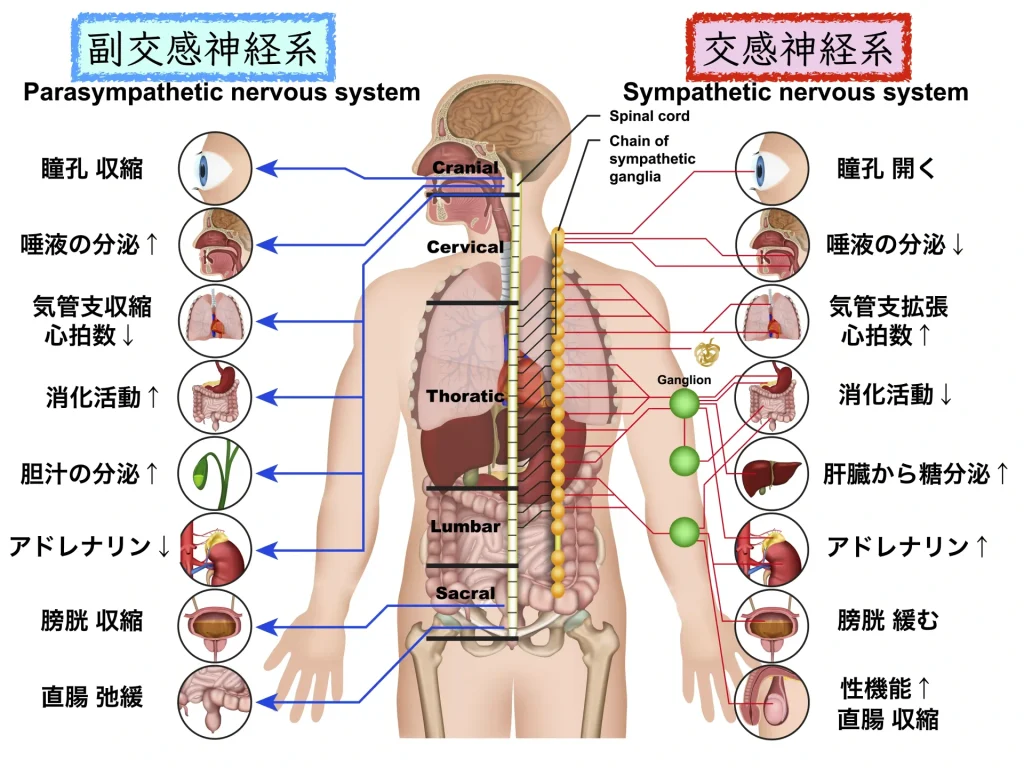
Eye focusing involves the complex interplay of the following elements:
- Nervous system function²
- Nerve transmission by acetylcholine
- Activation of the parasympathetic nervous system
- Balance with the sympathetic nervous system
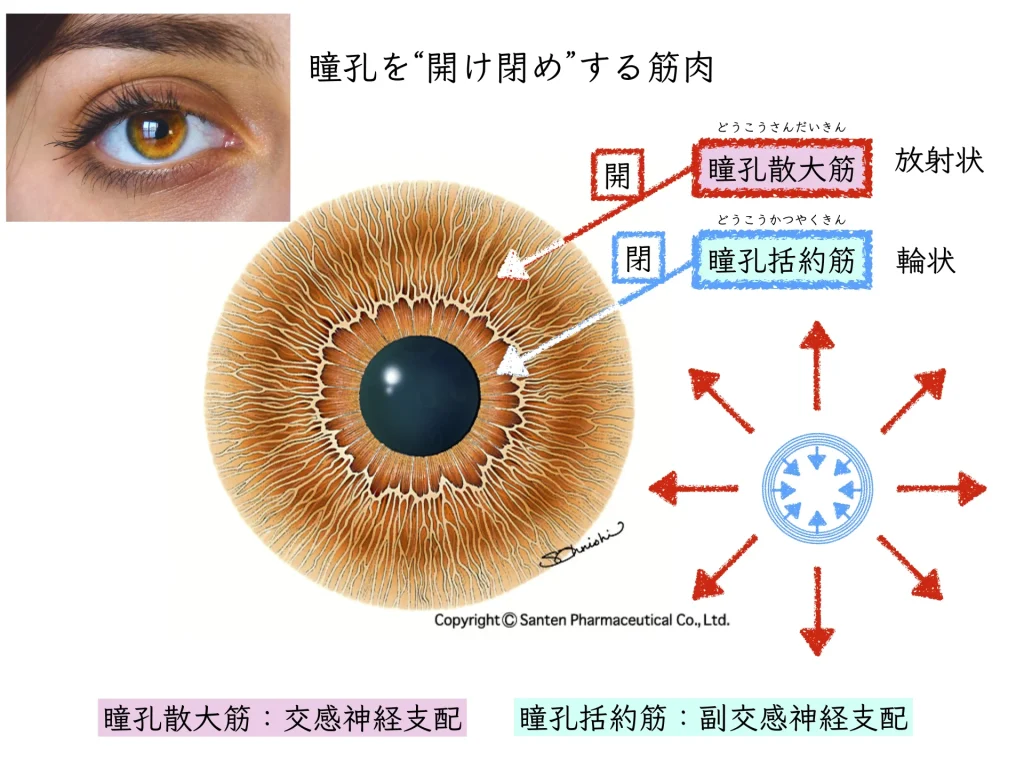
- Structural elements of the eye²
- Contraction and relaxation of the ciliary muscle
- Changes in lens thickness
- Action of the pupillary sphincter
- Regulation by the iris
- Mechanisms affected²
- Suppression of the parasympathetic nervous system
- Pupil dilation
- Paralysis of the ciliary muscle
- Increased light scattering in the eye
Medicines that may affect eye focusing
Anticholinergics and related drugs³
- Anticholinergics and related drugs³
- Oxybutynin (Pollakisu®, Neoxy® tape, oxybutynin tablets)
- Ipratropium (Atrovent®, Tersigan®)
- Tiotropium (Spiriva®, Spiriva® 2.5 µg Respimat®)
- Parkinson’s disease medicines
- Levodopa (Dopaston®, Neodopaston®, Menesit®, Madopar®, Dopacol®)
Psychotropic drugs⁴
a) Tricyclic antidepressants (TCA)
- Amitriptyline (Tryptanol®, amitriptyline tablets from generic manufacturers)
- Imipramine (Tofranil®, Imidol®)
- Clomipramine (Anafranil®, clomipramine tablets from generic manufacturers)
- Nortriptyline (Noritren®, Amitriptyline®)
b) Selective serotonin reuptake inhibitors (SSRIs)
- Paroxetine (Paxil®, paroxetine tablets from generic manufacturers)
- Fluvoxamine (Depromel®, Luvox®, fluvoxamine tablets from generic manufacturers)
- Sertraline (Jzoloft®, sertraline tablets from generic manufacturers)
Serotonin-norepinephrine reuptake inhibitors (SNRIs)
- Duloxetine (Cymbalta®, duloxetine formulations from generic manufacturers)
ADHD medicines⁵
- Methylphenidate (Concerta®)
- Atomoxetine (Strattera®, atomoxetine formulations from generic manufacturers)
- Guanfacine (Intuniv®)
- Lisdexamfetamine (Vyvanse®)
Ritalin® is currently indicated only for narcolepsy.
For ADHD, the only indicated medicine is Concerta® (an extended-release formulation).
General and over-the-counter medicines⁶
- Diphenhydramine (Restamin®, Drewell®, Gu-three P®, S-tac®)
- Chlorpheniramine (Allergin®, Polaramine®, Benza Block S®, Pabron Rhinitis Capsule S®)
- Scopolamine (Travelmin®)
Additional important information:
- For generic medicines, product names may differ by manufacturer.
- For over-the-counter medicines, the same ingredient may be sold under various product names.
- It may also be included in combination products, so checking the ingredient list is important.
* Always consult a doctor or pharmacist before using any medicine.
In particular, if you are considering switching to a generic medicine, it is recommended to consult a health professional beforehand.
What symptoms can appear⁷
Symptoms related to accommodation
- Difficulty focusing
- Difficulty relaxing focus
- Temporary blurred vision
- Difficulty keeping focus on near objects
Symptoms related to eye movement
- Gaze palsy
(Even when you try to read a book, your eyes move on their own and cannot rest firmly where you want to look.) - Impaired smooth eye movements
(difficulty following moving objects smoothly) - Nystagmus
(a continuing sensation of the eyes oscillating, like when you try to look at distant scenery from a train)
Other eye symptoms
- Dry eyes and the blurred vision that goes with them
(a dry feeling, and vision that is not clear, like after wearing contact lenses too long) - Changes in color vision
(colors look different from usual / look dull / become harder to tell apart) - Changes in contrast sensitivity
(like a black-and-white photograph, it becomes hard to distinguish the shades between white and black) - Increased light scattering
(light looks blurred / glare becomes stronger) - Photophobia due to pupil dilation
(abnormal glare)
Coping and prevention
What medical staff do
- Importance of a detailed medical interview
- Checking prescribed medicines
- Use of over-the-counter medicines
- Use of supplements and herbs
- History of cosmetic medical procedures
- Comprehensive eye examination
- Evaluation of accommodation
- Checking pupil responses
- Intraocular pressure measurement
- Visual acuity test
What patients can do
- Keep a record of symptoms
- When they began and how they progressed
- How symptoms fluctuate
- Relationship to medicine use
- Impact on daily life
- Adjust your living environment
- Appropriate lighting
- Optimal working distance
- Taking breaks
- Managing environmental factors
It would help to share the above with your doctor.
References
[1] Constable, P.A., Al-Dasooqi, D., Bruce, R. & Prem-Senthil, M. 2022, ‘A Review of Ocular Complications Associated with Medications Used for Anxiety, Depression, and Stress’, Clinical Optometry, vol. 14, pp. 13-25. https://pubmed.ncbi.nlm.nih.gov/35237084/
[2] Belliveau, A.P., Somani, A.N. & Dossani, R.H. 2023, ‘Pupillary Light Reflex’, StatPearls, StatPearls Publishing, Treasure Island (FL). https://www.ncbi.nlm.nih.gov/books/NBK537180/
[3] Altan-Yaycioglu, R., Yaycioglu, O., Aydin Akova, Y., Guvel, S. & Ozkardes, H. 2005, ‘Ocular side-effects of tolterodine and oxybutynin, a single-blind prospective randomized trial’, British Journal of Clinical Pharmacology, vol. 59, no. 5, pp. 588-592. https://pubmed.ncbi.nlm.nih.gov/15842558/
[4] Richa, S. & Yazbek, J.C. 2010, ‘Ocular adverse effects of common psychotropic agents: a review’, CNS Drugs, vol. 24, no. 6, pp. 501-526. https://pubmed.ncbi.nlm.nih.gov/20443647/
[5] Bingöl-Kızıltunç, P., Yürümez, E. & Atilla, H. 2022, ‘Does methylphenidate treatment affect functional and structural ocular parameters in patients with attention deficit hyperactivity disorder? – A prospective, one year follow-up study’, Indian Journal of Ophthalmology, vol. 70, no. 5, pp. 1664-1668. https://pubmed.ncbi.nlm.nih.gov/35502047
[6] Ahmad, R. & Mehta, H. 2021, ‘The ocular adverse effects of oral drugs’, Australian Prescriber, vol. 44, no. 4, pp. 129-136. https://australianprescriber.tg.org.au/articles/the-ocular-adverse-effects-of-oral-drugs.html
[7] Hilora, M. & Tripathy, K. 2023, ‘Accommodative Excess’, StatPearls, StatPearls Publishing, Treasure Island (FL). https://www.ncbi.nlm.nih.gov/books/NBK592379/