![Takeru Eye Clinic | Takatori Shopping Street, Sawara-ku, Fukuoka City [Nishijin Station / Fujisaki Station]](https://takeru-eye.com/wp-content/uploads/2022/10/takeru_logo_for-WP-header.png)

・My eye suddenly hurt a lot
・Tears in only one eye
・Tears that won’t stop
・Lights look dazzling
・Vision decreases
・A foreign-body sensation; the eye feels gritty
“Corneal epithelial erosion” is when the surface of the black part of the eye, thecornea, loses its epithelium (the surface layer).
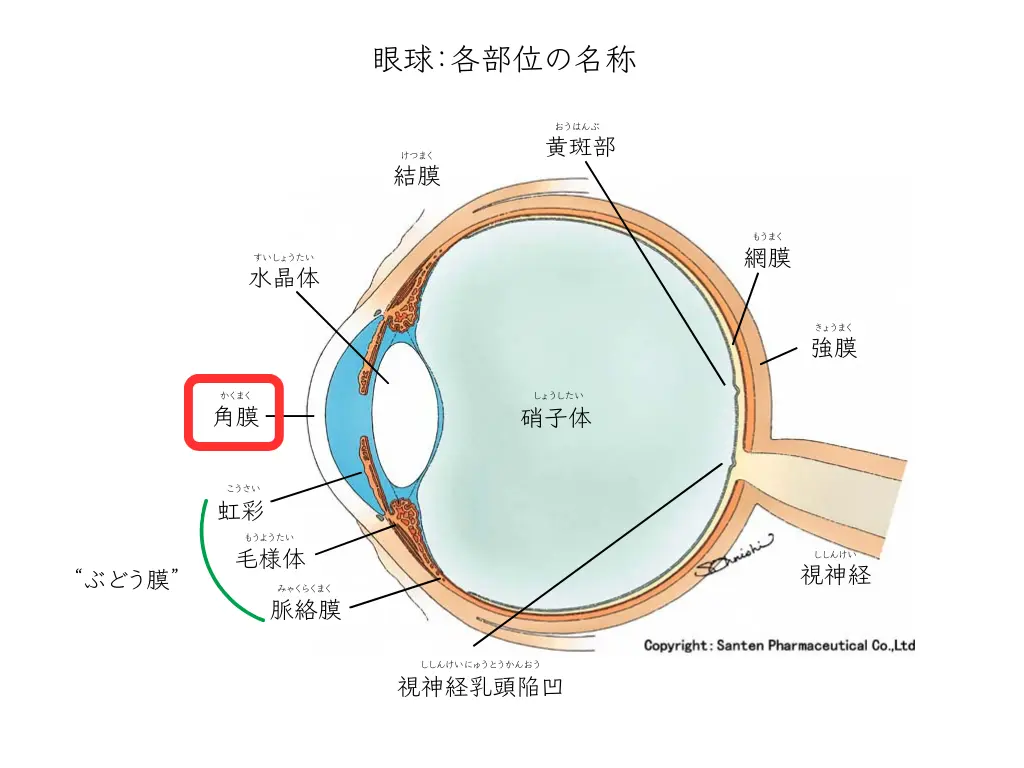
The sensory nerves distributed in the black part of the eye (the cornea) are known to be extremely sharp.
The pain is stronger the larger the area that has peeled off (the area of the epithelial erosion).
Corneal epithelial cells repair very quickly, so in most cases the pain subsides within several hours to a day.
After that, the same corneal epithelial erosion tends to occur again:recurrence
can become a problem.
Recurrent Corneal Erosion: Repeated Scratches on the Eye

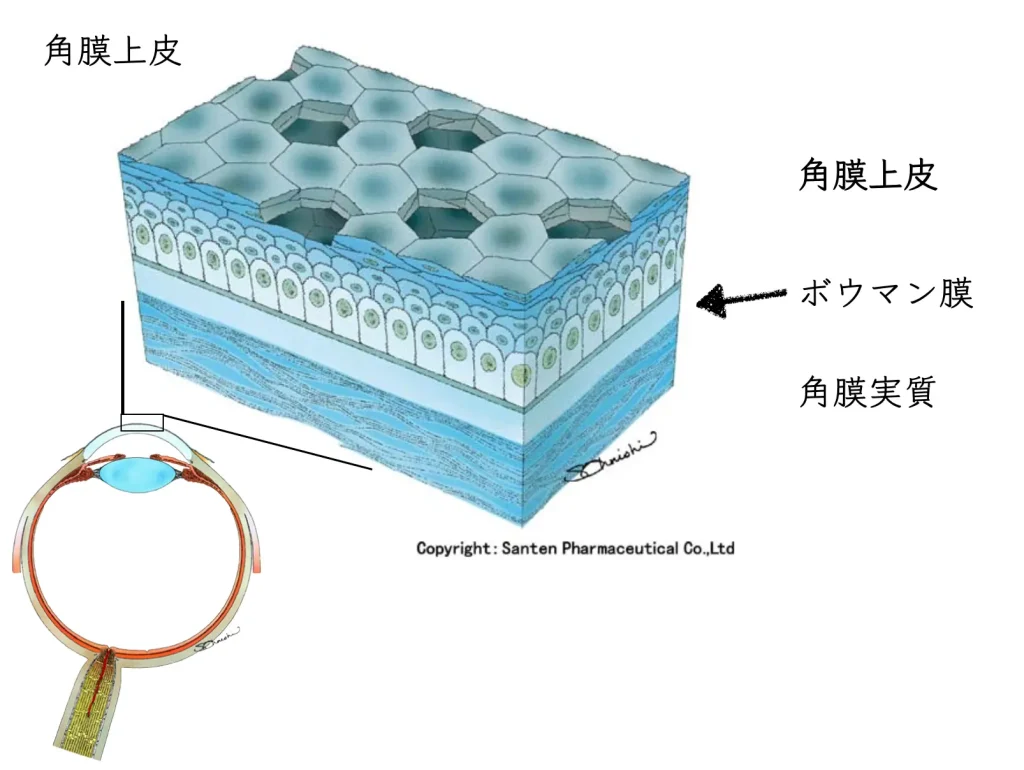
In “recurrent corneal erosion,” in which corneal epithelial erosions keep coming back,
the attachment between the corneal epithelium and the basement membrane is inadequate.
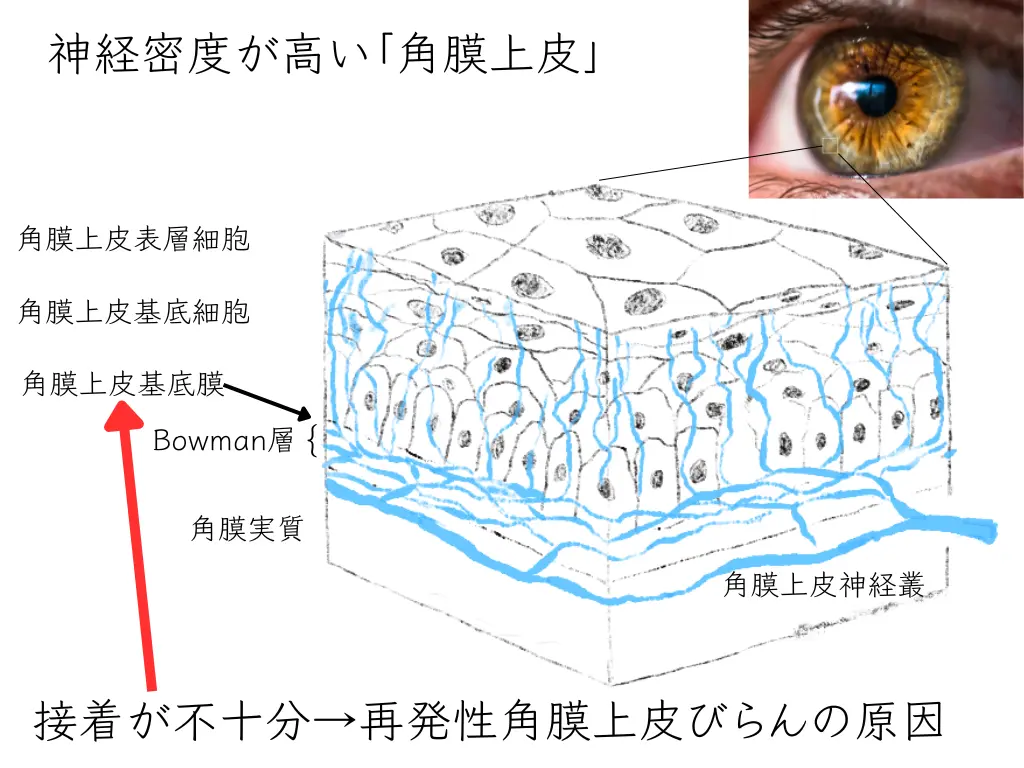
Symptoms of Recurrent Corneal Erosion
A typical feature is sudden pain in one eye in the middle of the night or on waking in the morning.
Along with the eye pain, there are symptoms such as
・Redness
・Dazzling light (photophobia: sensitivity to light)
・Tearing (epiphora)
・A scratch on the black part of the eye (the cornea)
・Foreign-body sensation
and others.
Causes of Recurrent Corneal Erosion
The following are listed as causes of recurrent corneal erosion.
・Eye injury
・Eyes that have had refractive surgery (LASIK, ICL)
・Eyes that have had cataract surgery
・Eyes that have had corneal transplant surgery
・Corneal dystrophy
・Basement membrane dystrophy
How Long Does the Pain of Recurrent Corneal Erosion Last?
Depending on the size of the erosion, pain can last for several hours.
In severe cases where the epithelial defect persists, pain may be felt for several days.
It can also recur intermittently over weeks to months.
Why Do Scratches on the Eye (Corneal Scratches) and Recurrent Corneal Erosion Hurt?
The cornea has a higher density of sensory nerve endings than the skin, so its sensation is far sharper.
This high sensitivity gives the cornea the ability to detect and respond to changes in the environment, and plays an important role in maintaining its integrity and function.
The transparent cornea has many sensory nerves distributed in it.
The sensory nerves of the cornea come from the trigeminal nerve (cranial nerve V).
They supply sensation to the transparent cornea and are known to be essential for maintaining the structure and function of the cornea.
When these nerves are damaged, corneal sensation decreases, and this is also known to cause conditions such as neurotrophic keratopathy.
Treatment of Recurrent Corneal Erosion
The first choice for treating recurrent corneal erosion is conservative treatment.
A combination of smooth eye drops that contain no antibiotics or preservatives, and a lubricating ointment or hypertonic saline ointment at night, is used.
Depending on the discomfort, atropine or a therapeutic contact lens can also be added.
Oral pain relievers are also given as needed.
To reduce friction between the eyelid and the cornea
eye ointment
To reduce edema
sodium chloride eye drops
In Japan, sodium chloride eye drops are not commonly used.
To reduce pain
atropine eye drops
oral pain relievers (acetaminophen, ibuprofen)
To prevent and treat corneal infection
antibiotic eye drops
macrolide antibiotic eye ointment (erythromycin)
To replenish growth factors and cytokines
autologous serum eye drops
To promote regrowth over the corneal defect
cryopreserved amniotic membrane (ProKera®)
References
Miller, D.D., Hasan, S.A., Simmons, N.L., Stewart, M.W., 2019. Recurrent corneal erosion: a comprehensive review. Clin Ophthalmol 13, 325–335. https://doi.org/10.2147/OPTH.S157430