![Takeru Eye Clinic | Takatori Shopping Street, Sawara-ku, Fukuoka City [Nishijin Station / Fujisaki Station]](https://takeru-eye.com/wp-content/uploads/2022/10/takeru_logo_for-WP-header.png)

In a small number of people with “high-risk eyes” (a narrow anterior chamber angle or strong hyperopia), an acute glaucoma attack can occur, very rarely, after a dilated (mydriatic) eye exam.
However, there is no problem if an ophthalmologist treats it promptly.
The symptoms of an acute glaucoma attack are
- headache
- vomiting
- eye pain
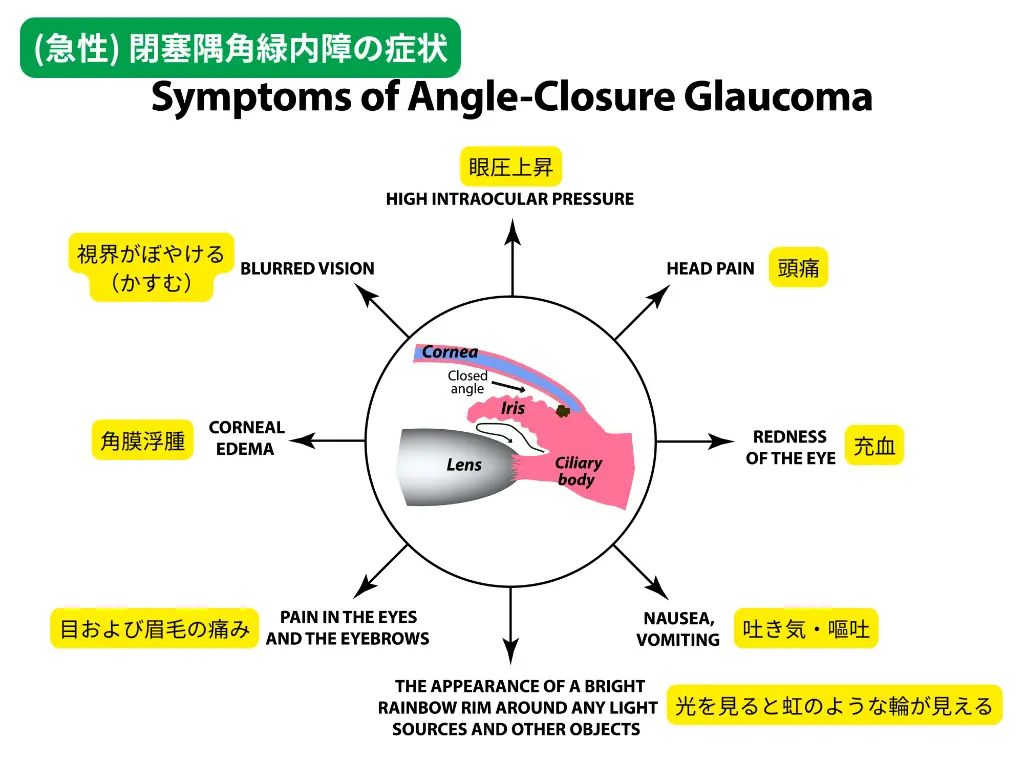
An acute glaucoma attack is caused by blockage of the anterior chamber angle, the drainage pathway for the fluid inside the eye (angle closure).
Angle closure raises eye pressure sharply and damages the nerve tissue at the back of the eye: the retina and the optic nerve.
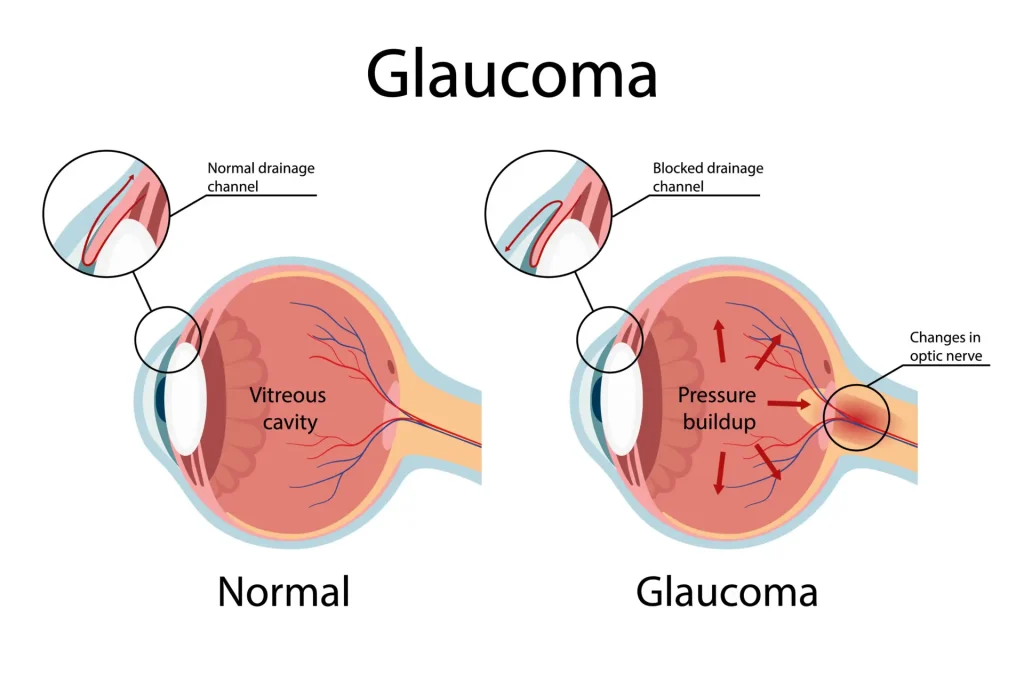

In an acute glaucoma attack,
in particular,severe headache and vomitingoften appear, so the first thought is to see an internist or a neurosurgeon rather than an eye doctor.
While tests are being done at the internal medicine or neurosurgery clinic, the eye pressure stays high.
What is frightening is that
while the cause of the headache and vomiting is being investigated, damage to the retina and optic nerve keeps advancing.
It can leave irreversible visual impairment.

Precautions after a dilated eye exam: the possibility and risk of an acute glaucoma attack

Eyes at high risk of an acute glaucoma attack
Before dilation, it is already possible to tell who is at high risk of an acute glaucoma attack.
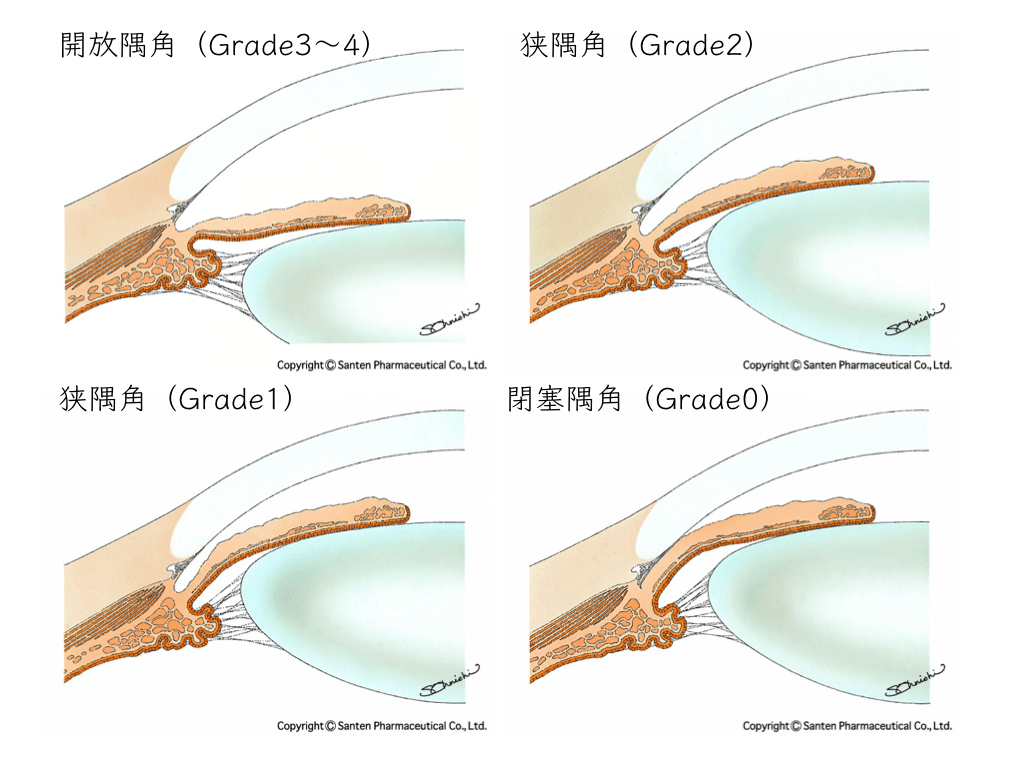
They are people who are farsighted (hyperopic) and have a narrow anterior chamber angle (narrow angle).
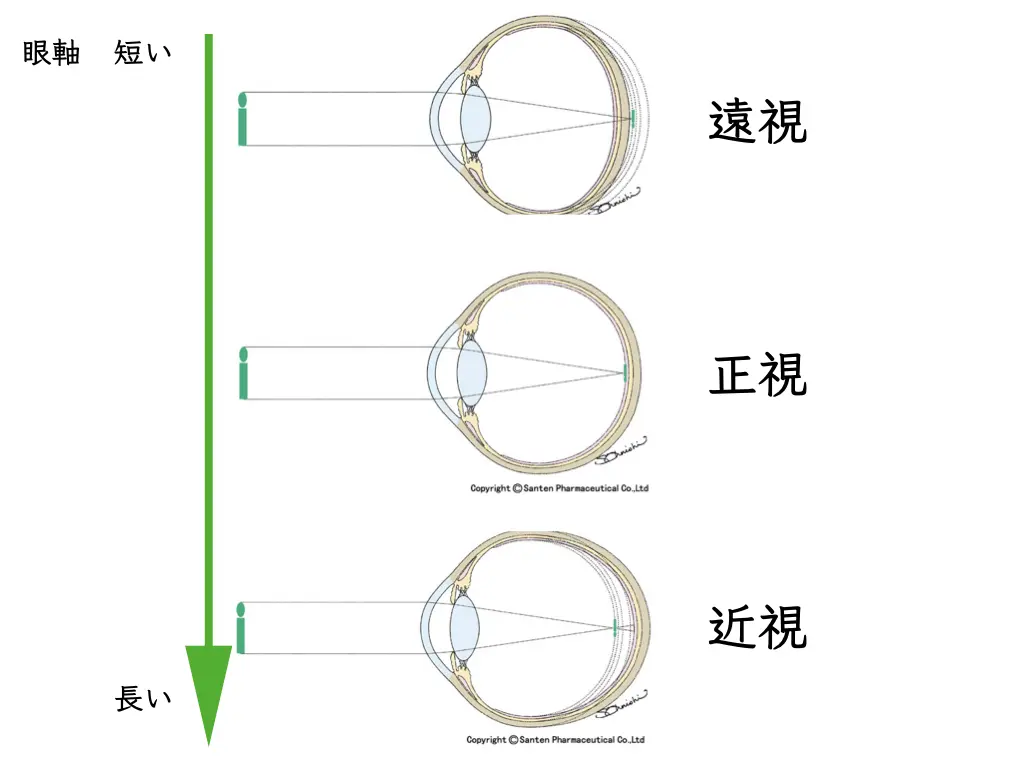
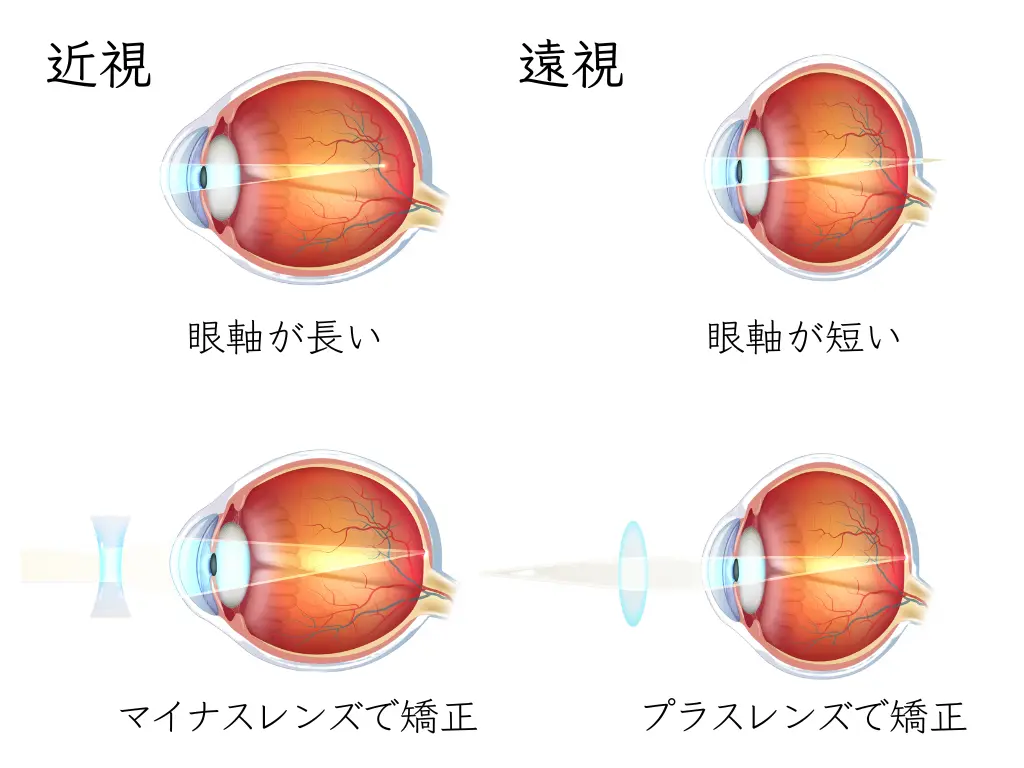
A hyperopic eye has a short axial length, so the anterior chamber angle is relatively narrow: a “narrow-angle” state.
Dilation is usually done with Mydrin®-P and Neosynesin® eye drops.
If the examination before dilation shows a narrow angle, the pupil is dilated with Neosynesin® eye drops.
This is a way to reduce, as far as possible, the risk of causing an acute glaucoma attack.
Even so, a glaucoma attack may occur on the way home or after getting home.
How to tell whether you are having an acute glaucoma attack
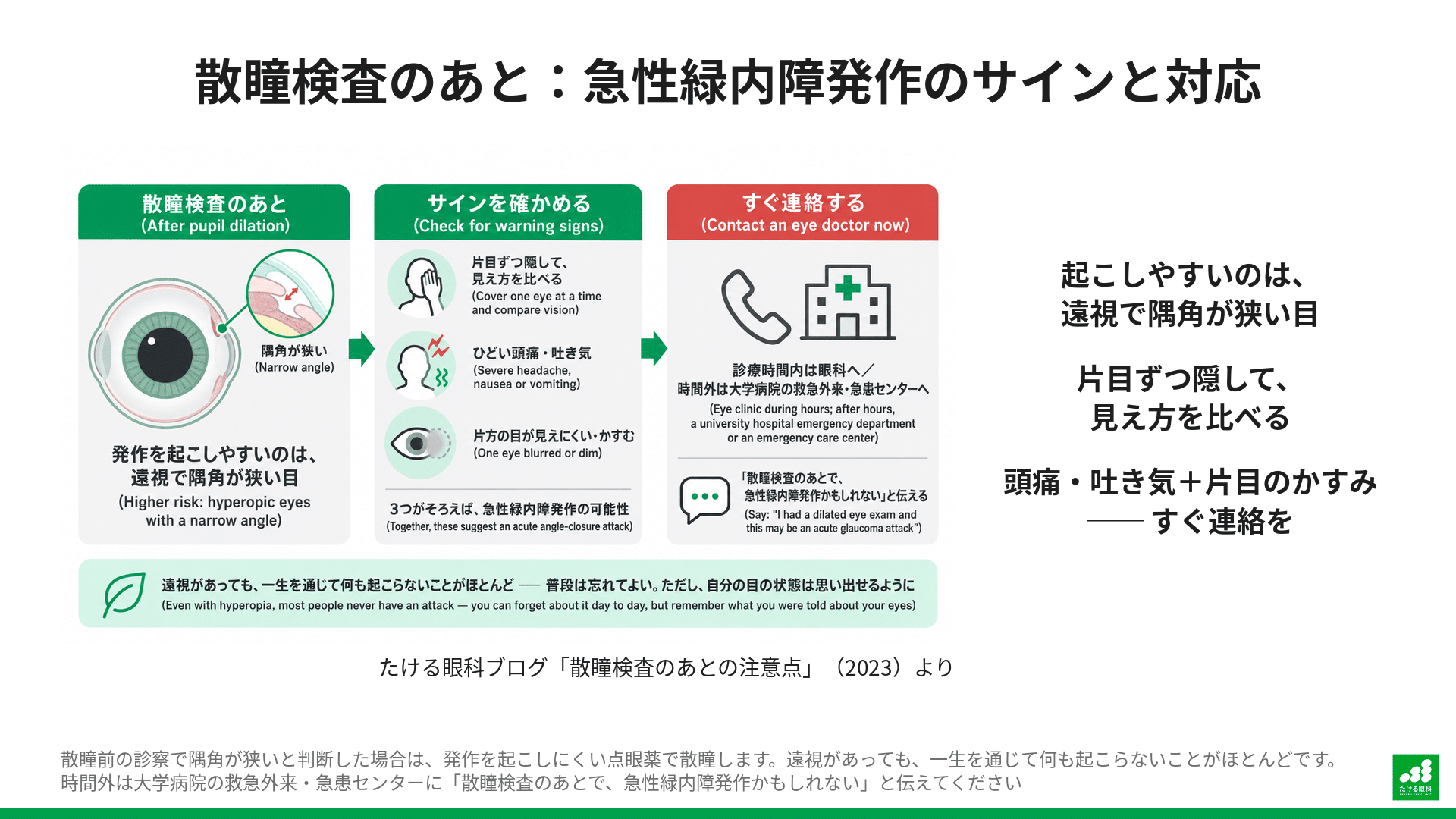
“Is what I am experiencing now an acute glaucoma attack?”
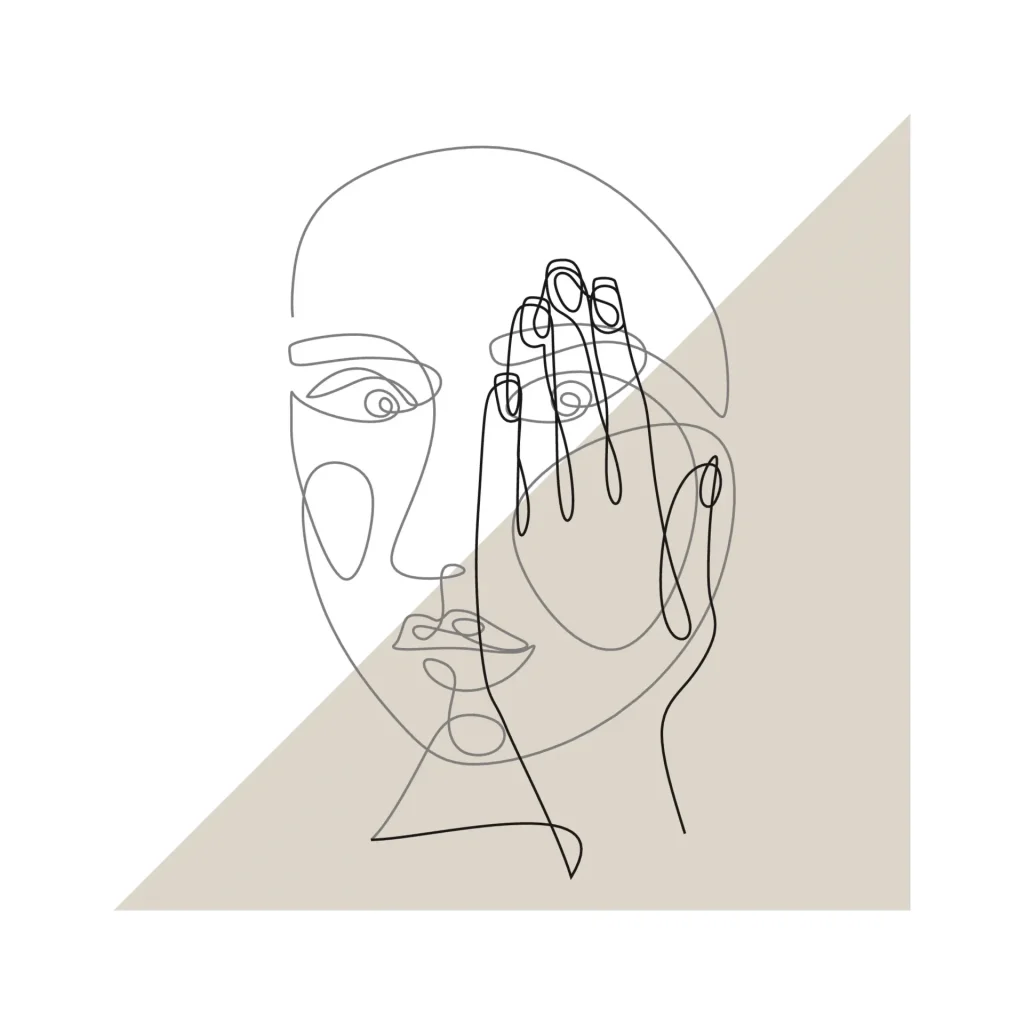
Cover one eye and check whether each eye
sees as clearly as usual.
- In a hyperopic eye,
- with severe headache and vomiting,
- if one eye cannot see or the vision is blurred,
it may be a headache and vomiting caused by an acute glaucoma attack.
If it is outside clinic hours,
the emergency department of a university hospital
an emergency clinic, or similar
and contact them.
“I may be having an acute glaucoma attack after a dilated eye exam.”
“I am hyperopic and was told my eyes are at risk of an acute glaucoma attack.”
Please tell them both of these things.
Treatment of an acute glaucoma attack
(1) Lower the eye pressure with an intravenous drip
(2) Once the eye pressure has settled, perform surgery to remove the crystalline lens
(cataract surgery to prevent recurrence of an acute glaucoma attack)

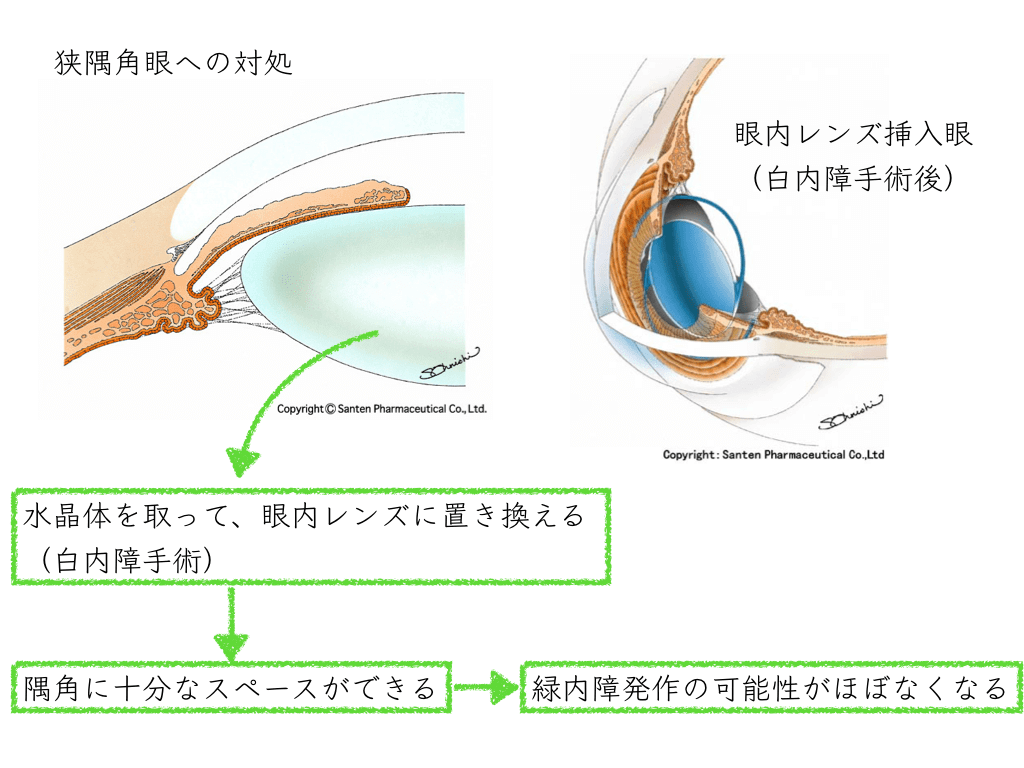
In the past, laser surgery (laser iridotomy, LI) was the usual approach.
It places a heavy burden on the corneal endothelium, and decades later there is a risk of developing bullous keratopathy.
What is bullous keratopathy?
Water enters the corneal stroma and the cornea becomes swollen and waterlogged.
A corneal transplant may be needed.
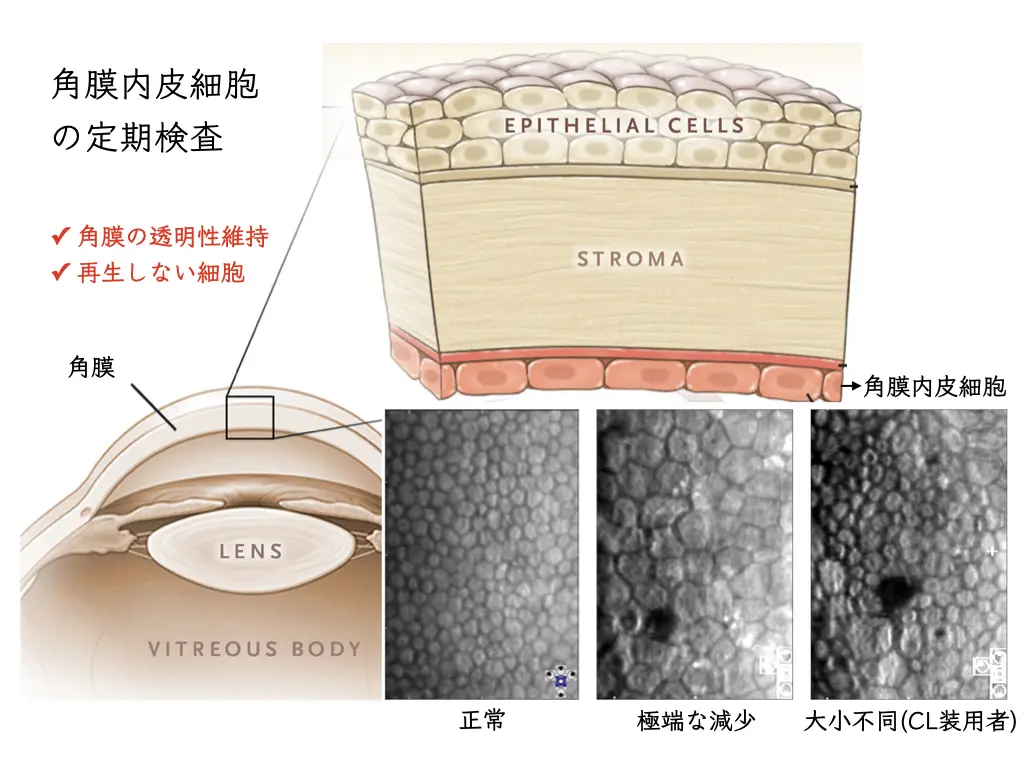
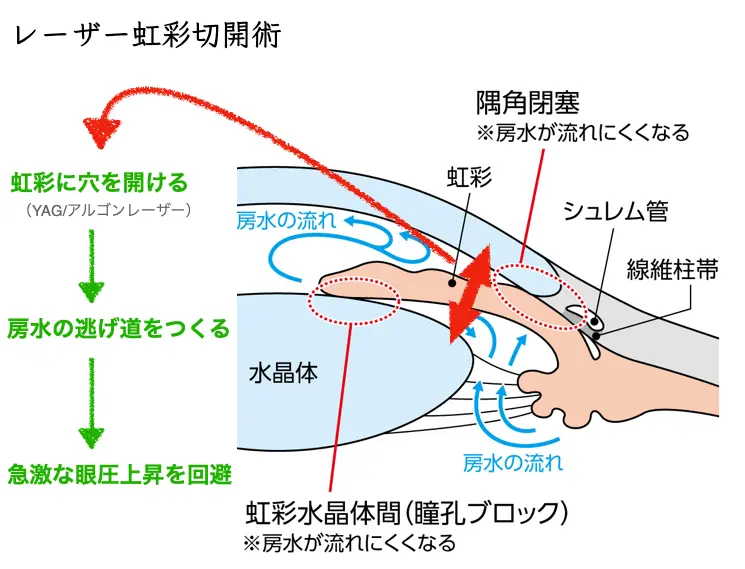
Laser iridotomy for narrow-angle eyes is now a method that is no longer recommended.1
The risk of an acute glaucoma attack: how not to worry too much
Even with hyperopia, most people go through life without anything happening.
It is fine to forget about it in everyday life.
Even so, I would like you to be able to recall the condition of your own eyes.
We also give you a card to show if anything happens.
These days, it is also possible to examine the fundus without dilating the pupil.
References
- He, M., Jiang, Y., Huang, S., Chang, D.S., Munoz, B., Aung, T., Foster, P.J., Friedman, D.S., 2019. Laser peripheral iridotomy for the prevention of angle closure: a single-centre, randomised controlled trial. The Lancet 393, 1609–1618. https://doi.org/10.1016/S0140-6736(18)32607-2