![Takeru Eye Clinic | Takatori Shopping Street, Sawara-ku, Fukuoka City [Nishijin Station / Fujisaki Station]](https://takeru-eye.com/wp-content/uploads/2022/10/takeru_logo_for-WP-header.png)

“It may be hayari-me, so please have your eyes checked at an eye clinic.”
Not a few patients come to us after being told this at a nursery school, kindergarten, or school. In fact, hayari-me is often a disease that cannot be confirmed on the spot. In this article I briefly explain why.
Epidemic Keratoconjunctivitis (Hayari-me) Cannot Be Diagnosed by Appearance Alone

You may wonder, “Is it difficult even for a specialist to tell?” In reality, it is hard to distinguish it from other types of conjunctivitis by appearance alone, and even ophthalmologists who specialize in the anterior segment (cornea, conjunctiva, etc.) find it difficult to make a definite call at a glance. Research has shown that there are limits to diagnosis based on symptoms and findings alone1. For that reason, we judge together with tests and the course of the illness.
A “Negative” Result Is Not Decisive
People sometimes ask, “Then is there a test that can confirm the diagnosis?”
There is a rapid test kit that checks for adenovirus.
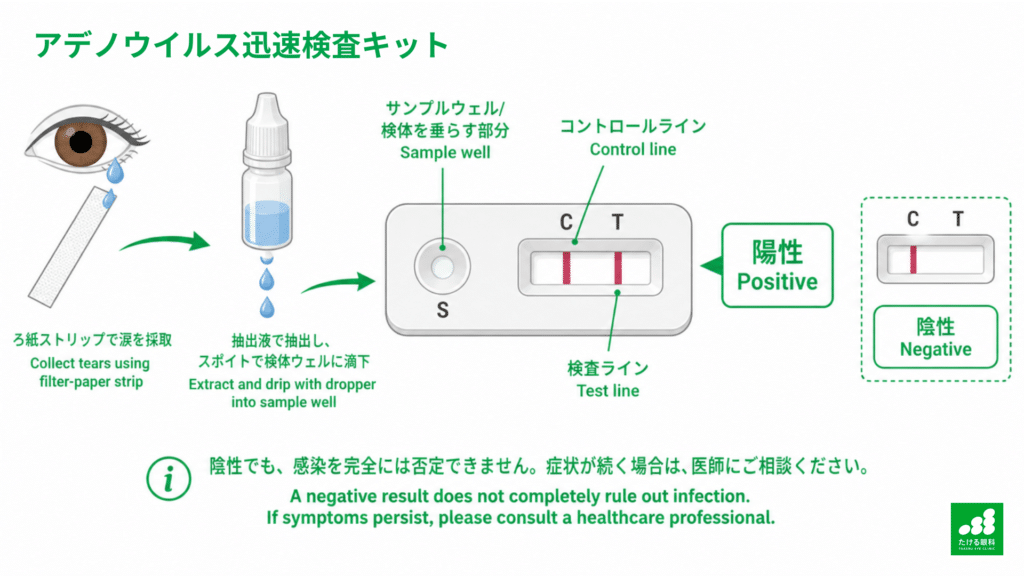
However, the result must be interpreted with care. If it is positive, we judge that hayari-me is likely. On the other hand, even if it is negative, we cannot say “you are not infected.” This is because the test is “almost certain if positive,” yet it is not uncommon for it to come back negative even when the person is actually infected (false negative)2. Depending on the study, it has been reported that a considerable proportion of infected people are judged negative3.
For that reason, especially when the result is negative, we too have no choice but to say, “At this point it is difficult to be definitive.” Because tests have such limitations, we make a comprehensive judgment together with symptoms and the epidemic situation.
How we examine and when we add further tests is explained in a little more detail in the related articles.

The Difficulty of the “Judgment” Asked of Kindergartens and Schools
The people who struggle most with this ambiguity are the teachers at nursery schools, kindergartens, and schools.
Hayari-me is contagious4. Under the School Health and Safety Act it is also classified as a “Class 3 infectious disease,” and children must refrain from attending nursery school or school until a doctor determines that there is no risk of infection5. If it spreads to other children, the nursery school or school has to decide how to respond. For that reason, they tell families, “Please have it properly assessed at an eye clinic.” However, even the eye clinic sometimes says, “It is difficult to judge.” This creates a situation in which nurseries and schools and medical institutions struggle to know how to respond.

There Is No Specific Drug; Treatment Centers on Calming Inflammation
Hayari-me is conjunctivitis caused by adenovirus, and there is currently no specific drug that eliminates the virus itself6. Treatment therefore centers on symptomatic therapy that relieves symptoms and calms the inflammation caused by the virus.
We sometimes use steroid eye drops, but they do not kill the virus; they are used to suppress strong inflammation. They are not a drug given to everyone from the start. We judge the need carefully and use them with caution when inflammation is strong or when pseudomembranes or corneal clouding appear7. This is because overuse also has disadvantages. Please understand that the aim is not to “cure” but to “suppress.”
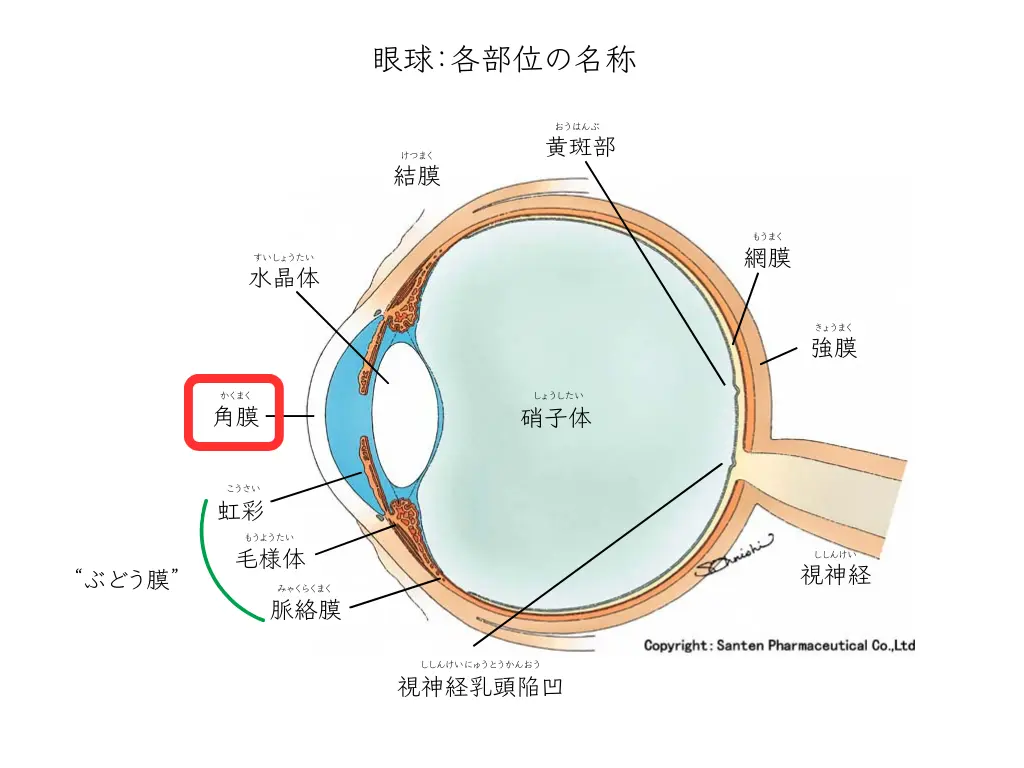
In addition, care is needed even after hayari-me has healed: small opacities may remain in the black of the eye (cornea) and affect vision. This point and how steroid eye drops are used are covered in a related article.

How We Handle It at Our Clinic
At our clinic, we perform a rapid test as needed based on the course of symptoms. Even when the result is negative, we proceed carefully and explain how to avoid spreading the infection to others.
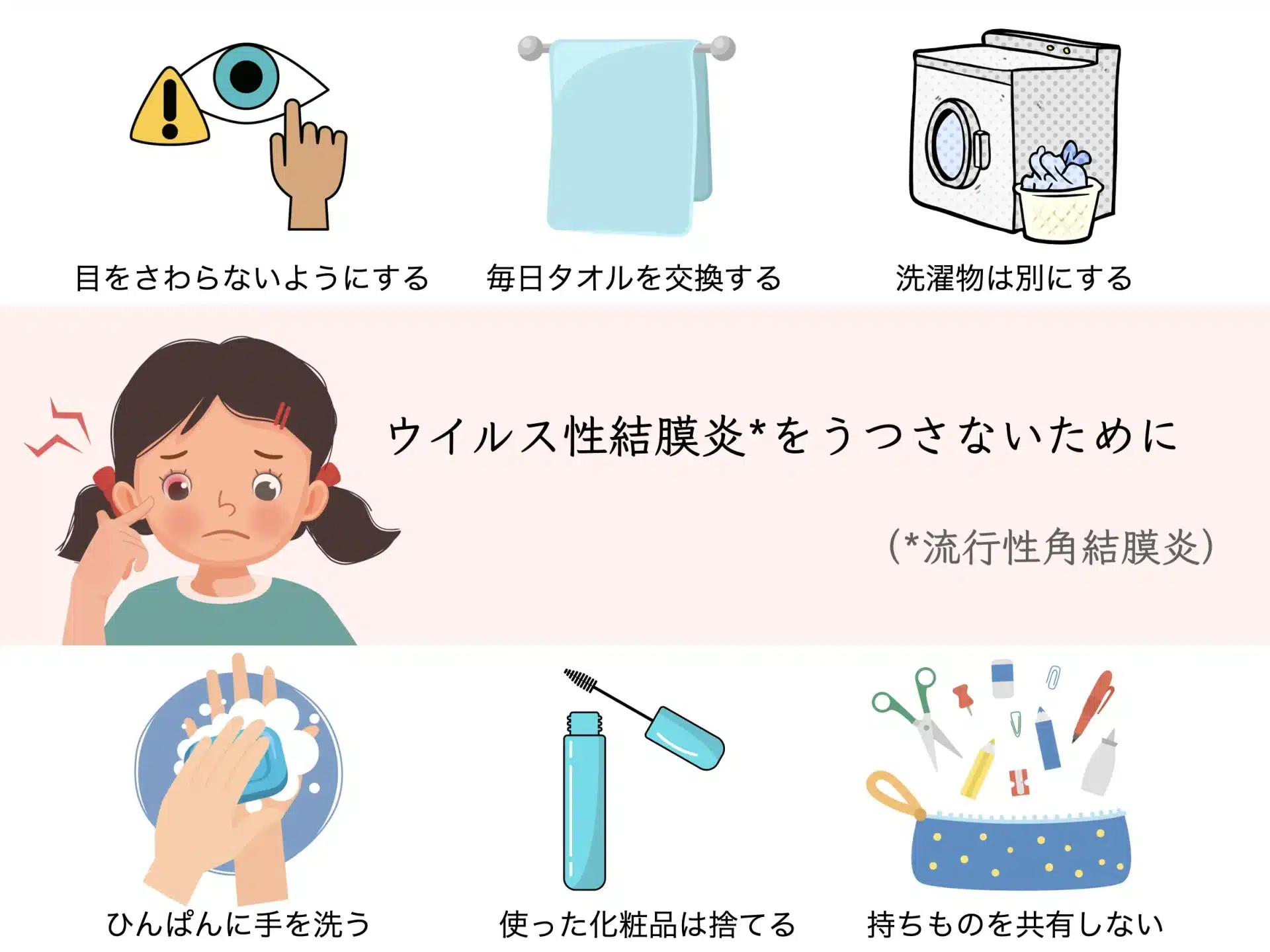
Using separate towels, not touching shared surfaces with hands that have rubbed the eyes, when to return to nursery school or school, and other points to watch for are explained one by one at the visit (mainly handled by orthoptists). Precisely because it is an ambiguous disease, we think these “things to watch for” are important.
You may often feel that what you are told at the hospital differs from what you expected. But that is the reality of hayari-me. If you have any worries or questions, please feel free to ask us anything at your visit.
References
- Diagnostic accuracy of clinical signs, symptoms and point-of-care testing for early adenoviral conjunctivitis. Clin Exp Optom. 2022. https://pmc.ncbi.nlm.nih.gov/articles/PMC9081290/
- Sambursky R, et al. The AdenoPlus test for diagnosing adenoviral conjunctivitis. JAMA Ophthalmol. 2013. https://pubmed.ncbi.nlm.nih.gov/23307204/
- Kam KYR, et al. Sensitivity and specificity of the AdenoPlus point-of-care test in an ophthalmic emergency department. Br J Ophthalmol. 2015. https://pubmed.ncbi.nlm.nih.gov/25824258/
- Centers for Disease Control and Prevention. Clinical Overview of Conjunctivitis. https://www.cdc.gov/conjunctivitis/hcp/clinical-overview/index.html
- Ministry of Health, Labour and Welfare. Epidemic keratoconjunctivitis. https://www.mhlw.go.jp/bunya/kenkou/kekkaku-kansenshou11/01-05-30.html
- Liu SH, et al. Topical pharmacologic interventions versus placebo for epidemic keratoconjunctivitis. Cochrane Database Syst Rev. 2022. https://pmc.ncbi.nlm.nih.gov/articles/PMC8892837/
- American Academy of Ophthalmology. Conjunctivitis Preferred Practice Pattern, 2023. https://www.aao.org/education/preferred-practice-pattern/conjunctivitis-ppp-2023