Changes in the circulation of fluid inside the eye appear as “eye pressure” (intraocular pressure).
Fluid (aqueous humor) produced by the ciliary body around the lens fills the space behind the cornea (the anterior chamber) and drains through the mesh-like trabecular meshwork into blood vessels outside the eye.
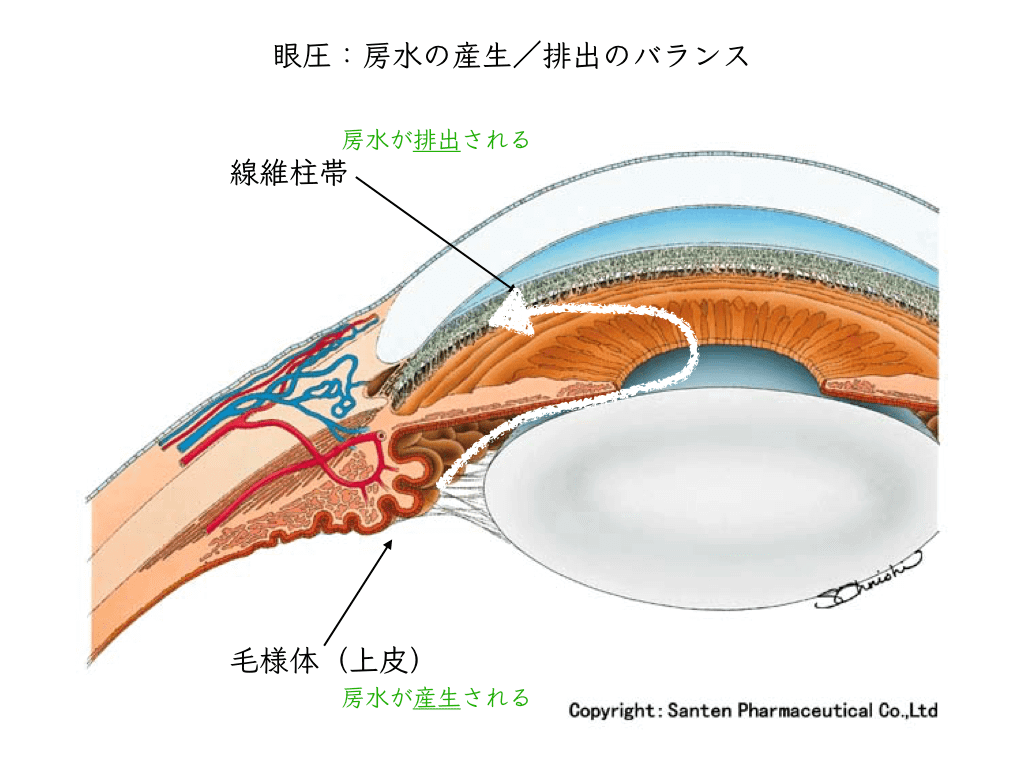
When this balance is disrupted, eye pressure rises and, over a long period, damages the nerve at the back of the eye. This is glaucoma.
Besides eye pressure, other factors involved in the progression of glaucoma include
Blood flow around the optic nerve
Oxidative stress
Systemic diseases (sleep apnea syndrome, high blood pressure, low blood pressure, diabetes, and others)
Smoking
among others1.
Lowering intraocular pressure is the only treatment approach proven to slow glaucoma progression.
Eye pressure goes up and down over the course of a day.
Eye pressure measured only at the moment of a clinic visit may not be enough to follow the course of the disease.
In exfoliation glaucoma, in which abnormal fibrillar (exfoliative) material accumulates and clogs the mesh-like trabecular meshwork and raise eye pressure,
daily fluctuation is known to be large.
- It also varies by region, and is known to be common in the Chikugo area of Fukuoka Prefecture (around Yame City and Kurume City)2.
For this reason, knowing the 24-hour pattern of eye pressure can be important in glaucoma care3.
Before the idea of “work-style reform” existed, a single junior doctor sometimes took on this task, but actually measuring the daily variation in eye pressure is extremely difficult.
In 2018, a medical contact lens with a built-in sensor was approved, and it has come into actual use.
SENSIMED Triggerfish®4

A sensor built into a silicone soft contact lens captures changes in the shape of the cornea and sclera. The sensor transmits data through an antenna to a recorder worn by the patient; the data are then transferred from the recorder to a computer via Bluetooth®, and measures “eye pressure.”
It can be worn all day
The well-known rise in eye pressure at sleep onset can be captured with Triggerfish®
These are the reported advantages, but there are still many limitations:
It does not give an accurate “eye pressure”; it gives a value that correlates with eye pressure through changes in the shape of the eye
Clinical evidence is not yet sufficient
It interferes with metal eyeglass frames, among other issues
Its correlation with accurate eye pressure rests on indirect evidence only.
At present, it is used only at some university hospitals and general hospitals.
(References)
- Glaucoma history and risk factors
Charles W. McMonnies
J Optom. 2017 Apr-Jun; 10(2): 71–78. - A patient survey of exfoliation syndrome in the Chikugo region of Fukuoka Prefecture [in Japanese]
Araki et al. (Kurume University)
Journal of the Japanese Ophthalmological Society. 2004; 108: 250. - Twenty-four-hour intraocular pressure pattern associated with early glaucomatous changes.
Liu JH, Zhang X, Kripke DF, Weinreb RN.
Invest Ophthalmol Vis Sci. 2003 Apr;44(4):1586-90. - Continuous intraocular pressure monitoring with a wireless ocular telemetry sensor: initial clinical experience in patients with open angle glaucoma.
Mansouri K, Shaarawy T.
Br J Ophthalmol. 2011 May;95(5):627-9.