![Takeru Eye Clinic | Takatori Shopping Street, Sawara-ku, Fukuoka City [Nishijin Station / Fujisaki Station]](https://takeru-eye.com/wp-content/uploads/2022/10/takeru_logo_for-WP-header.png)

○ People with good eyesight (= farsighted people) may have an acute glaucoma attack.
○ For people diagnosed with glaucoma, there are medicines that cannot be used (contraindicated).
Depending on the characteristics of your eyes, there are medicines you cannot use and things you need to be careful about.
Glaucoma card: telling each medical institution about the possibility of a “glaucoma attack”
“Do you have glaucoma?”
You may be asked this before surgery or at internal-medicine tests such as endoscopy (gastroscopy, colonoscopy).
It is hard to remember the details of your own eyes:
We give you a card that you can stick into your medication notebook.
We hope it will be useful when you visit each medical institution.
It is also fine to save it in a notes app on your smartphone.
“Glaucoma attack” that can occur in farsighted eyes
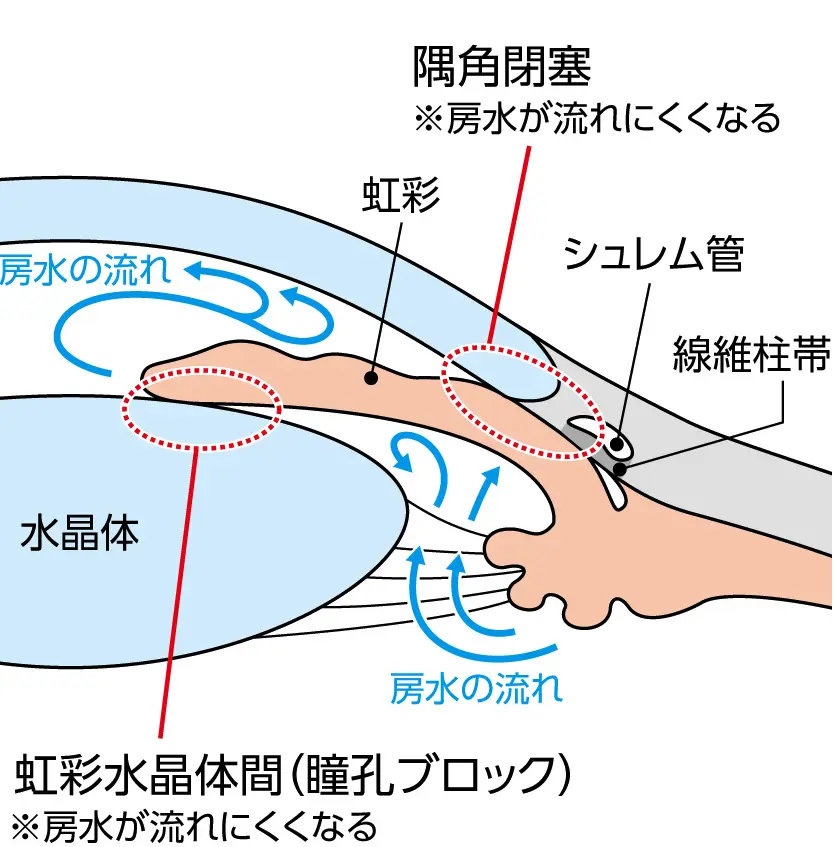
In farsighted eyes, the drainage pathway inside the eyeball (the angle) can be narrow.
• Reading in a dark place
• Using cold medicine
• Using anticholinergic drugs
and the like
can cause a “glaucoma attack.”
(Acute angle-closure glaucoma)
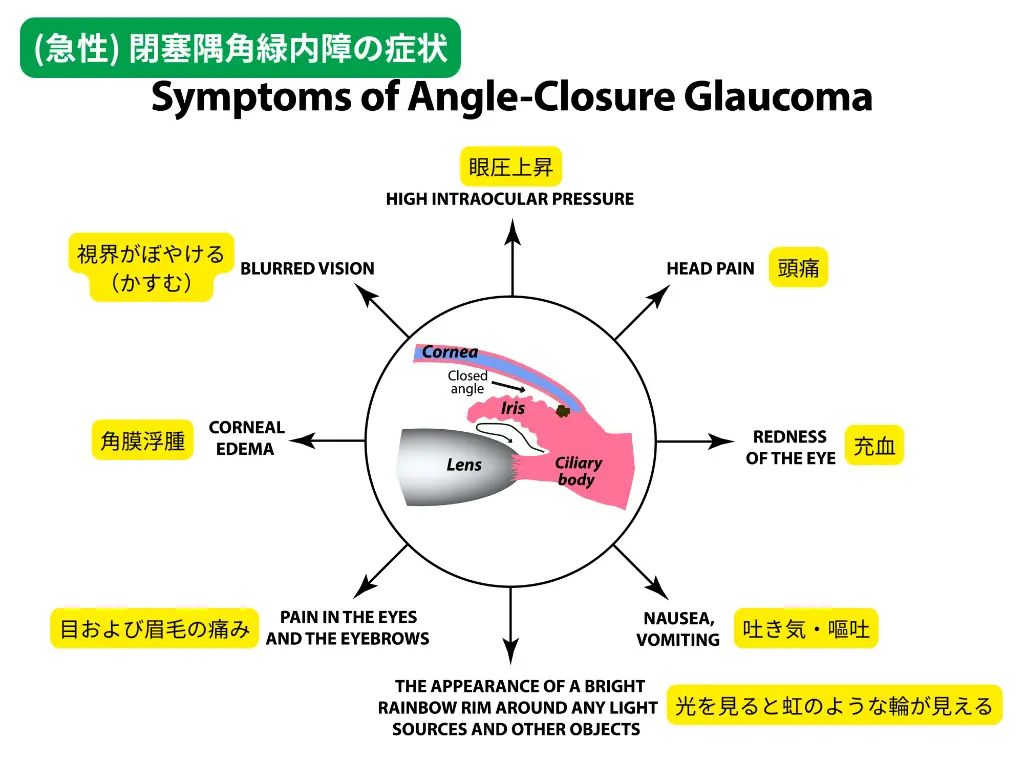
The angle closes (= the drainage pathway becomes blocked)
→ Eye pressure rises sharply
→ The following symptoms appear
[Symptoms of a glaucoma attack]
• Headache
• Vomiting
• Blurred vision (hazy vision)
• Red eye
• Eye pain
• Glare and halos around lights
Patients often see an internal-medicine doctor or a neurosurgeon, and the cause may be missed.
It is a disease that every doctor should know, and it sometimes appears on the national medical licensing examination.
(Case)
I once saw a patient who had a glaucoma attack after crying for several hours out of sadness.
The patient had farsighted eyes (= good eyesight).
Predisposition of farsighted eyes
+ pupil dilated in the dark
+ head kept down for a long time, so the lens moves down and closes the angle
= glaucoma attack
was my reasoning.
Eyes with advanced cataract may also have a narrowed angle.
Cataract progression
→ swelling of the lens
narrows the angle.
Eye pressure may be raised.
Cataract surgery is sometimes performed to lower eye pressure.
PACS (primary angle closure suspect): suspected primary angle-closure glaucoma
“Good eyesight since I was young”: in many cases, this means the eyes are farsighted.
PACS (primary angle closure suspect): suspected primary angle-closure glaucoma
There is a study result that “within 5 years, 22% progress to primary angle-closure glaucoma (PAC)”1。
We judge the state of the angle with a slit-lamp microscope and follow it, paying attention to rises in eye pressure.
Anterior segment OCTlets us show you the shape of the angle directly.
Preventing glaucoma attacks: the modern approach
Medical common sense from a few years ago may have changed greatly.
For farsighted eyes and eyes with a narrow angle (PACS), preventive treatment against glaucoma attacks is sometimes performed.
In the past, laser iridotomy (LI) was performed.
The 2019 Lancet paper states that
“prophylactic laser peripheral iridotomy is not recommended”2。
Cataract surgery is now the mainstream.
(Reason)
In laser iridotomy, both argon and YAG lasers are used to make a hole in the iris.
At that time, quite strong energy is applied within the anterior chamber (= the front part of the eyeball), and the corneal endothelium is damaged.
The damaged corneal endothelium can lead to bullous keratopathy decades later.
Bullous keratopathy is treated by corneal transplantation (penetrating keratoplasty, endothelial keratoplasty).
Both are surgical treatments performed at limited facilities and require general anesthesia.
There is also the risk of rejection after corneal transplantation.
It places a considerable burden on a body that has grown older.
* A new era is also arriving, with the regenerative medicine of Dr. Okumura and Professor Kinoshita at Kyoto Prefectural University of Medicine (transplantation of cultured corneal endothelial cells for bullous keratopathy)3。
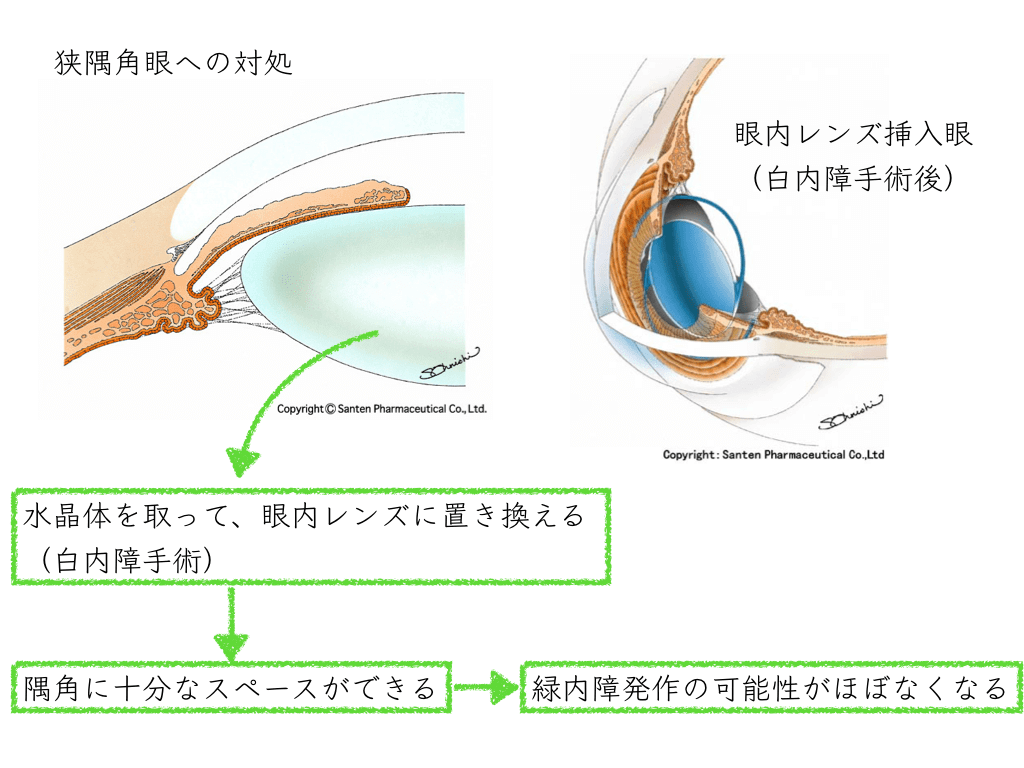
Cataract surgery for PACS
The lens, which takes up a relatively large space, is removed and replaced with a single thin intraocular lens.
The angle becomes wider, and the risk of a glaucoma attack almost disappears.
Timing of cataract surgery:
Operating on an eye that sees well and causes no trouble requires sufficient explanation and understanding.
1. Thomas, R., George, R., Parikh, R., Muliyil, J., Jacob, A., 2003. Five year risk of progression of primary angle closure suspects to primary angle closure: a population based study. Br J Ophthalmol 87, 450–454.
2. He, M., Jiang, Y., Huang, S., Chang, D.S., Munoz, B., Aung, T., Foster, P.J., Friedman, D.S., 2019. Laser peripheral iridotomy for the prevention of angle closure: a single-centre, randomised controlled trial. The Lancet 393, 1609–1618. https://doi.org/10.1016/S0140-6736(18)32607-2
3. Kinoshita, S., Koizumi, N., Ueno, M., Okumura, N., Imai, K., Tanaka, H., Yamamoto, Y., Nakamura, T., Inatomi, T., Bush, J., Toda, M., Hagiya, M., Yokota, I., Teramukai, S., Sotozono, C., Hamuro, J., 2018. Injection of Cultured Cells with a ROCK Inhibitor for Bullous Keratopathy. New England Journal of Medicine 378, 995–1003. https://doi.org/10.1056/NEJMoa1712770