![Takeru Eye Clinic | Takatori Shopping Street, Sawara-ku, Fukuoka City [Nishijin Station / Fujisaki Station]](https://takeru-eye.com/wp-content/uploads/2022/10/takeru_logo_for-WP-header.png)
Effects of Visual Field Loss on Daily Life and How to Prevent Them
Introduction
One of the questions glaucoma patients ask most often is, “Is there anything I should watch out for in daily life?”
Measures against the risk of falling are especially important.
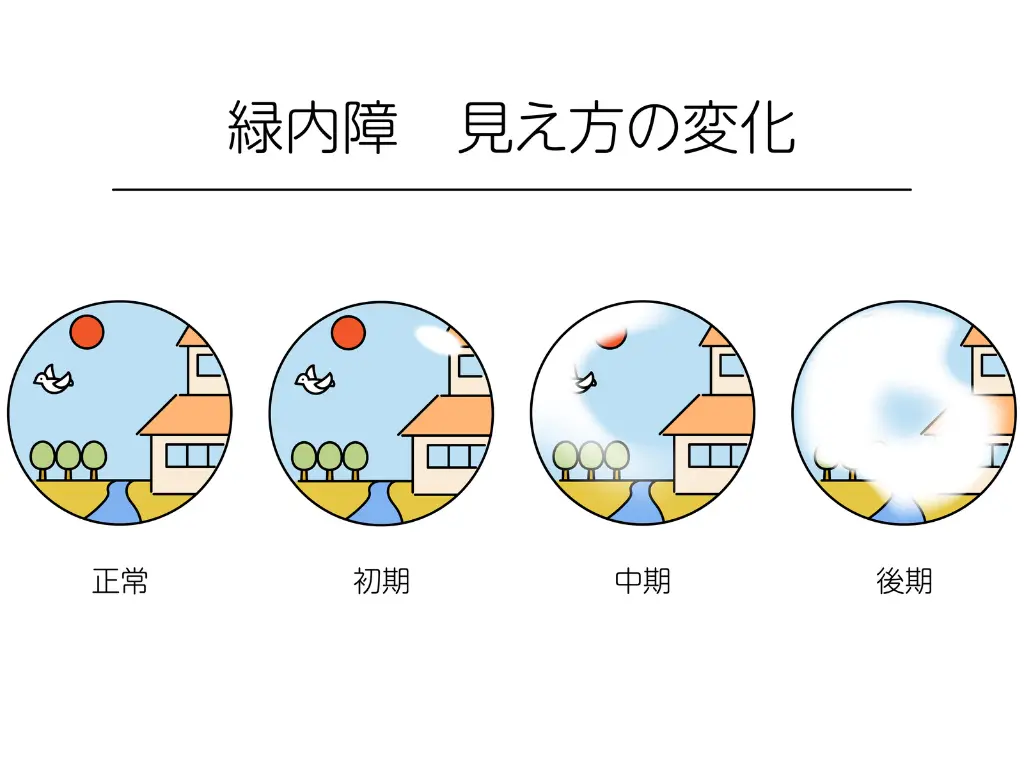
This is because the visual field loss caused by glaucoma makes it hard to notice steps and obstacles, which can lead to falls.
In this article, I explain in detail what glaucoma patients, as well as their families and caregivers, should know about fall risk and concrete countermeasures.
An interactive guide to living safely every day
The visual field changes caused by glaucoma affect walking safety more than you may realize. In particular, the following four factors work together to raise the risk of falling. Hover over the chart below to see details of each factor.
The Relationship Between Glaucoma and Fall Risk

How Visual Field Loss Affects Falls
Visual field loss caused by glaucoma is a major factor that raises the risk of falling. Particular attention is needed for the following reasons.
The Importance of the Lower Visual Field
In glaucoma, loss of the lower visual field (the field used to look at your feet) tends to occur, and this is closely related to fall risk.
Being unable to notice steps or obstacles underfoot makes tripping and falling more likely when walking.
Decline in Binocular Vision

As glaucoma progresses, stereopsis (the perception of distance) declines. Studies have shown that the stereoacuity threshold of glaucoma patients is significantly higher (worse) than that of healthy people (4). It becomes hard to judge stair steps and uneven floors accurately, which raises the risk of missing a step.
Effects on Vision at Night and in the Dark

In dim environments, glaucoma patients reach only lower contrast sensitivity than healthy people, so it takes them longer to obtain adequate visual function.
However, it has been reported that, in objective measurements, the light/dark adaptation time itself is similar to that of healthy people (9).
For this reason, the risk of falling is especially high in dark places.
*Light/dark adaptation time:
The time it takes for your eyes to get used to the dark and see things after moving from a bright place to a dark one. It is the same phenomenon as entering a movie theater: at first it is too dark to see your seat, but gradually you can see.
Serious Consequences of Falls
A fall is not just an injury; it can have serious consequences such as the following.
- Fractures (especially hip fractures)
- Head injury
- Increased risk of becoming bedridden
- Activity restriction due to fear of falling
- Decline in quality of life (QOL)
What the Research Shows About Glaucoma and Falls
Glaucoma and Fall Risk
An Often-Overlooked Danger: Fall Rates in Glaucoma Patients and the Importance of the Lower Visual Field
Comparison of Fall Rates
Healthy individuals
At least one fall in 12 months
Glaucoma patients
At least one fall in 12 months
2.7 times the fall risk
(adjusted odds ratio: 2.7, 95% confidence interval: 1.18-6.17)
The Danger of Advanced Glaucoma
In patients with advanced glaucoma, compared with healthy individuals,
the risk of falling is a strikingabout 8 times higher.
The Importance of Lower Visual Field Loss
With loss of the lower visual field,
the fall rate1.57 times higher.
The faster the lower visual field worsens, the higher the risk of falling.
For every0.5 dB/year faster the worsening,
the risk of falling2.47 times higher.
Visual Field Progression Rate and Falls
For every0.5 dB/year faster the visual field worsens,
the risk of falling2.28 times higher.
🚨 **Key Points** 🚨
Independent of the current severity of the disease,
the rate of progression itself is a risk factor.