![Takeru Eye Clinic | Takatori Shopping Street, Sawara-ku, Fukuoka City [Nishijin Station / Fujisaki Station]](https://takeru-eye.com/wp-content/uploads/2022/10/takeru_logo_for-WP-header.png)

In the eye clinic, I hear more than you might expect the complaint, “I feel my eyelids are drooping a little.”
Many people notice changes such as “in the mirror my eyes look smaller than before,” “in photos only one eye looks narrow,” or “they feel especially heavy in the evening,” yet hesitate to see a doctor, thinking “it’s not bad enough for surgery.”
Some are anxious about being recommended surgery, some cannot take so-called “downtime,” and some would like to try eye drops first. A drug that responds to these wishes is going on sale in Japan in May 2026.
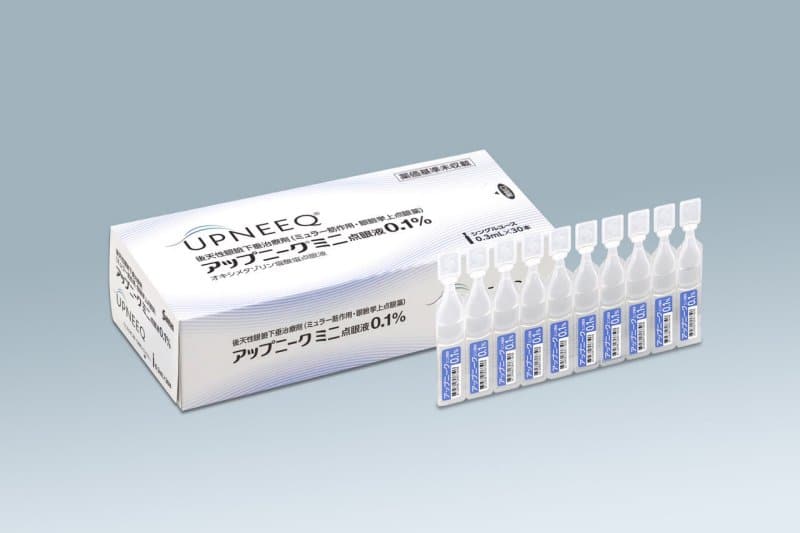
It is Upneeq® Mini ophthalmic solution 0.1% (generic name: oxymetazoline hydrochloride). It is the first drug approved in Japan as an eye drop treatment for acquired blepharoptosis (drooping eyelid).
Upneeq® Mini ophthalmic solution 0.1% went on sale today. Our clinic began prescribing it today as well. At the first visit, diagnosis and exclusion of other conditions are done under insurance coverage. The fee for the second and later visits (prescription fee included) is¥2,200 (tax included), with the drug cost charged separately.
If you have symptoms like the following, you may have blepharoptosis other than the age-related (aponeurotic) type. This drug is not indicated, and urgent investigation may be needed. Please see an eye doctor first.
- The eyelid dropped suddenly (acute onset)
- Things look double (diplopia)
- The pupils differ in size between the two eyes (anisocoria)
- Symptoms worsen in the evening or when tired (diurnal variation)
- There is an abnormality in eye movement (ocular motility disorder)
⚠ About use for cosmetic purposes
Upneeq® is a drug approved as a treatment for acquired blepharoptosis. Use by people without a diagnosis of blepharoptosis, or solely for cosmetic wishes, is off-label. The treatment guidelines of the Japanese Neuro-Ophthalmology Society and the Japan Society of Ophthalmic Plastic and Reconstructive Surgery also clearly prohibit use for cosmetic purposes.
| Item | Cost (tax included) |
|---|---|
| First visit (covered by insurance) | Insurance points (the copayment at the counter depends on your insurance ratio) |
| Return visit / examination fee (prescription fee included) | ¥2,200 |
| Drug cost (1 box of 30 vials) | ¥4,890 |
| Total for a return visit (guide) | ¥7,090 |
* The first visit is covered by insurance, so it is not included in the total above.
▶ Details of Upneeq® care (indications, costs and the flow at our clinic) are summarized on thededicated page.
What is acquired blepharoptosis?
Blepharoptosis is a condition in which the upper eyelid sits lower than normal.
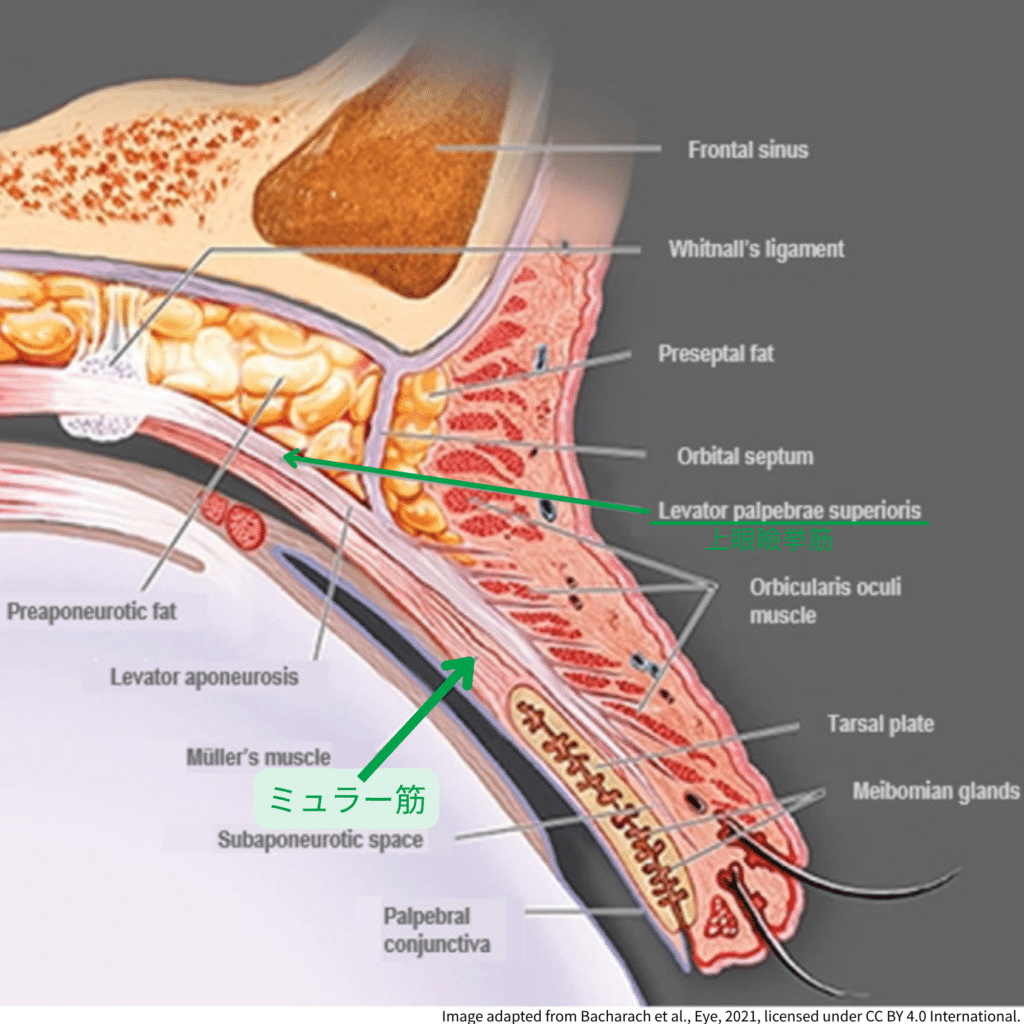
There are two muscles that lift the eyelid: the levator palpebrae superioris, a voluntary muscle (one you can move at will), and Müller’s muscle, a smooth muscle controlled by the sympathetic nerves. Most acquired blepharoptosis is “aponeurotic blepharoptosis,” in which the tendon of the levator palpebrae superioris stretches or loosens and the eyelid drops¹.
The main cause is aging, but it can also be caused by long-term wear of hard contact lenses¹. This is because the motion of putting lenses in and taking them out puts stress on the aponeurosis over many years.
When the eyelid drops, the upper part of the visual field becomes harder to see. Also, because you unconsciously raise your eyebrows to open your eyes, headaches and stiff shoulders can occur. It affects many aspects of daily life, such as eyes looking smaller².
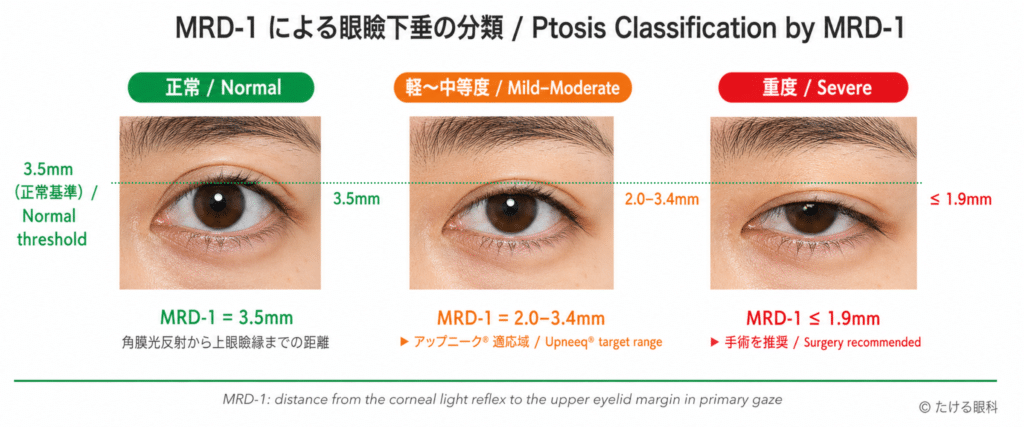
A widely used index of severity is the distance from the pupillary light reflex to the upper eyelid margin (Marginal Reflex Distance-1, MRD-1). The normal value is 3.5 mm or more; 2.0–3.4 mm is a guide for mild to moderate, and 1.9 mm or less for moderate to severe³.
Conventional treatment and its limits
Until now, the only fundamental treatment for acquired blepharoptosis was surgery. Representative procedures are levator advancement, which tightens the aponeurosis, and Müller muscle-conjunctival resection (MMCR), which resects and shortens Müller’s muscle¹.
Surgery can be expected to improve the condition, but what worries many patients is the so-called “downtime.” Swelling and bruising after surgery, adjusting left-right differences, and the psychological hurdle of “cutting” itself are not small.
“It’s only drooping a little; is that enough to need surgery?” “I’d like to try something first and then think.” In response to such voices, the non-invasive options ophthalmologists could offer have been limited until now.
The arrival of Upneeq® eye drops
Upneeq® Mini ophthalmic solution 0.1% (oxymetazoline hydrochloride) obtained manufacturing and marketing approval in Japan on December 22, 2025, and is to go on sale from Santen Pharmaceutical on May 15, 2026. It is the first drug approved in Japan as an eye drop for acquired blepharoptosis.
The active ingredient oxymetazoline is an imidazoline-type sympathomimetic that has long been used as a nasal decongestant and an eye redness reliever. At the 0.1% concentration used in Upneeq®, it acts on Müller’s muscle of the upper eyelid and produces the effect of lifting the eyelid⁴.
How does it lift the eyelid?
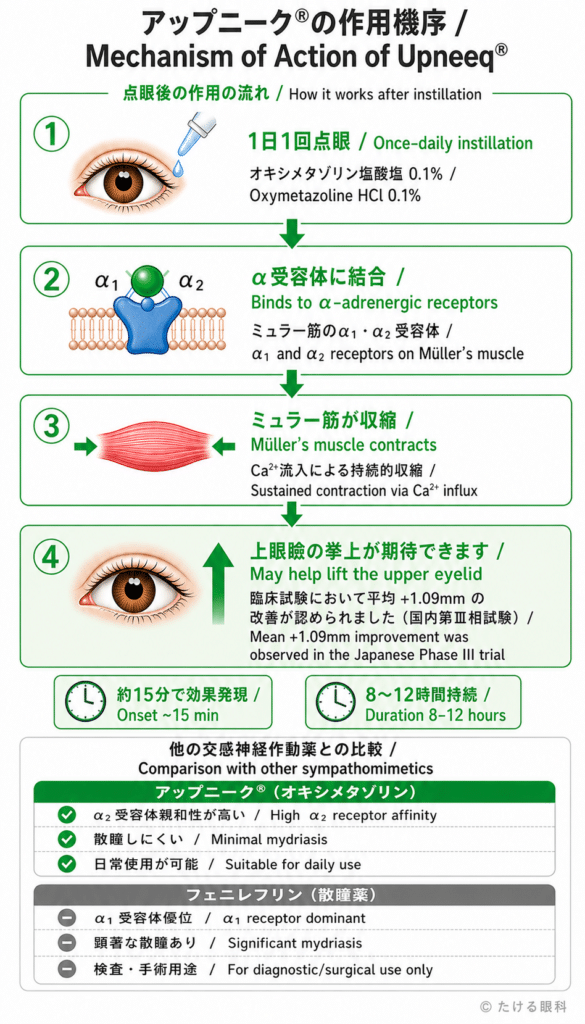
Let me explain the mechanism of action in a little more detail.
Müller’s muscle is a smooth muscle rich in α1 and α2 adrenergic receptors. When oxymetazoline binds to these receptors, the calcium ion concentration in the muscle rises, causing sustained contraction and lifting the eyelid⁴.
Some people may wonder, “why doesn’t it dilate the pupil?” Phenylephrine, another sympathomimetic, strongly stimulates the α1 receptors of the iris dilator muscle and is therefore used as a mydriatic for examinations and surgery. Oxymetazoline, on the other hand, has high affinity for α2 receptors, so excessive stimulation of the iris dilator is suppressed and almost no pupil dilation occurs⁵. That is why it can be used in daily life.
The effect begins about 15 minutes after instillation and is reported to last roughly 8–12 hours⁴.
What clinical trials have confirmed
In a domestic phase III placebo-controlled randomized controlled trial (hereafter, the domestic phase III trial), a total of 336 patients with acquired blepharoptosis were divided into three groups, once-daily dosing (QD), twice-daily dosing (BID) and placebo, and efficacy was evaluated6. The following are the results for the once-daily group (112 patients).
The primary endpoint was the change from baseline in MRD-1 two hours after instillation on day 14. As a result, in the Upneeq® once-daily group MRD-1 improved by a mean of +1.09 mm, a statistically significant difference from +0.50 mm in the placebo group (difference from placebo: +0.59 mm, p<0.05)⁶.
A pooled analysis of two phase III randomized controlled trials conducted in the United States also showed similar efficacy, and a significant improvement in the upper visual field was also confirmed7。
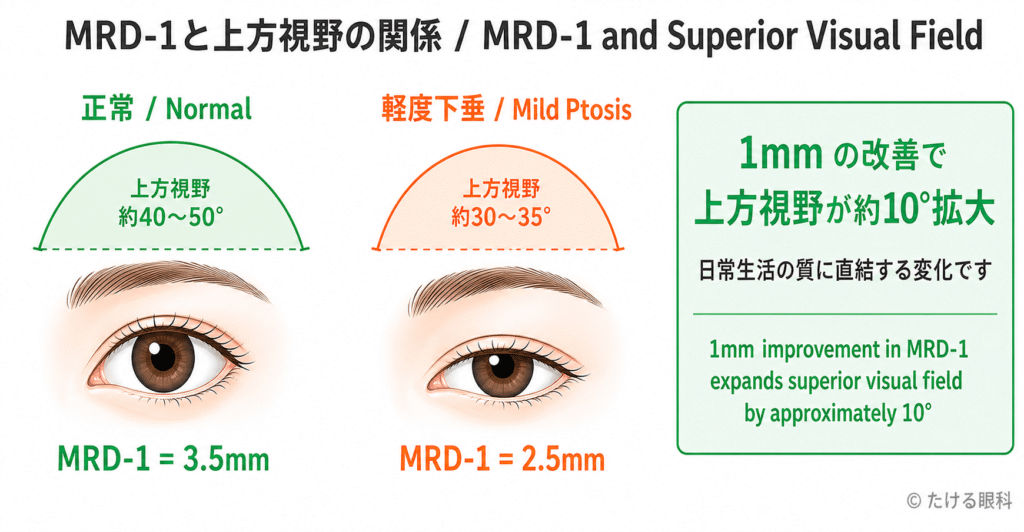
The figure of 1 mm may look small. However, it has been reported that even a slight improvement in MRD-1 widens the upper visual field that had been hidden by the eyelid7, and for people with mild to moderate blepharoptosis it is a change that bears directly on quality of daily life.
Also, in a 6-month long-term administration study, within the scope of the study, no attenuation of effect (tachyphylaxis) or rebound was confirmed⁶.
Who it is for
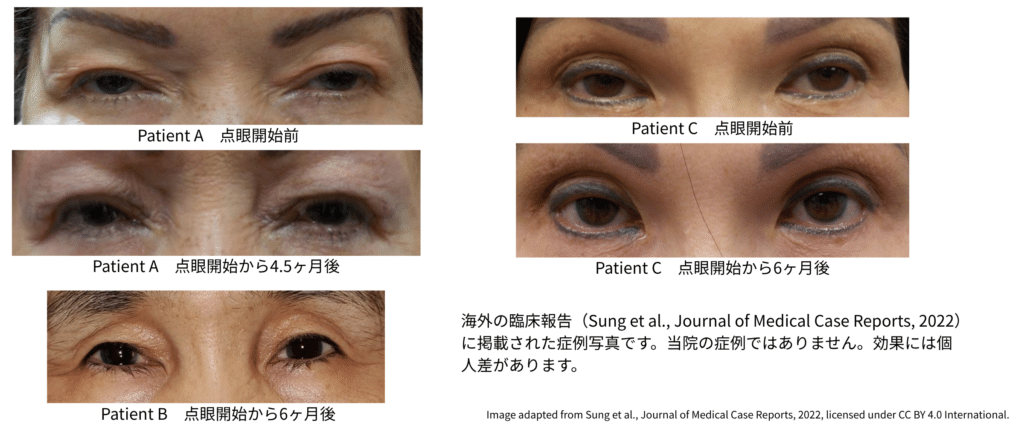
The indication of Upneeq® is acquired blepharoptosis.
The main targets are people with aponeurotic blepharoptosis from aging or long-term contact lens use whose MRD-1 is in the mild to moderate range (about 1.5–3.4 mm). It is a useful option for those who do not want surgery, who are unsure about surgery, or who want to try the effect first and then decide.
On the other hand, the following are outside the indication of this drug (the doctor judges individually).
Congenital blepharoptosis is mainly underdevelopment of the levator muscle itself, so stimulating Müller’s muscle alone does not give sufficient improvement. The same applies to blepharoptosis from neuromuscular diseases such as myasthenia gravis, Horner syndrome and oculomotor nerve palsy; for these, diagnosis and treatment of the underlying disease take priority¹.
Acute blepharoptosis, or cases with diplopia, anisocoria or diurnal variation, are outside the indication of this drug (please see the cautions at the beginning).
In the treatment guideline (2025) drawn up by the Japanese Neuro-Ophthalmology Society and the Japan Society of Ophthalmic Plastic and Reconstructive Surgery, acquired blepharoptosis is within the indication regardless of whether MRD-1 is mild, moderate or severe. Even in severe cases (MRD-1 about 0 mm) it is possible to try the drops, but an improvement of around 1 mm from the drops is often insufficient to restore visual function, and surgical treatment generally takes priority.
Safety and points to watch
The rate of adverse reactions in the domestic phase III trial was low; in the once-daily group, conjunctival hyperemia occurred in 1 of 112 patients⁶.
However, an analysis of the U.S. FDA Adverse Event Reporting System (FAERS) reported in 2026 newly pointed out the following risks in real-world practice⁸.
Note that FAERS is a spontaneous reporting system and does not show causality or accurate incidence. Individual evaluation that takes background factors into account is needed.
In real-world use, mydriasis was reported at a frequency of 5.6%. In people with untreated angle-closure glaucoma, it has been pointed out that this could lead to an acute glaucoma attack.
Blood pressure elevation was also reported in 1.6%, and careful follow-up is needed in people with hypertension or cardiovascular disease.
In addition, vitreous and retina-related adverse events (retinal detachment, posterior vitreous detachment and others) were also seen in a certain number, and for people with high myopia or retinal degeneration it is considered desirable to prescribe after a fundus evaluation⁸.
The most important safety risk isan acute glaucoma attack in patients with untreated narrow or closed angles. Because oxymetazoline is an α agonist, its secondary mydriatic effect cannot be completely eliminated. If prescribed to a patient with a narrow-angle structure, it could cause an acute angle-closure glaucoma attack and lead to serious visual impairment. The treatment guideline of the Japanese Neuro-Ophthalmology Society and the Japan Society of Ophthalmic Plastic and Reconstructive Surgery also explicitly states angle-closure glaucoma as an important precaution for use. In ICL wearers, whose number has been increasing in recent years, careful evaluation of the same structural risk is also needed. Before prescribing, we recommend checking the anterior chamber depth with a slit-lamp microscope and, if necessary, performing gonioscopy⁴ ¹¹.
MAO (monoamine oxidase) inhibitors (selegiline, rasagiline, safinamide and others, drugs used mainly for Parkinson’s disease) can cause a sudden rise in blood pressure and are listed as requiring caution with Upneeq®⁴. Emphasizing safety, our clinic in principle does not prescribe Upneeq® to people taking these drugs. If you are currently taking any of them, please be sure to tell us beforehand.
Relationship to surgery
Upneeq® is not a replacement for surgery but one of the options.
For moderate to severe blepharoptosis with MRD-1 of 1.5 mm or less, an improvement of about 1 mm from the drops is often insufficient to restore visual field and function, and surgical treatment such as levator advancement or MMCR takes priority¹.
On the other hand, using Upneeq® as a simulation of surgery has also been reported. By having the patient actually experience the state after instillation, you can share in advance an image of how things will look and how the appearance will be after surgery³.
Hering’s law of equal innervation also needs attention. When ptosis of one eye is improved with Upneeq®, the brain weakens the lifting command to both eyes, and the opposite eyelid may appear to droop. This phenomenon can occur with either surgery or eye drops, and it is important to explain it beforehand³.
According to the views of the Japanese Ophthalmological Society and the Japan Ophthalmologists Association, if you start self-pay treatment with Upneeq®, to have blepharoptosis surgery covered by insurancean interval of 6 months or more is requiredit is stated※. Also, if you want surgery during self-pay treatment, the surgery as well is entirely self-pay. If you may want surgery, please consult your doctor and consider the treatment policy.
* Japanese Ophthalmological Society and Japan Ophthalmologists Association. Points to note when providing self-pay care for acquired blepharoptosis (Q&A). Created May 12, 2026.
Position as self-pay care
Upneeq® Mini ophthalmic solution is not listed on the NHI drug price list, and it is self-pay care paid entirely out of pocket.
If you want Upneeq® on the same day as insurance-covered care for glaucoma, cataract and so on, we can accommodate that as well. In that case we create separate charts for insured care and self-pay care. Please tell the reception staff when you visit.
One box contains 30 vials, and one vial is for a single use. The package insert states to discard the first 1–2 drops before instillation. Because it must be protected from light, store it at room temperature in its aluminum pillow package⁴.
Our flow
At the first visit, we measure MRD-1 from anterior segment photographs and check levator function to evaluate the degree and cause of the blepharoptosis. We then do a trial of one drop on the spot and check the response 15–30 minutes later, which lets us evaluate Müller’s muscle responsiveness.
If levator function is reduced, or if we see diplopia, anisocoria or diurnal variation, we suspect a condition other than aponeurotic and consider further investigation or referral to a specialist institution.
After you have experienced the effect, we consider prescribing. A prescription starting from 10 vials (10 days’ supply) is also possible.
Follow-up checks the course roughly 1–2 weeks, 1 month and 3–6 months after starting the drops. For people with high myopia or cardiovascular disease in particular, we observe carefully, including evaluation of the fundus and blood pressure.
Key points
For the first time, an option other than surgery for acquired blepharoptosis has appeared.
For people with only a slight droop, who want to avoid surgery, or who want to try first, I feel I can now offer ophthalmologists’ new things to talk about.
After carefully judging the indication and evaluating safety, I would like to talk with each patient about the method that suits them.
References
- Slonim CB, Foster S, Jaros M, et al. Association of Oxymetazoline Hydrochloride, 0.1%, Solution Administration With Visual Field in Acquired Ptosis: A Pooled Analysis of 2 Randomized Clinical Trials. JAMA Ophthalmol. 2020;138(11):1168-1175. doi:10.1001/jamaophthalmol.2020.3812
https://pmc.ncbi.nlm.nih.gov/articles/PMC7530825/ - Cahill KV, Bradley EA, Meyer DR, et al. Functional indications for upper eyelid ptosis and blepharoplasty surgery: a report by the American Academy of Ophthalmology. Ophthalmology. 2011;118(12):2510-2517. doi:10.1016/j.ophtha.2011.09.029
https://pubmed.ncbi.nlm.nih.gov/22019388/ - Bacharach J, Lee WW, Harrison AR, Freddo TF. A review of acquired blepharoptosis: prevalence, diagnosis, and current treatment options. Eye (Lond). 2021;35(9):2468-2481. doi:10.1038/s41433-021-01547-5
https://pubmed.ncbi.nlm.nih.gov/33927356/ - Santen Pharmaceutical Co., Ltd. Upneeq® Mini Ophthalmic Solution 0.1% package insert and interview form. 2026.
https://www.santen.co.jp/ - Haenisch B, Walstab J, Herberhold S, et al. Alpha-adrenoceptor agonistic activity of oxymetazoline and xylometazoline. Fundam Clin Pharmacol. 2010;24(6):729-739. doi:10.1111/j.1472-8206.2009.00805.x
https://pubmed.ncbi.nlm.nih.gov/20030735/ - Ishikawa H, Oka K, Inoue H. Six-month efficacy and safety of oxymetazoline hydrochloride 0.1% in Japanese patients with acquired blepharoptosis: a phase 3 study. Jpn J Ophthalmol. Published online April 10, 2026. doi:10.1007/s10384-026-01340-5
https://pubmed.ncbi.nlm.nih.gov/41961227/ - Slonim CB, Foster S, Jaros M, et al. Association of Oxymetazoline Hydrochloride, 0.1%, Solution Administration With Visual Field in Acquired Ptosis: A Pooled Analysis of 2 Randomized Clinical Trials. JAMA Ophthalmol. 2020;138(11):1168-1175. doi:10.1001/jamaophthalmol.2020.3812
https://pubmed.ncbi.nlm.nih.gov/33001144/ - Azzam DB, Hong JD, Chen TH, et al. Safety Analysis of Oxymetazoline Eye Drops for Blepharoptosis Using the FDA Adverse Event Reporting System. Ophthalmic Plast Reconstr Surg. Published online April 8, 2026. doi:10.1097/IOP.0000000000003226
https://pubmed.ncbi.nlm.nih.gov/41949436/ - Putterman AM, Urist MJ. Müller muscle-conjunctiva resection. Technique for treatment of blepharoptosis. Arch Ophthalmol. 1975;93(8):619-623. doi:10.1001/archopht.1975.01010020595007
https://pubmed.ncbi.nlm.nih.gov/1156223/ - Ben Simon GJ, Lee S, Schwarcz RM, McCann JD, Goldberg RA. External levator advancement vs Müller’s muscle-conjunctival resection for correction of upper eyelid involutional ptosis. Am J Ophthalmol. 2005;140(3):426-432. doi:10.1016/j.ajo.2005.03.033
https://pubmed.ncbi.nlm.nih.gov/16083839/ - Ishikawa H, Watanabe A. Treatment guideline for oxymetazoline (0.1%) eye drop therapy for acquired blepharoptosis. Journal of the Japanese Ophthalmological Society. 2025. doi:10.60330/nggz-2025-054