![Takeru Eye Clinic | Takatori Shopping Street, Sawara-ku, Fukuoka City [Nishijin Station / Fujisaki Station]](https://takeru-eye.com/wp-content/uploads/2022/10/takeru_logo_for-WP-header.png)

Since opening in this Takatori shopping street in October 2018, we have, thanks to everyone, reached the milestone of our 7th anniversary.
We sincerely thank the people of the community, patients who come from afar, and all the staff who have walked with us, for making this possible.
Over these seven years, technology and equipment have changed, but our core philosophy has not.
That is
“an attitude of being kind to people and facing them wholeheartedly,”
and of continuing to explain increasingly advanced ophthalmic care “as clearly and carefully as possible until the patient understands.”
This is our way of thinking.
In the treatment of glaucoma and diabetic retinopathy, which progress without subjective symptoms, the patient’s own deep understanding of “why treatment is necessary” is as important as the treatment itself.
To realize this “medical care that patients are deeply convinced of,” what have we thought about, and what kind of system have we built?
At the milestone of our 7th anniversary, I have gathered the somewhat distinctive aspects of our clinic and the thinking behind them.
Why we place the highest priority on “explanation” and “time for dialogue”
In my days as a hospital physician until summer 2018, I felt the hesitation of having “not been able to convey the explanation sufficiently.”
I myself did not grow up in a special family of doctors and saw the medical setting from what you might call an ordinary viewpoint, so I felt that difficult technical terms and one-sided explanations are still common.
Resolving the anxieties and questions patients hold, and helping them objectively understand the state of their own eyes.
Because of this process, I believe patients become able to take on treatment positively.
However, securing enough time for dialogue within limited consultation time takes some ingenuity.
So that staff and physicians can devote themselves to “person-to-person dialogue,” we have actively used IT since opening.
An approach of explaining from the background of the disease
Why does the disease occur? Even within limited time, we try to convey the “core” of the fundamental reason, the “cause.”
Sometimes I touch a little on immunology as well, and I make a point of devising ways of explaining so that patients can firmly understand their own condition.
Thorough visual explanation
In the examination room, we display the patient’s test images and the explanatory images on our website on a large vertical monitor and a large iPad.
The monitor is set at the patient’s eye level so that images can be viewed comfortably without looking up, to help patients grasp their own condition intuitively.
Creating “time for dialogue” through DX
By introducing systems such as online questionnaires, automatic reception and payment machines, and a 24-hour AI chatbot, we automate the administrative work that arises in medical settings.
This is not mere operational efficiency, but an effort
to let staff concentrate on work that calls for warm, human care, such as testing patients and explaining to them.
Continuous information and its use in care
On our website, we continuously post easy-to-understand articles about various complex diseases, including uveitis and keratoconus,
while referring to the academic literature.
We also display these articles and images on the monitor as explanatory material in actual care, and let patients look back at them via a link after they go home.
All of this is the foundation for realizing medical care that shares “understanding” through dialogue.
Three areas of expertise that support our philosophy
The rough direction I had in mind at opening has deepened over these seven years of daily practice and experience into our clinic’s own areas of expertise.
1. Care incorporating the viewpoint of immunology
One of the directions at opening was “so that patients with uveitis, my specialty, can always visit with peace of mind.”
Behind this is
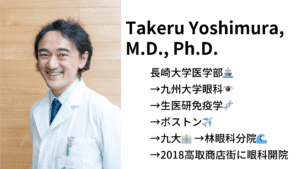
my immunology research (obtaining a Doctor of Medical Science degree) at the “Medical Institute of Bioregulation,” located on the grounds of the Kyushu University Faculty of Medicine,
and then my work on refractory ocular inflammatory diseases in Boston, USA.
My research activities at the university have come to a close, but the knowledge and experience gained there are the foundation of my present practice.
Knowledge of immunology is the basis for understanding not only uveitis but also allergic eye diseases, corneal diseases, and even some retinal diseases.
Having studied immunology deeply is also a path for thinking about eye symptoms accompanying systemic diseases, and I apply this knowledge to daily care and management.
In particular, the ultra-widefield fundus imaging device “Mirante,” introduced in 2021, can photograph a wide area of the fundus without dilation (opening the pupil), and has become an indispensable instrument for accurately grasping the spread of inflammation, such as vitreous opacities and vasculitis of the peripheral retina.
We also maintain a cooperative system with the Uveitis Clinic of Kyushu University Hospital, working to provide highly specialized care.

2. Pediatric ophthalmology that protects children’s futures
We see a wide range of ages from 0 to the 90s, but especially many child patients visit.
Around 2018, when we opened, myopia control treatment for children was not yet common in Japanese ophthalmic practice.
Having felt the importance of myopia control treatment while researching overseas papers, we have posted an explanation of it on our website since opening.
From the beginning, we used self-diluted atropine eye drops.
Since Santen Pharmaceutical’s “Ryjusea® Mini ophthalmic solution 0.01%” was released in April 2025, we no longer prepare self-diluted drops.
Ryjusea® Mini eye drops for slowing myopia progression in children are, at present, self-pay care not covered by insurance.
Also, in children’s visual development, early detection of amblyopia and strabismus is extremely important.
At our clinic, bright and energetic orthoptists (COs) perform many tests every day.
All our staff are graduates of Fukuoka International University of Health and Welfare (including its days as a vocational school), and having a shared educational background is also a strength of our clinic.
Using specialized equipment such as the Spot Vision Screener, which can test even infants, and a large amblyoscope (synoptophore) that examines in detail how both eyes work together, we strive to detect early the problems that are easily missed in 3-year-old checkups and the like.
3. English-language care and specialized review work
Another direction at opening was “so that patients who speak only English can visit without hesitation.”
This policy came from my own experience in Boston, USA, when I fell ill in an unfamiliar place and strongly felt the anxiety of being unable to speak in my native language.
Our clinic, as a “English-friendly Ophthalmology Practice”, also routinely provides care in English.
English is handled mainly by the physician, but staff also cooperate, using English questionnaires and translation tools, to support smooth care.
We also handle US-related international medical reviews.
Seven years of history: the evolution of the technology and system supporting our philosophy
Our clinic was not a succession-type opening; it started small from zero.
Therefore, the technology and equipment to realize our philosophy of “medical care that patients are deeply convinced of” could not all be assembled at once.
Many things have been enriched little by little, steadily, judging their necessity in daily practice.
Here are the main initiatives introduced and developed over these seven years, in chronological order.
| Time | Main equipment introduced / system developed | Purpose / role |
|---|---|---|
| October 2018 (at opening) | Accommodation analyzer (Accomo-Ref) | Visualizes the causes of eye strain (asthenopia) in graphs and is used for explanations. |
| 2019.05 | Corneal topography device | Early detection of keratoconus, and starting orthokeratology treatment (a myopia treatment program). |
| 2020.07 | YAG/SLT laser treatment device | Provides non-surgical glaucoma treatment (SLT) as an option. |
| 2020.12 | Spot Vision Screener | Strengthens amblyopia screening in infants. |
| 2021.07 | Large amblyoscope (synoptophore) | Supports detailed testing of strabismus and binocular function, expanding pediatric ophthalmic care. |
| 2021.08 | Ultra-widefield fundus imaging device (Mirante) | Photographs a wide area of the fundus in high definition without mydriatics. Improves the quality of retina, uveitis and glaucoma care. |
| 2024.04 | Hiring of 2 new-graduate orthoptists (CO) | Strengthens pediatric care and the specialized testing system. |
| 2024.07 | Introduction of an AI chatbot | Automates the provision of information on care and access, 24 hours a day, 365 days a year. |
| 2025.07 | Major expansion of the “Eye checkup (Ganka Dock)” | Greatly enriches the preventive medicine (early detection) system beyond the scope of insured care. |
A shift from treatment to “prevention”
What we have become especially aware of over these seven years is the importance of “preventive medicine.”
With glaucoma and age-related macular degeneration, it is not rare for the disease to be already considerably advanced by the time subjective symptoms appear.
The same is true of myopia in children.
After practicing as an ophthalmologist for many years, one becomes able to predict to some extent what future risks (such as retinal detachment and myopic maculopathy) strong myopia leads to.
It was once thought that “myopia is not a disease” and “progression cannot be stopped.”
But now that myopia control treatment is possible, common sense in ophthalmology has changed.
“Intervene while the child is young and reduce future risk.”
I have come to feel that we need to communicate this true importance even more actively.
Insured care is in principle aimed at treating disease.
For that reason, we had not been able to respond sufficiently to requests such as “I’m healthy now, but I want to know my eye condition well in preparation for the future.”
To address this issue, from July 2025 we decided to greatly expand the fully appointment-based “Eye checkup (Ganka Dock).”
This is a proactive preventive program that goes beyond the scope of insured care and aims at early detection and risk management at the stage before symptoms appear.
Ties with the community and a “happy workplace”
I believe the “bright and kind care” we aim for can be realized only when the staff themselves are healthy in mind and body.
Since opening, our clinic has set the goal of “creating a happy workplace,” and does not adopt the seniority-based thinking often seen in Japanese organizations.
We value creating a harmonious workplace where staff can freely show their individuality and cooperate with one another.
Our clinic is also an educational facility that accepts orthoptist trainees from Fukuoka International University of Health and Welfare.
An environment in which we teach students the latest knowledge is also a learning opportunity for existing staff.
We are very grateful that people who, after training, sympathize with the atmosphere and philosophy of our clinic and wish to work here continue to appear.
We also value the growth of staff working as orthoptists, and actively support their attendance at academic meetings.
Last year and this year, staff attended the Japan Clinical Ophthalmology Congress and had the opportunity to experience trends in Japanese ophthalmic care directly.
We hope they will be stimulated as professionals and apply it to daily tests and explanations to patients, and we would like to continue such opportunities
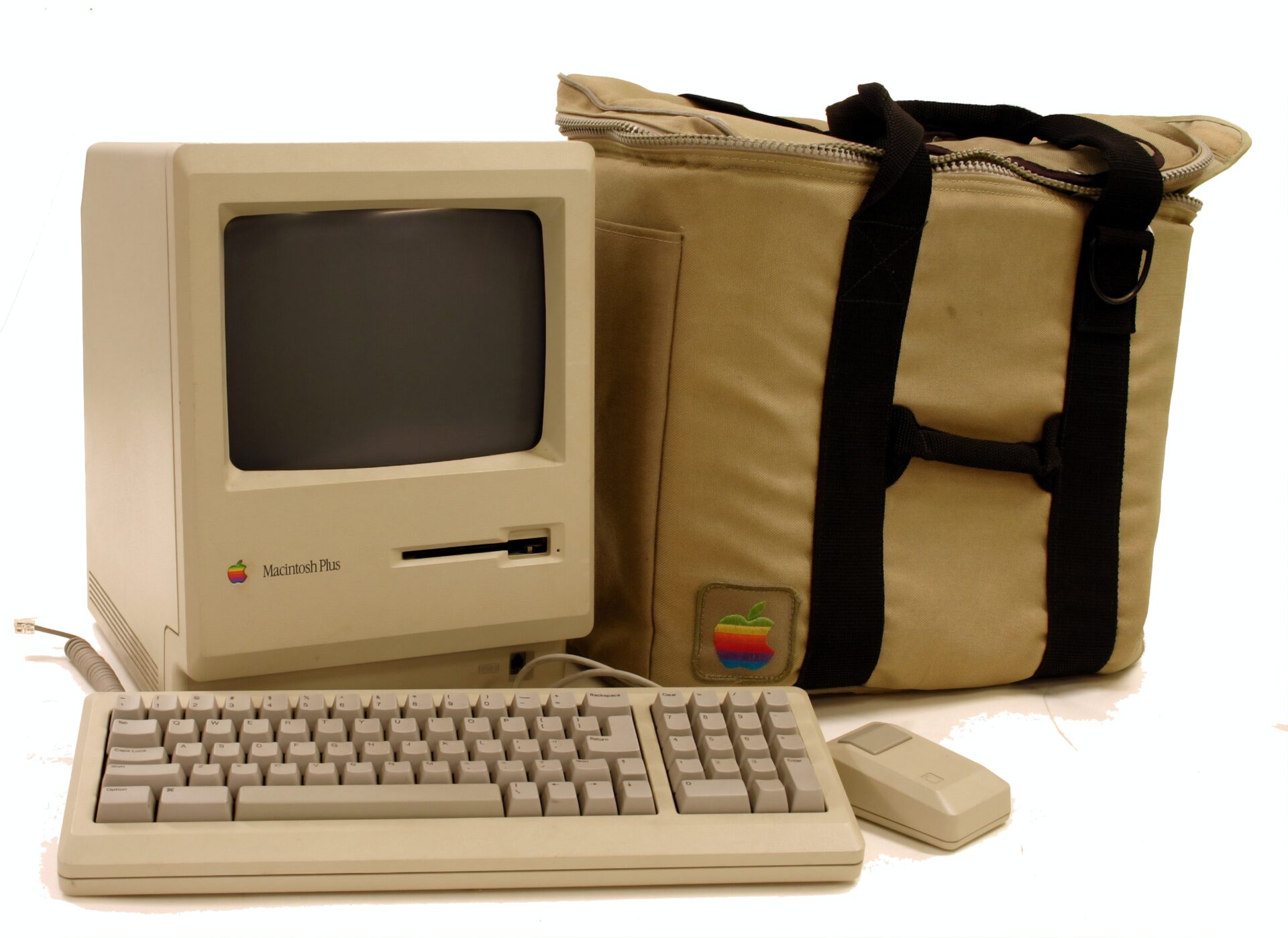
in the future. Also, for work efficiency and continuous learning, each orthoptist uses one MacBook Air.
They use it also for checking explanatory materials for patients and for daily study.
And Takatori Shopping Street, part of the “Sazae-san Shopping Street” where our clinic is located,Takatori Shopping Streetis a place with old-fashioned liveliness where local people interact actively.
I am very happy that, by being involved in running the shopping street in my small way, I can interact with many people in the community.
Separately from medicine, with the cooperation of musicians based in Fukuoka, we also hold the “Takatori Family Concert,” an activity to let local people enjoy music.
(From the Takatori Shopping Street Promotion Association: this year it is planned for Sunday, December 7)
Summary: gratitude and the medical care we aim for
We are deeply grateful once again for the many patients who have visited since we opened.
As a member of Takatori Shopping Street, we will value our ties with the people of the community, keep asking what “medical care that each patient is convinced of” means, and continue to face each and every patient sincerely.
Thank you for your continued support of Takeru Eye Clinic.