![Takeru Eye Clinic | Takatori Shopping Street, Sawara-ku, Fukuoka City [Nishijin Station / Fujisaki Station]](https://takeru-eye.com/wp-content/uploads/2022/10/takeru_logo_for-WP-header.png)

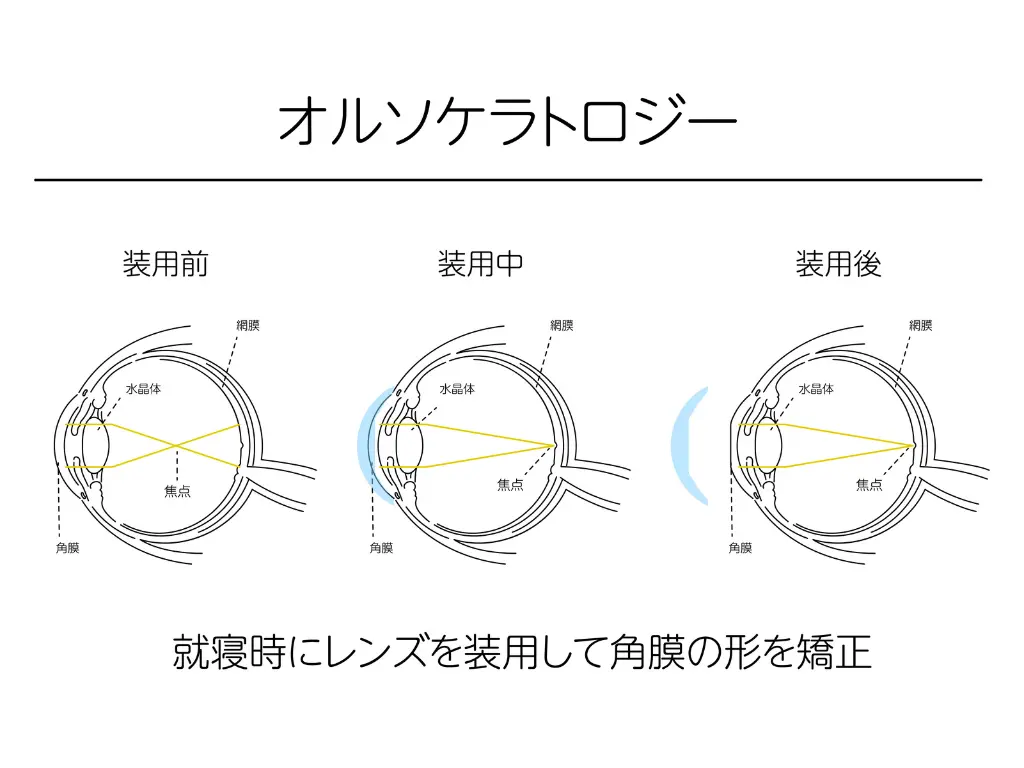
Orthokeratology, a method of myopia correction without surgery, was introduced at our clinic in the spring of 2019.
Many people so far have been able to obtain clear unaided vision without surgery.
However, it was difficult to apply to patients with strong astigmatism.
With the arrival of a new custom-order lens, Breath-O Correct® TD, orthokeratology treatment has become possible even for patients with strong corneal astigmatism.
We have been able to offer a new treatment option to patients with strong astigmatism, for whom conventional orthokeratology was difficult.
What “Astigmatism” Really Means, Often Misunderstood
The meaning of astigmatism may differ from the image people have of it.
Astigmatism is a condition in which the shape of the cornea (the black part of the eye) is distorted.
The word tends to give the impression that things “look disordered,”
but in fact it is a refractive error that arises because the curvature of the cornea and the lens differs depending on the direction.
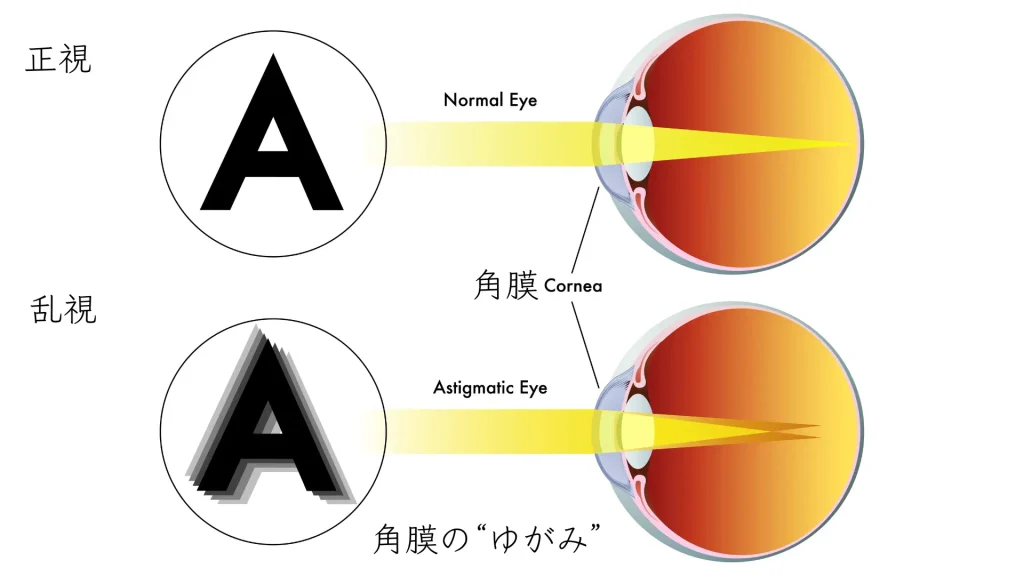
The cornea is originally shaped like a sphere, but when astigmatism is present it is shaped more like an ellipse or a rugby ball.
Everyone has some astigmatism, but what matters is astigmatism of a degree that needs correction.
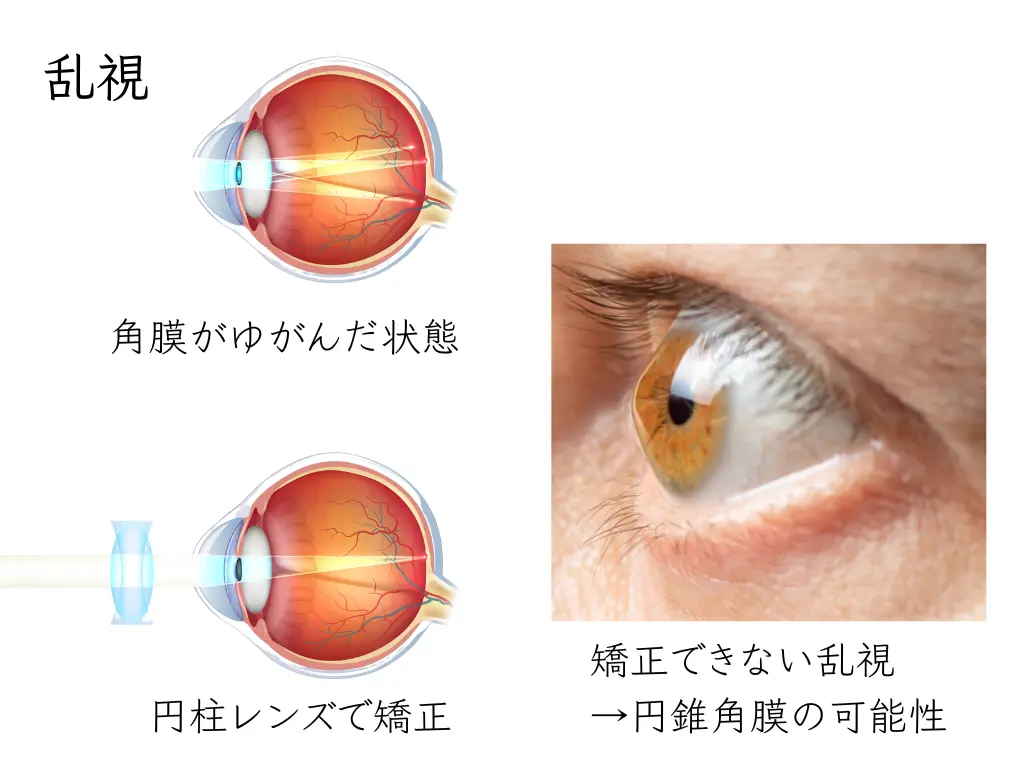
(Corneal topography sometimes reveals keratoconus.)
What Is Breath-O Correct® TD?
Breath-O Correct® TD is a custom-order orthokeratology lens used for patients with strong corneal astigmatism (1.50 D or more as a guide).
Its lens design has been devised for patients in whom stable wear was difficult with the conventional Breath-O Correct® (BOC).
Differences from the conventional lens
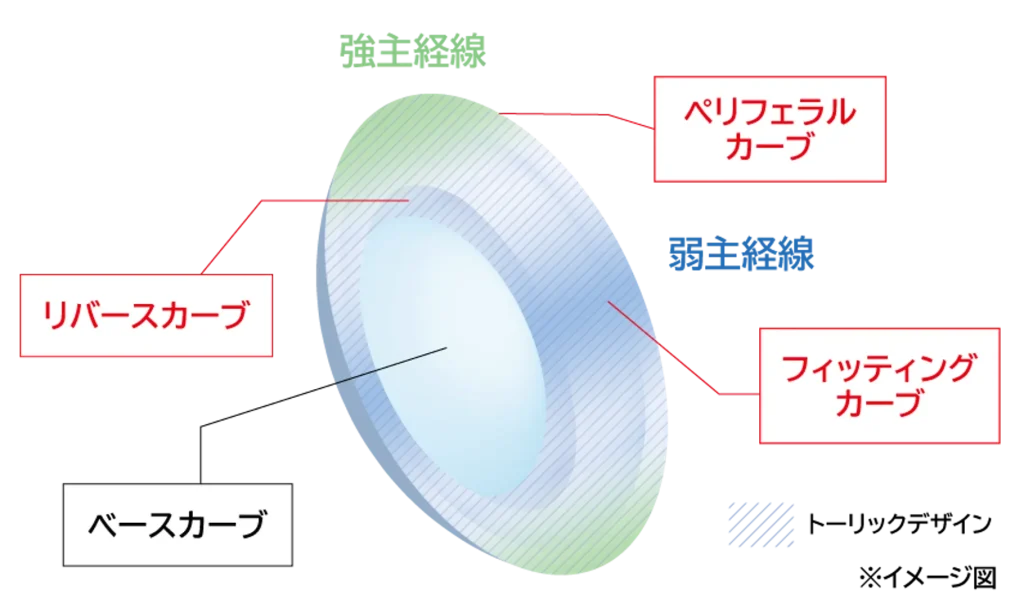
Conventional orthokeratology lenses have a spherical design, whereas Breath-O Correct® TD has the following:
- A toric design (a shape that differs by meridian) in the area outside the reverse curve
- The optic zone remains spherical
- The design of the flat and steep principal meridians follows that of the conventional product
With this design, the stable position of the lens is improved even in patients with large corneal astigmatism.
Who it is for
Breath-O Correct® TD is intended for people who meet the following conditions:
Main conditions
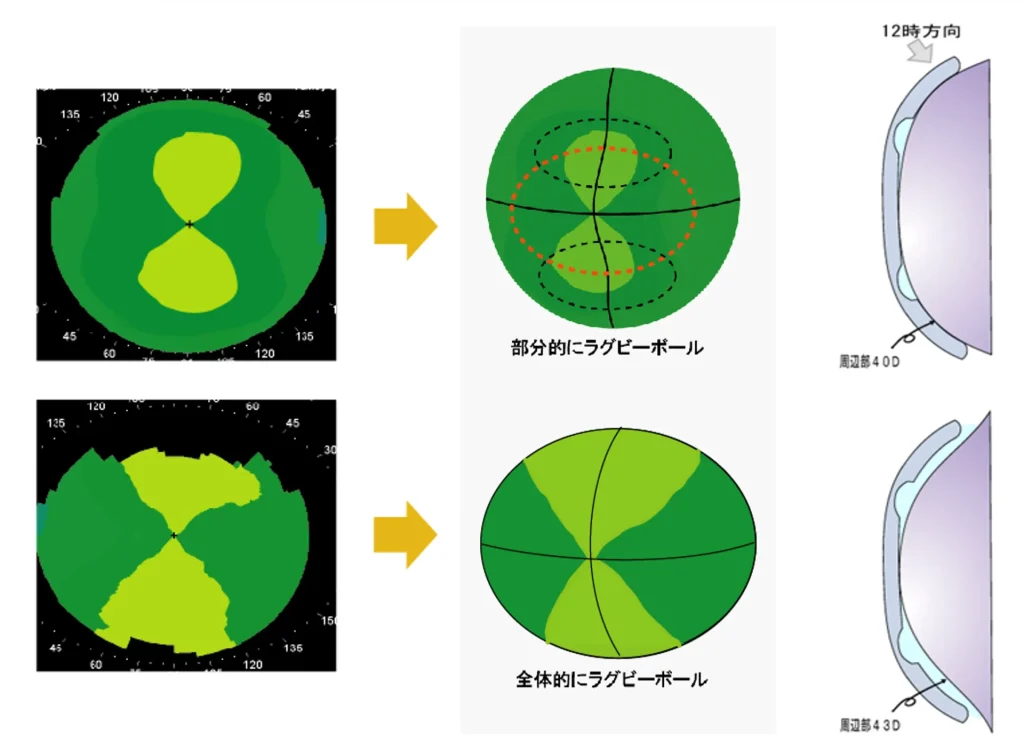
- Corneal astigmatism of 1.50 D or more (see the keratometry values)
- The corneal astigmatism extends to the periphery
- Myopia: -1.00 D to -4.00 D
- Cylinder power is no more than half of the spherical power
Certified orthoptistsperform the eye examinations and take the measurements.
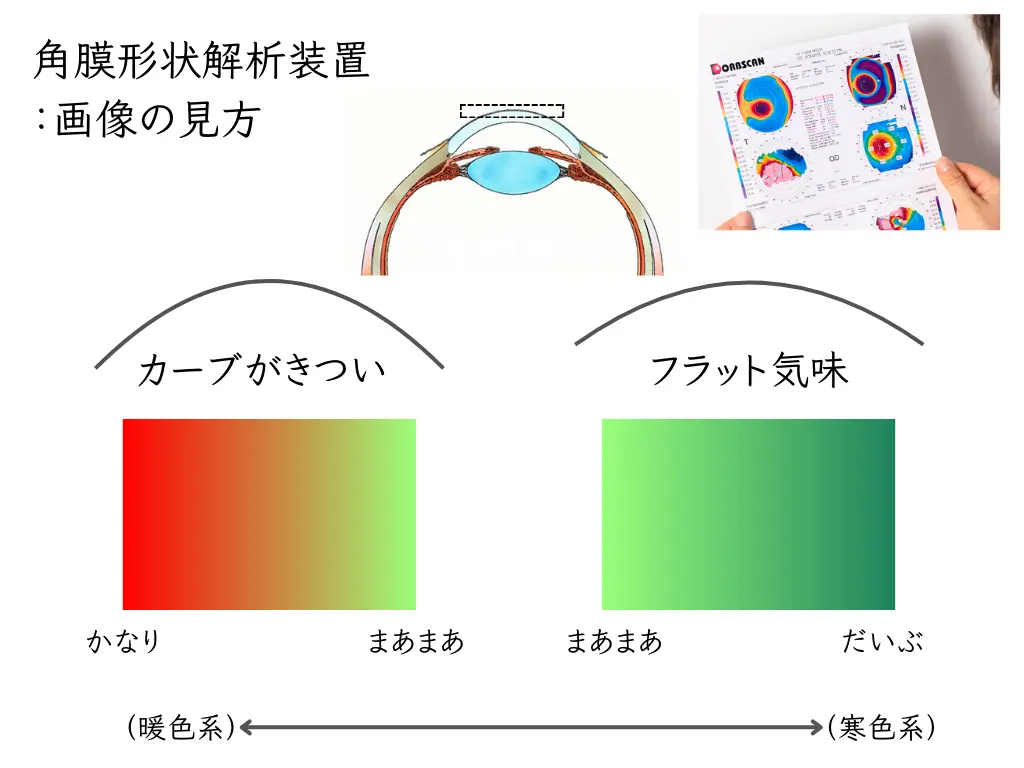
Steep and Flat Meridians: What the Astigmatism Power (“Cylinder Power”) Means
In a cornea with astigmatism, the direction with the tightest curve is called the “steep meridian,” and the direction with the gentlest curve is called the “flat meridian.”
- Steep meridian: the direction in which the corneal curve is steepest (stronger refractive power)
- Flat meridian: the direction in which the corneal curve is flattest (weaker refractive power)
The difference in refractive power between these two meridians is the degree of astigmatism (cylinder power).
For example, if the steep meridian is 45.00 D and the flat meridian is 43.00 D, the astigmatism is 2.00 D.

Orthokeratology for Astigmatism: What Is Important
Even if the corneal astigmatism is 1.50 D or more,
if the corneal astigmatism does not extend to the periphery, the conventional Breath-O Correct® (BOC) is used.
We examine the shape of the cornea in detail and confirm the distribution pattern of the corneal astigmatism.
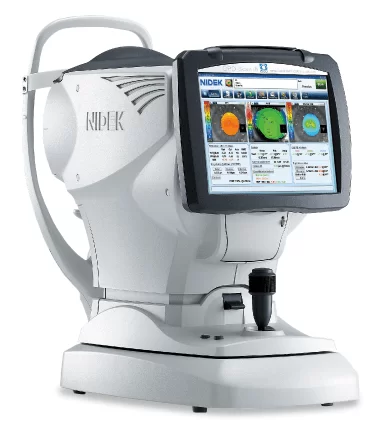
OPD (Optical Path Difference) scan III (NIDEK)
How Treatment Proceeds
1. Initial examination and assessment of suitability
Using a corneal topographer, we measure the corneal curvature and the distribution of astigmatism in detail.
Based on the results, we determine whether Breath-O Correct® TD is suitable.
2. Determining the lens specifications
Depending on the patient’s situation, we calculate the lens specifications by one of the following methods:
When prescribing for the first time from unaided eyes
- Fitting curve: use the flat meridian value
- Target power: use the objective refraction value
- Cylinder power: calculated as steep meridian minus flat meridian
- Size: start with the standard size (10.6 mm)
When switching from a conventional orthokeratology lens
- Use the keratometry values at the first visit and the information on the conventional lens
- Calculate an appropriate specification with a formula
3. Checking the fit
We have also ordered a Breath-O Correct® TD trial lens (for in-clinic testing only, not for loan).
We also use conventional orthokeratology trial lenses to check the fitting in advance.
When Breath-O Correct® TD is actually worn, the physician checks the following points.
The cornea is stained with a fluorescein strip, and the state of the fit is observed.
- The fluorescein staining pattern is an appropriate doughnut pattern
- The lens is well centered
- There is no air between the lens and the cornea
- The lens moves about 1 to 2 mm with blinking
- The width in the steep meridian direction stains slightly thicker than in the flat meridian direction
Warranty
Warranty conditions for Breath-O Correct® TD:
- Warranty period: within 12 months of the shipping date of the new lens
- Number of warranty replacements: up to 2 per eye (no distinction between prescription changes and breakage replacements)
- Orders: up to 1 lens per eye
Orthokeratology for Astigmatism: Points to Keep in Mind
Clarifying the purpose of treatment
Breath-O Correct® TD is a lens to improve the stable position in patients with large corneal astigmatism.
It is not a lens intended to correct total astigmatism (refractive astigmatism).
Total astigmatism (refractive astigmatism) is the combination of lenticular astigmatism and corneal astigmatism.
Because orthokeratology is a treatment that changes the shape of the cornea, it is effective for corneal astigmatism but cannot correct lenticular astigmatism.
How much astigmatism is there?
We use a corneal topographer / whole-eye refraction analyzer (NIDEK’s OPD-scan) to distinguish the type of astigmatism.
About the trial wear
Breath-O Correct® TD has no trial lenses available for loan.
During the one-week trial wear period, a conventional trial lens is used.
Sufficient explanation and examination at the fitting visit are very important.
The need to change specifications
If the fit with the first lens is inappropriate, specifications are changed after considering the following points:
- Curve change: when the fit is steep or flat
- Power change: when there is under-correction or over-correction
- Cylinder power change: when fluorescein stains in the steep meridian direction
- Size change: when inferior stabilization or horizontal deviation is seen
Summary
With the arrival of Breath-O Correct® TD,
a treatment option can now be offered even to patients with strong corneal astigmatism, for whom orthokeratology treatment had been difficult.
With detailed examinations and accurate calculation of specifications, good treatment results can be expected.
Patients who had given up on orthokeratology because of strong corneal astigmatism
may find it worth considering this new treatment option.
If you are considering treatment, it is important to undergo a detailed examination of the corneal shape and to receive a sufficient explanation.