![Takeru Eye Clinic | Takatori Shopping Street, Sawara-ku, Fukuoka City [Nishijin Station / Fujisaki Station]](https://takeru-eye.com/wp-content/uploads/2022/10/takeru_logo_for-WP-header.png)

Secondary glaucoma due to uveitis is one of the conditions that ophthalmologists find hard to treat.
It requires controlling inflammation and intraocular pressure at the same time, and in many cases drug therapy alone has its limits.
A study published in February 20251once again demonstrated thatselective laser trabeculoplasty (SLT)is effective and safe for uveitic secondary glaucoma.
Studies of SLT for this condition had been done before, but this study provides a more detailed analysis and new evidence.
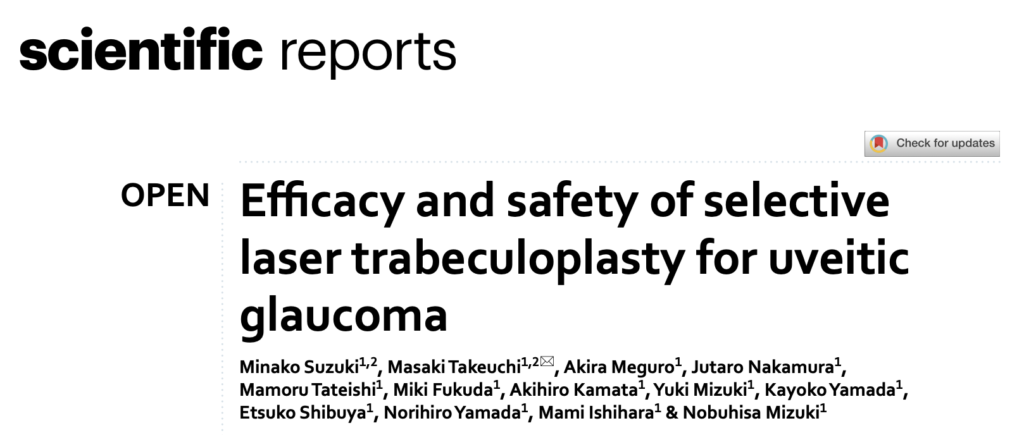
SLT: A New Option for Treating Secondary Glaucoma Due to Uveitis
In a study published in Nature Publishing Group’s Scientific Reports (Department of Ophthalmology, Yokohama City University), the effect of SLT was examined in 17 eyes (13 patients) in which drug therapy had not achieved sufficient intraocular pressure control.
SLT produced a statistically significant reduction in intraocular pressure.
The mean pretreatment intraocular pressure of 28.4 ± 6.5 mmHg fell to 17.3 ± 9.4 mmHg six months after SLT (P < 0.0001).
Importantly,no significant worsening of intraocular inflammation and no significant increase in steroid use were observed after SLT.
However, previous studies have reported post-SLT worsening of inflammation in about 10% of uveitic eyes, and the risk may rise particularly when inflammation has not fully subsided.
Success Rate and Effect on Medication Burden
The clinical success rate at 6 months was 64.7%.
Clinical success was defined as achieving an intraocular pressure of 21 mmHg or lower together with a reduction of at least 20% from baseline, without additional glaucoma surgery; both conditions had to be met.
When intraocular pressure remains poorly controlled, oral acetazolamide (Diamox) is sometimes added.
It has side effects such as numbness of the hands and feet, so we try to lower intraocular pressure while using it as little as possible.
In this study, the number of acetazolamide tablets needed decreased significantly at every follow-up period.
No patient achieved a medication-free state with SLT alone, and the one patient who was medication-free at 6 months had also undergone additional trabeculotomy after SLT.
Factors Affecting Treatment Outcome
The study also identified predictors of treatment success.
Patients with a shorter duration of uveitis and a lower baseline intraocular pressure had better treatment outcomes.
Patients with anterior uveitis responded well, but because of the small number of cases no statistical conclusion could be drawn.
Comparison with Other Types of Glaucoma
Other studies have reported that SLT is also effective for steroid-induced glaucoma.
On the other hand, it has also been suggested that the treatment failure rate in uveitic secondary glaucoma may be higher than in primary open-angle glaucoma (POAG).
This 2025 study produced better results than expected, but
some aspects of the long-term effect remain unclear.
Safety
In this study, no serious complications or significant worsening of inflammation were observed in the group of cases in which inflammation was well controlled.
The safety of SLT is best in cases where inflammation is well controlled, and
the risk may rise when inflammation has not fully subsided.
The risk of worsening inflammation is lowest when inflammation has been quiescent for at least 90 days before SLT.
The Importance of Individualizing Treatment
Although the results of this study are promising, the use of SLT for uveitic secondary glaucoma should be decided only after carefully assessing each patient’s individual condition.
It is important to select appropriate cases by judging factors such as the state of inflammation, the duration of the disease, and baseline intraocular pressure as a whole.
Future Challenges and Outlook
The study also has limitations.
The number of cases was limited to 17 eyes and the follow-up period was only 6 months, so efficacy beyond 6 months is unknown.Further verification is needed regarding the long-term effect of SLT in uveitic secondary glaucoma, the authors say.
In addition, larger studies are expected to provide further insight into predictors of treatment success and the optimal timing of treatment.
Steroid eye drops or injections can also raise intraocular pressure. An overview of the treatment of uveitis and its side effects is summarized in a separate article.

Summary
A 2025 study has scientifically demonstrated that SLT is effective for secondary glaucoma due to uveitis.
Significant improvement in intraocular pressure, a reduced medication burden, and good safety were confirmed, although in a small-scale study.
These results offer a useful treatment option for managing uveitic secondary glaucoma, which is often difficult to treat.
Better treatment outcomes can be expected especially in patients with a shorter disease duration and a relatively low baseline intraocular pressure.
The findings suggest that early treatment intervention may lead to better patient prognosis in appropriate cases.
However, the indication for treatment must be assessed carefully for each patient, and it is important to perform SLT when inflammation is well controlled.
Future larger, long-term studies are expected to clarify the place of SLT further.
References
- Suzuki, M., Takeuchi, M., Meguro, A., Nakamura, J., Tateishi, M., Fukuda, M., Kamata, A., Mizuki, Y., Yamada, K., Shibuya, E., Yamada, N., Ishihara, M., Mizuki, N., 2025. Efficacy and safety of selective laser trabeculoplasty for uveitic glaucoma. Sci Rep 15, 4077. https://doi.org/10.1038/s41598-025-88354-0