![Takeru Eye Clinic | Takatori Shopping Street, Sawara-ku, Fukuoka City [Nishijin Station / Fujisaki Station]](https://takeru-eye.com/wp-content/uploads/2022/10/takeru_logo_for-WP-header.png)
Half a year has passed since I wrote the previousarticleat the start of the year.
The core of our care has not changed greatly, but our policies have become considerably more concrete.
• Characteristics of the population makeup and the area:A “livable town”/ a long-established “temple town of Momiji Hachiman Shrine”
• Good access: easy to commute, and easy to get cooperation from partner medical institutions
According to the survey given at visits,
many patients come from Nishijin, Fujisaki, Takatori, Momochi, Shodai, Josai, and other surrounding areas,
on foot, by bicycle, or by public transportation.
(Through June 2019: on foot 59% / bicycle 18% / subway 5% / bus 4% / private car 14%)
I want to establish my own approach to care so that we can be an eye clinic that the community comes to know well over many years.
(1) Early detection of glaucoma
It is said that 1 in 20 people aged 40 and over has glaucoma, but almost everyone has no subjective symptoms at all.
Glaucoma (or suspected glaucoma) is often found by chance when I look at the fundus during a visit for a different condition.
We can find glaucoma from a very early stage because we can use excellent medical equipment.
Using OCT (optical coherence tomography), we measure the thickness of the optic disc and the retinal nerve fiber layer. At this point we judge whether glaucoma is suspected.
The Humphrey Field Analyzer HFA III 840 lets us perform visual field testing in less time than before.
For those who need it, we perform testing with the Goldmann perimeter (GP).
We combine the test results and judge glaucoma from multiple angles.
Even compared with 10 years ago, eye drops for glaucoma have advanced dramatically.
I believe the basis of glaucoma treatment is to take appropriate action early, slow the progression of glaucoma, and prevent symptoms of visual field loss throughout life.
Surgery is considered when it is judged that eye drop treatment can no longer manage the condition: “glaucoma cannot be cured by surgery.”
Please do not worry excessively about the word “glaucoma.” We will explain each person’s condition and outlook in detail.
(2) Children’s eyes (pediatric ophthalmology)
There are many children in the neighborhood, and there are times when the waiting room becomes lively. They also enjoy the picture books and origami.
Myopia and refractive error:
In the smartphone era, the myopic population is expected to grow even further:“Myopia boom”
If myopia progresses to high myopia, the risk of developing glaucoma, retinal degeneration, and other conditions after adulthood becomes higher (pathologic myopia).
Recently, evidence for slowing myopia progression has been shown one after another; I have reviewed papers from around the world (from PubMed).
We introduce methods for slowing (preventing) myopia progression that have sufficient scientific evidence and no risk of side effects. Spending more time playing outdoors is very important.
Myopia and refractive errors in children
My impression is that many children have accommodative dysfunction for near vision, together with homework and long hours of study.
Based on the results of the accommodation analyzer (Accommoref), we recommend low-dose atropine eye drops.
We have also finished preparing the orthokeratology (treatment program), and several people have now joined.
Proper lens care is the most important thing.
Orthokeratology – Takeru Eye Clinic | Takatori Shopping Street, Sawara Ward, Fukuoka
Amblyopia and strabismus:
With several orthoptists (ORT), we can carry out children’s tests smoothly.
When needed, after a detailed examination using atropine or Cyplegin® eye drops, we also fit appropriate glasses.
I believe it is important not to miss the timing of testing and treatment.
The work of orthoptists / Pediatric ophthalmology and low vision
Childhood amblyopia can be detected early
(3) Retinal disease and uveitis
Inflammatory eye diseases such as diabetic retinopathy, age-related macular degeneration, uveitis, and retinal vascular occlusion,
as well as myopic macular degeneration (pathologic myopia), etc.
With OCT angiography, we assess the state of the retinal blood vessels without the risk of contrast dye allergy.
With advances in diagnostic imaging, the field of “medical retina” has been established, and fewer diseases require surgery than 10-plus years ago.
This is the field in which I have worked with the most passion in research and care since my studies abroad from Kyushu University.
When needed, we provide care mainly in cooperation with the Department of Ophthalmology at Kyushu University.
Why laser treatment of the fundus / injections into the eye are done
Ocular inflammation and uveitis
(4) Dry eye and corneal disease
Dry eye is said to involve a vicious circle in the tear film on the ocular surface, triggered by inflammation.
For patients with symptoms, we perform fluorescein staining and explain the condition of each person’s ocular surface.
About dry eye: from the Journal of the Japanese Ophthalmological Society
Corneal diseases such as herpetic keratitis, keratitis, and corneal ulcer require extensive knowledge of infectious disease and immunology.
Bacterial staining (Gram staining) is also used as a diagnostic aid, and I connect the knowledge I have to the use of antibiotics and steroids.
With the introduction of a corneal topographer, we can now also care for keratoconus.
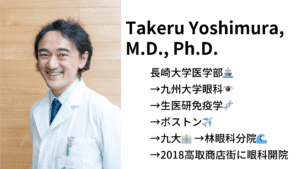
After graduating from Nagasaki University, I studied corneal disease for one year in the Department of Ophthalmology at Yamaguchi University.
For diseases that need detailed work-up, I mainly consult and refer to Dr. Naoyuki Morishige (Oshima Eye Hospital), a senior colleague since my residency.
(5) Quantifying eye fatigue / glasses and contact lens prescriptions
(tired eyes, headache, stiff shoulders, pain behind the eyes, nausea)
Some people go to a bonesetter (seitai). There also seem to be cases of poor physical condition caused by eye fatigue.
The accommodation analyzer shows the state of the muscle that focuses the eye (the ciliary muscle).
Using glasses or contact lenses that do not currently fit often seems to lead to tired eyes and eye strain.
With the cooperation of orthoptists (ORT), we prescribe glasses and contact lenses suited to each person’s living situation.
In contact lens care, we always perform a corneal endothelial cell count.
With contact lenses, sheet music is easy to see
The meaning of getting contact lenses at an eye clinic
(6) Cataract
With age, clouding of the lens occurs in everyone (cataract).
If it does not interfere with daily life, there is little indication for surgery, but it is important to treat it before it becomes quite advanced.
After examining the state of the cataract and checking in particular that there is nothing abnormal at the back of the eye, we judge whether treatment is indicated and explain it.
With the whole-eye refraction analyzer (OPD-Scan), we can now also show a simulation of how things look.
Depending on surgical indication and your wishes, we refer you directly to a doctor who specializes in surgery.
The Reiwa era
Introducing a machine that can explain the “quality of vision”
(7) Low vision clinic (by appointment)
Low vision is defined as “visual acuity of 0.05 or more and less than 0.3, measured with corrective glasses on both eyes” (World Health Organization, WHO).
Even outside this, for symptoms such as difficulty seeing or glare,
we can introduce visual aids: magnifiers, loupes (made by Eschenbach), tinted glasses, typoscopes, handheld video magnifiers, monocular telescopes, etc.
To date, we have introduced visual aids to people with retinitis pigmentosa / microphthalmos / Leber hereditary optic neuropathy / (advanced) glaucoma / macular degeneration (people whom I have followed over a long period).
Beyond the diseases listed above,
I would like to be involved in the eye health of everyone in the community, from babies to adults and the elderly.
Please feel free to consult us at any time, even about small things.
I am grateful beyond words to our excellent staff and everyone who helps us, for creating a comfortable space and running the in-clinic IT systems. Thank you, always.
Efforts to avoid keeping you waiting / in-clinic system configuration
I will continue to keep updating my own knowledge.
Thank you for your continued support.
- Please also use the parking lot at the back of the Fine Garden Takatori grounds.
- It is on a narrow one-way street and a little hard to find, so please feel free to call and ask.
* A map of nearby coin parking lotsis also available.