![Takeru Eye Clinic | Takatori Shopping Street, Sawara-ku, Fukuoka City [Nishijin Station / Fujisaki Station]](https://takeru-eye.com/wp-content/uploads/2022/10/takeru_logo_for-WP-header.png)

Uveitis in Behçet’s disease (Behçet’s ocular disease) is a very severe disease in which the normally clear inside of the eye becomes clouded by inflammation.
From my days as a resident, I was allowed to take part in the Kyushu University uveitis clinic, where Dr. Kohei Sonoda and Dr. Akiko Ariyama saw many patients with Behçet’s uveitis.
With oral steroid and immunosuppressant treatment, patients improved, but attacks came during the quiet phase (remission), requiring steroid injections around the eye (sub-Tenon injection) and causing loss of vision. As this repeated, the tissues of the eye were gradually damaged, leading to major loss of vision (social blindness).
At that time the Kyushu University uveitis clinic was testing the effect of granulocyte adsorption therapy (Adacolumn®).
Around 2003, when I entered graduate school in immunology, a film based on an original story by Masashi Sada, depicting a person with Behçet’s ocular disease, an intractable disease,“Gege” (解夏)was released. I remember going to the cinema to see it, and the Nagasaki city filming locations were nostalgic for me.
Steroids and immunosuppressants are effective, but long-term use also causes various side effects. I thought a great deal, and presented my work, on why inflammation of the eye occurs and on the possibility of treating it by means other than steroids.
In the pathology of Behçet’s disease, the inflammatory cytokine (a protein secreted from cells) tumor necrosis factor (TNF) is known to act as the villain.
The biologic drug (infliximab) that suppresses TNF, which is produced in the body during inflammation, became covered by insurance in 2007.
After returning to Japan I went back to the uveitis clinic, and seeing many patients whose inflammation had almost disappeared with infliximab treatment, I literally felt that an age had passed (a “paradigm shift”)。
However, the burden on patients who receive an infusion at the university hospital internal medicine clinic every two months is also large.
Adalimumab, which was in clinical trials at that time, was approved in 2016, and its effect can be obtained by subcutaneous injection at home, making it even more convenient.
At yesterday’s ocular inflammation seminar held in Fukuoka City, I was able to hear a lecture by Dr. Hiroshi Keino of Kyorin University (Kyorin Eye Center) in Tokyo. Eye clinics with physicians who specialize in uveitis clinical care and research are few in Japan, and I have often met Dr. Keino at the Japanese Society for Ocular Inflammation, in Boston, and elsewhere, and learned a great deal from him.
From the lecture:
• Based on visual outcomes at 5 years, infliximab is recommended to be introduced early.
• Adalimumab is effective, but appropriate criteria for its use need to be established as cases accumulate.
• Importance of screening before use (side effects such as infections and cancer).
Inflammatory cytokines play an important role for the cells that fight infection and the cells that eliminate cells in the body that are trying to become cancerous (innate immune mechanisms). Removing them may lead to side effects such as infection and cancer.
There are many other biologic drugs expected to be effective for ocular inflammation, and we await expansion of their indications.
I believe it is important to heal the tissues of the eye while preserving their transparency and function.
For that reason, treatment from early in the disease is needed, based on early judgment by an ophthalmologist.
Today excellent biologic drugs can be used, but the side effects above and secondary failure (the body producing antibodies against the drug, so that it no longer works) remain major problems.
The use of biologic drugs is also a major issue from the standpoint of health economics.
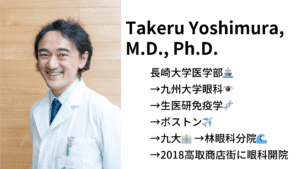
Takeru Eye Clinic is located along the Fukuoka City subway line, and alongside general ophthalmic care it provides care in cooperation with the Kyushu University Hospital uveitis clinic. I hope to stay involved with patients with ocular inflammation for a long time. We look forward to your continued support.