![Takeru Eye Clinic | Takatori Shopping Street, Sawara-ku, Fukuoka City [Nishijin Station / Fujisaki Station]](https://takeru-eye.com/wp-content/uploads/2022/10/takeru_logo_for-WP-header.png)
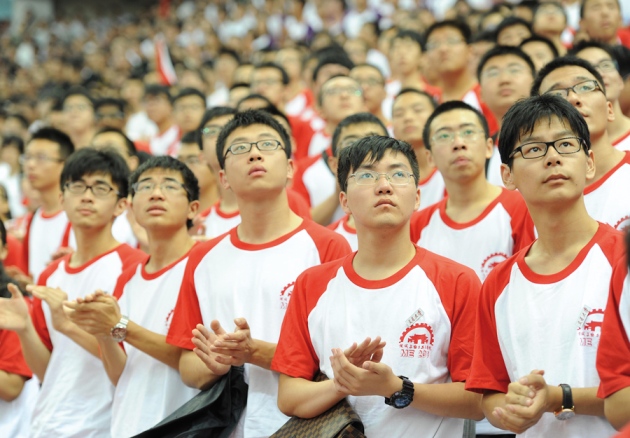
A 2015 article in Nature noted that the myopic population, which was 10–20% 60 years ago, has risen to 90% in China and to 96.5% of 19-year-olds in Seoul, South Korea:
2026 update: the following is available.
The myopia boom
Nature 519, 276–278 (19 March 2015)
The march of myopia
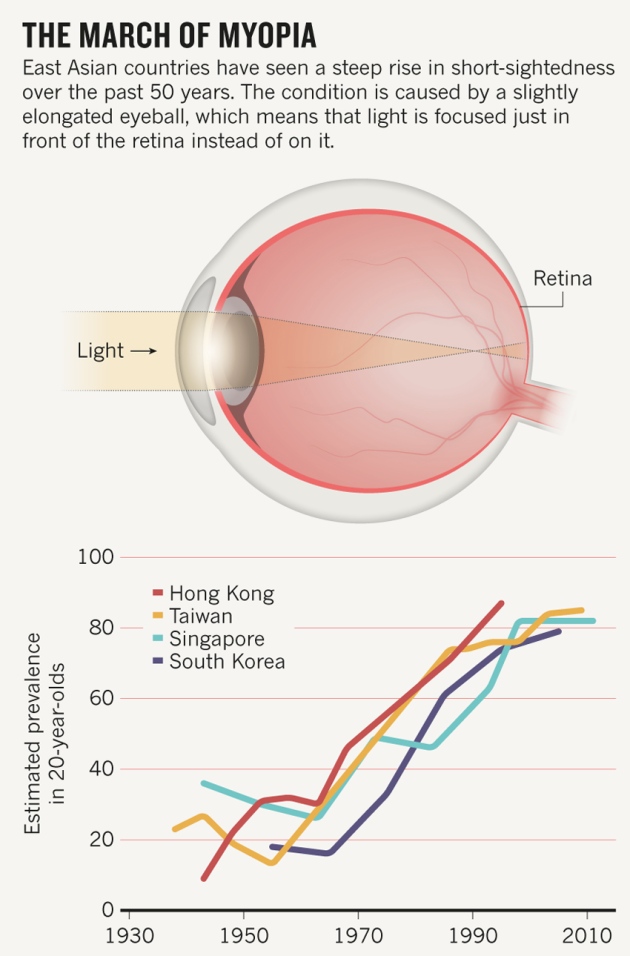
* Myopia is rising sharply.
It is not just that myopia is inconvenient because you need to wear glasses or contact lenses.
In high myopia, the depth of the eye (axial length) lengthens and the retina on the inner surface of the eyeball is stretched, and as a result,
after adulthood, retinal detachment, glaucoma, cataract, retinal degeneration, and other conditions can develop, sometimes leading to blindness (pathologic myopia).
“Environmental factors are larger than genetics.”
Today’s children, besides reading and studying,
also spend more time looking at computers and smartphones.
At age 15: children in Shanghai spend 14 hours on study, in the UK 5 hours, and in the US 6 hours. And in Japan?
In Israel, it was reported in the 1990s that the harder children studied at yeshivas (religious seminaries), the more likely they were to become myopic.
When looking at near objects, the eye’s accommodation works strongly to focus light on the retina
: this response leads to elongation of the axial length.
From a survey of 500 children in California and 4,000 children in Sydney,
children who play outdoors do seem less likely to become myopic.
Friends I made while studying abroad: Israelis, Americans, Chinese, Koreans, Spaniards, Venezuelans, Cubans, and others
When I think back on them, I feel I can see what is described above.
Almost all of my friends from China and Korea seemed to be myopic.
High myopia / Japan-China-Korea ophthalmology meeting
“Brightness is also related to myopia progression”
An experiment is introduced in which chickens raised in bright outdoor light had 60% less myopia progression than chickens raised under indoor lighting.
The “photoreceptors” that detect light in the retina
are known to work mainly as rods at night and as cones during the day.
It is beginning to be thought that when we spend more time at home, this cycle is disrupted, leading to elongation of the axial length (= myopia).
“Being active outdoors”
→ getting enough light and spending a lot of time looking far away
: thought to lead to slowing of myopia.
From the second illustration in the article:
Keep myopia away, go outdoors and play!
(Let’s play outside so we don’t get myopia!)
/ Eyes are very precious, so take good care of them!
• Playing ball games
• Walking
• Playing all out on the sports field
In addition, make lots of time to play outside every day.
And please spend less time on
• Computer games
• Handheld games and smartphone games
.
Study, PC work, creative activities, and the eyes
○ ○ ○
To reduce myopia in children: what we can do now
“I want to reduce myopia in children.”
I think about this in earnest every day.
Besides improving environmental factors, what we can do right now is mainly
• Diluted atropine eye drops: “relieving accommodative tension”
• Orthokeratology: “a way to create daytime hours when the retina is in focus”
.
Myopia in children
Orthokeratology has become safer and more effective than before.
It is a treatment that doctor and patient should both use with the utmost care, after the patient has been given a full explanation and understands it.
At Takeru Eye Clinic, we are currently preparing to introduce orthokeratology after the Golden Week holidays.
Please feel free to consult us. Thank you.