![Takeru Eye Clinic | Takatori Shopping Street, Sawara-ku, Fukuoka City [Nishijin Station / Fujisaki Station]](https://takeru-eye.com/wp-content/uploads/2022/10/takeru_logo_for-WP-header.png)

Added in 2024

Laser treatment can be effective for glaucoma.
Unlike fundus laser treatment, it is characterized by not causing tissue destruction.
○ It lowers eye pressure by improving flow through the eye’s “water channel,” the drainage angle and trabecular meshwork.

Laser Treatment for Glaucoma (SLT): A Video Introduction
- After numbing eye drops, a special lens (gonioscope) is placed on the eye.
- Low-energy YAG laser is applied to the trabecular meshwork.
- About 50 laser spots are applied per half circumference, treating the entire circumference of the drainage angle.
- The laser spot size is 400 μm. The power is about 0.8 mJ.
- Pigment cells clogging the drainage angle are involved in the rise in eye pressure.
- [Inside the trabecular meshwork after irradiation] Inflammatory cells and cytokines (proteins) gather.
- Inflammatory cells (macrophages) eat the pigment cells.
- This improves flow through the trabecular meshwork without tissue damage.
- Aqueous humor flows from the ciliary epithelium toward the trabecular meshwork.
As flow through the trabecular meshwork improves, eye pressure falls. - Trabecular meshwork with less pigment (enlarged view)
The flow of aqueous humor has improved.
(Source: video by Ellex)
Selective Laser Trabeculoplasty (SLT)
Performed in a regular outpatient visit. (Covered by Japanese insurance as gonio-photocoagulation.)
○ Candidates: among patients diagnosed with open-angle glaucoma or ocular hypertension,
• those who have difficulty using eye drops (side effects, irregular work schedule, pregnancy or breastfeeding, tendency to forget drops, etc.)
• those who cannot achieve enough eye pressure reduction with eye drops,
and similar patients may be considered for treatment.
✔ SLT was first performed in 1995 and, after gaining approval from the US Food and Drug Administration (FDA) in 2001, has become widely used1.
✔ Recent clinical studies have repeatedly confirmed high treatment effects.
✔ It does not restore lost visual field.
✔ You can carry on your normal daily life from the day of the laser.
(There are no precautions or special points to watch for in daily life.)
After FDA approval in 2001, the number of SLT procedures increased substantially,
rising in the United States from 75,647 in 2001 to 142,682 in 20121.
SLT: The Actual Treatment Flow
Because eye pressure must be measured before and one hour after treatment,
we ask you to come in at 9:00 or 14:00 on a weekday,
on a day when you can set aside plenty of time.
(Including waiting time, it takes about 3 hours at most.)
After eye pressure measurement, an anterior segment examination, and corneal endothelial cell measurement,
Iopidine® eye drops, which suppress a temporary rise in eye pressure, are instilled.
Take a walk along the shopping street; there is also a café across the road.
Waiting with tea in the clinic is also a good option.
It takes about 5-10 minutes.
There is almost no pain.
We examine the condition of the anterior segment and, after measuring eye pressure,
instill Iopidine® eye drops.
Iopidine® eye drops are instilled.
Slightly blurred vision for 3 days is as expected.
This is thought to be part of the process in which pigment in the drainage angle decreases, caused by mild inflammation in the anterior chamber.
Eye pressure is measured 1 week after treatment.
If necessary, the untreated fellow eye is treated.
Laser Treatment for Glaucoma: Two Key Papers Evaluating SLT (Selective Laser Trabeculoplasty) as First-Line Treatment

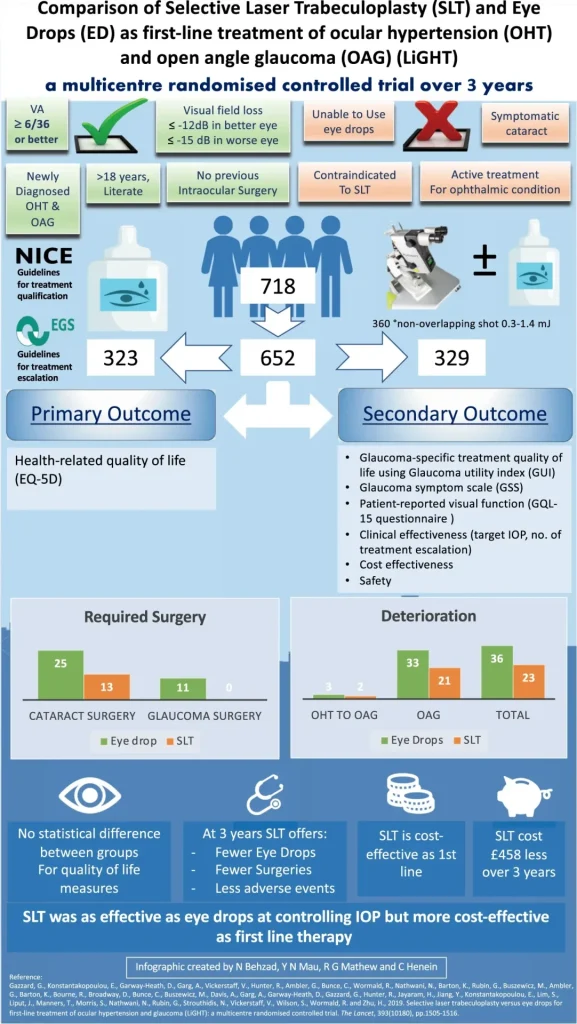
○ A clinical study in The Lancet (UK)2:
The LiGHT study (Laser in Glaucoma and ocular HyperTension)
718 patients with open-angle glaucoma or ocular hypertension were
divided into two groups, an eye drop group of 362 patients (622 eyes) and an SLT group of 356 patients (613 eyes), and followed for 3 years.
✔ 74% of the SLT group achieved eye pressure control for 3 years without eye drops.
✔ Cost-effectiveness in terms of medical costs also improved.
○ A clinical study in the Journal of the Japanese Ophthalmological Society (Nippon Ganka Gakkai Zasshi)3:
SLT was performed as first-line treatment for 3 years in 42 cases (40 eyes) of open-angle normal-tension glaucoma (NTG).
✔ Eye pressure fell significantly during the 3 years after SLT.
(15.8±1.8 mmHg → 13.5±1.9 mmHg; p<0.001, paired t-test)
✔ Indices of the rate of visual field progression (MD slope / VFI slope): the rate of progression over 3 years was slow.
(Measured with the Humphrey® Field Analyzer)
* Neither study reported serious complications.
Added in 2025
Laser Treatment for Glaucoma (SLT): A Review of 30 Papers from 2024 summarizes the evidence up to 2024. Here I add important study results published since then.
LiGHT Study: 6-Year Follow-up Results (2023)
The LiGHT study continued after the 3-year follow-up, and 6-year follow-up results were reported in 2023⁵.
✔ In the SLT group,about 70% maintained their target eye pressure for 6 years without eye drops or surgery.
(This is little changed from about 75% at 3 years, confirming that the effect lasts over the long term.)
✔ Proportion with confirmed glaucoma progression: 26.8% in the eye drop group versus 19.6% in the SLT group, significantly fewer.
✔ Glaucoma surgery (trabeculectomy): 32 eyes in the eye drop group versus 13 eyes in the SLT group, significantly fewer.
✔ Cataract surgery: 95 eyes in the eye drop group versus 57 eyes in the SLT group, significantly fewer.
No serious laser-related complications were reported.
How Long the Effect of SLT Lasts: “6 Years or More”
It used to be explained that “the effect of SLT lasts about 2-3 years on average.” The 6-year data from the LiGHT study show thatthe median duration of the SLT effect is 6 years or more.
Even if repeat treatment becomes necessary, SLT can be performed again.
SLT May Slow Visual Field Worsening (2025)
A study re-analyzing the LiGHT data with improved statistical methods was reported in 2025⁶.
✔ Compared with the eye drop group, the SLT group hada 29% slower rate of visual field worsening (−0.26 dB/year vs −0.37 dB/year, P=0.006)
This suggests that SLT may have an advantage not only in lowering eye pressure but also in preserving the visual field (the range you can see).
For People Already Using Eye Drops (2025)
In 2025, an analysis based on extended data from the LiGHT study was published in JAMA Ophthalmology ⁷.
It has been reported that even when SLT was performed after more than 3 years of treatment with eye drops,the number of eye drops could be reduced and eye pressure control became more stable.
It is not necessarily true that “I already use eye drops, so SLT is not relevant to me.” SLT may be considered even for the purpose of reducing the burden of eye drops.
Why SLT (Selective Laser Trabeculoplasty) Works
Inflammatory cells (macrophages) that gather after laser irradiation of the drainage angle eat (phagocytose) the pigment clogging the trabecular meshwork.
This is considered the main mechanism4.
Unlike the argon laser treatment (ALT) performed in the past, it does not destroy tissue.
(It does not damage the eye’s water channel, the drainage angle and trabecular meshwork)
References
1. Garg, A., Gazzard, G., 2018. Selective laser trabeculoplasty: past, present, and future. Eye (Lond) 32, 863–876. https://doi.org/10.1038/eye.2017.273
2. Gazzard, G., Konstantakopoulou, E., Garway-Heath, D., Garg, A., Vickerstaff, V., Hunter, R., Ambler, G., Bunce, C., Wormald, R., Nathwani, N., Barton, K., Rubin, G., Buszewicz, M., Ambler, G., Barton, K., Bourne, R., Broadway, D., Bunce, C., Buszewicz, M., Davis, A., Garg, A., Garway-Heath, D., Gazzard, G., Hunter, R., Jayaram, H., Jiang, Y., Konstantakopoulou, E., Lim, S., Liput, J., Manners, T., Morris, S., Nathwani, N., Rubin, G., Strouthidis, N., Vickerstaff, V., Wilson, S., Wormald, R., Zhu, H., 2019. Selective laser trabeculoplasty versus eye drops for first-line treatment of ocular hypertension and glaucoma (LiGHT): a multicentre randomised controlled trial. The Lancet 393, 1505–1516. https://doi.org/10.1016/S0140-6736(18)32213-X
3. [Usefulness of selective laser trabeculoplasty as first-line treatment for normal-tension glaucoma] (in Japanese). 新田 耕治, 杉山 和久, 馬渡 嘉郎, 棚橋 俊郎. Nippon Ganka Gakkai Zasshi 2013;117(4):335-343
4. Alvarado, J.A., Katz, L.J., Trivedi, S., Shifera, A.S., 2010. Monocyte modulation of aqueous outflow and recruitment to the trabecular meshwork following selective laser trabeculoplasty. Arch. Ophthalmol. 128, 731–737. https://doi.org/10.1001/archophthalmol.2010.85
5. Gazzard G, Konstantakopoulou E, Garway-Heath D, et al; LiGHT Trial Study Group. Laser in Glaucoma and Ocular Hypertension (LiGHT) Trial: six-year results of primary selective laser trabeculoplasty versus eye drops for the treatment of glaucoma and ocular hypertension. Ophthalmology. 2023;130(2):139-151. doi:10.1016/j.ophtha.2022.09.009 https://pubmed.ncbi.nlm.nih.gov/36122660/
6. Montesano G, Crabb DP, Garway-Heath DF, et al. Six-year rate of visual field progression in the Laser in Glaucoma and Ocular Hypertension Trial. Ophthalmology. 2026;133(2):169-177. doi:10.1016/j.ophtha.2025.09.023 https://pubmed.ncbi.nlm.nih.gov/41043781/
7. Konstantakopoulou E, Gazzard G, Garway-Heath D, et al. Selective laser trabeculoplasty after medical treatment for glaucoma or ocular hypertension. JAMA Ophthalmol. 2025;143(4):295-302. doi:10.1001/jamaophthalmol.2024.6492 https://pmc.ncbi.nlm.nih.gov/articles/PMC11843460/
* The Lancet: known as one of the world’s five most trusted major medical journals.