![Takeru Eye Clinic | Takatori Shopping Street, Sawara-ku, Fukuoka City [Nishijin Station / Fujisaki Station]](https://takeru-eye.com/wp-content/uploads/2022/10/takeru_logo_for-WP-header.png)
In glaucoma care, lowering eye pressure with eye drops, laser or surgery is the standard treatment (a treatment supported by large-scale scientific evidence).
Besides eye pressure, factors involved in glaucoma include
regulation of blood vessels, oxidative stress and autoimmunity1-3。
Regulation of blood vessels:

In everyday practice, I am often asked things such as
• Is there anything I should be careful about with glaucoma?
• Is there any food that is good for me?
and so on.
I give explanations based on standard treatment.
For healthcare professionals, knowledge of complementary and alternative medicine (CAM)
is also not something to be overlooked.4 。
Tea and glaucoma
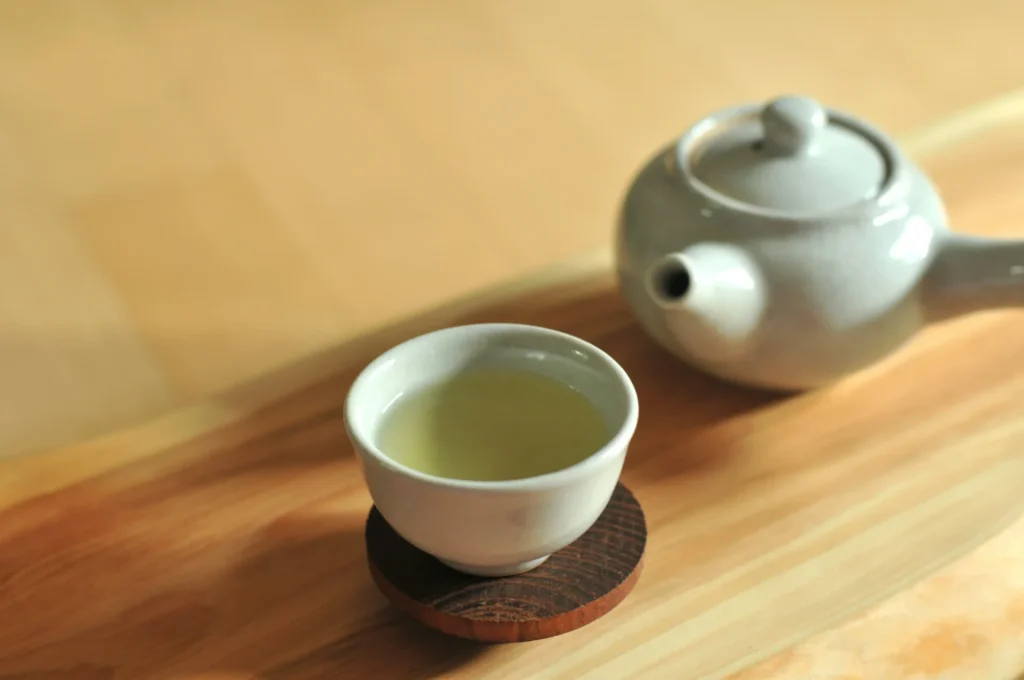
Among the main components of tea,
polyphenols, caffeine and minerals are known as having high nutritional value5。
Among the polyphenols, the important “flavonoids” are said to be involved in glaucoma6,7. This involvement is separate from eye pressure.

Flavonoids are described as reducing oxidative stress in retinal ganglion cells8 and improving blood flow9has been described.
The former8is research in vitro (in test tubes), and the latter9is research in 19 healthy men.
In 2017, the results of a clinical study of 1,678 people were published10:
• Drinking coffee, iced tea or soft drinks was not significantly associated with the incidence of glaucoma.
• People who drank one cup of hot tea every day had a 74% lower incidence (odds ratio) of glaucoma.
• Decaffeinated tea showed no significant association with the incidence of glaucoma.
None of these findings is yet backed by sufficient scientific evidence.
They cannot be taken as evidence that tea works against glaucoma or lowers eye pressure.
It seems fair to say that “drinking hot tea containing caffeine looks like a good idea in order to avoid developing glaucoma as far as possible (prevention).”
Takeru Eye Clinic
takeru-eye.com
“Takatori Shopping Street”
Fukuoka City Subway, Nishijin Station / Fujisaki Station
(Addendum)
Please try Yame tea 🍵
○ Touring Yame and Oku-Yame by tea
○ Why is Yame tea so delicious?
○ How to brew delicious tea
○ Kuroki Town, Tea Village Memorial Hall
○ Hoshino Village, Tea Culture Hall
○ Joyo Town, Firefly and Stone Bridge Hall
○ Yabe Village, Somalian curry
○ Yame City, Yame Central Grand Tea Plantation
Ushijima Seicha in Yame 🍵
![[Prices may have changed since the link was created.]](https://hbb.afl.rakuten.co.jp/hgb/1cfb3f33.6e2339d4.1cfb3f34.d29b00c0/?me_id=1283147&item_id=10000156&pc=https%3A%2F%2Fthumbnail.image.rakuten.co.jp%2F%400_mall%2Fushijimaseicha%2Fcabinet%2F03148099%2Fimgrc0080857110.jpg%3F_ex%3D240x240&s=240x240&t=picttext "[Prices may have changed since the link was created.]")

Yame City hometown tax donation 👏
![[Prices may have changed since the link was created.]](https://hbb.afl.rakuten.co.jp/hgb/1d958dbc.176fee64.1d958dbd.67b6f557/?me_id=1373848&item_id=10000496&pc=https%3A%2F%2Fthumbnail.image.rakuten.co.jp%2F%400_mall%2Ff402109-yame%2Fcabinet%2Fitemimg2%2Fds416nt-r_01.jpg%3F_ex%3D240x240&s=240x240&t=picttext "[Prices may have changed since the link was created.]")
(References)
1. Ernest, P.J., Schouten, J.S., Beckers, H.J., Hendrikse, F., Prins, M.H., Webers, C.A., 2013. An evidence-based review of prognostic factors for glaucomatous visual field progression. Ophthalmology 120, 512–519. https://doi.org/10.1016/j.ophtha.2012.09.005
2. Almasieh, M., Wilson, A.M., Morquette, B., Cueva Vargas, J.L., Di Polo, A., 2012. The molecular basis of retinal ganglion cell death in glaucoma. Prog Retin Eye Res 31, 152–181. https://doi.org/10.1016/j.preteyeres.2011.11.002
3. Geyer, O., Levo, Y., 2020. Glaucoma is an autoimmune disease. Autoimmunity Reviews 19, 102535. https://doi.org/10.1016/j.autrev.2020.102535
4. Wan, M.J., Daniel, S., Kassam, F., Mutti, G., Butty, Z., Kasner, O., Trope, G.E., Buys, Y.M., 2012. Survey of Complementary and Alternative Medicine Use in Glaucoma Patients. Journal of Glaucoma 21, 79–82. https://doi.org/10.1097/IJG.0b013e3182027c0c
5. Wierzejska, R., 2014. Tea and health–a review of the current state of knowledge. Przegl Epidemiol 68, 501–506, 595–599.
6. Patel, S., Mathan, J.J., Vaghefi, E., Braakhuis, A.J., 2015. The effect of flavonoids on visual function in patients with glaucoma or ocular hypertension: a systematic review and meta-analysis. Graefes Arch Clin Exp Ophthalmol 253, 1841–1850. https://doi.org/10.1007/s00417-015-3168-y
7. Milea, D., Aung, T., 2015. Flavonoids and glaucoma: revisiting therapies from the past. Graefes Arch Clin Exp Ophthalmol 253, 1839–1840. https://doi.org/10.1007/s00417-015-3167-z
8. Maher, P., Hanneken, A., 2008. Flavonoids protect retinal ganglion cells from ischemia in vitro. Exp. Eye Res. 86, 366–374. https://doi.org/10.1016/j.exer.2007.11.009
9. Grassi, D., Mulder, T.P., Draijer, R., Desideri, G., Molhuizen, H.O., Ferri, C., 2009. Black tea consumption dose-dependently improves flow-mediated dilation in healthy males. J. Hypertens. 27, 774–781. https://doi.org/10.1097/HJH.0b013e328326066c
10. Wu, C.M., Wu, A.M., Tseng, V.L., Yu, F., Coleman, A.L., 2018. Frequency of a diagnosis of glaucoma in individuals who consume coffee, tea and/or soft drinks. Br J Ophthalmol 102, 1127–1133. https://doi.org/10.1136/bjophthalmol-2017-310924