![Takeru Eye Clinic | Takatori Shopping Street, Sawara-ku, Fukuoka City [Nishijin Station / Fujisaki Station]](https://takeru-eye.com/wp-content/uploads/2022/10/takeru_logo_for-WP-header.png)

“When I was a child, I was told I had ‘pseudomyopia’ and used eye drops. I also went to training sessions where I looked at a distant landscape through a machine. What was all that?”
This is a question parents sometimes ask me in the examination room.
I think it is because the treatment they received as children and the treatment we offer their children today are so different.
The old treatment was not “wrong.” At that time there was no easy way to measure the length of the eyeball, and the treatment was reasonable given the knowledge of the day. As technology and research advanced, it was replaced by more reliable methods.
In this article I sort out, by following the literature, how thinking about myopia treatment has changed.
The idea of “pseudomyopia”
When near work continues for a long time, the ciliary muscle responsible for focusing can stay tense, and the eye may temporarily become myopic-like.
This condition has been called accommodative spasm, or so-called “pseudomyopia”1。

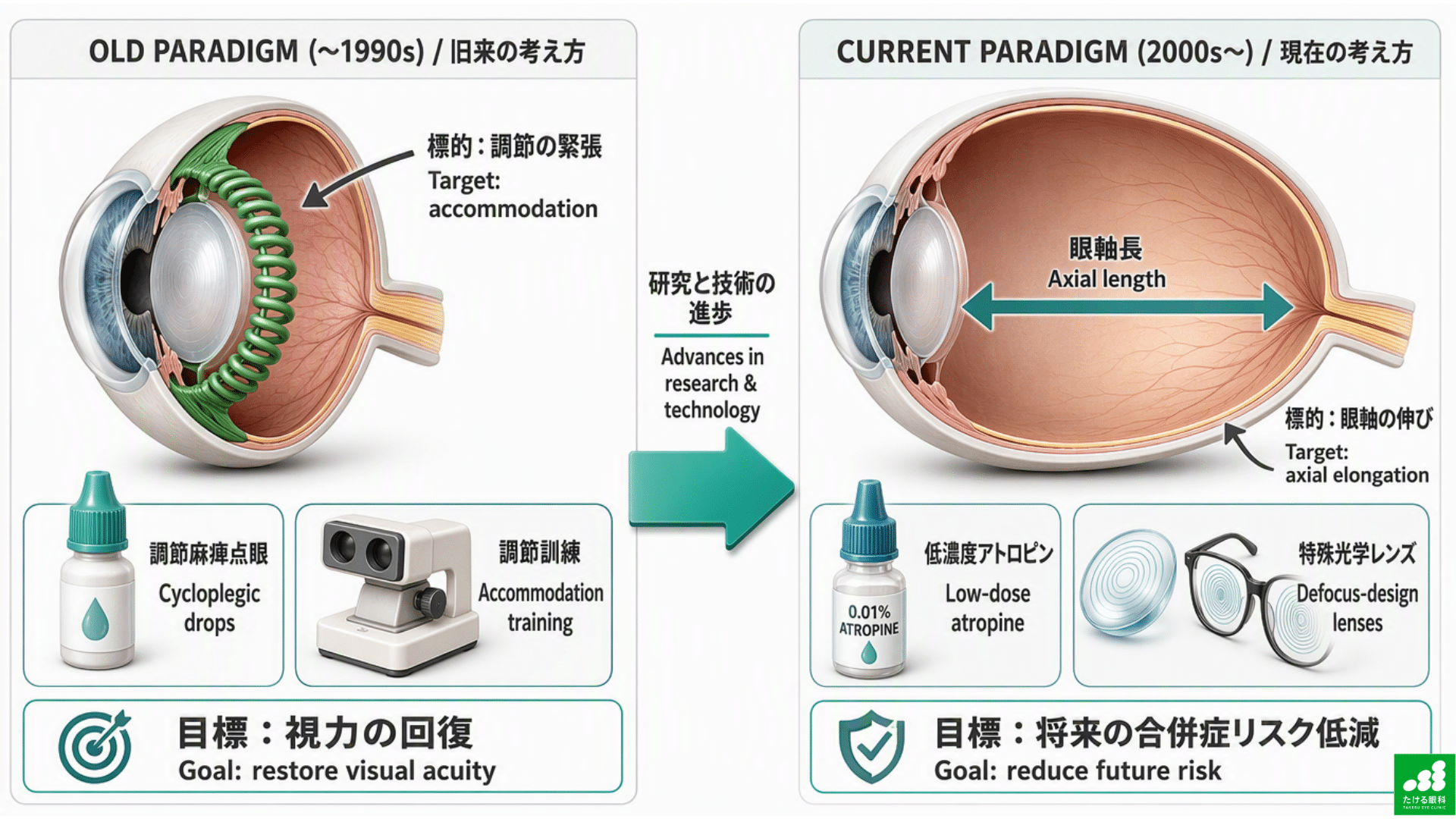
When the tension relaxes, vision returns. From this arose the idea that “myopia begins with accommodative tension; if it is relaxed early, true myopia might be avoided.”
In Japan this idea (the accommodation theory) was systematized in the 1960s and spread nationwide as the standard response for children flagged for reduced vision at school screenings.
The treatment at the time: eye drops and training
This treatment set for pseudomyopia was available at eye clinics across the country for many years.
Before bed, a cycloplegic eye drop (Mydrin®-M: tropicamide) was used, and during the day an eye drop to improve accommodation (Miopin®, Mypirin®: neostigmine). Children also visited the clinic once or twice a week for accommodation training (WAC), looking at a distant landscape through a machine.
The goal of treatment was to relax the ciliary muscle and recover vision.
In fact, a certain number of children do see better when the accommodative tension relaxes. Accommodative tension itself is a real phenomenon that is confirmed by current research2。
Even so, doubts existed from early on.
Material for the general public from the Japan Ophthalmologists Association states, “Opinion is divided on whether a pseudomyopia state really exists” and “it is not a very well-founded treatment, so it is better not to expect much from it”1。
What the domestic trials of the time confirmed was only that “accommodative tension is released and vision and refraction improve in the short term”3。
High-quality clinical trials showing that eye drops or training suppress the elongation of the eyeball itself have not been found, even in international systematic reviews4。
Including the detours: the history of myopia treatment

Looking back over the history of myopia treatment, there were many trials and errors beyond the accommodation theory.
| Period | Mainstream thinking / treatment | Looking back now |
|---|---|---|
| From the 19th century | “Apparent myopia” due to spasm of accommodation is described2 | The origin of the concept of pseudomyopia |
| 1960s | In Japan the “accommodation theory” is systematized. Pseudomyopia treatment with eye drops plus training spreads nationwide together with school screening1,3 | The goal was to recover vision. Axial length could not yet be measured |
| 1970s–1990s | Training devices (WAC and others) spread. The idea of undercorrection, that “keeping glasses weak prevents progression,” also spreads | Later trials suggested undercorrection may actually speed up progression5 |
| Same period (overseas) | A culture of training based on the accommodation theory develops in the Soviet Union and China (in China, eye exercises, “eye acupressure exercises,” are still done in schools today) | Meta-analyses have not confirmed any effect in preventing or suppressing myopia6 |
| 1977–2005 | Animal experiments show that “visual input affects the growth of the eyeball”7,8 | The scientific basis for a paradigm shift |
| 2003 | A large trial of progressive addition lenses that reduce the accommodative load (COMET) | The difference was statistically significant but clinically small9 |
| 2006–2019 | Randomized controlled trials of atropine eye drops (ATOM1, ATOM2, LAMP) and of orthokeratology follow one after another10,11 | “Axial length” becomes the main measure for evaluating treatment |
| 2019–2022 | Randomized controlled trials of MiSight® and myopia control glasses, and approval in Europe and the United States12,13 | An era of suppressing axial elongation with optical design |
| 2024–2026 | In Japan, Ryjusea® Mini and MiSight® are approved, and myopia control glasses are launched domestically14,15,16 | In Japan too, myopia management combined with axial length measurement is spreading |
* The superscript numbers correspond to the reference numbers at the end of the article.
Here are a few representative detours.
It was once widely believed that “keeping glasses weak keeps myopia from progressing.”
However, a trial reported in 2002 showed the opposite of what was expected: myopia progressed faster in the undercorrected group5。
Today, appropriate full correction is recommended.
From the idea that “reducing the accommodative load for near viewing should slow progression,” progressive addition lenses for distance and near were also tested on a large scale.
In a 3-year comparison trial (COMET, 2003), the difference was only 0.20 D, showing that the effect of slowing myopia progression obtained by intervening on accommodation alone is limited9。
There were training approaches overseas as well. In China, eye exercises called “eye acupressure exercises” are still done in schools today, but a meta-analysis of 11 trials found no meaningful effect on either vision or refraction6。
Each of the efforts discussed here was a serious attempt based on the hypotheses of its time. And the fact that verification showed them to be “of little effect” was itself valuable knowledge that led to the next step.
What we have learned: myopia is elongation of the “axial length”
The turning point came from animal experiments.
In 1977 it was reported that “visual deprivation alone makes the eyeball elongate and become myopic” in monkey eyes7, and a series of later studies showed that the growth of the eyeball is controlled by focus information reaching the retina8。
Most children’s myopia progresses through “elongation of the axial length,” the eyeball stretching from front to back.
And once the axial length has stretched, it is extremely difficult to bring it back.
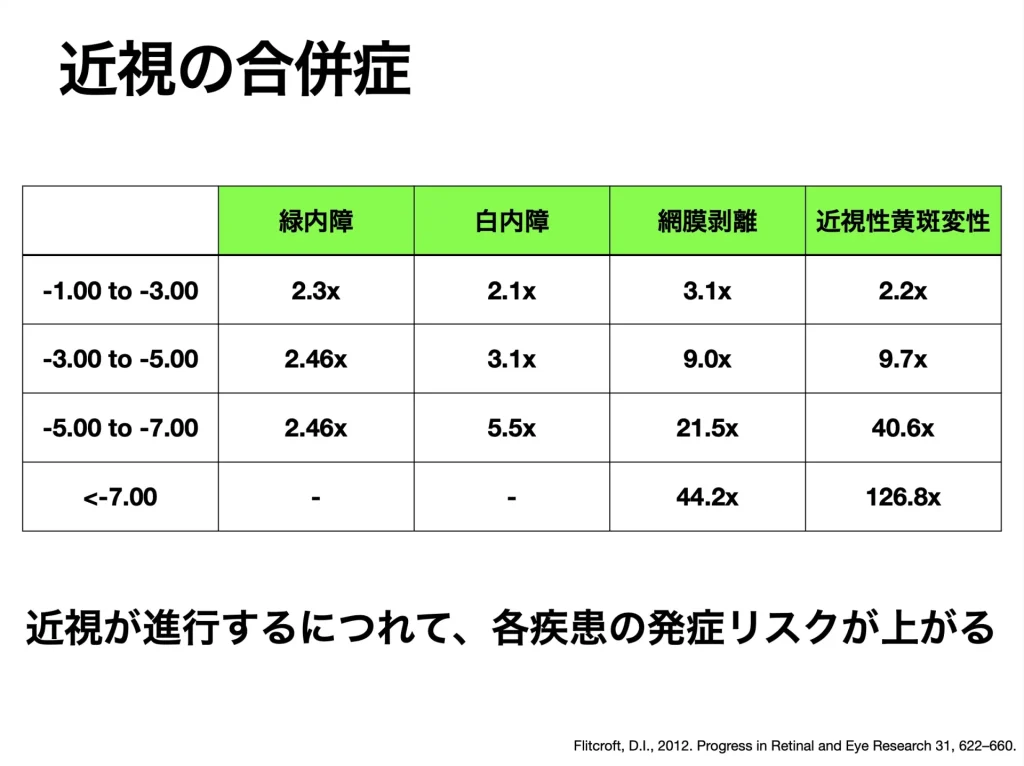
It is known that the longer the axial length, the higher the future risk of progression to high myopia and of eye complications such as myopic maculopathy, retinal detachment, and glaucoma.
So research worldwide shifted from “dealing with it after it has stretched” to “slowing the speed of stretching.”
Current treatments: options confirmed in randomized controlled trials
Since the 2000s, myopia control treatments have been tested in randomized controlled trials (RCTs) against placebo or standard care.
| Treatment | Representative trial | Reported result (difference from the control group in each trial) |
|---|---|---|
| Low-concentration atropine eye drops | LAMP trial (2019, 2-year RCT)10 | Suppresses progression in a concentration-dependent way (greatest at 0.05%) |
| Orthokeratology | ROMIO trial (2012, 2-year RCT)11 | Suppresses axial elongation by about 43% |
| MiSight® | Chamberlain 2019 (3-year RCT)12 | Suppresses axial elongation by about 52% |
| Myopia control glasses (DIMS) | Lam 2020 (2-year RCT)13 | Suppresses axial elongation by about 62% |
* The figures are those reported in each trial. Effects vary between individuals, and these treatments do not completely stop progression. RCT: randomized controlled trial. Because the subjects and conditions differ between trials, the figures for different treatments cannot be simply compared.
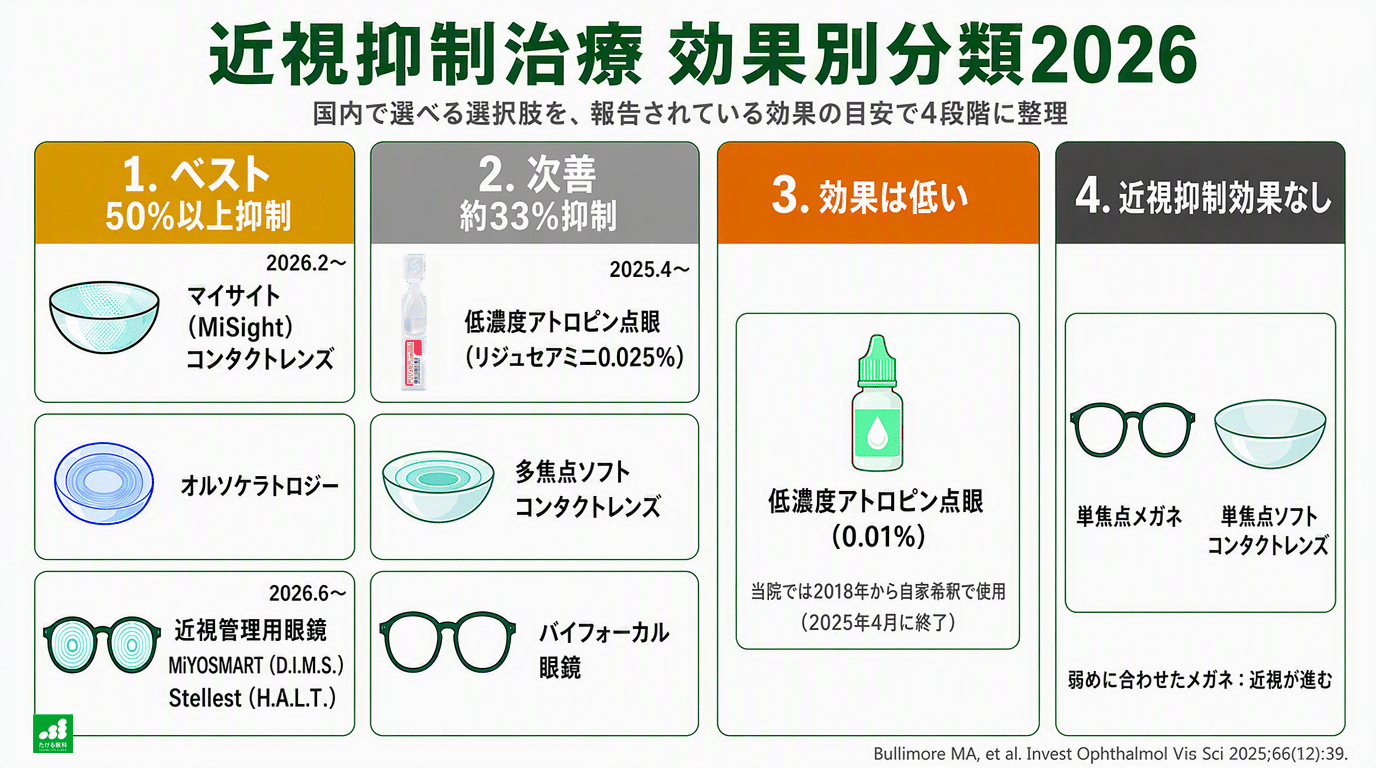
In Japan too, in December 2024, Ryjusea® Mini, a low-concentration atropine eye drop, was approved for the first time in Japan as an eye drop intended to slow the progression of myopia14。
In 2025, MiSight® was approved in Japan as a soft contact lens intended to slow myopia progression15. In June 2026, the domestic launch of MiYOSMART®, a spectacle lens for children’s myopia, also began16. Spectacle lenses, unlike drugs and contact lenses, are not subject to the same kind of marketing approval system.
In addition, a large school-based trial has shown that about 2 hours of outdoor activity a day is effective for “preventing the onset” of myopia17. However, outdoor activity alone cannot completely prevent onset. The evidence for outdoor activity is stronger for preventing onset than for slowing progression in children who are already myopic.
Was the old myopia treatment “wrong”?
I consider it inappropriate to regard the old myopia treatment as wrong.
Reasons:
(1) The technology to measure axial length was not in wide use. Devices that measure axial length safely and precisely using light spread in clinical practice only from the 2000s. What cannot be measured cannot be made a goal of treatment. The only measures ophthalmologists of that time could rely on were visual acuity and refraction.
(2) The accommodation theory was a leading hypothesis consistent with the observations of the time. The link between near work and myopia had long been known, and the explanation “near work → accommodative tension → myopia” was naturally accepted.
(3) There was no means anywhere in the world to slow the stretching of the axial length. For children and parents who came worried about declining vision, the best that ophthalmologists of the time could offer was an approach to accommodation.
The phenomenon of accommodative tension (pseudomyopia) itself is still confirmed to be real today. However, accommodative tension is not the main cause of children’s myopia. Even if the tension relaxes and vision temporarily improves, that does not mean the stretching of the axial length has been slowed.
Cycloplegic eye drops are still used today for accurate refraction tests and for evaluation when accommodative spasm is suspected. Eye drops for testing and low-concentration atropine treatment aimed at slowing myopia progression are different things.
What has changed is the answer to the goal of “slowing myopia progression.”
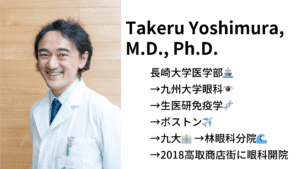
In practice at Takeru Eye Clinic (Takatori Shopping Street, Sawara Ward, Fukuoka)
Since opening in 2018, Takeru Eye Clinic has followed global trends in myopia control.
(We continually check trends in myopia management, including overseas research results.)
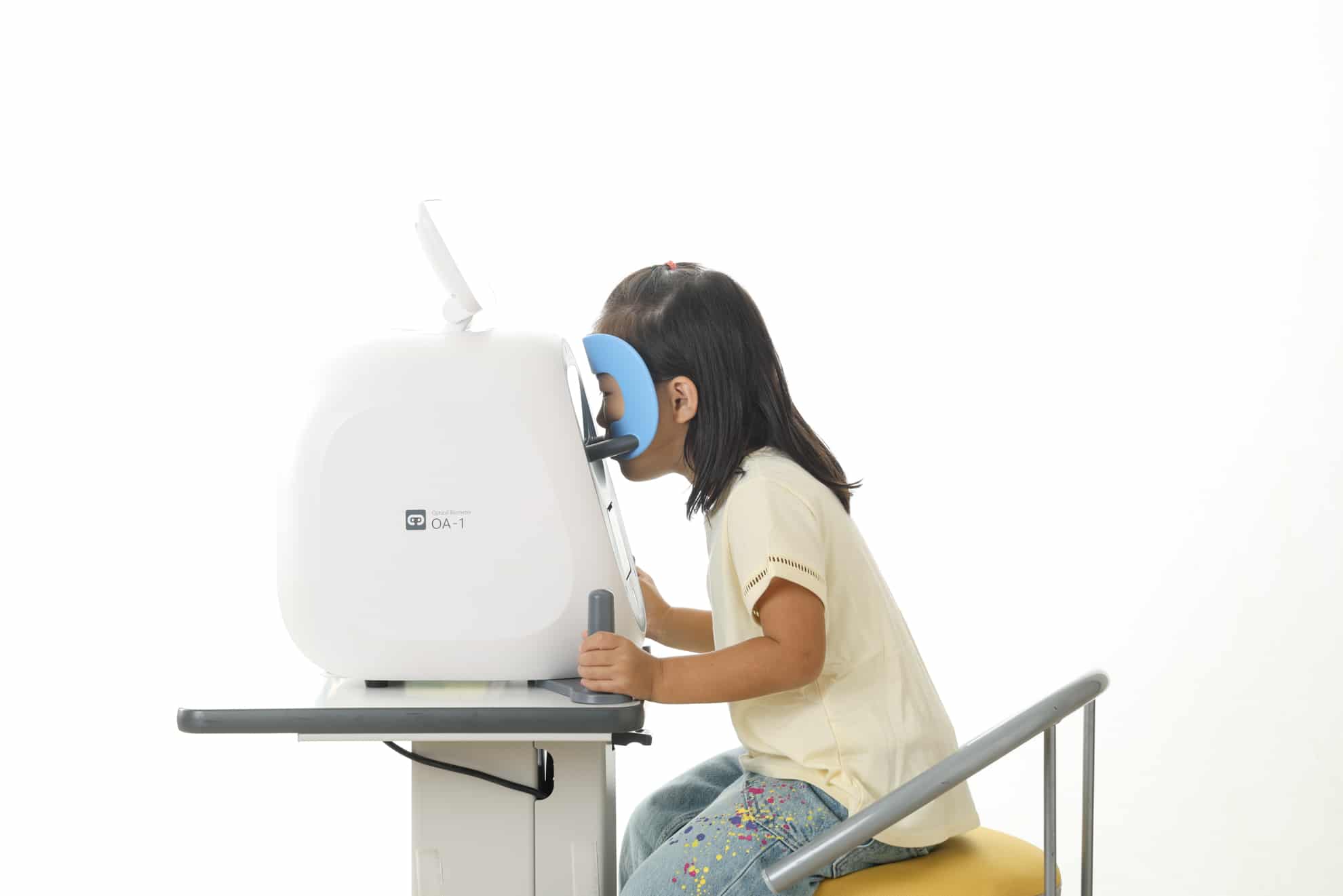
Today we make progression management based on axial length measurement the foundation of myopia care.
We regularly check the “speed” of elongation with an axial length measuring device, and think together with you about options such as Ryjusea® Mini (offered since April 2025), MiSight® (offered since its first day of sale in February 2026), orthokeratology, and myopia control glasses, according to the speed of progression, age, and lifestyle.
None of the myopia progression control treatments for children are covered by insurance (self-pay).
Costs and visit schedules are described on the information page for each treatment.
Not every child diagnosed with myopia needs these treatments. When progression is slow, observing without treatment is also an important option. We decide together with the family, taking into account age, speed of progression, lifestyle, and cost.
What I want to tell patients
“Was the treatment I received long ago meaningless?”
The best of that time and the best of today are different. That difference is the progress of these several decades.
Medicine moves forward on the accumulation of the previous generation. Because there was research on pseudomyopia and trials of progressive lenses, it became clear that accommodation alone cannot sufficiently explain the onset and progression of myopia, and we arrived at axial length, an important measure for evaluating myopia progression.
Today’s treatments, too, may be replaced by even better ones in ten years.
We will keep following that change and keep updating this article each time.
References
- Japan Ophthalmologists Association. When your child is told they have myopia (health information about the eyes). https://www.gankaikai.or.jp/health/39/06.html
https://www.gankaikai.or.jp/health/39/index.html - García-Montero M, Felipe-Márquez G, Arriola-Villalobos P, Garzón N. Pseudomyopia: a review. Vision (Basel). 2022;6(1):17. https://doi.org/10.3390/vision6010017
- Hosaka A. Myopia prevention and therapy. The role of pharmaceutical agents. Japanese studies. Acta Ophthalmol Suppl. 1988;185:130-131. https://pubmed.ncbi.nlm.nih.gov/2853518/
- Walline JJ, Lindsley KB, Vedula SS, et al. Interventions to slow progression of myopia in children. Cochrane Database Syst Rev. 2020;1(1):CD004916. https://doi.org/10.1002/14651858.CD004916.pub4
- Chung K, Mohidin N, O’Leary DJ. Undercorrection of myopia enhances rather than inhibits myopia progression. Vision Res. 2002;42(22):2555-2559. https://doi.org/10.1016/s0042-6989(02)00258-4
- Lin Z, Xiao F, Cheng W. Eye exercises for myopia prevention and control: a comprehensive systematic review and meta-analysis of controlled trials. Eye (Lond). 2024;38:473-480. https://doi.org/10.1038/s41433-023-02739-x
- Wiesel TN, Raviola E. Myopia and eye enlargement after neonatal lid fusion in monkeys. Nature. 1977;266(5597):66-68. https://doi.org/10.1038/266066a0
- Smith EL 3rd, Kee CS, Ramamirtham R, Qiao-Grider Y, Hung LF. Peripheral vision can influence eye growth and refractive development in infant monkeys. Invest Ophthalmol Vis Sci. 2005;46(11):3965-3972. https://doi.org/10.1167/iovs.05-0445
- Gwiazda J, Hyman L, Hussein M, et al. A randomized clinical trial of progressive addition lenses versus single vision lenses on the progression of myopia in children. Invest Ophthalmol Vis Sci. 2003;44(4):1492-1500. https://doi.org/10.1167/iovs.02-0816
- Yam JC, Jiang Y, Tang SM, et al. Low-Concentration Atropine for Myopia Progression (LAMP) study. Ophthalmology. 2019;126(1):113-124. https://doi.org/10.1016/j.ophtha.2018.05.029
- Cho P, Cheung SW. Retardation of myopia in Orthokeratology (ROMIO) study: a 2-year randomized clinical trial. Invest Ophthalmol Vis Sci. 2012;53(11):7077-7085. https://doi.org/10.1167/iovs.12-10565
- Chamberlain P, Peixoto-de-Matos SC, Logan NS, Ngo C, Jones D, Young G. A 3-year randomized clinical trial of MiSight lenses for myopia control. Optom Vis Sci. 2019;96(8):556-567. https://doi.org/10.1097/OPX.0000000000001410
- Lam CSY, Tang WC, Tse DY, et al. Defocus Incorporated Multiple Segments (DIMS) spectacle lenses slow myopia progression: a 2-year randomised clinical trial. Br J Ophthalmol. 2020;104(3):363-368. https://doi.org/10.1136/bjophthalmol-2018-313739
- Santen Pharmaceutical Co., Ltd. Notice of marketing approval in Japan for “Ryjusea® Mini Ophthalmic Solution 0.025%.” December 27, 2024. https://www.santen.com/ja/news/2024/2024_1/20241227
- Cooper Vision Japan Co., Ltd. Regarding domestic marketing approval of “MiSight 1 day” as a myopia progression control lens (approval no. 30700BZX00189000). 2025. https://coopervision.jp/our-company/news-center/250829
- HOYA Corporation (HOYA Vision Care Company). Notice of domestic launch of the children’s myopia spectacle lens “MiYOSMART.” On sale June 1, 2026. https://kyodonewsprwire.jp/release/202605259604
- He M, Xiang F, Zeng Y, et al. Effect of time spent outdoors at school on the development of myopia among children in China: a randomized clinical trial. JAMA. 2015;314(11):1142-1148. https://doi.org/10.1001/jama.2015.10803