![Takeru Eye Clinic | Takatori Shopping Street, Sawara-ku, Fukuoka City [Nishijin Station / Fujisaki Station]](https://takeru-eye.com/wp-content/uploads/2022/10/takeru_logo_for-WP-header.png)

“I was told my glasses prescription hasn’t gone up, but is my myopia really settling down?”
In July 2026, Takeru Eye Clinic began using the Tomey optical axial length measuring device “OA-1” to measure axial length in children’s myopia management.
There are two main purposes for introducing it.
One is to let parents and us check together, on the spot, not only “how myopic the eye is now” but also “how fast it is progressing”.
The other is to show where a child’s axial length sits among Japanese children of the same age, like a growth curve.
Myopia management is a treatment that aims not to stop progression but to slow its speed. With this premise, whether treatment is going well can only be judged by looking at whether “the speed of myopia progression has slowed.”
Below I explain, in order, why we look at axial length at all, the index called the AL/CR ratio, what it means to look at “speed,” and the OA-1 device itself.
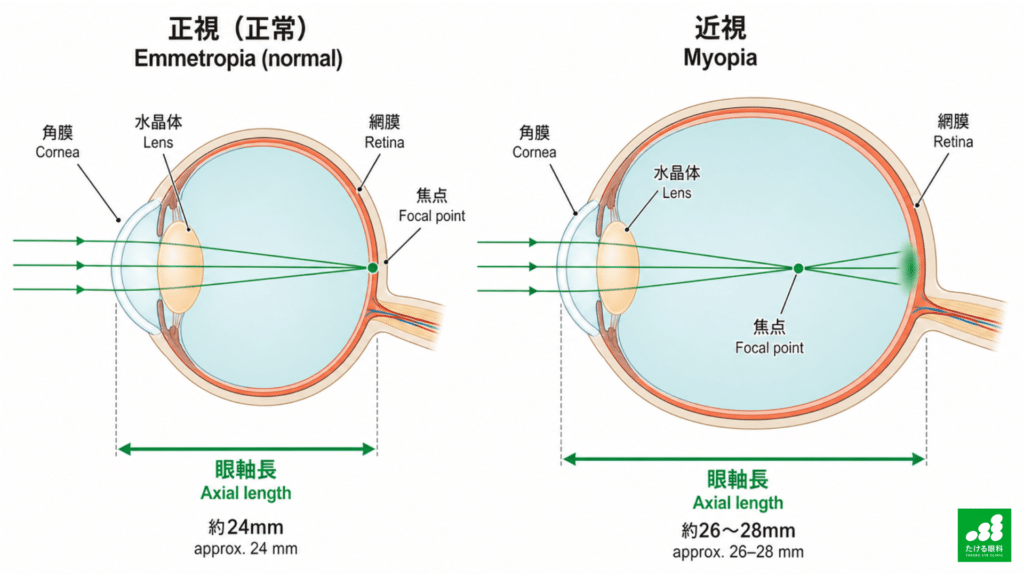
What is “axial length”? A number close to the “core” of myopia
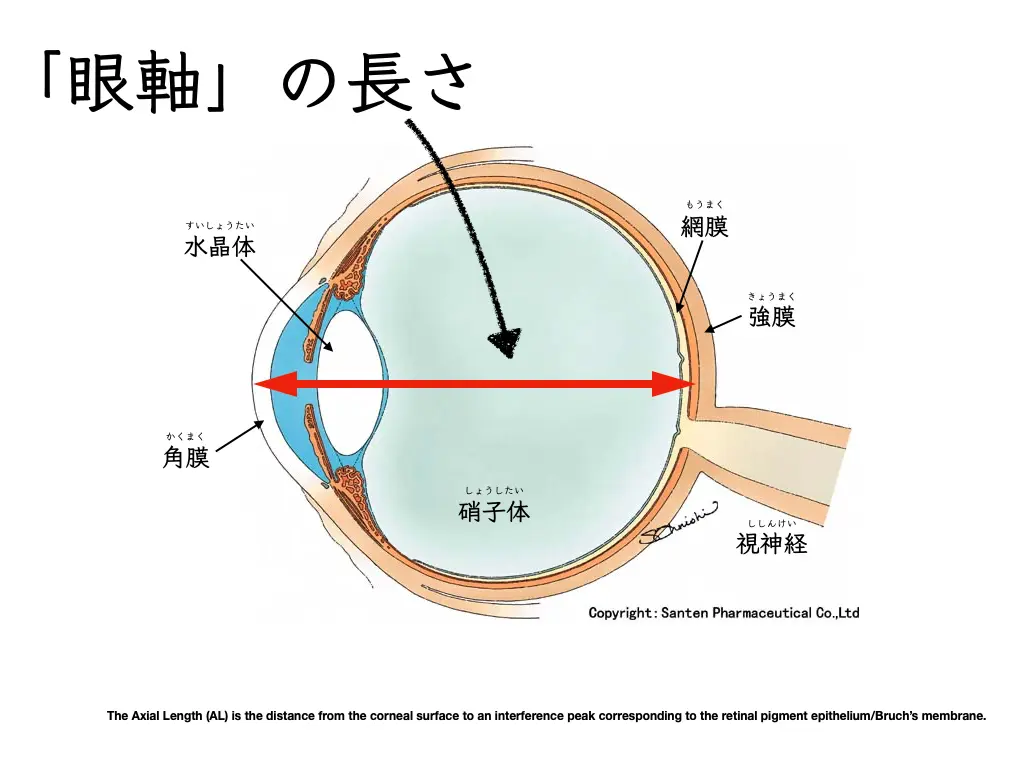
Axial length is the length of the eye from front to back, that is, the distance from the surface of the cornea to the retina. In adults it is roughly 24 mm.
Most myopia is caused by the axial length growing too long. Seen from the side, the ball-shaped eyeball gradually changes into an egg shape that is a little longer front to back.
When the eye becomes longer front to back, the point of focus falls in front of the retina and distant objects look blurry.
Axial length is a number close to the “core” of myopia. Visual acuity (1.0, 0.5 and so on) and glasses prescription (refractive power) give clues to the degree of myopia.
However, visual acuity changes with the day’s physical condition, concentration and room brightness, and the prescription is affected by the eye’s focusing power (accommodation). To measure a child’s prescription accurately, eye drops that stop accommodation (cycloplegic drops such as Cyplegin®) are needed, which takes time and is a burden.

Axial length, by contrast, is the length of the structure of the eye itself. It can be measured without eye drops, is not easily affected by the day’s condition, and can be followed in fine steps of 0.01 mm.
For following the progression of myopia, it is an index that can be tracked more finely and more reproducibly than changes in refractive power, and is emphasized in the international guidance for myopia research (IMI)¹. That is why, in myopia management, we follow axial length as the scale.
📌 Why follow axial length rather than prescription? (clinical note)
Refractive power moves in 0.25 D steps, which corresponds to about 0.08 mm of axial length. Axial length can be measured with a resolution of 0.01 mm or finer, so progression can be captured in roughly 10 times finer detail¹.
In addition, axial length hardly changes before and after cycloplegia, so it can be measured repeatedly at every visit without Cyplegin®. A refraction test under cycloplegia is essential for the initial evaluation of myopia, but axial length is better suited to follow-up of progression afterwards.
There is another reason axial length matters. It has been reported that the longer the axial length, the more likely retinal and optic nerve diseases (retinal detachment, myopic maculopathy, glaucoma and others) become in the future.
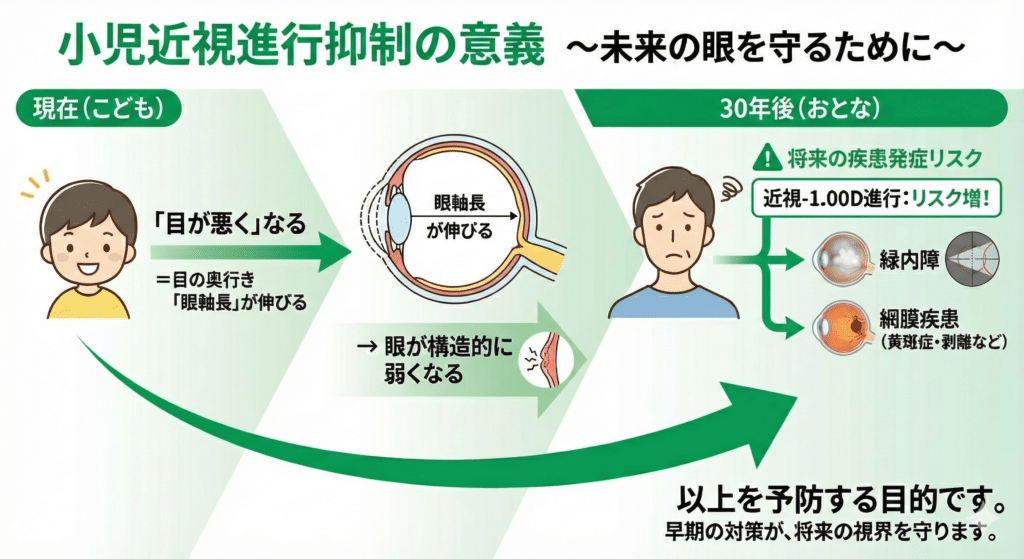
A large European study showed that from an axial length of around 26 mm upward, the proportion who develop visual loss that cannot be restored by correction over a lifetime rises step by step². It has also been reported that the earlier myopia starts, the more likely it is to reach strong myopia (high myopia) in the future³.
The real aim of myopia management is not so much to make the glasses prescription as an adult one or two steps lighter, but to lower future risk even a little. The relationship between progression of myopia and future risk of eye disease (glaucoma and retinal disease) is also explained inMyopia progression of −1.00 D: what is the future eye risk? (glaucoma and retinal disease).
The overall thinking behind slowing myopia progression is summarized on the following pages of our clinic.
Axial length alone is not enough: the AL/CR ratio
Axial length is a number close to the core of myopia, but it cannot explain everything. Eye size and corneal curvature vary between individuals, and taller children tend to have longer axial lengths.
Even at the same 25 mm, the degree of myopia differs between an eye with a gently curved cornea and one without.
This is where the ratio of axial length (AL) to corneal curvature (corneal radius of curvature, CR), the AL/CR ratio, comes in. It has long been known that the AL/CR ratio corresponds better to the degree of myopia (refraction) than axial length alone⁴.
In a study of schoolchildren in China as well, the AL/CR ratio correlated more strongly with refractive power than axial length alone (explanatory power rose from about 44% to 66%), and it was reported to be useful for judging myopia⁵. Even in situations such as school health checks, where cycloplegic drops are hard to use, the AL/CR ratio is an index that can be used to screen for myopia.
📌 Guide values for AL/CR and how to read them by age (clinical note)
In school myopia screening, whether the AL/CR ratio exceeds about 3.0 is used as one guide⁵ ⁶ (the optimal value varies by age and population). Interpretation needs care, however.
Even for the same 1 mm increase in axial length, at younger ages the cornea flattens and the lens power decreases, so the change in prescription is small, and the older the child, the larger the change in prescription. The AL/CR ratio is an index that smooths out these changes of the eye with growth, and it must be read with age in mind.
Another important point is that the likelihood of myopia differs between populations. An analysis pooling multiple studies has shown that East Asian children have a higher proportion of myopia than Western children⁷.
The way the eye grows and elongates is also thought to differ between populations, and even the same axial length can mean something different against a different background population.
In evaluating children’s myopia, it is meaningful to compare with data from Japanese and Asian children.
The OA-1 can also automatically calculate the AL/CR ratio in addition to axial length.
What has changed: from “today’s number” to “the speed of progression”
Takeru Eye Clinic took up axial-length-based myopia management early, and has recorded the axial length of each child with myopia using an optical axial length measuring device (Nidek’s AL-Scan M) and myopia management software (MV-1). We summarized the time we introduced it in an earlier article.
We are now switching the measuring device to the new OA-1. Measurement itself has been accurate with the previous device, and we had no complaints about the legibility of its screens and graphs.
What we wanted to change was the part that shows the way myopia progresses as “speed.”
As axial length is measured every three months or six months, numbers line up in the record. For example, “24.10 mm → 24.28 mm → 24.40 mm.”
With the previous data management software, these numbers and line graphs over time could be displayed. But there was no function that clearly showed the speed of progression (progression rate, mm/year), that is, how many millimeters it grows per year, as a slope. It therefore had to be calculated by hand.
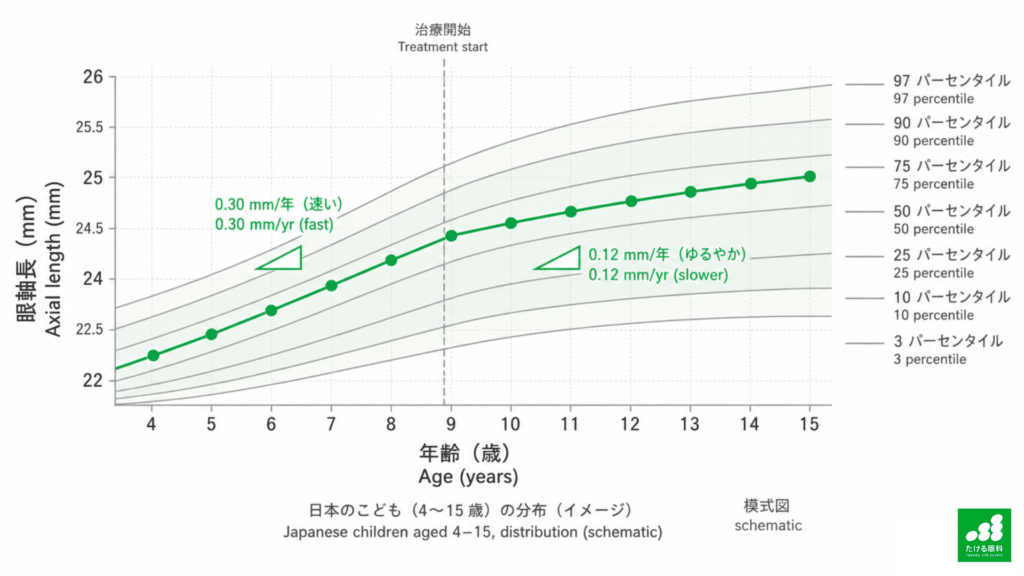
Why is the “speed” of axial length elongation important?
Think of a child’s height record. On the growth chart in the maternal and child health handbook, we look not so much at today’s height itself but at “at what angle the line is heading upward.”
During a period of rapid growth the line is a steep slope, and as things settle the slope becomes gentler. Axial length is the same.
What we most want to know in myopia management is “whether the slope of growth has become gentler since starting treatment.”
With only a list of numbers, the slope has to be calculated in your head. Grasping by mental arithmetic that “24.10 to 24.28 is 0.18 mm in half a year, so over a year it would be…” is not easy for parents or for medical staff.
But if the speed of progression (for example, “0.30 mm/year last year, 0.12 mm/year this year”) can be shown as a slope, you can see at a glance that the slope has become gentler.
Looking at speed has another meaning. The effect of treatment is determined by the product ofthe treatment method chosenandhow well it is continued (compliance).
Are you using orthokeratology properly every night? Are you able to keep up the eye drops? When the speed of progression changes suddenly, it may mean not only that the treatment is not a good fit but also that continuing it has become difficult.
Being able to see speed lets us notice changes in axial length early and review them together with parents.
📌 Our guide for starting or reviewing treatment (our clinic’s practice)
The literature does not set any single number, but our clinic has one practical guide. For those not yet being treated, when axial length grows by 0.20 mm or more per year, we explain the treatment options. For those already being treated, if growth of 0.22 mm or more per year continues, we consider reviewing or strengthening treatment. More than the number itself, we emphasize “whether the speed of growth has slowed compared with before treatment started.”
In addition, the OA-1 also makes it easier to see “where the child is now.” The OA-1 software (Axial Manager 2) displays axial length percentile curves for Japanese children aged 4 to 15, based on Japan’s national myopia survey (the Ministry of Education survey of myopia in schoolchildren) and health check data for preschool children⁸.
As with a height growth chart, you can see where a child’s axial length sits among Japanese children of the same age and which band it follows. This curve has been refined with the OA-1 in the school health check study (COY-NEXT) led by Tohoku University.
With the device we had used, comparison was mainly against growth curves based on data from European children. For examining Japanese children, I think it is meaningful to be able to compare with Japanese data.
How to read the signs that “myopia treatment may not be working,” and how to rebuild treatment in that case, are also touched on in the following article of our clinic.
What does the OA-1 device do?
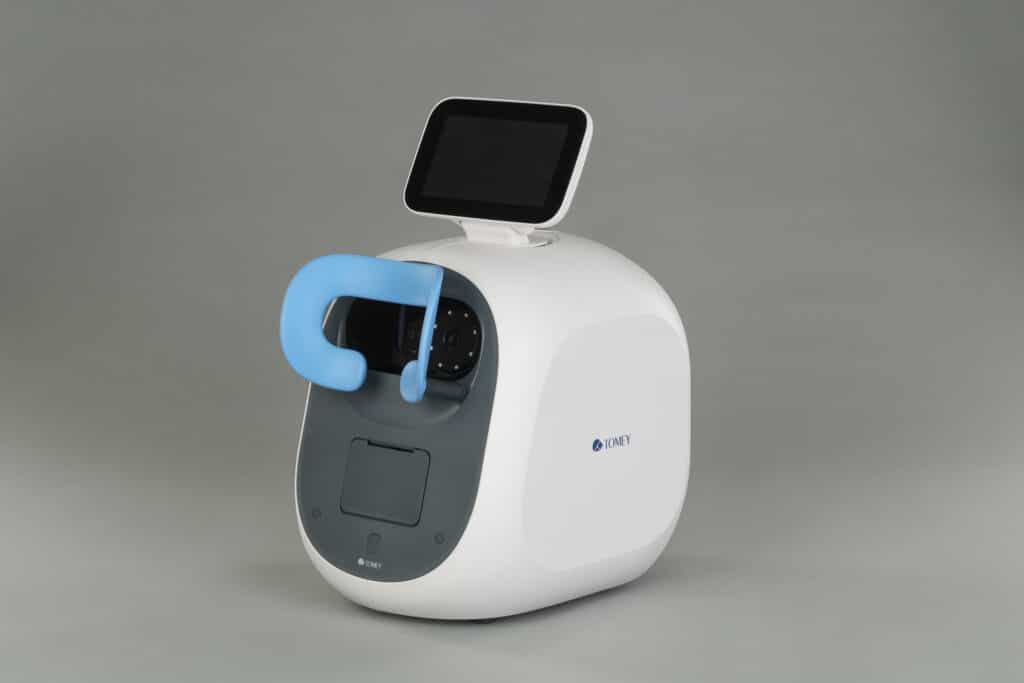
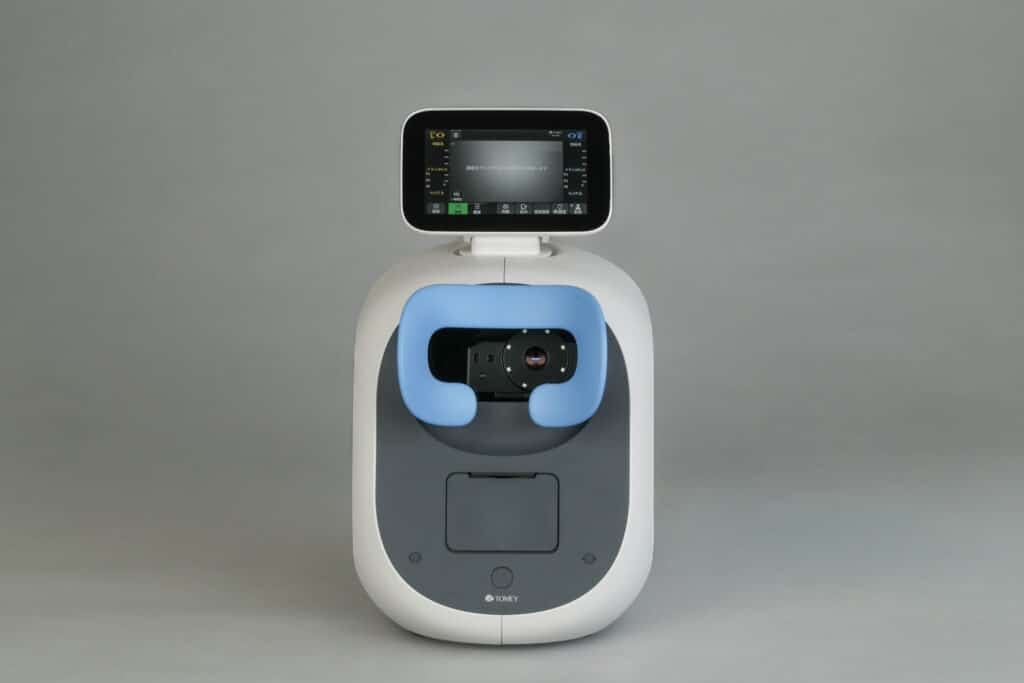
Image courtesy of Tomey Corporation
The OA-1 is a device that measures axial length without touching the eye. According to the manufacturer, it measures using light interference (OCT), a method that uses light.
A very weak near-infrared light is shone into the eye, and the front-to-back length is calculated from the tiny difference in time for the light to bounce back from the retina at the back of the eye. It is painless and needs no numbing drops.
Of course there is no air puff either. One measurement takes only about ten-odd seconds.
In an examination that follows tiny increases such as axial length, what matters most is that the device does not drift (reproducibility).
Another feature of the OA-1 is its shape, designed so that children can be measured easily. There is no chin rest, children can look in naturally by themselves, and animal animations appear on the screen to attract their gaze.
It is built so that talking hardly affects the measurement, and so that small children and eyes that were hard to measure before are easier to measure. The OA-1’s design was selected for a 2025 Good Design Award (Japan Institute of Design Promotion)⁹.
The actual examination is done by anorthoptist who checks the child’s condition and proceeds within a comfortable range. Children see fun images whose patterns change.

Image courtesy of Tomey Corporation
“Designed for children” is about how comfortable it is to use.
There is no age limit on what can be measured. The OA-1 can measure adult eyes in the same way. (The picture of the target to look at can be changed.)
A long axial length (stronger myopia) is related to glaucoma and retinal disease, so axial length measurement is also an important test in following people with high myopia.
The OA-1 can accommodate everyone from children to adults.
What is known and what is not
The OA-1 is a newly released device. At present there are no published data comparing its measurements side by side with the Nidek device we have been using.
For that reason, we cannot say things like “the OA-1 is more accurate.” Optical measurement of axial length is generally considered highly reproducible, but published data confirming the accuracy of the OA-1 on its own are still limited.
I think we are at the stage of confirming this through actual use.
There is one more practical point for children who have been in treatment until now.
When the measuring device changes, measuring the same eye can give values that differ very slightly.
This comes from differences in each device’s optical design, and it does not mean that either one is wrong.
For that reason, on the axial length graph of a child recorded until now with the Nidek device, the line may appear to shift slightly like a step at the point of switching to the OA-1.
The step is due to “the device having changed,” not to “the eye suddenly changing.” We record the time of the switch, subtract the step, and look at whether the speed of growth itself has changed.
Even if you see a small step in the graph, in most cases it is the effect of switching devices. If anything concerns you, please feel free to ask at your visit.
How we do it in practice
Takeru Eye Clinic (Takatori Shopping Street, Sawara Ward, Fukuoka) has followed worldwide myopia research since opening in 2018 and built its myopia management program.
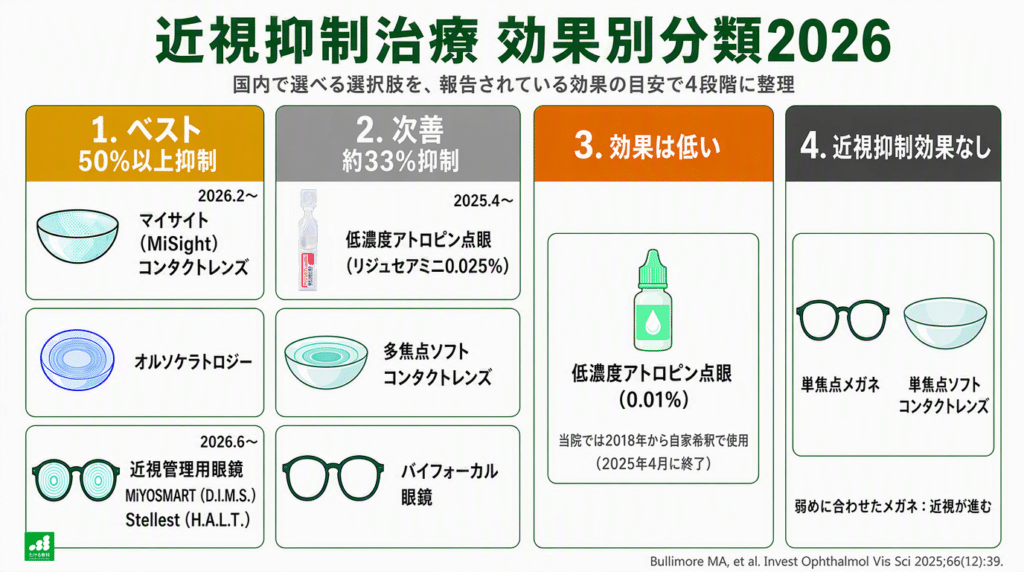
We offer several options: orthokeratology, Ryjusea® Mini (low-concentration atropine eye drops), MiSight®, and myopia control glasses (MiYOSMART® and Stellest®).
Whichever treatment is chosen, what we do in common is measure axial length. With measurement every three months, we check whether the speed of growth has slowed, and review treatment as needed.
With the OA-1, sharing “speed” becomes easier to understand than before. The results can also be printed as a report for explaining to parents.
How to choose a treatment is decided by laying side by side the speed of progression, age, lifestyle and the family’s thinking. An overview of the options is summarized in the following article.
We also run a management app (Myopia Progression Control Management App) that lets families check axial length data at home.
By entering axial length, you can look back on your phone at the “speed” you saw in the examination room.
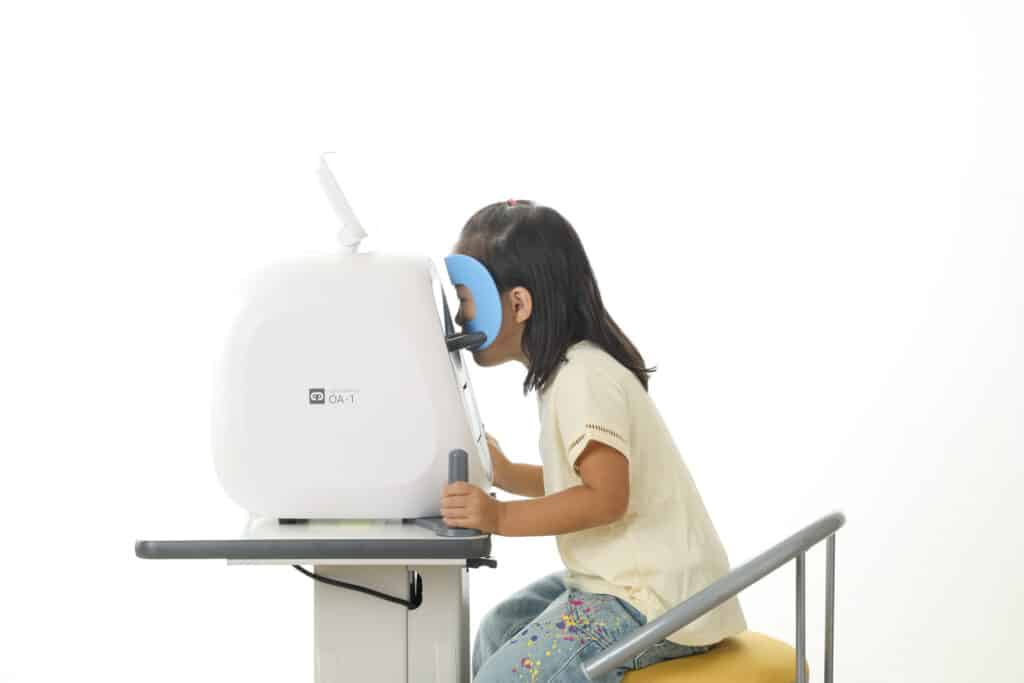
Image courtesy of Tomey Corporation
Why we chose the OA-1
The reasons Takeru Eye Clinic replaced the machine it had been using with the OA-1 are mainly the following.
- It shows the speed of myopia progression (mm/year) as a slope, making it easier to share with parents whether treatment is working
- It supports percentile curves for Japanese children (ages 4–15), allowing comparison with Japanese data
- It automatically calculates the AL/CR ratio in addition to axial length
- It measures in ten-odd seconds without touching the eye, in a design children can look into naturally
All of these fit our policy of looking together with parents at the speed of progression and at the child’s position among Japanese children.
For patients and parents
What we really want to see in myopia management is not today’s prescription or visual acuity number itself, but “whether the speed at which myopia progresses is becoming gentler”.
Now that the speed of axial length elongation can be seen as a slope, and the child’s position among Japanese children can be checked, it has become easier than before to confirm together whether treatment is having an effect.
If you have questions about how to read axial length or how myopia progresses, please ask at your visit. At the child’s examination, we will explain while showing the actual graph.
References
- Wolffsohn JS, Kollbaum PS, Berntsen DA, et al. IMI – Clinical Myopia Control Trials and Instrumentation Report. Invest Ophthalmol Vis Sci. 2019;60(3):M132-M160. https://doi.org/10.1167/iovs.18-25955
- Tideman JWL, Snabel MCC, Tedja MS, et al. Association of Axial Length With Risk of Uncorrectable Visual Impairment for Europeans With Myopia. JAMA Ophthalmol. 2016;134(12):1355-1363. https://jamanetwork.com/journals/jamaophthalmology/fullarticle/2569443
- Hu Y, Ding X, Guo X, et al. Association of Age at Myopia Onset With Risk of High Myopia in Adulthood in a 12-Year Follow-up of a Chinese Cohort. JAMA Ophthalmol. 2020;138(11):1129-1134. https://doi.org/10.1001/jamaophthalmol.2020.3451
- Grosvenor T, Scott R. Role of the axial length/corneal radius ratio in determining the refractive state of the eye. Optom Vis Sci. 1994;71(9):573-579. https://doi.org/10.1097/00006324-199409000-00005
- He X, Zou H, Lu L, et al. Axial Length/Corneal Radius Ratio: Association with Refractive State and Role on Myopia Detection Combined with Visual Acuity in Chinese Schoolchildren. PLoS One. 2015;10(2):e0111766. https://doi.org/10.1371/journal.pone.0111766
- Mu J, Zeng D, Fan J, et al. The accuracy of the axial length and axial length/corneal radius ratio for myopia assessment among Chinese children. Front Pediatr. 2022;10:859944. https://doi.org/10.3389/fped.2022.859944
- Rudnicka AR, Kapetanakis VV, Wathern AK, et al. Global variations and time trends in the prevalence of childhood myopia, a systematic review and quantitative meta-analysis: implications for aetiology and early prevention. Br J Ophthalmol. 2016;100(7):882-890. https://doi.org/10.1136/bjophthalmol-2015-307724
- Ministry of Education, Culture, Sports, Science and Technology. FY2021 Survey of Myopia in Schoolchildren: Report of Results. 2023. https://www.mext.go.jp/b_menu/houdou/2024/attach/mext_01403.html
- Japan Institute of Design Promotion. Good Design Award, list of winners: “Optical axial length measuring device [OA-1]” (FY2025). https://www.g-mark.org/gallery/winners/29522?years=2025