![Takeru Eye Clinic | Takatori Shopping Street, Sawara-ku, Fukuoka City [Nishijin Station / Fujisaki Station]](https://takeru-eye.com/wp-content/uploads/2022/10/takeru_logo_for-WP-header.png)

I have divided my writing about Ryjusea® Mini into three articles
- What is Ryjusea® Mini (approval, eligibility, use, side effects)
- Costs and selected medical care (what insurance covers and our policy) (this article)
- What happens if you stop? When you feel it is not working (rebound and when to stop)
From June 2026, Ryjusea® Mini moved to “selected medical care” (Sentei Ryoyo). Here I explain how the costs work and our clinic’s policy.
What is selected medical care?
At the Central Social Insurance Medical Council meeting on January 9, 2026, the direction was shown to move myopia progression control treatment with Ryjusea® Mini into the “selected medical care” framework from June 2026, and prescription under selected medical care began in June 2026.
Under selected medical care:
- Examination and test costs: covered by health insurance (20–30% copayment)
- Drug cost (Ryjusea® Mini):remains fully out of pocket
It may be eligible for children’s medical expense subsidy programs (eligibility varies by municipality).
I think it is very meaningful that the burden on patients is moving in a lighter direction as a system, and that myopia progression control treatment will reach more people.
At the Asia-Pacific Myopia Management Symposium (APMMS 2026) held in Tokyo in May 2026, myopia experts from around the world stated clearly that “pediatric myopia management is no longer an alternative but a standard of care.”
As treatment options in Japan are quickly coming into place, I would like to state our clinic’s policy once again.
Why our clinic continues self-pay care
At our clinic, even after June 2026, we have decided tocontinue myopia management as self-pay care.
Reason 1: Axial length measurement every 3 months is the core of treatment
“Within a few months the glasses prescription had already changed.” “Before I knew it, vision had dropped rapidly.”
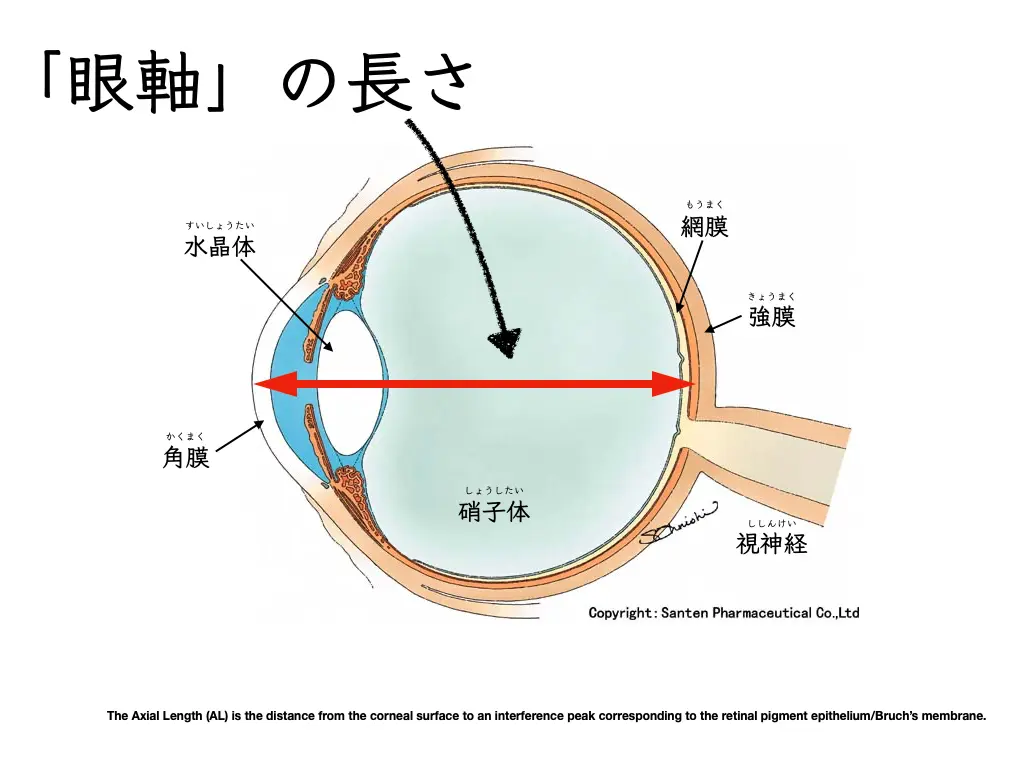
In school-age children, in whom myopia progresses easily, the axial length grows at a faster pace than you might imagine.
Under selected medical care, insurance coverage of axial length measurement is limited to twice a year.
Myopia management at our clinic is based on axial length measurement every 3 months. This is not mere habit; there is clinical evidence for it.
It has been reported that children in East Asia, including Japan, have faster axial progression than those in Europe and the United States (Brennan/Naduvilath et al. Ophthalmic Physiol Opt. 2025).
| Age | Annual axial elongation (in myopia) | Converted to 3 months |
|---|---|---|
| Ages 6–8 | 0.45〜0.58 mm | 0.11〜0.14 mm |
| Ages 8–10 | 0.30〜0.40 mm | 0.07〜0.10 mm |
| Ages 10–12 | 0.20〜0.30 mm | 0.05〜0.07 mm |
(Source: CLEERE Study, Shanghai pediatric cohort study and others)
The standard recommendation is to measure axial length at 6-month intervals. However, it has been reported that axial elongation is faster in East Asian children than in Europeans, and that the difference is particularly large in younger children (Brennan et al. Ophthalmic Physiol Opt. 2024)。
Given this fast pace of progression, our clinic bases its practice on axial length measurement every 3 months, in order to catch changes earlier.
Conversely, with measurement at 6-month intervals, you would reach the next visit having missed roughly half of the changes in a period of rapid progression.
The fact that each 1 diopter of myopia progression statistically raises the risk of future complications is explained in detail in a separate article.
Reason 2: When we notice that myopia is progressing “fast,” we can immediately consider the next step
The flow of myopia management at our clinic is as follows.
- Measure axial length every 3 months
- Calculate the speed of progression (converted to mm/year) from the difference from the previous measurement
- Compare with age-specific criteria and judge whether progression is rapid
- Strengthen treatment if necessary
When Ryjusea® Mini alone is not effective enough, evidence shows that switching to combination therapy with orthokeratology or MiSight® can raise the suppression rate further.
Being able to make this judgment every 3 months is the strength of myopia management at our clinic. With 6-month intervals, this judgment is delayed by half a year.
Reason 3: For those who want to continue myopia treatment with conviction
At APMMS 2026, Prof. Ian Flitcroft (Centre for Eye Research Ireland) presented a formula.
Effectiveness of treatment = treatment effect × compliance
If compliance (the rate of continuing treatment) falls to 0, even the best treatment has an effectiveness of 0.
Introducing selected medical care makes the choice of “let’s just try it for now” easier to make.
But myopia progression control treatment only means something once it has been continued for at least two years.
If it is stopped partway, the suppressed effect is lost, and there is a risk that myopia starts to progress again. The rebound with the 0.025% concentration is explained in detail inthis article.
We consider an “environment in which treatment can be continued” to be the premise of treatment.
“It became easier to start because of the cost”
→ “It became hard to keep going”
→ “Myopia started to progress again”
This may lead to a worse outcome than not having treated at all.
Our clinic wants to provide the best management to those who come to us wanting to “manage myopia properly.” That is why we decided to maintain self-pay care.
If you want to slow your child’s myopia as much as possible, we will take care of you with attention.
Myopia management made visible with numbers
It is important to be able to show “it’s progressing fast” or “it’s being suppressed” not by feeling but by numbers.
Calculating the speed of progression every time
All eye examinations are handled bycertified orthoptists (CO/ORT).
TheAL-Scan M and MV-1 (NIDEK) used for axial length measurement are not easily affected by fixation, so even small children can be measured accurately in a short time.
We calculate the speed of progression (converted to mm/year) from the difference from the previous measurement and compare it with age-specific criteria.
For example, for an 8-year-old, growth of 0.30 mm or more per year corresponds to “rapid progression.” Seeing the number “it grew 0.08 mm since last time,” we can have a concrete conversation: “That is 0.32 mm per year, in the fast range. Let’s first check together whether the eye drops are being continued, and then consider adding orthokeratology.”
It is a judgment based on numbers, not on “it somehow feels like it’s progressing.”
Before strengthening treatment, we first check whether the eye drops or lenses are being used as decided. What we do next differs depending on whether it is not working or not being continued.
Guide for strengthening treatment (annual axial elongation):
- 0.20 mm or more: caution needed, follow-up is strengthened
- 0.30 mm or more: consider strengthening treatment (adding OrthoK or MiSight, etc.)
- 0.40 mm or more: progression is very fast. After checking that treatment is being used, discuss combination therapy
We give you the axial length graph every time
At every visit, we print the axial length measurements so far as a graph and hand it to you.
“The pace of growth has slowed since treatment began.” “It was a little faster only during this period.” We manage your child’s eye changes while checking them together with the parents.
Myopia management app (for parents)
Since February 2026, our clinic has offered a myopia management app that lets parents check the course of axial length on their smartphone at any time.
- Check the axial length graph over time on your smartphone
- Compare with BHVI percentile curves by age
- Manage several children together if you have siblings
- 3-level alert display
Nearly 200 patients are currently using it.
The app becomes easier to use as data from measurements every 3 months accumulate.
With axial length measured twice a year, data accumulate at a different pace, so it becomes harder to make full use of the app’s functions.
Overview of the myopia progression management app:
https://takeru-eye.com/myopia-app-introduction
About the visit interval
The basic interval is every 3 months (4 times a year), but if it overlaps with school events or exam periods, 2 months or 4 months later is fine too. If you come 4 times a year, the quality of management is maintained even if the interval varies a little.
Several children who live in dormitories or come from far away also visit us. For them, we have them come in at the time they return home. With the approach of “visit when you come back to Fukuoka,” they can continue without strain.
Our cost structure (self-pay, unchanged)
Even after the move to selected medical care, we have decided not to change our cost structure.
| Item | Cost (tax included) |
|---|---|
| At start of treatment (examination and prescription fee) | ¥3,300 |
| Ryjusea® Mini (1 month supply) | ¥4,380 |
| Annual management fee (includes visual acuity tests, axial length measurement and slit-lamp examination every 3 months) | ¥17,600 |
| Examination fee when combined with orthokeratology | None (only the ¥1,100 prescription fee) |
The axial length graph is printed and handed to you at every visit.
Selected medical care vs self-pay care: comparison
| Selected medical care From June 2026 |
Self-pay care Takeru Eye Clinic’s policy |
|
|---|---|---|
| Examination and test costs | Covered by insurance (20–30% copayment) May be effectively free with children’s medical expense subsidy |
Fully out of pocket |
| Drug cost | Fully out of pocket (unchanged) ¥4,380 / box (1 month supply) |
Fully out of pocket ¥4,380 / box (1 month supply) |
| Frequency of axial length measurement | Up to twice a year (insurance) From the third time, not covered by insurance Changes over half a year may be missed |
Every 3 months Speed of progression grasped in real time Rapid progression can be found early |
| Grasping the speed of progression | Evaluation every six months Early detection of a rapid progression period may be delayed |
Calculated in mm/year every time Compared with age-specific criteria to judge whether progression is rapid |
| Axial length graph | Varies by medical institution |
Printed and handed to you every time All data so far visualized in a graph |
| Myopia management app | Practically difficult With axial length measured twice a year, data do not accumulate |
Available Parents can check the course of axial length on their smartphone at any time About 200 users |
| Timing of strengthening treatment |
Up to 6 months of delay Progression cannot be checked until the next measurement |
Judged every 3 months If the effect is insufficient, the switch to OrthoK or MiSight is decided early |
| Combination with OrthoK / MiSight |
Fully out of pocket on the same day A visit on a separate day may be needed |
Managed as a whole Axial length measurement, prescription and lens management handled together on the same day |
| Medical expense deduction | Eligible Both examination fees and drug costs are expected to be deductible |
Eligible Because it is an approved drug under the Pharmaceuticals and Medical Devices Act, it is expected to be deductible in the tax return |
* The final decision on medical expense deduction rests with the tax office. Please keep your receipts safe.
* How selected medical care is handled when orthokeratology or MiSight is combined may change in the future.
Differences between self-pay care and selected medical care, and Takeru Eye Clinic’s policy
Since its opening in 2018, Takeru Eye Clinic has followed the science of myopia progression control and summarized each new piece of evidence in blog articles.
From 0.01% atropine eye drops in 2018, introducing Nature’s “myopia boom” in 2019, introducing orthokeratology (2019), Ryjusea® Mini (April 2025) and MiSight® (February 2026), we have, as a result, followed the course of myopia research around the world.
For a long time I thought only about immunology and uveitis, and optics was not my strong field. As I kept up while studying the myopia papers, this is where I ended up.
For this selected medical care too, I decided our clinic’s policy as an extension of that.
With selected medical care, examination and test costs become covered by insurance. The twice-yearly axial length measurements are also covered by insurance.
The cost difference between selected medical care and self-pay care was about ¥1,000–¥1,400 per month, because the drug cost is the same.
We have decided not to move to selected medical care, and to continue to offer, as self-pay care, comprehensive management that combines axial length measurement every 3 months, quantitative evaluation of the speed of progression, integrated management with orthokeratology and MiSight®, and provision of the axial length graph every time and use of the myopia management app.
Note that those who combine orthokeratology or MiSight® as self-pay care are outside the scope of selected medical care.
What matters most in myopia management is to keep going. Our clinic provides care in a system that can carefully support that “continuation.”
New options for myopia control spectacle lenses are also appearing one after another.
HOYA’s “MiYOSMART®” (DIMS lens) from June 1, 2026,
and Nikon-Essilor’s “Essilor® Stellest®” from June 11, 2026,
will each begin to be handled in Japan.
Both are recommended in the guideline of the Japanese Society of Myopia, and are options for children at ages and in situations where contact lenses are difficult.
We are preparing for both now.
References
- Chen J, Liu S, Zhu Z, et al. Axial length changes in progressive and non-progressive myopic children in China. Graefes Arch Clin Exp Ophthalmol. 2023;261(5):1493-1501. https://doi.org/10.1007/s00417-022-05901-5
- Jones LA, Mitchell GL, Mutti DO, Hayes JR, Moeschberger ML, Zadnik K. Comparison of Ocular Component Growth Curves among Refractive Error Groups in Children. Invest Ophthalmol Vis Sci. 2005;46(7):2317-2327. https://doi.org/10.1167/iovs.04-0945
- Brennan NA, et al. Regional/ethnic differences in ocular axial elongation and refractive error progression in myopic and non-myopic children. Ophthalmic Physiol Opt. 2024. https://pmc.ncbi.nlm.nih.gov/articles/PMC11629838/
- Bullimore MA, Brennan NA. Myopia Control: Why Each Diopter Matters. Optom Vis Sci. 2019;96(6):463-465. https://doi.org/10.1097/OPX.0000000000001367
- Yam JC, et al. Low-Concentration Atropine for Myopia Progression (LAMP Study) Phase 3. Ophthalmology. 2022;129(3):308-321. https://doi.org/10.1016/j.ophtha.2021.10.002
- Flitcroft IA, Bullimore MA, Gifford KL, et al. Myopia Correction, Myopia Control and Myopia Management: Definitions and Recommended Usage. Invest Ophthalmol Vis Sci. 2025;66(6):41. https://doi.org/10.1167/iovs.66.6.41
- Flitcroft IA. Managing myopia: assessing the latest evidence and clinical significance. 6th Asia-Pacific Myopia Management Symposium (APMMS 2026). May 10, 2026; Tokyo.
- Rogers RW. A Protection Motivation Theory of Fear Appeals and Attitude Change. J Psychol. 1975;91:93-114.