![Takeru Eye Clinic | Takatori Shopping Street, Sawara-ku, Fukuoka City [Nishijin Station / Fujisaki Station]](https://takeru-eye.com/wp-content/uploads/2022/10/takeru_logo_for-WP-header.png)

Updated February 10, 2026
As the “Pediatric Myopia Control Continuing Management Program,”
we have decided to provide MiSight® 1 day as self-pay care.
Updated May 21, 2026
The policy from June 2026 has been added.
The payment method has been updated to an annual management fee (once a year) and lens cost (purchased each time, every 3 months). For those already under contract, we are explaining the switch individually at your visit.
Pediatric Myopia Control Continuing Management Program
A continuing management program using MiSight® 1 day and Ryjusea® Mini ophthalmic solution, with an annual management fee and pay-per-visit lens cost.
* The content may change in the future because of changes in the system or company policy.
“A first in Japan”: a contact lens to slow children’s “myopia progression.” 36% of elementary school students and 60% of junior high school students have vision below 1.0; a new option for serious vision decline
April 9, 2026 (Thu) 13:06 TBS NEWS DIG
https://newsdig.tbs.co.jp/articles/-/2588619
[ 👇 初めてのコンタクトで、適応できるか不安な方へ ]
https://takeru-eye.com/myopia-control/
The following keeps earlier descriptions.
[Added January 16, 2026] A latest notice has come from the academic societies
On January 14, 2026, four societies, the Japanese Ophthalmological Society, the Japan Ophthalmologists Association, the Japan Contact Lens Society and the Japanese Society of Myopia, announced the official view that examination fees accompanying prescription of contact lenses for slowing myopia progression (MiSight and others) are “to be billed under insurance as ordinary contact lens examination fees.”
This is a great step forward for patients, buta very important caution was also presented at the same time.
For the new drug “Ryjusea® Mini (eye drops),” the details of the selected medical care system have not yet been decided as of now (January 16, 2026), and it continues to be handled as “non-insured care (self-pay).”
Therefore, under Japan’s rule against “mixed medical care” (combined insured and non-insured treatment), the handling of costs divides as follows depending on the treatment pattern.
- When MiSight is used “alone” Examination costs are “covered by insurance” (30% copayment and so on).
- When MiSight and Ryjusea are used “together” Because Ryjusea is self-pay, everything including the examination costs becomes “entirely self-pay (non-insured care).”
Our articles have so far explained it as “entirely self-pay,” but a new rule has been made clear: “if MiSight is used alone, the examination is covered by insurance.”
However, if you wish to “combine it with eye drops” aiming for a greater effect, it remains entirely self-pay until Ryjusea becomes selected medical care.
The system is moving in a complicated way, so the doctor will explain individual cases in detail in the examination room.
* Two ophthalmology specialists at our clinic have obtained the MiSight® 1 day prescribing facility certificate (CooperVision Japan).
“Is the myopia control contact lens (MiSight) covered by insurance?”
“I saw in the news that children’s myopia treatment will soon be covered by insurance…”
Our clinic has been working on children’s myopia control since opening and sees many such patients,
and we are receiving this kind of question from parents in the examination room more and more often.
Even for us ophthalmologists, the answer is“we don’t know yet.”We feel sorry about that.
Even when we ask the manufacturer, CooperVision, the answer is only “undecided at this time.”
The reality is that no formal notice has yet arrived from the government.
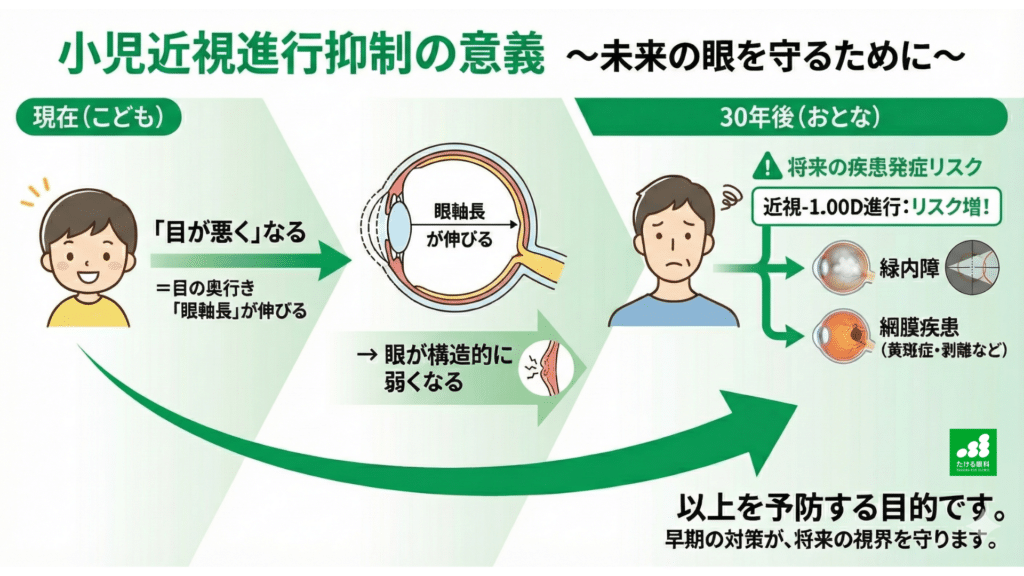
The significance of “pediatric myopia control”
Eyes becoming “worse”
= the depth of the eye, the “axial length”, grows longer
→ the eye becomes structurally weaker
→ development of disease 30 years later (when the child has grown old)
The aim is to prevent the above.
For Ryjusea Mini, the myopia control eye drop, as of April 2025 the story was “insurance cannot be used.”
At that time, we summarized the situation in detail.
However, an important piece of news came out recently: “myopia control eye drops (Ryjusea® Mini) and others are being adjusted toward entering the framework of selected medical care.”
[About the future of Ryjusea® Mini prescription] At the Central Social Insurance Medical Council on 1/9, the direction of moving to “selected medical care” from June this year was shown. If realized, “examination and tests are covered by insurance and the drug cost is out of pocket” is expected. We will announce details and our clinic’s response as soon as confirmed. https://t.co/7SoDdc7swQ
— たける眼科 – Takeru Yoshimura, M.D., Ph.D. (@takeru_eye) January 11, 2026
In response, the questions arise: “Then what about contact lenses (MiSight)?” “From when can insurance be used?”
As the current conclusion, our clinic has set the policy that“as of January 12, 2026, we still handle it as entirely self-pay care”.
Why this judgment? The reason becomes visible when you read the “way of thinking” in the materials issued by the Ministry of Health, Labour and Welfare.
First, what is “MiSight”?
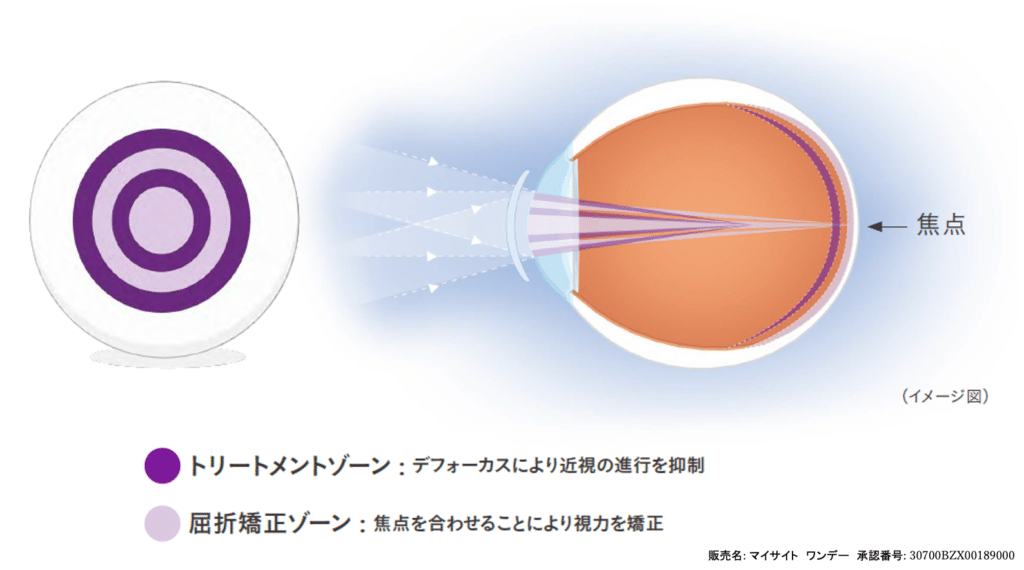
MiSight (MiSight® 1 day) is a disposable soft contact lens that corrects myopia and at the same time has a function to slow its progression.
Normally, when myopia is corrected with glasses or contact lenses, a phenomenon occurs in which focus in the peripheral retina shifts backward (hyperopic defocus), and this is thought to be the switch that makes the axial length (the length of the eyeball) grow.
MiSight is designed so that this switch is not turned on, by providing special zones in the lens that create “blur” (treatment zones). In clinical data, a reported 52% suppression of axial length growth has been seen.
-1024x576.png)
Six years behind the United States and the rest of the world, introduction in Japan is finally beginning.
Why can’t “insurance” be used now?
Can’t insurance be used for myopia control treatment?
The biggest reason is the rule in Japan’s medical system called“the prohibition of mixed medical care.”This is the rule.
Japan’s current public medical insurance (30% copayment and so on) in principle covers “treatment of diseases that have already occurred.” Treatment to slow myopia progression is, at present, close to “preventive medicine,” so it is generally regarded as outside insurance coverage.
The problem here is the way of “using insurance only for the consultation fee and paying out of pocket for the lens cost.” If this is done casually, it is regarded as “mixed medical care,” combining insured and self-pay care, which falls under an act prohibited by law.
If it is judged to be mixed medical care, there is a risk that everything, including the consultation fee that would originally be covered by insurance, becomes entirely the patient’s own expense.
For that reason, many medical institutions thoroughly apply the rule “everything is self-pay from the start of myopia control treatment” in order to protect patients.
The new “way of thinking” shown by the government
To change this situation, the government (the Ministry of Health, Labour and Welfare and the Central Social Insurance Medical Council) has also begun to move.
For the new eye drops approved at the end of 2024 (Ryjusea® Mini) and others, there is a discussion on whether to add them to“selected medical care (sentei ryoyo),”a system that allows the combined use of insurance and self-pay.
In the materials actually published, the government’s current“way of thinking”is written. It is somewhat difficult text, but because it is a very important part, I introduce it by quoting it as it is.
(Way of thinking)
In December 2024, atropine sulfate hydrate with the efficacy and effect of slowing myopia progression was approved under the Pharmaceuticals and Medical Devices Act, but this drug has not been listed in the NHI drug price list.
The proportion of elementary and junior high school students with uncorrected visual acuity below 1.0 is increasing year by year, and it is assumed that there is a certain need for slowing myopia progression. Also, if a patient who has visited for the purpose of contact lens wear also wishes a prescription of atropine sulfate hydrate, the examination done for contact lens prescription is insured care, but the prescription of atropine sulfate hydrate is non-insured care, and there is a risk of conflict with Article 19, paragraph 1 (drugs used by insured physicians) of the Rules for Health Insurance Medical Institutions and Insurance Physicians (Ministry of Health and Welfare Ordinance No. 15 of 1957).
In light of this, in order to enable smooth treatment for myopia, drugs approved under the Pharmaceuticals and Medical Devices Act with the efficacy and effect of slowing myopia progression will be made subject to selected medical care.
Central Social Insurance Medical Council, General Assembly (640th), Agenda, Friday, January 9, 2026 (Reiwa 8)
There are two points that can be read from this text.
- It is trying to solve the problem of mixed medical care
The government also recognizes that mixing “contact lens examination (insured)” and “myopia control drug (self-pay)” could break the rules, and it is trying to make it “selected medical care” to resolve that problem. - The subject is, after all, “the drug (atropine)”
What is specifically named in this “way of thinking” is “atropine sulfate hydrate (eye drops).” Contact lenses (MiSight and others) may be included in context, but they are not specified at present and the interpretation is not settled.
Outlook and our clinic’s policy
So, will MiSight also ride this flow and become selected medical care?
At present,“no clear conclusion has yet been reached.”This is the situation.
The title of the materials includes the words “drugs, medical devices and so on,” but as far as the “way of thinking” above shows, the center of the discussion is eye drops. Eye drops may be systematized first, with contact lenses coming afterward, and it is not impossible that they will be excluded.
We must not confuse patients with unconfirmed information, so our clinic has decided to take the following stance.
1. Until the formal decision, we continue “self-pay care paid entirely out of pocket”
Until the national system is settled and a formal notice comes to us medical institutions, we will observe compliance and continue the current self-pay care. This protects patients by preventing trouble later such as “after all it was entirely your own expense.”
2. We will share information right away
Toward June 2026, the situation is expected to keep changing. As soon as new information is confirmed, we will announce it on our website right away.
Those considering MiSight, or those who have already started, may feel anxiety or worry in the gap of the system.
But the progression of myopia does not wait for the system to be decided. A child’s eyes grow very fast. While waiting “until the system is decided,” myopia may progress.
First, I would like us to think together about the best treatment within the current rules.
If you have any questions, please do not hesitate to ask at your visit.
References
- Chamberlain P, et al. A 3-year Randomized Clinical Trial of MiSight Lenses for Myopia Control. Optom Vis Sci. 2019.
https://pubmed.ncbi.nlm.nih.gov/31343513/ - CooperVision. How Do MiSight® 1 Day Contact Lenses Work?
https://www.misight.com/blog/how-do-misight-1-day-contact-lenses-work - Chamberlain P, et al. Long-term Effect of Dual-Focus Contact Lenses on Myopia Progression in Children: A 6-year Multicenter Clinical Trial. Optom Vis Sci. 2022.
https://pubmed.ncbi.nlm.nih.gov/35086120/ - CooperVision. MiSight® 1 day | CooperVision Practitioner.
https://coopervision.com/practitioner/our-products/misight-1-day/misight-1-day - Insurance Bureau, Medical Economics Division, Ministry of Health, Labour and Welfare. Central Social Insurance Medical Council, General Assembly (640th) materials: Response to the results of the call for proposals and opinions on cases to be introduced into selected medical care, etc. (Chuikyo Sou-2). January 9, Reiwa 8 (2026).
https://www.mhlw.go.jp/content/10808000/001629047.pdf - Santen. Santen launches RYJUSEA Mini ophthalmic solution 0.025% Japan’s first ophthalmic solution for slowing myopia progression.
https://www.santen.com/en/news/2025/2025_1/20250318 - Yam JC, et al. Low-Concentration Atropine for Myopia Progression (LAMP) Study. Ophthalmology. 2019.
https://pubmed.ncbi.nlm.nih.gov/30514630/ - Ohno-Matsui K, Igarashi-Yokoi T, et al. Efficacy and Safety of Low-Concentration Atropine in Slowing Myopia Progression in Children in Japan: The Randomized, Double-Blind Phase II/III ORANGE Study.
https://pmc.ncbi.nlm.nih.gov/articles/PMC12651634/