![Takeru Eye Clinic | Takatori Shopping Street, Sawara-ku, Fukuoka City [Nishijin Station / Fujisaki Station]](https://takeru-eye.com/wp-content/uploads/2022/10/takeru_logo_for-WP-header.png)

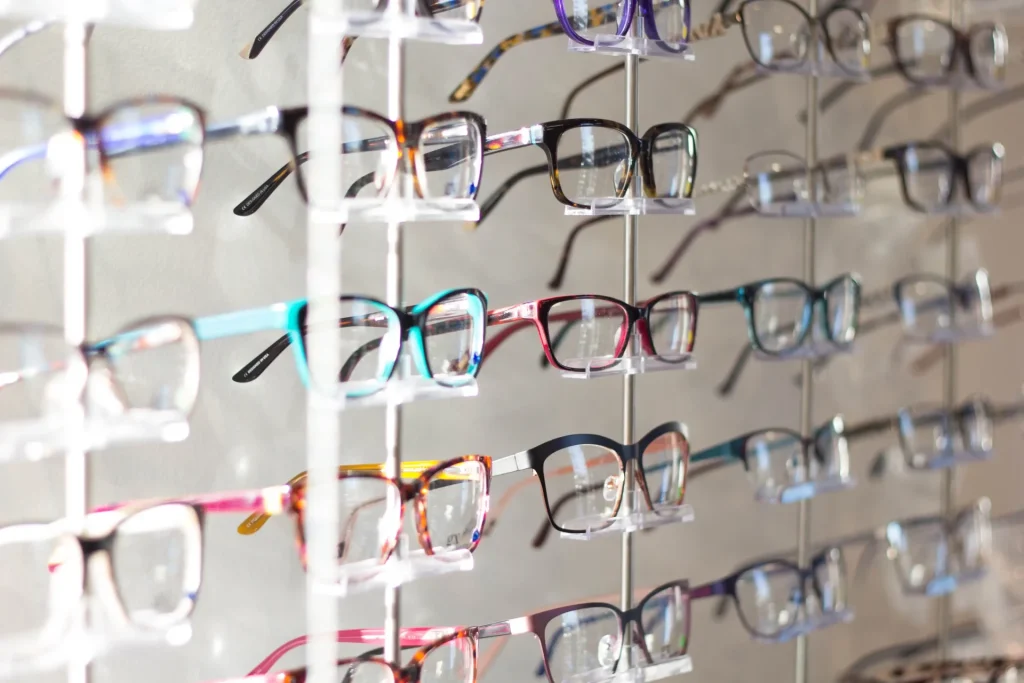
Children’s glasses: what we used to take for granted
A belief held for a long time:
“To keep myopia from progressing, have the child wear glasses with a weak (undercorrected) prescription”
Many reports have shown that this is wrong.
I regard keeping myopia from progressing (myopia control) as preventing retinal disease and glaucoma decades from now in the child.
“For nearsighted children, full-correction glasses are best”
Here is an introduction to the findings so far.
A 2002 paper1 Chung
Participants: 94 children (aged 9 to 14) whose myopia had already begun.
Results: The 47 children given undercorrected glasses had further myopia progression.
Conclusion: “Undercorrection makes myopia progress faster and promotes axial elongation.”
A 2006 paper2 Adler
Participants: 48 nearsighted children (aged 6 to 15)
Results: The 25 children given undercorrected glasses had further myopia progression.
Conclusion: “Undercorrected glasses had no effect of slowing myopia.”
A 2014 paper3 Vasudevan
Participants: A review of the medical records of 76 children with myopia (aged 11 to 33; mean 14 ± 5 years), 275 outpatient visits in total.
61 of the 76 were aged 11 to 19, and the remaining 15 were aged 20 to 33.
Undercorrection (-0.5 D: 44 people, -0.37 D: 21 people, -0.25 D: 63 people, -0.12 D: 22 people), full correction (0 D: 125 people)
Results: Myopia progressed in proportion to how weak the correction was.
Conclusion: “Nearsighted children who wore undercorrected glasses had further myopia progression. This result was consistent with the results shown in clinical trials to date.”
Wearing undercorrected glasses for myopia makes myopia progress much more than full correction does.
This result is consistent with the results of many studies reported so far.
Except in special cases, full-correction glasses are recommended for myopia in children and young people.3。
Under-correction of myopia produced a greater degree of myopic progression than did the full-correction. This finding is consistent with nearly all of the earlier studies in humans. Full-correction of myopia would be beneficial and most efficacious in children and young adults with myopia. Clinicians should prescribe the full myopic refraction, in the absence of other contrasting case history aspects.3
Please also see the following:
The “myopia boom”
Increase in myopia among elementary and junior high school students / dry eye: an introduction to findings published this week
Myopia and refractive errors in children
High myopia / Japan-China-Korea ophthalmology meeting
(References)
1. Chung, K., Mohidin, N., O’Leary, D.J., 2002. Undercorrection of myopia enhances rather than inhibits myopia progression. Vision Research 42, 2555–2559. https://doi.org/10.1016/S0042-6989(02)00258-4
2. Adler, D., Millodot, M., 2006. The possible effect of undercorrection on myopic progression in children. Clinical and Experimental Optometry 89, 315–321. https://doi.org/10.1111/j.1444-0938.2006.00055.x
3. Vasudevan, B., Esposito, C., Peterson, C., Coronado, C., Ciuffreda, K.J., 2014. Under-correction of human myopia – Is it myopigenic?: A retrospective analysis of clinical refraction data. Journal of Optometry 7, 147–152. https://doi.org/10.1016/j.optom.2013.12.007