“It’s sad for a child to have glasses.”
“Maybe they shouldn’t wear glasses yet.”
“To think my cute 👦👧 will end up with a glasses face.”
“The grandparents said it isn’t time for glasses.”
This is about developing a child’s ability to see by keeping what they see in focus on the retina inside the eye.
Glasses That Develop a Child’s Ability to See

Wearing glasses to prevent amblyopia (about ages 3 to 8)
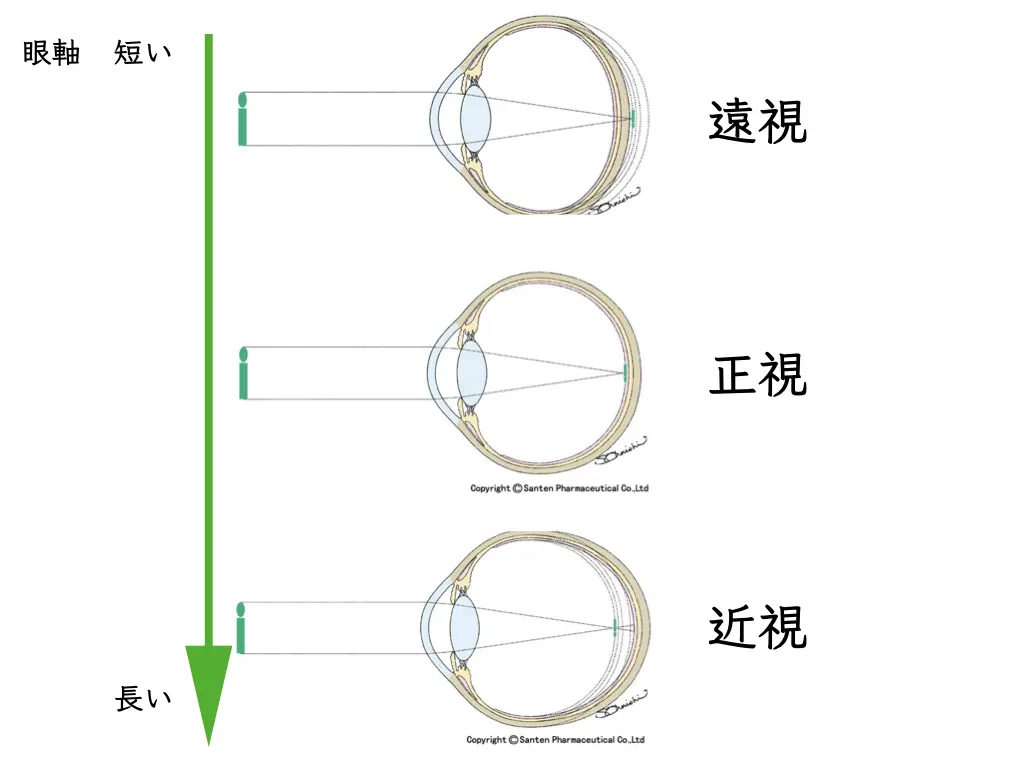
A small child’s eye can be extremely short in length
: “hyperopia”
The image is not focused on the retina, and the lens works hard, bulging to adjust focus.
In childhood, the brain receives clear images and the child develops their own “ability to see.”
If hyperopia is strong, focusing cannot keep up and blurry vision continues.
The eyes may also turn inward
: “accommodative esotropia”
For the brain to develop the ability to see, being in focus is essential.
Because there is a time limit, an early eye examination is needed.
If it is found by the3-year-old check-up,
treatment can proceed without rushing.Amblyopia (suspected amblyopia) is often found with theSpot Vision Screener
sometimes used at pediatric clinics, eye clinics, and city offices.

Children have a strong ability to try to focus
: “strong accommodation”

This makes it impossible to determine refraction (the eye’s prescription) accurately.
For that reason, we do a test using “cycloplegic drops.”
Cyplegin®
Atropine
After learning the accurate refraction, we prescribe glasses.
Wearing glasses to keep myopia (= poor eyesight) from progressing (from the lower grades of elementary school to about high school)
Do glasses make your eyes worse?
I think we used to be told that myopia progresses if you wear glasses that fit exactly.
We now know that this common belief was wrong.
It is important to wear fully corrected glasses.
But theory and reality can differ.
・The way they see feels too strong
・Should they wear glasses not only during class but all the time?
・The child doesn’t want to wear glasses
It is hard to force a child, saying, “Wear your glasses.”
From when should a child wear glasses?
In the eye exam, we try several prescriptions.
We sometimes also do anaccommodation analysis.
After buying properly prescribed glasses
and trying them on,
the child may say, “Oh, I can see!😯”
and may come to want to wear them.
I think it is fine to wait for that.
Even elementary school students still have a strong ability to focus.
If glasses are fitted as they are, they can end up “over-corrected.”
・Cram school
・School homework
・Lessons and activities
・Club activities
Being glary for a few days after a cycloplegic test may be a problem.
Midrin® P
The test is done using mydriatic drops.
The glare and blurred vision last for a few hours.
This leads to an accurate glasses fitting.
The risk of high myopia
“High myopia” that has progressed can shift to “pathologic myopia.”
It is known that, decades later as the child grows, the risk of developing an eye disease rises.
We regard this as preventive medicine to avoid pathologic myopia.
The Growing Years of the Eye
From babyhood to starting elementary school
The sensitive period for vision
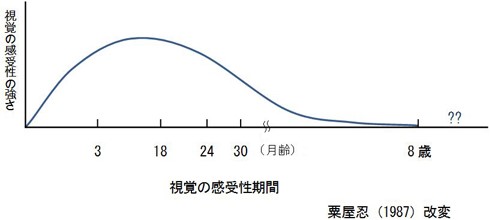
By seeing clear, focused images, the child develops the brain’s ability to see.
If help with focusing is needed (often “hyperopia”),
glasses are used.
From the lower grades of elementary school to high school
To keep myopia from progressing (so the eyes don’t “get worse”)
Glasses: focus on the center
It is known that clearing up blur keeps myopia from progressing more than staying uncorrected does.
Orthokeratology: focus on the center and the surrounding area as well
According to the latest knowledge,
focusing on the surrounding area as well can also slow myopia progression further.
Glasses That Develop a Child’s Ability to See
・Wearing glasses to prevent amblyopia (about ages 3 to 8)
・Wearing glasses to keep myopia (= poor eyesight) from progressing (from the lower grades of elementary school to about high school)
We think of it as two broad categories.
To help your child’s eyes grow, early action is important.
If anything worries you even a little, please have the eyes checked at an eye clinic.