![Takeru Eye Clinic | Takatori Shopping Street, Sawara-ku, Fukuoka City [Nishijin Station / Fujisaki Station]](https://takeru-eye.com/wp-content/uploads/2022/10/takeru_logo_for-WP-header.png)

Glaucoma is not cured by surgery.
Glaucoma surgery is considered when intraocular pressure simply cannot be lowered.
It would be good if we could lower eye pressure with a treatment that does not require surgery.
When it is difficult to control intraocular pressure with eye drops,
SLT (selective laser trabeculoplasty) is a non-invasive treatment that is considered before surgery.
* Non-invasive: does not damage the tissues of the eye
Our clinic also introduced SLT in 2021.
In 2019, the effectiveness of SLT was scientifically demonstrated in the journal The Lancet, and follow-up reports have been published one after another.
In 2024, a paper summarizing 30 reports was published.
I will add an overview of the historical progress of glaucoma treatment and the development of SLT.
Laser Treatment for Glaucoma (SLT): A Review of 30 Papers from 2024

The History and Evolution of Laser Treatment for Glaucoma: From ALT to SLT
Characteristics of ALT (Argon Laser Trabeculoplasty)
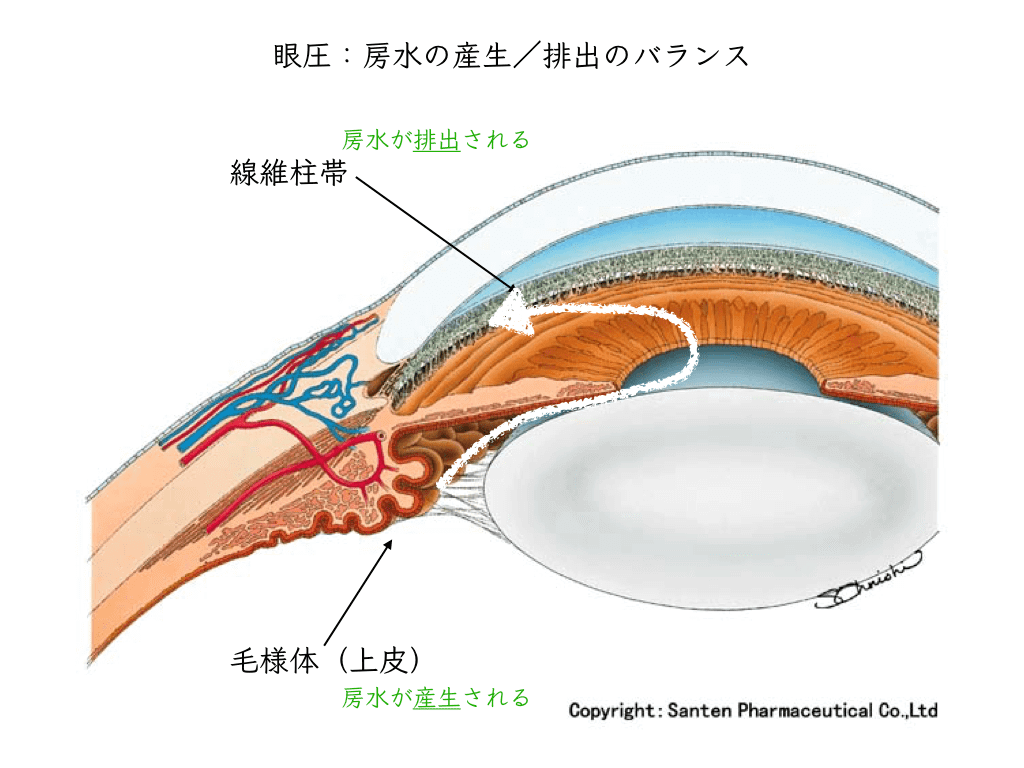
ALT is aconventional glaucoma treatment using an argon laser¹, first reported by Wise et al. in 1979.
Heat coagulation of the trabecular meshwork causes permanent structural changes in the tissue (tissue destruction), which lowers intraocular pressure.
A strong inflammatory reaction occurs immediately after treatment, and because these tissue changes are irreversible, retreatment is difficult.
The Arrival of SLT and Verification of Its Effectiveness
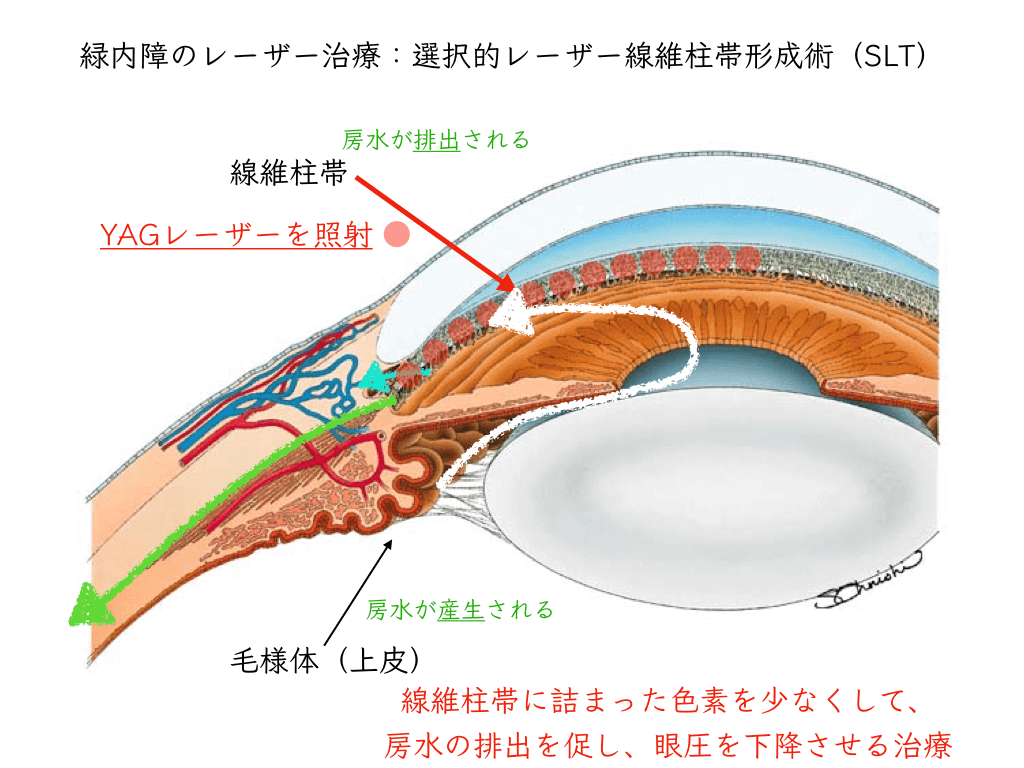
SLT (selective laser trabeculoplasty), which is now the mainstream approach,
was developed in 1995 by Dr. Mark Latina,
and was approved by the FDA (U.S. Food and Drug Administration) in 2001.
In Japan, it has been available under national health insurance since April 2014.
SLT has the following characteristics:
- Less thermal damage to tissue
- Mild inflammatory reaction
- Reversible changes in tissue structure
- Retreatment is possible if needed
Because of these characteristics, it has developed as a less invasive treatment.
In 2011, a study by Bovell et al.² reported that SLT and ALT showed equivalent intraocular pressure-lowering effects over 5 years in patients with various types of open-angle glaucoma.
This long-term comparative study demonstrated the effectiveness of SLT at an early stage and provided the scientific basis for the later spread of SLT.
A Clinical Study in Japan (2013)
A study reported by Nitta et al. in the Journal of the Japanese Ophthalmological Society
was an important study showing the effectiveness of SLT in Japanese patients with normal-tension glaucoma (NTG)³.
Study Overview
- Subjects: patients with normal-tension glaucoma (NTG)
- 42 cases, 40 eyes
- SLT was performed as first-line treatment in all patients
- Follow-up period: 3 years
- Study site: Department of Ophthalmology, Fukui-ken Saiseikai Hospital
Key Findings
Sustained Intraocular Pressure Reduction
- Before treatment: 15.8 ± 1.8 mmHg
- After treatment: 13.5 ± 1.9 mmHg
- Statistically significant (p<0.001, paired t-test)
- The effect was sustained over 3 years
Suppression of Visual Field Progression
- Assessed by MD slope / VFI slope
- Visual field progression over 3 years was slow
- Suggests the possibility of protecting visual function
Safety Confirmed in Japanese Patients
- No serious complications
- Possible applicability to normal-tension glaucoma
- Long-term safety confirmed
This study provided important implications for glaucoma treatment in Japan, in that it demonstrated the effectiveness and safety of SLT for normal-tension glaucoma, which is especially common among Japanese people. It is also regarded as a pioneering study showing the potential of SLT as first-line treatment.
The LiGHT Study (2019)
The LiGHT (Laser in Glaucoma and ocular HyperTension) study reported by Gazzard et al. (2019) was a groundbreaking study that greatly changed the position of SLT in glaucoma treatment⁴.
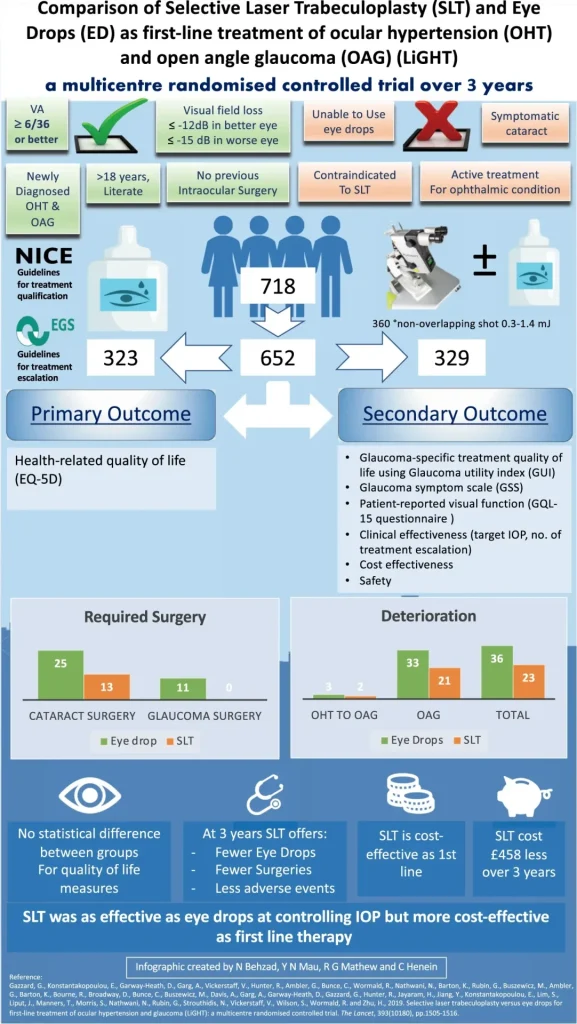
Study Overview
- Subjects: 718 patients (1,235 eyes) with open-angle glaucoma or ocular hypertension
- SLT group: 356 patients (613 eyes)
- Eye-drop group: 362 patients (622 eyes)
- Follow-up period: 3 years
- Study sites: six eye centers in the United Kingdom
Key Findings
Long-Term Intraocular Pressure Control
- 74% of the SLT group needed no eye drops for 3 years
- The rate of achieving target intraocular pressure was significantly higher in the SLT group
- Intraocular pressure fluctuation was smaller than in the eye-drop group
Advantages in Health Economics
- Although the initial investment is high, it leads to long-term cost savings
- No need to keep purchasing eye drops
- The number of clinic visits can be reduced
Improved Quality of Care
- Resolves the problem of adherence to eye drops
- Improves patients’ quality of life (QOL)
- Avoids side effects of eye drops and effects on the ocular surface
* Adherence means that patients continue, of their own will, to carry out the treatment plan (taking medication, using eye drops, etc.) decided in consultation with their doctor.
The term “compliance,” used previously, strongly implied following the doctor’s instructions, whereas adherence emphasizes the patient’s active participation in treatment.
Eye-drop adherence in glaucoma means that patients keep using their eye drops at the prescribed times and in the correct way. Even when there are no symptoms, it is an important commitment to continue the daily eye-drop treatment needed to protect the optic nerve.

Demonstrated Safety
- No serious complications reported
- Transient increases in intraocular pressure can be managed with appropriate care
- Long-term safety confirmed
This large clinical trial scientifically demonstrated that SLT can be considered as a first-line treatment option for glaucoma.
In particular, in addition to high efficacy and safety,economic benefits for healthcarewere shown, which is expected to have a major influence on future glaucoma treatment strategies.
Clinical Study in Tanzania (2021)

The Level I study by Philippin et al. was a groundbreaking study that showed new possibilities for glaucoma treatment in developing countries⁵. In this study, the effects of SLT and conventional eye-drop treatment (timolol) were compared in a real-world clinical setting in Tanzania.
Study Overview
- Subjects: 201 patients (382 eyes) at a single center in Tanzania (Kilimanjaro Christian Medical Centre)
- Follow-up period: 12 months
- Comparison: randomly assigned to the SLT group or the timolol eye-drop group
Key Findings
Rate of achieving target intraocular pressure:
- SLT group: 61% of patients achieved and maintained target intraocular pressure
- Timolol group: 31% of patients achieved and maintained target intraocular pressure
Average intraocular pressure reduction:
- SLT group: reduction of 8.2 mmHg
- Timolol group: reduction of 6.8 mmHg
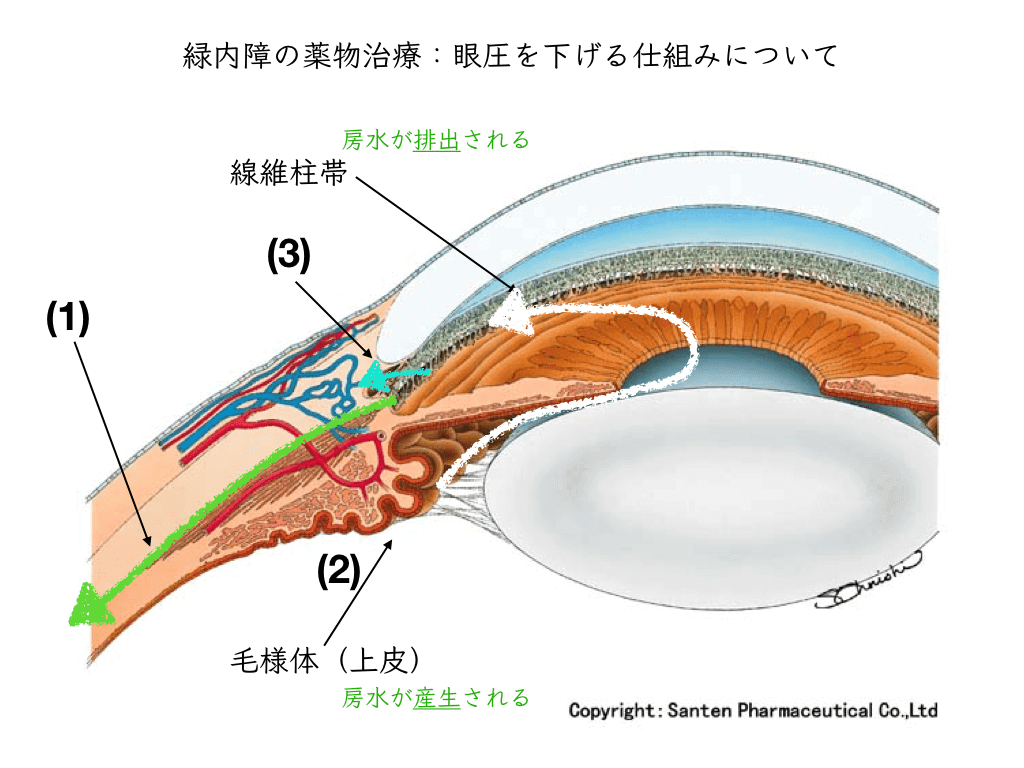
* Timolol (beta-blocker):
A standard glaucoma eye drop known by brand names such as Timoptol®, Timoptol® XE, and Rysmon® TG.
As shown in (2) in the figure below, it lowers eye pressure by suppressing aqueous humor production in the ciliary body (epithelium).
It must be used twice a day, and it has restrictions, such as not being usable by patients with bronchial asthma or heart disease.
Significance of the Study
Feasibility in developing countries:
- Can be performed even in regions where continued use of expensive eye drops is difficult
- A treatment that can be performed even where the electricity supply is unstable
- An effective option in regions with limited access to medical care
Solving the adherence problem:
- No daily eye-drop management is needed
- Avoids problems with storing and using medication
- Long-term cost-saving effect
* Adherence refers to patients using their prescribed medication correctly and continuously.
In the case of eye drops, they must be instilled correctly at the set times every day.
Impact on healthcare systems:
These results showed that SLT can be an important option for glaucoma treatment in developing countries, and that it is a promising treatment for reducing global health disparities.
In particular, the confirmation of its effectiveness in settings where continuous drug therapy is difficult may have a major influence on glaucoma treatment strategies worldwide.
Comprehensive Evaluation by the American Academy of Ophthalmology (2024)
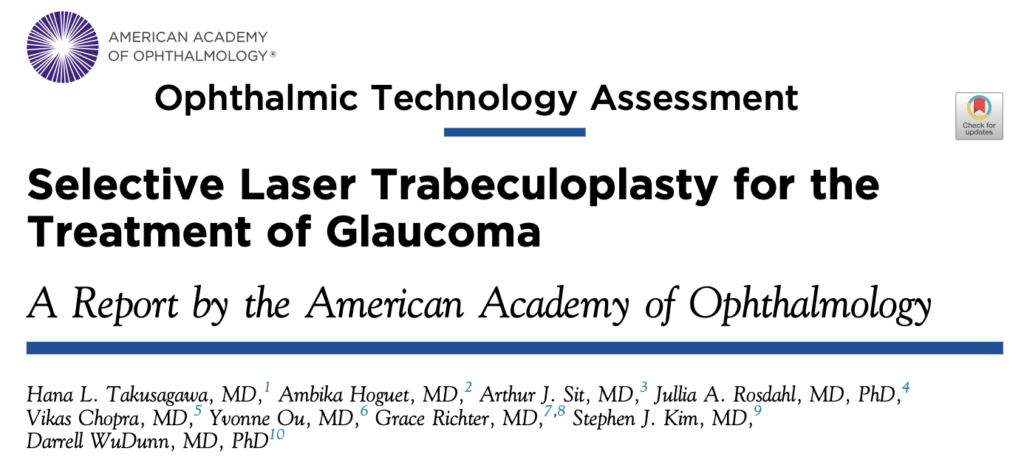
In the latest report published by the American Academy of Ophthalmology (in the journal Ophthalmology), Takusagawa et al. reported a comprehensive systematic review of SLT in glaucoma treatment⁶.
* A systematic review is a research method that comprehensively collects studies on a specific topic and analyzes and integrates them using scientific methods. By gathering information comprehensively without bias and rigorously evaluating quality, it provides the most reliable scientific evidence available at the present time.
Overview of the Systematic Review
- Subjects: 30 studies on SLT published since November 2011
- Evaluation criteria: the evidence-based medicine criteria of the Centre for Evidence-Based Medicine, University of Oxford
- Study quality: 19 of the 30 studies were of the highest level of evidence (Level I)
Study Selection Criteria
- Original research
- Randomized controlled trials
- Focused on glaucoma or ocular hypertension
Key Findings
Basic Characteristics and Effectiveness of SLT
- Possibility of repeat treatment: because there is less structural change and coagulation damage to tissue than with ALT, it can be performed repeatedly
- Versatility of treatment: effective over the long term both as initial treatment and as an adjunct to existing eye-drop therapy
- Relationship with medication: use of steroid or NSAID eye drops before and after the procedure does not interfere with the pressure-lowering effect
Important Insights from the Comprehensive Analysis
- Effectiveness as initial treatment: can be an effective initial treatment option in place of conventional eye-drop therapy
- Broad range of indications: the LiGHT study (open-angle glaucoma and ocular hypertension) and the Nitta study (normal-tension glaucoma) show that it is effective for a wide range of glaucoma types
- Long-term effect: 3-year follow-up in the LiGHT study (2019) and the Nitta study (2013) confirmed that the effect was sustained
- High safety: no serious complications were reported in any study
- Economic benefits: the improved cost-effectiveness shown in the LiGHT study suggests that it may be an economically advantageous option
Conclusions and Future Outlook
This systematic review
provided strong scientific evidence of the clinical value of SLT in the following respects:
- Effectiveness as initial treatment
- Durability of long-term effect
- High safety
- Potential economic benefits for healthcare
These results strongly suggest that SLT may play an important role in glaucoma treatment.
It is expected to become an even more important treatment option in the future.
However, the following points should be noted:
- Careful consideration of the treatment plan according to each patient’s individual circumstances
- Choosing the optimal treatment in consultation with your ophthalmologist
In addition, based on these study results, longer-term follow-up and studies in more diverse patient groups are expected.

References
¹ Wise, JB & Witter, SL (1979), ‘Argon laser therapy for open-angle glaucoma: a pilot study’, Archives of Ophthalmology, vol. 97, no. 2, pp. 319-322.
² Bovell, AM, Damji, KF, Hodge, WG, Rock, WJ, Buhrmann, RR & Pan, YI (2011), ‘Long term effects on the lowering of intraocular pressure: selective laser or argon laser trabeculoplasty?’, Canadian Journal of Ophthalmology, vol. 46, no. 5, pp. 408-413.
³ 新田耕治, 杉山和久, 馬渡嘉郎 & 棚橋俊郎 (2013), ‘正常眼圧緑内障に対する第一選択治療としての選択的レーザー線維柱帯形成術の有用性’, 日本眼科學会雜誌, vol. 117, no. 4, pp. 335-343.
⁴ Gazzard, G, et al. (2019), ‘Selective laser trabeculoplasty versus eye drops for first-line treatment of ocular hypertension and glaucoma (LiGHT): a multicentre randomised controlled trial’, The Lancet, vol. 393, no. 10180, pp. 1505-1516.
⁵ Philippin, H, et al. (2021), ‘Selective laser trabeculoplasty versus 0.5% timolol eye drops for the treatment of glaucoma in Tanzania: a randomized controlled trial’, The Lancet Global Health, vol. 9, no. 11, pp. e1589-e1599.
⁶ Takusagawa, HL, et al. (2024), ‘Selective Laser Trabeculoplasty for the Treatment of Glaucoma: A Report by the American Academy of Ophthalmology’, Ophthalmology, vol. 131, no. 1, pp. 37-47.