![Takeru Eye Clinic | Takatori Shopping Street, Sawara-ku, Fukuoka City [Nishijin Station / Fujisaki Station]](https://takeru-eye.com/wp-content/uploads/2022/10/takeru_logo_for-WP-header.png)

“MiSight®, orthokeratology and myopia control glasses look and are used so differently. How do they differ, and in what way?”
This is a question parents often ask me in myopia control consultations.
These three treatments look quite different, but they are actually based on a common theory: creating myopic defocus (an out-of-focus blur) in the peripheral retina.
They are like siblings born from the same design philosophy.
Low-concentration atropine eye drops (Ryjusea® Mini ophthalmic solution) are the one exception: they work not optically but as a drug, a separate route of treatment.
In this article I will explain, in order, the “peripheral defocus theory” that forms the backbone of myopia control, and atropine as a different kind of brake.
The eye uses “blur” as a cue
“Defocus” means blur from being out of focus. Just as a photo is blurred when a camera’s focus is off, in the eye the image is blurred when light comes to a focus in front of or behind the retina.
The growing eye uses this small blur as a cue. Myopia treatment is a way of making that cue work in our favor.
Most children’s myopia progresses as the eyeball lengthens from front to back (elongation of the axial length).
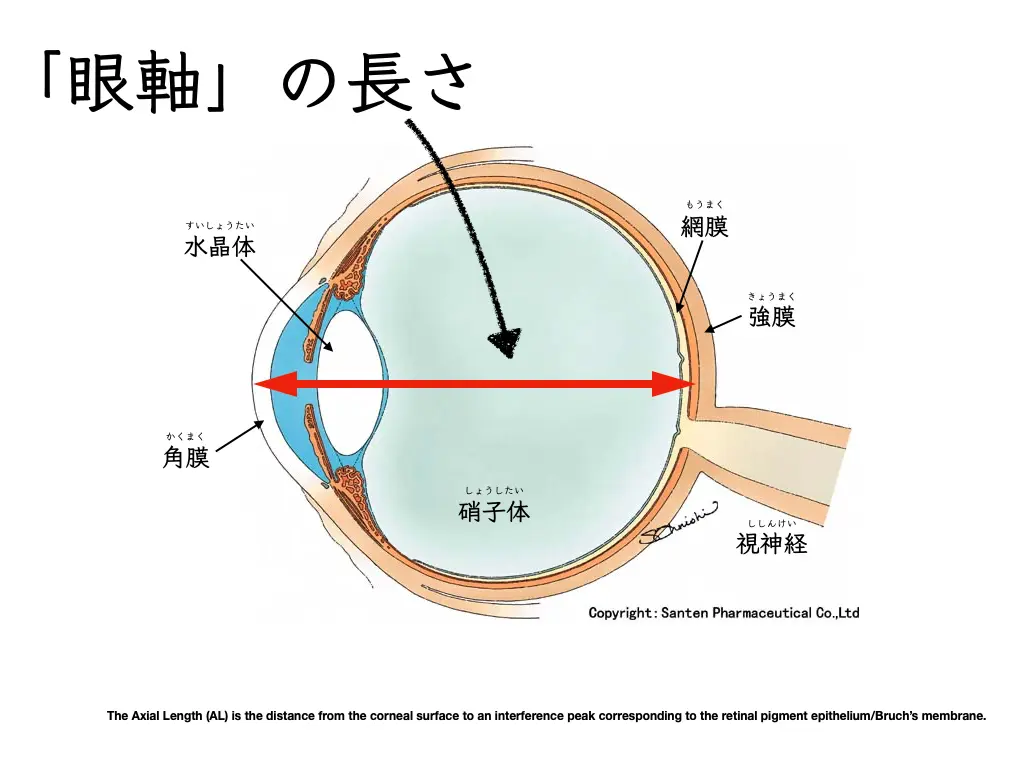
Axial length is the distance from the top of the cornea to the retina. If the axial length grows too long, light comes to a focus in front of the retina and distant objects look blurry. Slowing the progression of myopia can be restated as slowing the lengthening of the axial length.
So how does the eye decide “how fast to grow”?
Clues to the answer have emerged from an accumulation of animal experiments using chicks and monkeys. Animal experiments may stir mixed feelings in some people. Myopia control treatments used around the world today rest on this accumulated research.
What has become clear is the following mechanism.
The growing eye adjusts its own rate of elongation using the “state of focus” reaching the retina as a cue1。
When the eye detects that focus lies behind the retina (hyperopic defocus), it speeds up its growth, as if to “stretch and catch up with the focus.” Conversely, when it detects that focus lies in front of the retina (myopic defocus), a brake is put on elongation.
📌 What is defocus?: It means a shift of focus. A state in which focus falls “behind” the retina is called hyperopic defocus, and one in which it falls “in front of” the retina is called myopic defocus. For the eye, hyperopic defocus is thought to act as a “grow” signal and myopic defocus as a “don’t grow” signal.
A further important finding came from experiments in monkeys.
What a visual acuity test measures is the performance of the center of the retina (the fovea). Yet even in monkey eyes in which the fovea had been made nonfunctional, the regulation of eye growth was preserved2,3. What controls eye growth was not the “center” of the visual field but the “periphery” of the retina, which covers a much larger area.
I was surprised by this interesting reversal.
What we think of as “vision” is a single point at the center, yet it is the peripheral visual field, which we are normally unaware of, that holds the steering wheel of eye growth.
From this, a treatment strategy was derived4。
Correct the center properly so it sees clearly. Then, by deliberately creating “myopic defocus,” a brake signal, only in the peripheral retina, it might be possible to slow axial elongation while preserving vision.
The three treatments above all realize this same strategy with different tools. The mechanisms revealed in animal experiments have also been confirmed to be shared across a wide range of species, including chicks, tree shrews, marmosets, and rhesus monkeys5。
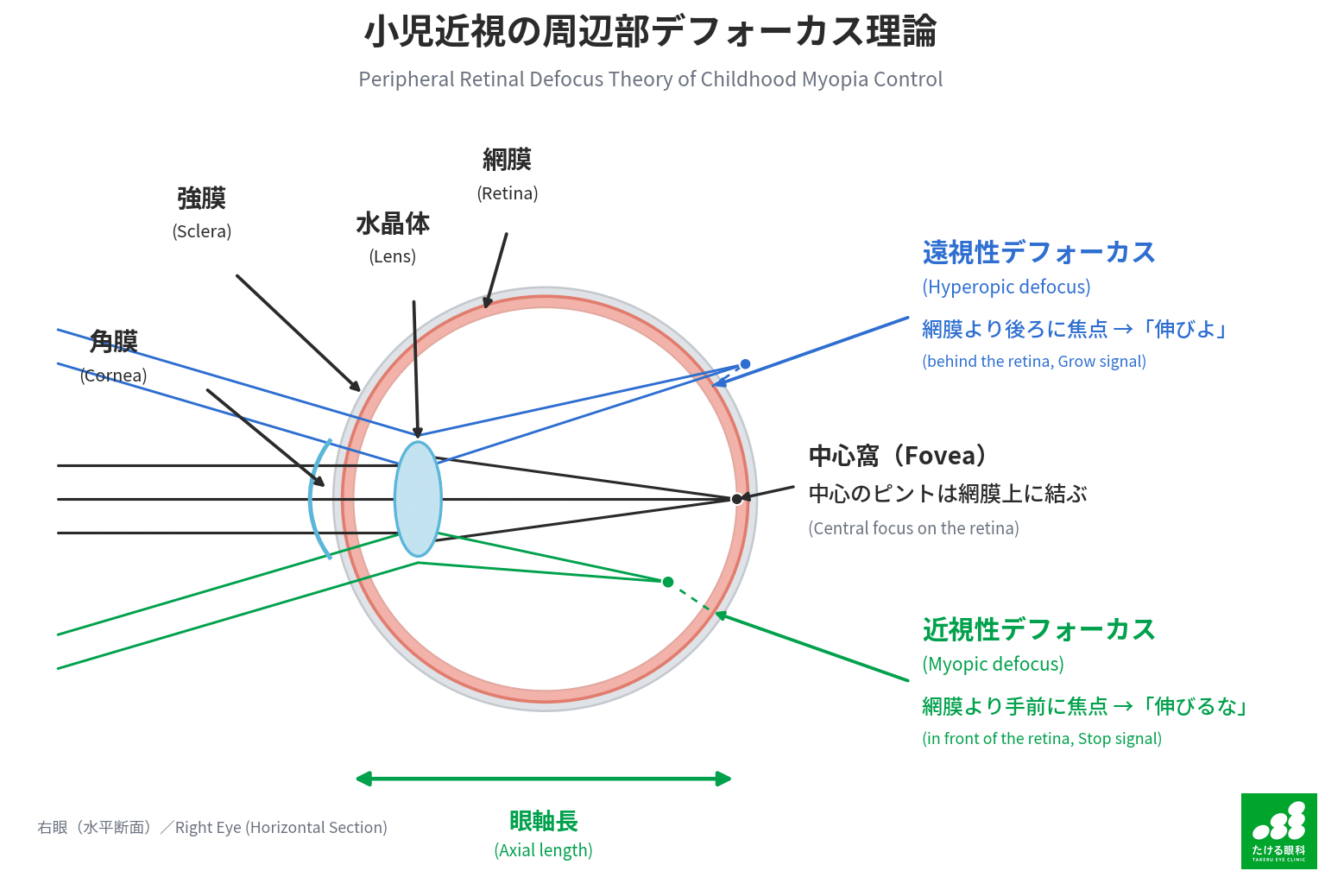
This “peripheral defocus” is currently one of the most promising ideas, but causality has not been fully proven in humans. In recent years it has also been pointed out that other mechanisms may be involved, such as a reduction in the contrast (crispness) of the image the retina receives, and this is a field where further understanding is expected.
Three treatments: different ways of making the same thing
Let’s look at how each treatment creates myopic defocus in the periphery.
MiSight® (MiSight® 1 day) is a daily disposable soft contact lens. The center of the lens has the power that corrects myopia, and concentric “treatment zones” are arranged around it, bringing peripheral light to a focus in front of the retina. Because a contact lens moves with the eye, a feature is that the treatment zones stay over the pupil whichever direction you look6。
Orthokeratology is a treatment in which special hard lenses are worn during sleep to reshape the cornea itself. The center of the cornea is flattened, which corrects myopia, while the mid-periphery becomes relatively steeper. In the eye after wear, measurements have confirmed that peripheral refraction shifts toward myopic defocus7. You spend the day without glasses, while the brake signal keeps being sent to the periphery.
Myopia control glasses (MiYOSMART®, Stellest®) are glasses in which many tiny lenslets are laid out around a central zone that looks like a normal lens. In MiYOSMART®’s DIMS lens, lenslets of +3.50 D8, and in Stellest®, aspheric lenslets, bring peripheral light to a focus in front of the retina. Because glasses are fixed to the frame, the difference from contact lenses is that the line of sight moves around within the lens.
Here are the results of clinical trials of the three treatments side by side.
| Treatment | Trial (age of subjects) | Duration | Slowing of refraction progression | Slowing of axial length elongation |
|---|---|---|---|---|
| MiSight® | Chamberlain 2019 (ages 8–12) | 3 years | −0.73D(59%) | −0.32mm(52%) |
| Orthokeratology | ROMIO trial 2012 (ages 6–10) | 2 years | (not measurable*) | 43%(0.36mm vs 0.63mm) |
| MiYOSMART(DIMS) | Lam 2020 (ages 8–13) | 2 years | −0.44D(52%) | −0.34mm(62%) |
| Stellest(HAL) | Bao 2022 (ages 8–13) | 2 years | −0.80D | −0.35mm |
Source: Chamberlain 20196、Cho & Cheung 20129、Lam 20208、Bao 202210. *Because orthokeratology changes the shape of the cornea, it cannot be evaluated by refraction and is evaluated by axial length. The Stellest® trial is reported as a difference from the control group’s progression (−1.46 D / 0.69 mm), which converts to roughly half suppression.
I hope the way the numbers line up shows that these are less “separate treatments” than “different versions of the same principle.”
Long-term data are also accumulating. For MiSight®, a sustained effect has been reported over 6 years of follow-up11. For MiYOSMART®, over 6 years of follow-up, no rebound, a sudden speeding up of progression after stopping wear, was reported12。
Here I want to be honest about something.
Compared with the evidence that these treatments “work,” the understanding of “why they work” is still under way.
While animal experiments clearly confirm the peripheral defocus mechanism, it has not been fully proven in human children that peripheral defocus is the real source of the effect. There is another hypothesis (the contrast theory) that lowering image contrast is itself what works, and a trial has reported slowed progression with glasses designed to lower contrast13。
Also, the percentage figures for suppression depend on the population in each trial, and effects vary between individuals14. Even in the MiSight® trial, it was reported that for about 10% of children the effect was unclear11. It is worth stating that this is not a treatment that works equally for everyone.
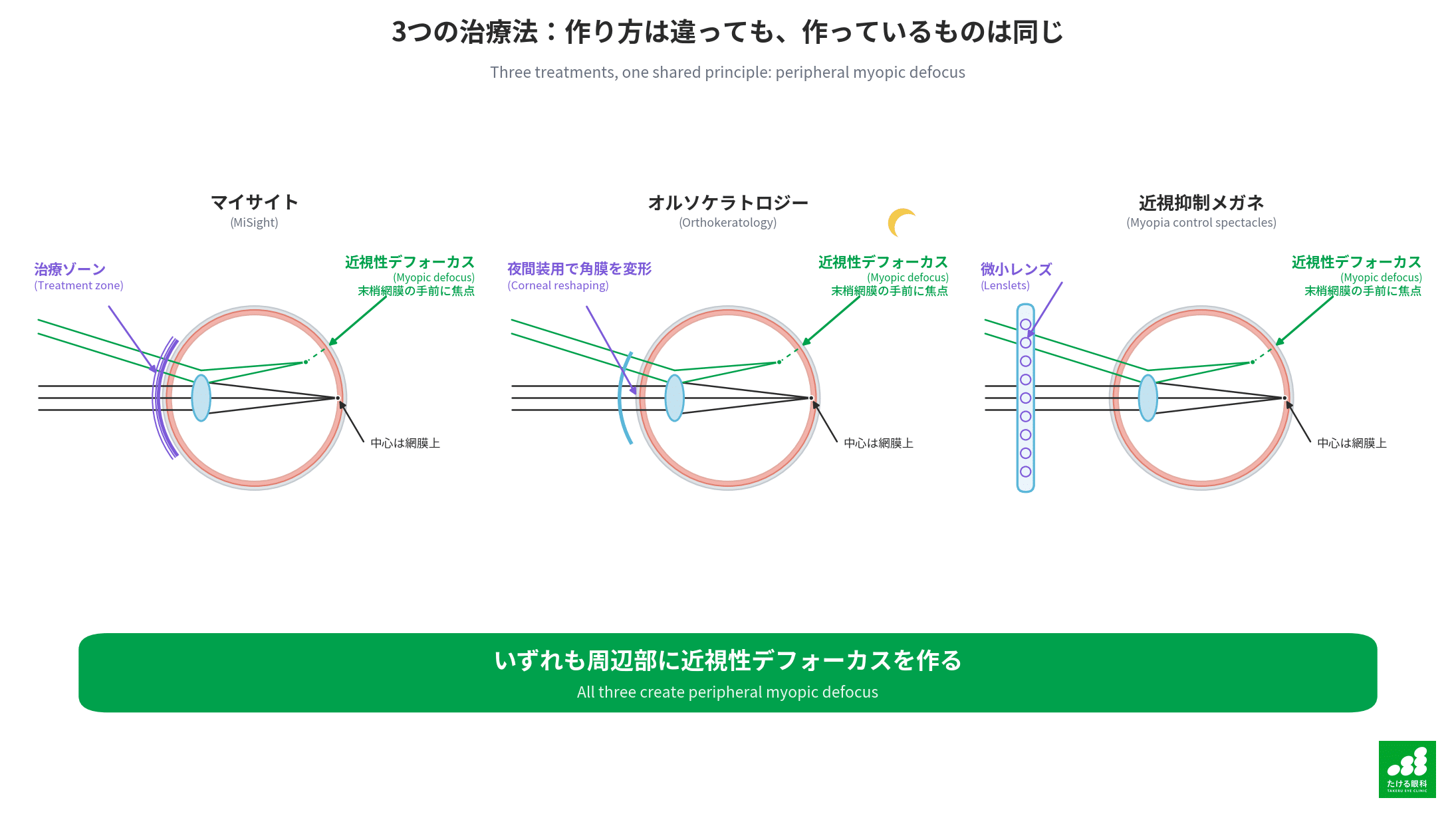
These three share a common idea in that they “create myopic defocus in the periphery,” but the lens design and the way light is delivered differ, and the way the effect appears varies between individuals. It is more accurate to think of them not as “exactly the same,” but as “achieving the same aim, each in its own way.”
Low-concentration atropine is a separate route: a brake from a drug, not from light
The exact mechanism by which low-concentration atropine slows myopia progression is, in fact, still not fully understood. Several pathways, including muscarinic receptors, are thought to be involved, and it is at a stage where no single explanation captures it.
Low-concentration atropine works differently from the three above. Rather than changing the path of light as a lens does, it acts on the tissues of the eye as a drug.
It was once thought to work “because it rests the focusing muscle.” Atropine does temporarily rest focusing.
But animal experiments overturned that explanation. The focusing muscle of the chick differs in type from that of humans and is not paralyzed by atropine. Even so, experimental myopia in chicks was suppressed by atropine15. This means it works through a separate pathway that does not involve focusing.
It is now thought that it acts on muscarinic receptors in the retina, retinal pigment epithelium, choroid and sclera, and may ease the process by which the wall of the eyeball (the sclera) stretches16。
Changes in choroidal blood flow and thickness and involvement of the neurotransmitter dopamine are also being studied, but the full picture of the mechanism of action is not yet settled.
To summarize, while peripheral-defocus treatments speak to the eye’s growth-control system with a “light signal,” atropine acts on a different entry point of the same system with a “pharmacological action.” The entrances differ, but the exit, “easing the lengthening of the axial length,” is common.
It is also easy to see why combinations of the two are being studied, precisely because the entrances differ.
Atropine concentration: think of it as “how hard you press the brake”
Atropine has been studied at many concentrations, from a high 1% to low concentrations such as 0.01%, 0.025% and 0.05%.
I find it easiest to organize concentration with the analogy of a car’s brake.
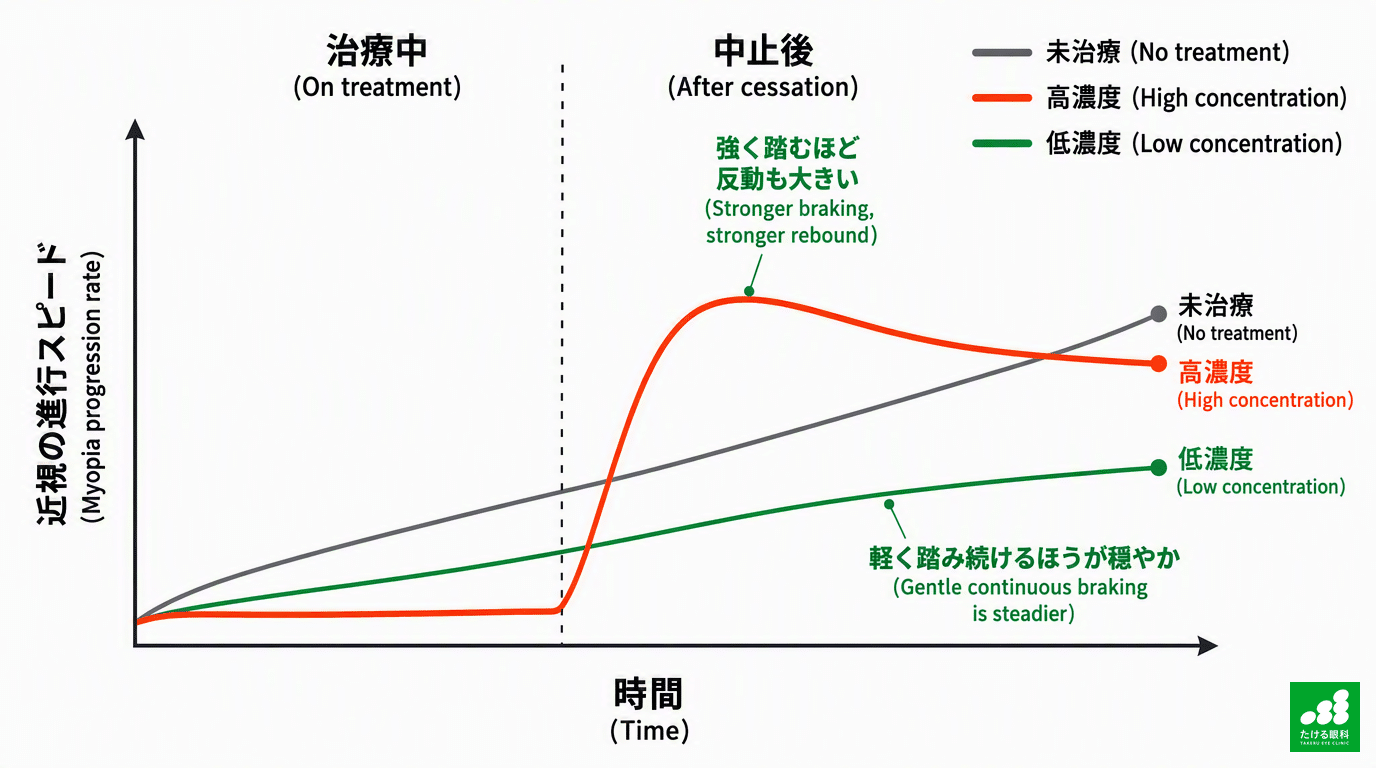
High concentration (1%) is like pressing the brake hard.
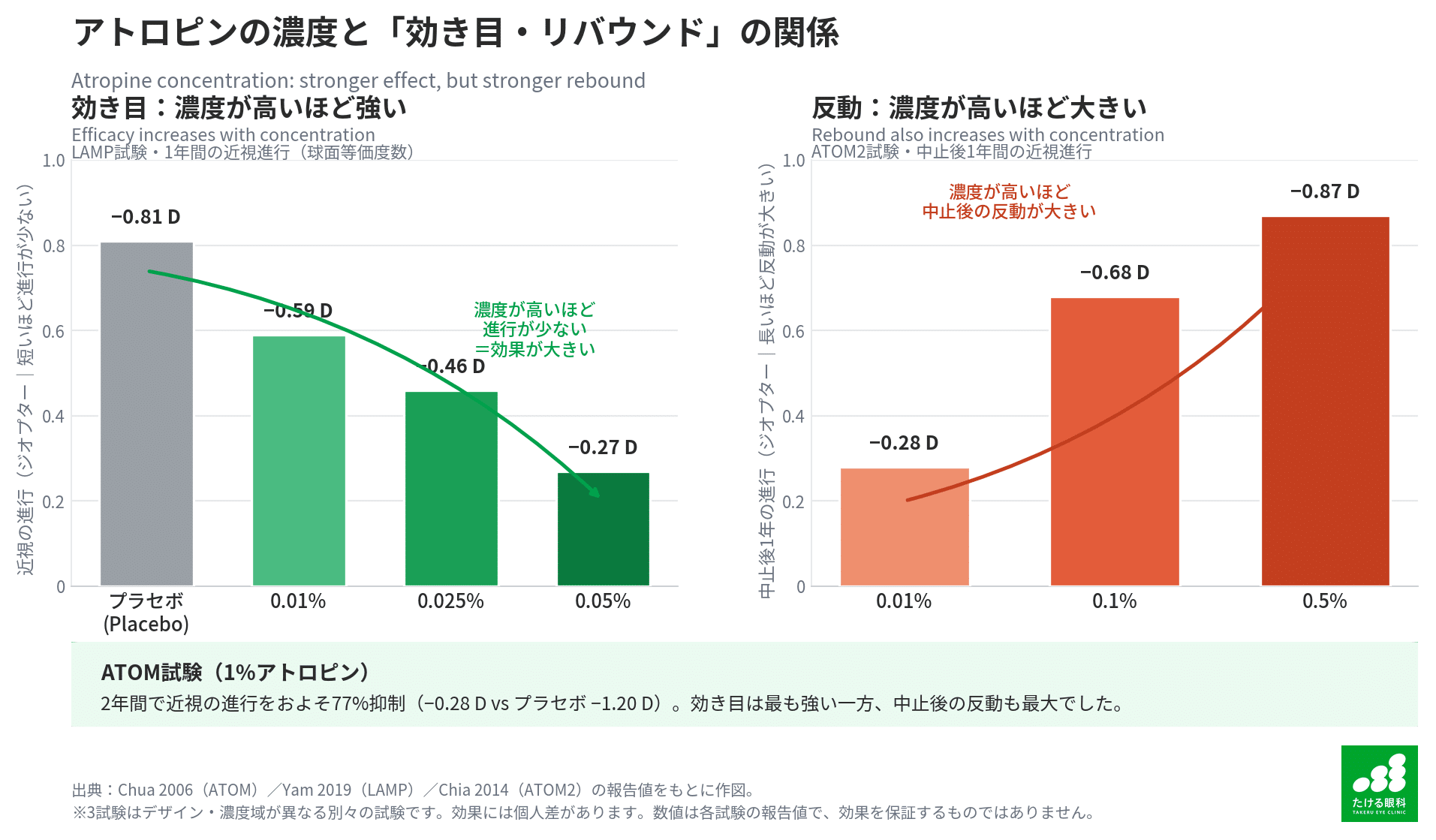
In Singapore’s ATOM trial, 1% atropine slowed myopia progression by about 77% over 2 years17. The strength of its effect stands out even among past studies.
But if you suddenly take your foot off a hard-pressed brake, there is a kickback. After 1% was used for 2 years and then stopped, myopia progressed at a faster pace over the following year than when no treatment had been given18. This is rebound, a sudden progression after stopping. In addition, side effects of 1%, such as glare and blurred near vision, which correspond to the “heavy feel” of the brake, cannot be ignored.
Low concentration is like pressing the brake lightly and steadily.
In the ATOM2 trial, three concentrations, 0.5%, 0.1% and 0.01%, were used for 2 years and then stopped, and the following year was observed. Myopia progression was −0.87 D in the 0.5% group, −0.68 D in the 0.1% group and −0.28 D in the 0.01% group; the higher the concentration, the larger the rebound19,20。
As a result, over the 5-year total, a reversal occurred: the 0.01% group, the “gentlest brake,” showed the least progression21。
On the other hand, it has also been confirmed that the effect itself grows stronger with concentration. In Hong Kong’s LAMP trial, comparing 0.01%, 0.025% and 0.05%, a clean concentration dependence was shown: the higher the concentration, the greater the suppression22。
So we can summarize it this way.
The higher the concentration, the more strongly the brake works. But the kickback when you lift your foot is also larger. A low concentration has a milder effect, but is easier to continue and the kickback when stopping is smaller. In the long run, continuing to press a light brake can pay off. Up to here, the clinical trial data support the brake analogy well.
However, there are three points where taking the analogy literally leads to misunderstanding, so let me add some notes.
(1) Even if rebound comes, you do not “end up worse off than if you had not treated.” Even in the ATOM trial, where the rebound after stopping 1% was large, the treated group still had less progression over the three years in total18. It is like part of the “savings” earned by the brake being eroded, not a debt.
(2) In real treatment, we do not take our foot off the brake suddenly. The year-3 analysis of the LAMP trial showed that the rebound was smaller when treatment was stopped at an older age and at a lower concentration. It has also been reported that, with low concentrations, the rebound after stopping was within a clinically small range23. The current standard thinking is to continue until the age at which myopia progression naturally settles down, and then taper gradually, choosing the timing.
(3) Even among low concentrations, results for the effect of 0.01% are divided between trials. In Japan’s ATOM-J trial, the effect of 0.01% was statistically significant but modest24, and a US trial reported that no significant effect could be confirmed25. The honest assessment at present is that 0.01%, the “lightest brake,” may be too light for some children.
The fact that the concentration of Ryjusea® Mini ophthalmic solution, the first myopia progression drug approved in Japan, is 0.025% rather than 0.01%26 can be understood as a setting that takes the balance between effect, rebound and side effects into account.
Myopia management at Takeru Eye Clinic (Takatori Shopping Street, Sawara Ward, Fukuoka)
We offer both families of “brakes.”
Light brakes, that is, peripheral-defocus treatments: we began orthokeratology (from 2019), MiSight® (from February 2026) and the myopia control glasses MiYOSMART® (from June 2026) one after another.
As the drug brake, we offer Ryjusea® Mini ophthalmic solution 0.025%, a low-concentration atropine (from 2025, self-pay).
(From shortly after opening in 2018 until Ryjusea® Mini ophthalmic solution became available in 2025, we used 0.01% atropine eye drops.)
Because light brakes based on the same theory overlap in how they work, the basic idea is to choose one of them to suit your lifestyle. Can the child manage contact lens care at this age? Is the shape of the cornea suited to overnight wear? Are glasses a more reassuring choice? Much of this is decided in discussion with the family.
A drug brake, whose entrance is different, can be an option in combination with a light brake.
And whichever brake you choose, the way to check the effect is the same. At our clinic we regularly measure the growth of the axial length with an axial length measuring device, and manage treatment while confirming with numbers whether it is really working as a brake.
How to choose a treatment is summarized in detail in another article.
What I want to tell patients
MiSight®, orthokeratology and myopia control glasses look different from one another, but they are treatments based on a common theory:
“creating myopic defocus (blur) in the peripheral retina.”
Low-concentration atropine is a treatment that heads from a different entrance, pharmacological action, to the same exit of “easing the lengthening of the axial length.”
Atropine concentration can be likened to how hard you press the brake. Press hard and it works well, but lift suddenly and there is kickback. Press lightly and keep pressing, then release gently at a chosen time. That is the way of using it that the long-term data support.
Understanding of why it works is still under research. The effect varies between individuals, and even with the same treatment the change in growth differs from person to person.
I believe it is important to choose a treatment after understanding the rationale, and to confirm its effect with a number, the axial length.
If you are curious about myopia progression control, please feel free to ask anything at your visit.
Attending academic conferences to keep learningOrthoptists also keep acquiring new knowledge all the time.
References
- Wallman J, Winawer J. Homeostasis of eye growth and the question of myopia. Neuron. 2004;43(4):447-468. https://doi.org/10.1016/j.neuron.2004.08.008
- Smith EL III, Kee CS, Ramamirtham R, Qiao-Grider Y, Hung LF. Peripheral vision can influence eye growth and refractive development in infant monkeys. Invest Ophthalmol Vis Sci. 2005;46(11):3965-3972. https://doi.org/10.1167/iovs.05-0445
- Smith EL III, Ramamirtham R, Qiao-Grider Y, et al. Effects of foveal ablation on emmetropization and form-deprivation myopia. Invest Ophthalmol Vis Sci. 2007;48(9):3914-3922. https://doi.org/10.1167/iovs.06-1264
- Smith EL III. Prentice Award Lecture 2010: a case for peripheral optical treatment strategies for myopia. Optom Vis Sci. 2011;88(9):1029-1044. https://doi.org/10.1097/OPX.0b013e3182279cfa
- Troilo D, Smith EL III, Nickla DL, et al. IMI – Report on experimental models of emmetropization and myopia. Invest Ophthalmol Vis Sci. 2019;60(3):M31-M88. https://doi.org/10.1167/iovs.18-25967
- Chamberlain P, Peixoto-de-Matos SC, Logan NS, Ngo C, Jones D, Young G. A 3-year randomized clinical trial of MiSight lenses for myopia control. Optom Vis Sci. 2019;96(8):556-567. https://doi.org/10.1097/OPX.0000000000001410
- Queirós A, González-Méijome JM, Jorge J, Villa-Collar C, Gutiérrez AR. Peripheral refraction in myopic patients after orthokeratology. Optom Vis Sci. 2010;87(5):323-329. https://doi.org/10.1097/OPX.0b013e3181d951f7
- Lam CSY, Tang WC, Tse DY, et al. Defocus Incorporated Multiple Segments (DIMS) spectacle lenses slow myopia progression: a 2-year randomised clinical trial. Br J Ophthalmol. 2020;104(3):363-368. https://doi.org/10.1136/bjophthalmol-2018-313739
- Cho P, Cheung SW. Retardation of Myopia in Orthokeratology (ROMIO) study: a 2-year randomized clinical trial. Invest Ophthalmol Vis Sci. 2012;53(11):7077-7085. https://doi.org/10.1167/iovs.12-10565
- Bao J, Huang Y, Li X, et al. Spectacle lenses with aspherical lenslets for myopia control vs single-vision spectacle lenses: a randomized clinical trial. JAMA Ophthalmol. 2022;140(5):472-478. https://doi.org/10.1001/jamaophthalmol.2022.0401
- Chamberlain P, Bradley A, Arumugam B, et al. Long-term effect of dual-focus contact lenses on myopia progression in children: a 6-year multicenter clinical trial. Optom Vis Sci. 2022;99(3):204-212. https://doi.org/10.1097/OPX.0000000000001873
- Lam CSY, Tang WC, Zhang HY, et al. Long-term myopia control effect and safety in children wearing DIMS spectacle lenses for 6 years. Sci Rep. 2023;13(1):5475. https://doi.org/10.1038/s41598-023-32700-7
- Rappon J, Chung C, Young G, et al. Control of myopia using diffusion optics spectacle lenses: 12-month results of the CYPRESS randomised controlled trial. Br J Ophthalmol. 2023;107(11):1709-1715. https://doi.org/10.1136/bjo-2021-321005
- Brennan NA, Toubouti YM, Cheng X, Bullimore MA. Efficacy in myopia control. Prog Retin Eye Res. 2021;83:100923. https://doi.org/10.1016/j.preteyeres.2020.100923
- McBrien NA, Moghaddam HO, Reeder AP. Atropine reduces experimental myopia and eye enlargement via a nonaccommodative mechanism. Invest Ophthalmol Vis Sci. 1993;34(1):205-215. https://pubmed.ncbi.nlm.nih.gov/8425826/
- Upadhyay A, Beuerman RW. Biological mechanisms of atropine control of myopia. Eye Contact Lens. 2020;46(3):129-135. https://doi.org/10.1097/ICL.0000000000000677
- Chua WH, Balakrishnan V, Chan YH, et al. Atropine for the treatment of childhood myopia. Ophthalmology. 2006;113(12):2285-2291. https://doi.org/10.1016/j.ophtha.2006.05.062
- Tong L, Huang XL, Koh AL, Zhang X, Tan DT, Chua WH. Atropine for the treatment of childhood myopia: effect on myopia progression after cessation of atropine. Ophthalmology. 2009;116(3):572-579. https://doi.org/10.1016/j.ophtha.2008.10.020
- Chia A, Chua WH, Cheung YB, et al. Atropine for the treatment of childhood myopia: safety and efficacy of 0.5%, 0.1%, and 0.01% doses (Atropine for the Treatment of Myopia 2). Ophthalmology. 2012;119(2):347-354. https://doi.org/10.1016/j.ophtha.2011.07.031
- Chia A, Chua WH, Wen L, Fong A, Goon YY, Tan D. Atropine for the treatment of childhood myopia: changes after stopping atropine 0.01%, 0.1% and 0.5%. Am J Ophthalmol. 2014;157(2):451-457.e1. https://doi.org/10.1016/j.ajo.2013.09.020
- Chia A, Lu QS, Tan D. Five-year clinical trial on atropine for the treatment of myopia 2: myopia control with atropine 0.01% eyedrops. Ophthalmology. 2016;123(2):391-399. https://doi.org/10.1016/j.ophtha.2015.07.004
- Yam JC, Jiang Y, Tang SM, et al. Low-Concentration Atropine for Myopia Progression (LAMP) study: a randomized, double-blinded, placebo-controlled trial of 0.05%, 0.025%, and 0.01% atropine eye drops in myopia control. Ophthalmology. 2019;126(1):113-124. https://doi.org/10.1016/j.ophtha.2018.05.029
- Yam JC, Zhang XJ, Zhang Y, et al. Three-year clinical trial of Low-Concentration Atropine for Myopia Progression (LAMP) study: continued versus washout: phase 3 report. Ophthalmology. 2022;129(3):308-321. https://doi.org/10.1016/j.ophtha.2021.10.002
- Hieda O, Hiraoka T, Fujikado T, et al. Efficacy and safety of 0.01% atropine for prevention of childhood myopia in a 2-year randomized placebo-controlled study. Jpn J Ophthalmol. 2021;65(3):315-325. https://doi.org/10.1007/s10384-021-00822-y
- Repka MX, Weise KK, Chandler DL, et al; Pediatric Eye Disease Investigator Group. Low-dose 0.01% atropine eye drops vs placebo for myopia control: a randomized clinical trial. JAMA Ophthalmol. 2023;141(8):756-765. https://doi.org/10.1001/jamaophthalmol.2023.2855
- Santen Pharmaceutical Co., Ltd. Notice of marketing approval in Japan for “Ryjusea® Mini Ophthalmic Solution 0.025%” (December 27, 2024). https://www.santen.com/ja/news/2024/2024_1/20241227