![Takeru Eye Clinic | Takatori Shopping Street, Sawara-ku, Fukuoka City [Nishijin Station / Fujisaki Station]](https://takeru-eye.com/wp-content/uploads/2022/10/takeru_logo_for-WP-header.png)

I have divided the Ryjusea Mini information into three articles.
- What is Ryjusea Mini? (approval, who it is for, how to use it, side effects) (this article)
- Costs and selected medical care (what insurance can cover, and our clinic’s policy)
- What happens if you stop? If you feel it is not working (rebound, when to stop)
Japan’s First Eye Drop to Slow Myopia Progression Has Been Approved
On April 21, 2025, “Ryjusea® Mini Ophthalmic Solution 0.025%” (Santen Pharmaceutical), the first eye drop in Japan intended to slow myopia progression, is scheduled to go on sale.
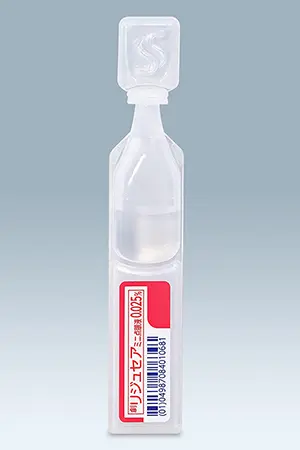
This drug is a prescription medicine that received approval from the Ministry of Health, Labour and Welfare on December 27, 2024.
It will be a new treatment option, especially for myopia in childhood, when it tends to progress.
March 18, 2025 – Santen Pharmaceutical press release
Notice of Launch of “Ryjusea® Mini Ophthalmic Solution 0.025%,” Japan’s First Eye Drop Intended to Slow Myopia Progression
https://www.santen.com/ja/news/2025/2025_1/20250318
In connection with this, a notice was issued by the Japan Ophthalmologists Association on April 11, 2025.
Precautions when providing myopia progression control treatment with low-concentration atropine eye drops (Japan Ophthalmologists Association , Social Insurance General Planning)
- No combination with insured care – Treatment for myopia, from examination to prescription, is entirely self-pay, and insured care and self-pay care cannot be combined for the same disease
- Separate management of medical records – Records for insured care and self-pay care must be kept completely separate, and in the case of electronic medical records, separate patient numbers are used
- Handling of glasses and contact lens prescriptions – While being treated with low-concentration atropine eye drops, prescriptions for glasses and contact lenses are also self-pay
- Response to side effects – Treatment of side effects of low-concentration atropine eye drops (such as redness) is also self-pay
- Explanation and consent – Before starting treatment, the diagnosis, treatment, costs, frequency, and possible side effects must be explained in detail, and for minors, a consent form from the patient and a guardian is required
- Precautions on self-diluted atropine – The indication of 1% atropine eye drops is “mydriasis and cycloplegia for the purpose of diagnosis or treatment,” and diluting it for the purpose of slowing myopia progression is not permitted because it may conflict with Article 18 of the Regulations for Insured Medical Institutions and Insurance Physicians.
Based on the above, I have also described our clinic’s response.
What matters:
Low-concentration atropine is not the only method of myopia control, but
when low-concentration atropine eye drops are used for the purpose of myopia control, it is necessary to move to self-pay care.
About Future Prescribing of Ryjusea® Mini (updated September 2026)
Since June 2026, Ryjusea® Mini has moved to “selected medical care” (sentei ryoyo): consultation and tests are covered by insurance, and the cost of the drug is paid by the patient. Our clinic continues myopia management on a self-pay basis in order to keep measuring axial length every three months. The costs and reasons are summarized in “Ryjusea Mini: Costs and Selected Medical Care”.
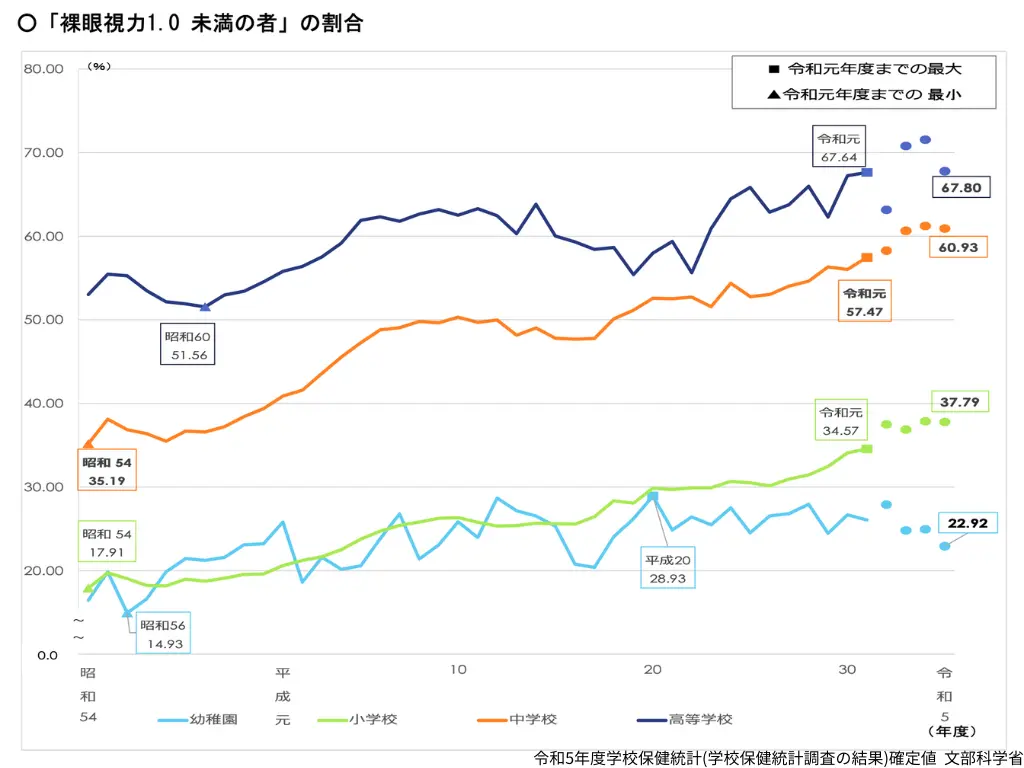
I have been writing about myopia in children since the clinic opened in 2018:
March 21, 2025 – Nikkei Business
Santen to Launch Japan’s First Myopia-Control Eye Drop, Targeting Childhood
https://www.nikkei.com/article/DGXZQOUC175RB0X10C25A3000000/
January 13, 2025 – Toyo Keizai Online
Why Santen’s “Myopia Progression Inhibitor” Is Drawing Attention
First approval in Japan: a new option for children’s myopia care
https://toyokeizai.net/articles/-/850646
Low-Dose Atropine Treatment
for Slowing Myopia Progression
Understanding an evidence-based option for children’s eyes
Myopia in Children Is Rising
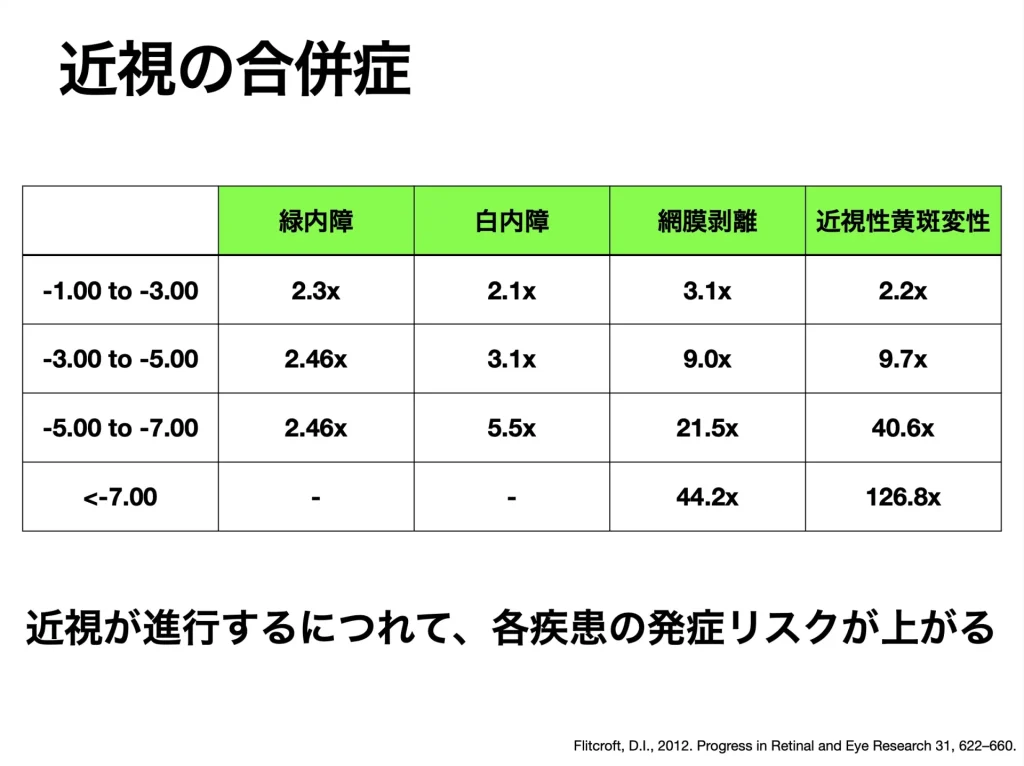
Myopia is not just poor eyesight.
It is a global health problem that raises the risk of serious eye disease later in life.
Slowing progression early is essential
to protecting your child’s eye health for life.
About 33%
slower myopia progression
(with 0.025% atropine)
Ryjusea® Mini Ophthalmic Solution 0.025%: Who It Is For and Its Effect on Myopia Progression
Ryjusea® Mini Ophthalmic Solution 0.025% contains a low concentration of atropine sulfate hydrate, and its effect in slowing myopia progression in children has been confirmed.
Once myopia has progressed, it does not go back. Measures from an early stage are important.
The purpose of this treatment is to slow the progression of myopia.
However, it cannot stop the progression of myopia completely.
Also, this treatment is not one that “restores vision.”
Depending on the degree of myopia, vision correction with glasses or similar is needed separately.
About Self-Pay Care

Important notice:
This treatment is currently not covered by insurance and is self-pay (entirely paid by the patient).
Based on the guidelines of the Japan Ophthalmologists Association, please note the following points.
Important points on self-pay care
- No combination with insured care: Treatment for myopia, from examination to prescription, is entirely self-pay. Insured care and self-pay care cannot be combined for the same disease.
- Glasses and contact lens prescriptions are also self-pay: During treatment to slow myopia progression, prescriptions for glasses and contact lenses are also self-pay.
- Treatment of other diseases: for conditions unrelated to myopia, such as allergic conjunctivitis and eye injuries, even on the same day, insured care is possible. However, medical records and billing are clearly separated.
- Response to side effects: Treatment of side effects of low-concentration atropine eye drops (such as redness) is also self-pay.
Differences Between Insured Care and Self-Pay Care
There are many important differences between insured care and self-pay care, including procedures, cost burden, and scope of coverage.
Basic differences
Insured care is a public contract-based medical service between the insurer (a health insurance association, municipality, and so on) and the medical institution, based on the medical insurance laws such as the Health Insurance Act. Patients pay part of the medical costs (usually 10 to 30%), and the insurer pays the rest. Self-pay care, on the other hand, is medical care based on a direct contract between the medical institution and the patient, and the patient pays the entire cost.
Limits on treatment
In insured care, only examinations, treatments, and drugs approved by the Ministry of Health, Labour and Welfare can be used, and their fee points and conditions of use are strictly defined.
In self-pay care, by contrast, it is possible to offer the patient the most suitable treatment from a wider range of options, including drugs and treatments not covered by insurance.
In the case of Ryjusea® Mini Ophthalmic Solution 0.025%
Treatment to slow myopia progression with Ryjusea® Mini Ophthalmic Solution 0.025% is currently not covered by insurance and is therefore self-pay. For that reason, all costs from consultation to prescription are paid by the patient, and it cannot be combined with insured care, including prescriptions for glasses and contact lenses. However, for diseases unrelated to myopia (such as allergic conjunctivitis), insured care is possible if it is separated appropriately.
In self-pay care, the pricing differs depending on the medical institution.
It is important to receive a sufficient explanation of the treatment and costs in advance and to start after agreeing to them.
Ryjusea® Mini Ophthalmic Solution 0.025%: Treatment Flow and Costs

Detailed Disclosure of the Safety and Costs of Myopia Progression Treatment (description based on the exception to the Medical Advertising Guidelines)
| Item | Details |
| 1. Treatment | This treatment uses “Ryjusea® Mini 0.025%,” Japan’s first approved drug for slowing myopia progression, instilled once a day before bedtime to slow the elongation of the depth of the eyeball (axial length). |
| 2. Standard costs (tax included) | [At the start] Consultation and prescription fee: ¥3,300 + drug cost: ¥4,380 (one month’s supply) [Continuing] Annual management fee: ¥17,600 (including tests every 3 months) + drug cost: ¥4,380 per month * When combined with orthokeratology, the consultation fee is waived (only the drug cost and prescription fee) |
| 3. Treatment period and number of visits | To evaluate the effect correctly, continuing for at least 2 years is recommended. For safety management and follow-up, regular visits every 3 months are required. |
| 4. Risks and side effects | The main side effects are temporary glare (photophobia) and difficulty focusing at near (blurred vision). Rarely, allergic conjunctivitis (itching, redness) or eyelid eczema associated with the eye drops may occur. |
We have decided to offer treatment to slow myopia progression with Ryjusea® Mini 0.025% at a fee structure that follows the notice of the Japan Ophthalmologists Association.
No appointment is necessary.
Treatment Flow
- First visit: Myopia is evaluated under regular insured care. Axial length is also measured for the first time.
- Trial period (if you wish): You can try Ryjusea® Mini 0.025% with one vial (¥330) (purchased on a separate day under insured care).
- Start of treatment (self-pay): We explain the treatment in detail and obtain a consent form.
- Regular follow-up: You visit after 1 month, and after that, every 3 months.
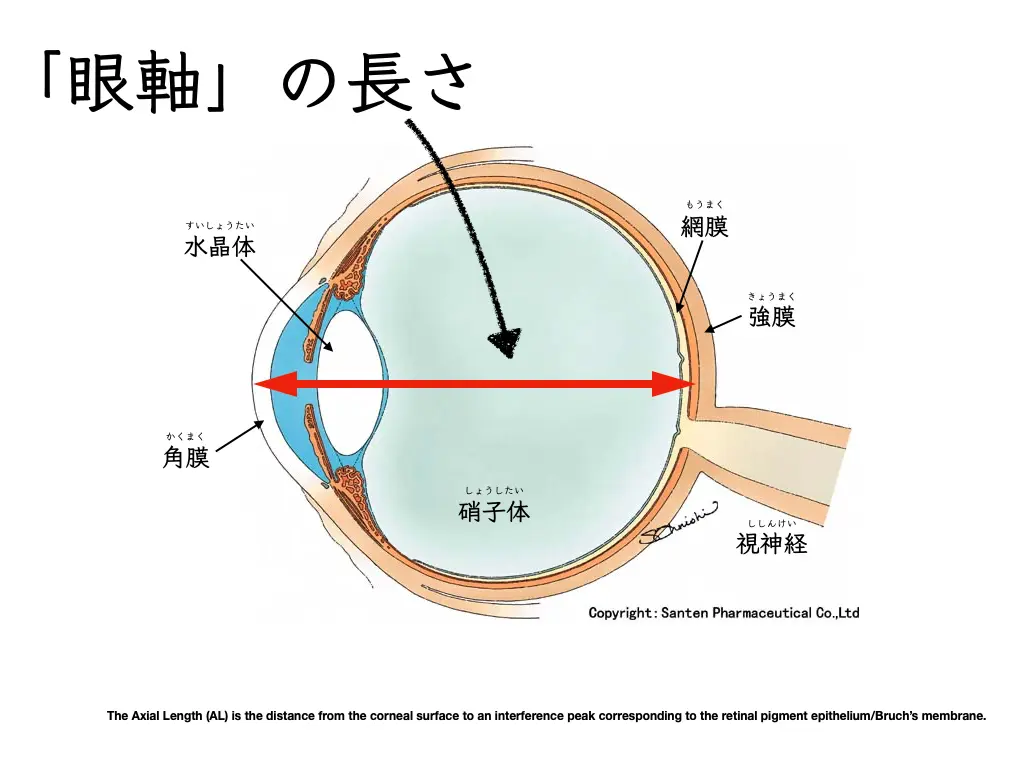
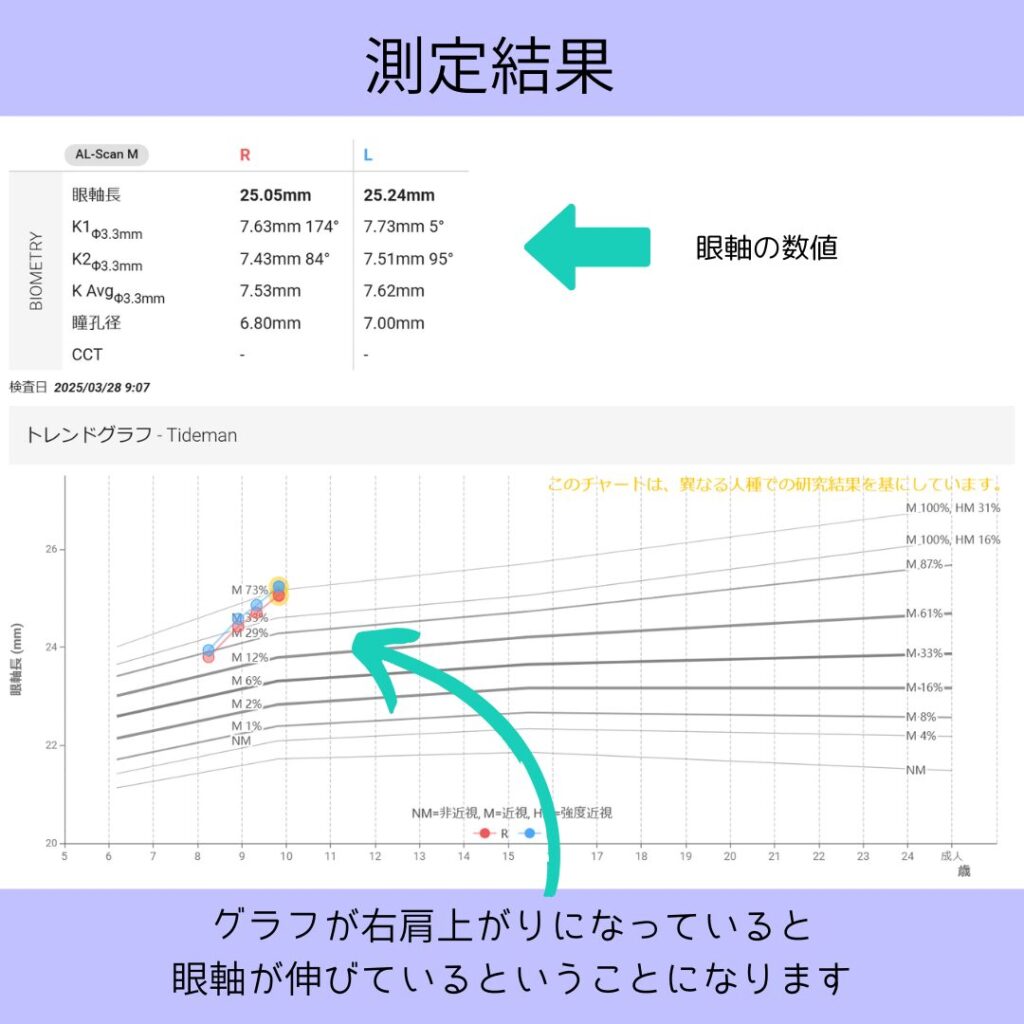
We give you a graph of your axial length measurements up to that day.
Ryjusea® Mini Ophthalmic Solution 0.025%: Costs of Treatment to Slow Myopia Progression
At the start of treatment (when moving to self-pay care)
- Consultation and prescription fee (including the glasses prescription fee if needed): ¥3,300
- Ryjusea® Mini 0.025% 0.3 ml × 30 vials: ¥4,380
After 1 month (follow-up)
- Consultation and prescription fee for 1 year (including visual acuity tests, axial length measurement, and slit-lamp examination every 3 months): ¥17,600
- Ryjusea® Mini 0.025% 0.3 ml × 30 vials: ¥4,380 (prescribed up to 3 months’ supply)
Annual renewal
- Consultation and prescription fee for 1 year (including visual acuity tests, axial length measurement, and slit-lamp examination every 3 months): ¥17,600
- Ryjusea® Mini 0.025% 0.3 ml × 30 vials: ¥4,380 (prescribed up to 3 months’ supply)
Influence of accommodation:“Pseudomyopia” is judged to be strong
- If a re-refraction test after cycloplegic (Cyplegin®) eye drops is performed, an additional ¥1,100
* Not charged if a mydriatic (Midrin®) is used
An accommodation analyzer (Accomoref®) is used, and the judgment is based on its results
Additional consultation (if needed)
- Consultation and prescription fee (including the glasses prescription fee if needed): ¥3,300
- If a re-refraction test after cycloplegic (Cyplegin®) eye drops is performed, an additional ¥1,100
Orthokeratology: when used together
- No consultation fee for Ryjusea® Mini 0.025% is needed (it is included in the orthokeratology consultation fee)
- Ryjusea® Mini 0.025% 0.3 ml × 30 vials: ¥4,380 (prescribed up to 3 months’ supply; prescription fee of ¥1,100 charged separately)
- All prices shown include tax.
- At the first visit, “myopia” is confirmed under insured care, and prescribing under self-pay care begins from the next day onward.
- Measurement of axial length is the most accurate indicator for evaluating the progression of myopia.
At every visit, we print a graph of your progress and explain it to you.
Points to Note on Insurance Coverage
- It has become clear that health insurance cannot be applied to myopia-related care, such as visual acuity tests, glasses prescriptions, and contact lens prescriptions, while low-concentration atropine eye drops are being used.
If a glasses prescription is needed, I would like to do it, if possible, on the same day the eye drops are prescribed.
Allergies (hay fever), styes, injuries (eye trauma), and so on: - Content in which myopia is not directly involved
can be treated under insured care even on the same day.
The fee structure above may be revised in the future.
Explanation and Consent for Patients
At the start of treatment,
we make sure to explain the following matters in detail and obtain your agreement:
- Diagnosis (the state of myopia)
- Treatment, costs, and frequency
- Possible side effects of treatment
- Other treatment options and what they involve
For minor patients, the consent of the patient and a guardian is required.
For Safe and Appropriate Treatment
Ryjusea® Mini Ophthalmic Solution 0.025% must be used appropriately under a physician’s prescription.
Please avoid using it on your own judgment or in a way other than the prescribed directions and dose.
In addition, the Japanese Ophthalmological Society, the Japanese Society of Myopia, and the Japan Ophthalmologists Association have submitted a request that combination with insured care become possible in the future. We will inform you whenever there is a change in the system.
Treatment to Slow Myopia Progression with Low-Concentration Atropine Eye Drops: Frequently Asked Questions (FAQ)

Questions about treatment
Q1: What kind of drug is Ryjusea® Mini Ophthalmic Solution 0.025%?
A: Ryjusea® Mini Ophthalmic Solution 0.025% is the first eye drop in Japan intended to slow myopia progression, released by Santen Pharmaceutical. Its active ingredient is a low concentration of atropine sulfate hydrate, and its effect in slowing myopia progression in children has been confirmed.
Q2: Which patients are eligible for treatment?
A: It is mainly intended for children with progressive myopia. It is especially suitable for children whose myopia is progressing or who are at high risk of progression. The physician will explain the details of suitability at the consultation.
Q3: How soon does the treatment take effect?
A: The effect of slowing myopia progression varies among individuals, but continuous use is generally required. The effect of treatment is evaluated through regular consultations and tests.
Q4: Are there side effects?
A: The main side effects reported include pupil dilation, accommodation disorder (difficulty seeing at near), glare, and conjunctival redness. Visual impairment, headache, and eyelid eczema have also been reported.
Because it is a low-concentration preparation, the side effects are relatively mild, but if you have any symptoms that concern you, please consult your physician.
Also, if treatment with Ryjusea® Mini Ophthalmic Solution 0.025% is interrupted partway, myopia may progress faster (rebound of myopia progression).
Q5: How long should treatment continue?
A: Myopia progression is marked mainly during the growth period, so in many cases it is recommended to continue until growth settles. The specific duration of treatment is determined by the physician according to each patient’s condition.
Questions about insurance and costs
Q6: Can insurance be used? Why is our clinic self-pay?
A: Since June 2026, Ryjusea® Mini has moved to “selected medical care” (sentei ryoyo). Under selected medical care, health insurance can be used for consultations and tests, and the cost of the drug is paid entirely by the patient. However, axial length measurement that can be billed to insurance is limited to twice a year.
Our clinic continues myopia management on a self-pay basis in order to measure axial length every three months and confirm how fast it is progressing. Please see “Ryjusea Mini: Costs and Selected Medical Care” for the reasons and a comparison of annual costs.
Q7: How much does treatment cost?
A: At the start of treatment, the consultation and prescription fee (including a glasses prescription) is ¥3,300, and Ryjusea® Mini Ophthalmic Solution for one month (30 vials) is ¥4,380.
After that, the basic fees are the annual consultation fee of ¥17,600 (including visual acuity tests, axial length measurement, and slit-lamp examination every 3 months) and the drug cost of ¥4,380 per month.
When a cycloplegic test is needed, ¥1,100 is added.
If an additional consultation is needed, a separate ¥3,300 is charged.
For patients receiving orthokeratology treatment, no separate consultation fee is charged. Only the prescription fee for Ryjusea® Mini Ophthalmic Solution, ¥1,100, is charged.
Q8: If I am receiving insured care for another disease, can I also receive myopia treatment on the same day?
A: For diseases unrelated to myopia (for example, allergic conjunctivitis), you can receive insured care. However, medical records, tests, prescriptions, and billing must be clearly distinguished.
Symptoms related to side effects of low-concentration atropine eye drops (such as redness) are handled as self-pay care.
Q9: If I stop treatment, can I return to regular insured care?
A: If treatment with low-concentration atropine eye drops is stopped, you can return to insured care from the next day onward.
However, repeatedly stopping and restarting over a short period is not appropriate.
Questions about the practice of treatment
Q10: How should the eye drops be used?
A: Normally, one drop is instilled in each eye once a day before bedtime.
Q11: Can glasses or contact lenses be prescribed during treatment?
A: Glasses and contact lenses during treatment are also prescribed as part of self-pay care. Prescriptions for glasses and contact lenses under insured care are not possible during treatment with low-concentration atropine eye drops.
Q12: If decreased vision is pointed out at a school screening, is the follow-up examination insured care?
A: If you are receiving treatment to slow myopia progression with low-concentration atropine eye drops, the examination after a school screening is also self-pay care.
Q13: How should low-concentration atropine eye drops be stored at home?
A: They can be stored at room temperature, but keep them out of direct sunlight and out of the reach of children. After opening, use them within the period instructed.
Q14: How often are regular visits?
A: At our clinic, the first follow-up is 1 month after starting treatment, followed by a regular visit once every 3 months and a detailed examination once a year (visual acuity, axial length measurement, slit-lamp examination, and so on). Depending on symptoms and progress, the physician may set an appropriate interval.
Other questions
Q15: Are there tests required before starting treatment?
A: Before starting treatment, visual acuity tests, refraction tests, axial length measurement, and fundus examination are needed. In some cases, additional tests such as corneal topography may be performed. These are tests done under insured care at the first visit.
Q16: Do I need to sign a consent form before starting treatment?
A: For minor patients, a consent form from the patient (if capable of consent) and a guardian is required. You will give consent after receiving a sufficient explanation of the treatment, costs, side effects, and so on.
Q17: If I was receiving similar treatment at another clinic, can I continue at your clinic?
A: Yes. If we have information about the treatment and course at the other clinic, treatment can be continued more smoothly.
Q18: What is the difference from self-prepared low-concentration atropine eye drops such as Myopine®?
A: Ryjusea® Mini Ophthalmic Solution 0.025% is a prescription medicine approved by the Ministry of Health, Labour and Welfare, and its quality, efficacy, and safety are assured. Compared with self-prepared eye drops or Myopine® imported for personal use, it has the advantage of stable concentration and quality.
By adjusting the base (vehicle), the effect on the anterior segment (iris and ciliary body) is reduced and transfer to the posterior segment (sclera) is increased. It is characterized by reduced photophobia (glare) and a greater effect on slowing axial elongation.
Q19: What is the difference between Midrin®-M and low-concentration atropine eye drops?
A: Midrin®-M (tropicamide) and low-concentration atropine eye drops differ in mechanism of action and effect. Atropine acts on all five types of muscarinic receptors and effectively slows myopia progression by suppressing axial elongation (about 33% at the low concentration of 0.025%, and a higher effect at the higher concentrations of 0.05–1%). Tropicamide, on the other hand, is a short-acting agent that acts mainly on the M4 receptor; it has the effect of relieving accommodative tension in so-called “pseudomyopia,” but it has no effect on long-term suppression of myopia progression (suppressing elongation of the axial length). Low-concentration atropine (0.025%) has few side effects and is the first-choice drug for myopia management, whereas tropicamide is suited to temporary mydriasis for diagnostic purposes.
Q20: Can it be combined with other methods to slow myopia progression?
A: Lifestyle improvements such as increasing outdoor activity, limiting near-work time, and securing appropriate lighting are recommended alongside treatment. Orthokeratology can be combined. For combination with other medical interventions, please consult your physician.
Q21: How is the effect of treatment evaluated?
A: We evaluate the progression of myopia through regular visual acuity tests, refraction tests, axial length measurement, and so on. In general, the change in axial length is the most important evaluation indicator.