![Takeru Eye Clinic | Takatori Shopping Street, Sawara-ku, Fukuoka City [Nishijin Station / Fujisaki Station]](https://takeru-eye.com/wp-content/uploads/2022/10/takeru_logo_for-WP-header.png)

I am writing about Rejusea® Mini in three articles
- What is Rejusea® Mini (approval, who it is for, how to use, side effects)
- Cost and selected medical care (what insurance can do, our clinic’s policy)
- What happens if you stop? When you feel it is not working (rebound, when to stop) (this article)
“If you become myopic, you can just correct your vision with glasses or contact lenses.”
This is what people have long believed.
But the myopia that we ophthalmologists are concerned about is not merely an “out-of-focus” problem.
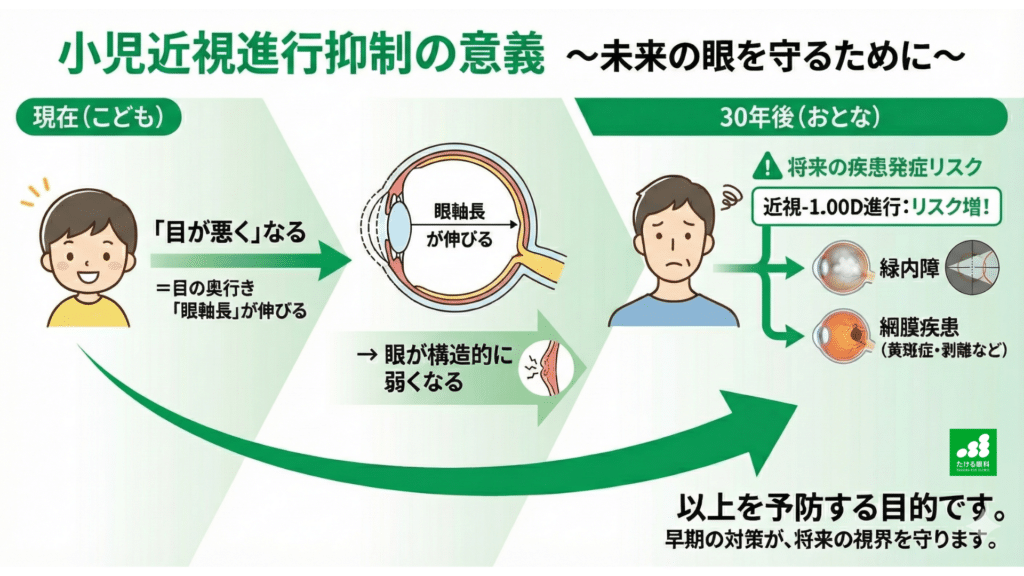
The real problem is that, as a child grows, the depth of the eye (axial length) lengthens excessively and the shape of the eyeball itself is deformed.
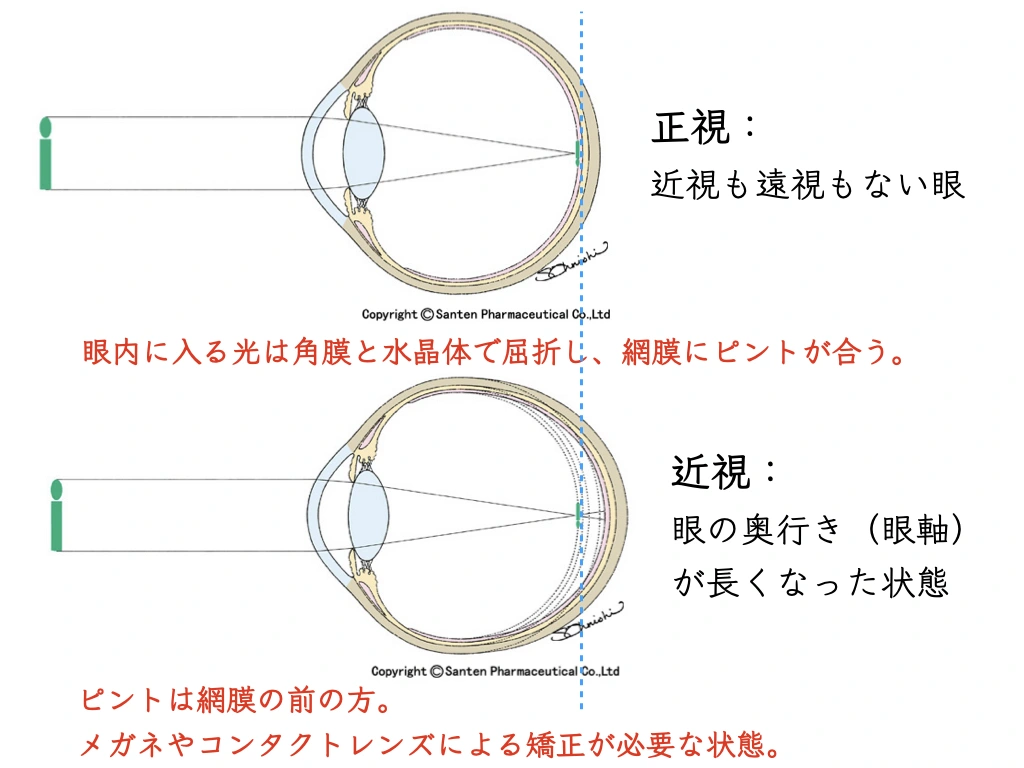
Once the axial length has grown, it basically does not return to its original length.
Just as the rubber of a balloon is stretched thin as it inflates, when the eyeball elongates, strain is placed on the retina and optic nerve, raising the risk of eye disease in the future.
The goal of modern myopia treatment has changed greatly, from simply “making things visible” to “slowing the elongation of the axial length itself.”
Recently, we wrote on our website about the approval of the myopia progression control drug “Rejusea® Mini ophthalmic solution 0.025%.”
[About the future of Rejusea® Mini prescription] At the Central Social Insurance Medical Council on 1/9, the direction of moving to “selected medical care” from June this year was shown. If realized, “examination and tests are covered by insurance and the drug cost is out of pocket” is expected. We will announce details and our clinic’s response as soon as confirmed. https://t.co/7SoDdc7swQ
— たける眼科 – Takeru Yoshimura, M.D., Ph.D. (@takeru_eye) January 11, 2026
Updated May 21, 2026
The policy from June 2026 has been added.
Since then, in the examination room we have had more chances to receive more specific questions from parents.
“What is different from the 0.01% eye drops we used before?”
“Why is it 0.025%, a number that looks so odd?”
“If we stop in the future, is there a worry that vision will suddenly get worse (rebound)?”
“It seems it isn’t working. May we stop?”
In this article, looking back on the history of atropine treatment, I explain in detail, based on current medical knowledge, why “0.025%” has now been chosen as the new standard, and about “when to stop” and “rebound,” which many parents worry about.
History of atropine treatment: from “too strong” to “too weak”
To understand the arrival of Rejusea Mini, we need to go back a little in time and trace the history of atropine research.
ATOM1 study: very effective, but with large side effects
In 2006, a groundbreaking study (ATOM1) was published in Singapore. It used high-concentration atropine at “1%.” As a result, it showed a remarkable effect, slowing myopia progression by 77%.¹
But there was a problem. The 1% concentration caused strong side effects: the pupil stays wide open (mydriasis) and near text cannot be read at all (cycloplegia).
Furthermore, the moment treatment was stopped, a “rebound phenomenon” occurred in which myopia progressed rapidly.¹
This was not realistic as a treatment for children who go to school every day.
ATOM2 study: global standardization of 0.01% and its “hidden weakness”
So, thinking “wouldn’t side effects disappear if it were more dilute?”, the ATOM2 study was carried out in 2012.
Here, the very low concentration of “0.01%” drew attention as having few side effects while still being effective.¹
Since then, 0.01% atropine has been widely prescribed around the world as a compounded in-hospital preparation such as “Myopine.”
However, from long years of use, a certain “weakness” gradually became clear.
That is, it became clear that 0.01% atropine suppresses the change in refraction (the degree of myopia), but its effect on suppressing “elongation of the axial length (the length of the depth of the eye),” the essential cause of worsening myopia, is limited.²

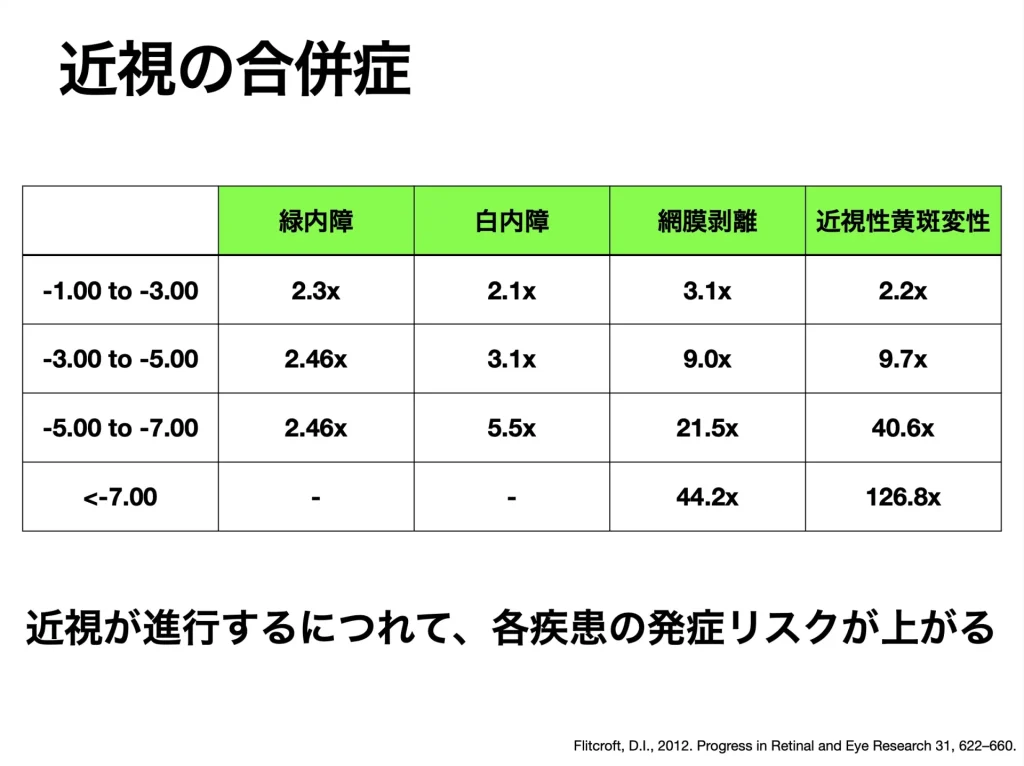
The risk of future eye diseases caused by myopia (retinal detachment, glaucoma and others) rises as this “axial length” grows. In other words, it began to be pointed out that even if the apparent refractive error is suppressed, the deformation of the shape of the eye itself may not be sufficiently prevented.
| Disease | Increase in risk per −1.00 D progression (approximate) | Approximate risk by degree (compared with emmetropia or mild myopia) |
|---|---|---|
| Myopic maculopathy (MMD) | About 1.2 -fold | High myopia (over −6.00 D): about 40 -fold |
| Retinal detachment (RRD) | About 1.1 -fold | Moderate or higher (over −3.00 D): about 10 -fold |
| Glaucoma (POAG) | About 1.2 -fold | Moderate to high myopia: about 3.3 -fold |
Why “0.025%”? The answer drawn from the LAMP study
“0.01% may be insufficient to slow axial length elongation. On the other hand, if the concentration is raised too much, side effects appear.”
The study carried out to resolve this dilemma was the large-scale “LAMP study” by the Chinese University of Hong Kong.² This study directly compared three concentrations: 0.05%, 0.025% and 0.01%.
As a result, the difference in effect by concentration was shown clearly.
- 0.05%: the most effective, but side effects are also slightly more likely.
- 0.01%: fewer side effects, but the effect of slowing axial length elongation is weak (an inhibition rate of about 12% estimated against the placebo group).²
- 0.025%: slowed axial length elongation by about 33%, with side effects almost the same as 0.01%.⁷
In other words, 0.025% has been scientifically shown to be the optimal compromise, a middle-ground concentration (Middle Ground) that combines “
「a high effect that significantly slows axial length” and “safety on a par with 0.01%”.³
The reason Rejusea Mini, approved in Japan, adopted 0.025% is thought to be that, based on the results of this LAMP study, it was judged that “the balance of effect and safety is optimal” for Japanese children.
Why does it feel like “it isn’t working”?
Rejusea Mini is not a drug that stops myopia but a drug that slows the speed at which the axial length grows. In the LAMP study, 0.025% slowed axial length elongation by about 30%, but myopia still progresses little by little during treatment. So it is not unusual to feel that “the refraction went up even though I am using the drops” or “vision got worse.”
Whether it is working is judged not by visual acuity or refraction but byhow many mm the axial length grows per year, compared with the reference for children of the same age. At our clinic we measure axial length every 3 months and tell you that speed each time.
If the speed of growth has not slowed enough, before stopping we consider switching to, or combining with, orthokeratology or MiSight®. Please talk with us once before stopping on your own judgment.
What happens if you stop Rejusea Mini? Rebound and when to stop

What parents worry about most is what happens after treatment is interrupted.
To the worry that “won’t it get rapidly worse as a rebound if we stop?”, phase 3 of the LAMP study (year-3 data) gives an important answer.⁴
Even with 0.025% atropine, a small rebound is seen after stopping
In the study, after treatment was continued for 2 years, treatment was stopped completely in year 3 (washout) and the course was observed.
- 0.05% group: showed the largest rebound of the three groups (a phenomenon in which myopia progression accelerates after stopping)4。
- 0.025% group: a statistically significant rebound was seen after stopping, but its degree was smaller than in the 0.05% group4。
- 0.01% group: the rebound was the smallest of the three groups, but the original myopia control effect also remained weak4。
From these data we can see that reboundcan occur at all concentrations, andbecomes larger the higher the concentration (concentration-dependent). 0.025% is thought to be a concentration that keeps the rebound relatively small while maintaining a certain myopia control effect.
How long should it be continued?
It is recommended to continue until around junior high school age, when the child’s height is growing and the axial length also grows easily (until the growth period ends).
Even though the rebound risk is low, if you are anxious about stopping suddenly,
some experts recommend a method (tapering) of gradually reducing from daily instillation to “every 2 days” and “every 3 days” after the growth peak has passed.⁴
Technical features of Rejusea Mini ophthalmic solution
Finally, let me also introduce the features of the drug itself.
Unlike conventional atropine drops made as compounded in-hospital preparations, Rejusea Mini is an approved drug developed by a pharmaceutical company (Santen Pharmaceutical). It uses a drug delivery technology called “DDS (drug delivery system).”

Weakly acidic and hard to act on the anterior segment (iris and ciliary body): the pupil is less likely to dilate
Increased viscosity: acts on the posterior segment, slowing axial length elongation
The places where atropine acts are thought to be the “retina” and “sclera” at the back of the eye.⁵
Rejusea Mini has a special design that suppresses distribution of the drug to the front part of the eye (iris and ciliary body), which causes side effects, while delivering the drug efficiently to the back of the eye (posterior segment) where the effect is needed.³
Being a preservative-free “single-use type” is also thought to be a great advantage in protecting the surface of the eye (cornea) of children who instill drops every day for a long time.³
About handling unapproved imported products (such as Myatro®)
Giving first priority to children’s eye safety, our clinic uses only “Rejusea® Mini ophthalmic solution,” a genuine drug approved in Japan by the Ministry of Health, Labour and Welfare.
We do not prescribe or handle overseas-made eye drops (such as Myatro® [Myatro® 0.01%/0.05%]) for the following reasons.
1. National approval and quality assurance
Rejusea® Mini is a drug whose efficacy and safety were confirmed through clinical trials in Japan, and which obtained manufacturing and marketing approval.
On the other hand, products such as Myatro® are imported products that have not received approval under Japanese law.
2. Not covered by the Adverse Drug Reaction Relief System
This is the biggest difference.
If a serious side effect occurs when a drug approved in Japan (Rejusea®) is used appropriately, it may be eligible for the national public Relief System for Adverse Drug Reactions.
However, when an unapproved imported drug (Myatro®) is used, it is not eligible for this relief system, and there is no public compensation in the unlikely event of trouble.
Because this is treatment that affects your precious child’s future, our clinic’s policy is to use only domestically approved drugs backed by public safety standards and a compensation system.
Thank you for your understanding.
Summary: the new standard of myopia treatment
The arrival of Rejusea Mini (0.025% atropine) marks a change in myopia treatment, from the era of “just use 0.01% for now”
to the era of “choosing a scientifically grounded concentration in order to firmly suppress axial length.”That is the change its arrival signifies.
Of course, 0.025% is not necessarily the best for every child, but at least when we think about “effect,” “safety” and future “rebound,” 0.025% can be called a very reasonable choice.⁶
If you have any questions, such as when to start treatment, when to stop, or switching from the 0.01% you are using now, please ask at your visit.
I hope we can think together about the best method to protect your child’s eye future.
References
- Upadhyay A, Beuerman RW. Biological Mechanisms of Atropine Control of Myopia. Eye & Contact Lens. 2020;46(3):129-135. https://www.ncbi.nlm.nih.gov/pmc/articles/PMC7176345/
- Yam JC, Jiang Y, Tang SM, et al. Low-Concentration Atropine for Myopia Progression (LAMP) Study: A Randomized, Double-Blinded, Placebo-Controlled Trial of 0.05%, 0.025%, and 0.01% Atropine Eye Drops in Myopia Control. Ophthalmology. 2019;126(1):113-124. https://pubmed.ncbi.nlm.nih.gov/30514630/
- Santen Pharmaceutical Co., Ltd. RYJUSEA Mini ophthalmic solution 0.025% (atropine sulfate hydrate) Approved in Japan for Slowing the Progression of Myopia in Children. 2024. https://www.santen.com/en/news/2024/2024_1/20241227
- Yam JC, Zhang XJ, Zhang Y, et al. Three-Year Clinical Trial of Low-Concentration Atropine for Myopia Progression (LAMP) Study: Continued Versus Washout: Phase 3 Report. Ophthalmology. 2022;129(3):308-321. https://pubmed.ncbi.nlm.nih.gov/34627809/
- McBrien NA, Stell WK, Carr B. How does atropine exert its anti-myopia effects?. Ophthalmic Physiol Opt. 2013;33(3):373-378. https://pubmed.ncbi.nlm.nih.gov/23662969/
- Santen Pharmaceutical Co., Ltd. Santen launches RYJUSEA Mini ophthalmic solution 0.025% for slowing the progression of myopia in children in Japan. 2025. https://www.santen.com/en/news/2025/2025_1/20250318
- Bullimore MA, Saunders KJ, Baraas RC, et al. IMI—Interventions for Controlling Myopia Onset and Progression 2025. Invest Ophthalmol Vis Sci. 2025;66(12):39. https://doi.org/10.1167/iovs.66.12.39