![Takeru Eye Clinic | Takatori Shopping Street, Sawara-ku, Fukuoka City [Nishijin Station / Fujisaki Station]](https://takeru-eye.com/wp-content/uploads/2022/10/takeru_logo_for-WP-header.png)

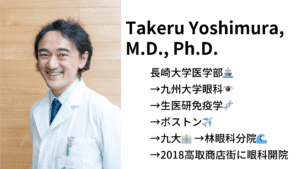
After finishing my residency I became a graduate student, and when my basic immunology research at the Medical Institute of Bioregulation, Kyushu University had reached a natural pause, I was given the chance to take part in Dr. Kohei Sonoda’s invited lecture for the Council of the Japanese Ophthalmological Society (Dr. Sonoda is now a professor at Kyushu University). That allowed me to carry out a lot of research on ocular immunology.
Each of these papers brings back many memories. One I published in 2009 analyzed intraocular fluid (vitreous) and discussed vitreoretinal diseases from the standpoint of inflammation. It is still widely cited today, and I am glad the research proved meaningful.
» Comprehensive Analysis of Inflammatory Immune Mediators in Vitreoretinal Diseases(A comprehensive analysis of inflammatory humoral factors in vitreoretinal diseases)
The research I did under Dr. Sonoda’s guidance gave me many reasons to think about immunity in the eye, and it has been the foundation of how I think about eye disease, from my time studying in Boston to today.
[Age-related macular degeneration]
Yesterday I attended a seminar sponsored by Alcon and learned how the understanding of this disease has changed over the past few years.
• Age-related macular degeneration used to be a disease with no treatment at all.
• Photodynamic therapy (PDT) was approved in 2003.
• Intravitreal anti-VEGF antibody injections were approved in 2008.
• Today, based on the concept of pachychoroid neovasculopathy, attention is turning to the role that choroidal thickness plays in the disease, among other things.
At the clinic, when needed, I examine patients with OCT (optical coherence tomography) and OCT angiography (OCTA), and I show every image on the monitor in front of the patient while explaining it.
In recent practice I was able to confirm that OCTA can show choroidal neovascularization and that deep-penetration OCT can show choroidal thickness.
Both diagnosis and treatment of age-related macular degeneration have advanced dramatically.
The disease is sometimes found because of a symptom that appears when one eye is covered: things look distorted.
Finding it early is thought to widen the treatment options.
I would like to provide care in cooperation with the Department of Ophthalmology at Kyushu University and its affiliated institutions.
If you are concerned, please feel free to consult me at any time.
Thank you for your understanding.