![Takeru Eye Clinic | Takatori Shopping Street, Sawara-ku, Fukuoka City [Nishijin Station / Fujisaki Station]](https://takeru-eye.com/wp-content/uploads/2022/10/takeru_logo_for-WP-header.png)

“I want to lose weight in a healthy way with this medication.”
Tirzepatide (brand names: Mounjaro®, Zepbound®) has become a source of hope for many patients as a treatment for obesity. While its strong weight-loss effect draws attention, you may wonder, “Why would a medicine for losing weight have anything to do with eye disease?”
In fact, the changes this drug brings about in the body are closely tied not only to body weight but also to blood sugar control. And a rapid change in blood sugar may have an unexpected effect on the retina, at the back of the eye.
Whether or not you know you have diabetes, here is important eye-related information for everyone who starts this medicine to treat obesity.
A Rapid “Improvement” Can Affect the Eyes
Tirzepatide (Mounjaro®, Zepbound®) not only reduces body weight but also powerfully improves blood sugar. Recent research has shown that, depending on the state of the retina, this rapid improvement can actually carry a risk of making a disease called “diabetic retinopathy” worse.
- People with no retinal abnormalities, or only very early changes
In this case, good metabolic control with tirzepatide can be expected to have a protective effect that helps prevent retinopathy from developing in the future¹. - People whose retinopathy has already progressed to some degree without their noticing
Behind obesity there may be “hidden diabetes” or a high-blood-sugar state that you are not aware of. If moderate or more advanced retinopathy is already present, a rapid improvement in blood sugar from treatment could be a trigger for temporary worsening of retinopathy, according to reports¹.
Why Would a Weight-Loss Drug Affect the Eyes?
The key to this phenomenon is a “rapid drop in blood sugar.”
Retinal blood vessels exposed to high blood sugar for a long time have, so to speak, become “accustomed” to that environment, and their ability to regulate blood flow on their own has declined. When a powerful drug such as tirzepatide acts on them and blood sugar normalizes rapidly, the balance of blood flow in the retina can be disrupted, and some areas may temporarily receive too little blood flow (ischemia).
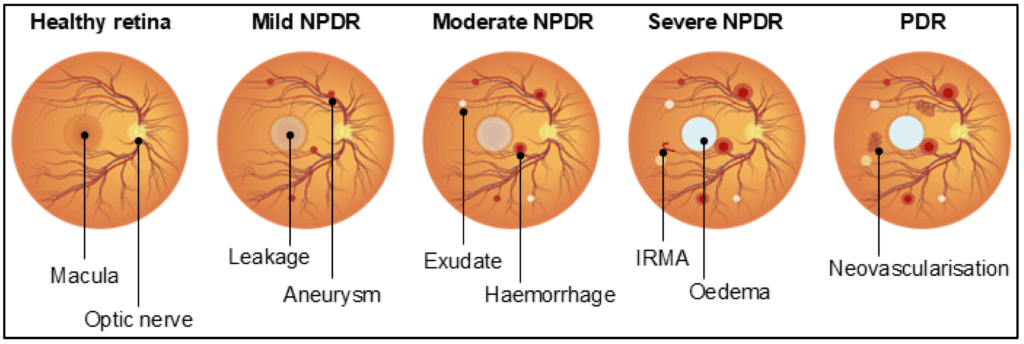
The body treats this as a danger signal and releases a substance called vascular endothelial growth factor (VEGF). VEGF is a signal that prompts the growth of new blood vessels (neovascularization), but these new vessels are very fragile and can cause serious visual impairment, such as bleeding and retinal detachment.
This series of reactions is called “early worsening of diabetic retinopathy” (EWDR). It is not so much a side effect of the drug as a phenomenon that occurs while the body adapts to a rapid change². It has long been known not only with tirzepatide but also with intensive blood-glucose-lowering therapy with insulin³˒⁴.

What the Latest Data Show
Recent studies have reported that, among people who had no retinopathy at the start of treatment, good blood sugar control lowers the risk of newly developing retinopathy by about 27%. On the other hand, a real-world cohort study (Buckley et al., 2025) reported that the odds of newly developing proliferative diabetic retinopathy (PDR) were about 2.15 times higher in the tirzepatide group (odds ratio 2.15, 95% confidence interval 1.24–3.74), and that this increase was concentrated especially among people who already had mild to moderate retinopathy at the start of treatment (mild NPDR with maculopathy [R1M1], or moderate to severe NPDR [R2]).

Among people receiving treatment for obesity, retinopathy often progresses without any symptoms. For that reason, thinking “I don’t have diabetes, so I’m fine” can actually carry some risk.
For People About to Start Obesity Treatment
Used appropriately, tirzepatide is a very effective treatment option for improving obesity and its related conditions. To receive its benefits safely, there is one thing that matters most.
It is to have a thorough fundus examination at an eye clinic at least once before starting treatment.
At the eye clinic, the pupils are dilated with eye drops and the whole retina is examined in detail. This lets us assess in advance early retinal changes that you cannot notice yourself, and whether there is a risk of worsening with treatment.
Even if a risk is found, that does not mean treatment is impossible. Your physician and the eye doctor can work together, adjusting the drug dose so that blood sugar falls more gradually and following your eyes more carefully at the eye clinic, so that treatment can proceed safely.
Treatment meant to help you lose weight and regain a healthy body should never end up costing you your irreplaceable eyesight. A visit to an eye doctor before starting treatment is an important first step in protecting the health of your eyes in the future.
References
- Bain, S. C., Klufas, M. A., Ho, A. and Matthews, D. R. (2019) ‘Worsening of diabetic retinopathy with rapid improvement in systemic glucose control: A review’, Diabetes, Obesity and Metabolism, 21(3), pp. 454–466.
- Buckley, A. J., Tan, G. D., Gruszka-Goh, M., Scanlon, P. H., Ansari, I. and Suliman, S. G. I. (2025) ‘Early worsening of diabetic retinopathy in individuals with type 2 diabetes treated with tirzepatide: a real-world cohort study’, Diabetologia, 68(10), pp. 2069–2076.
- Hebsgaard, J. B., Pyke, C., Yildirim, E., Knudsen, L. B., Heegaard, S. and Kvist, P. H. (2018) ‘Glucagon-like peptide-1 receptor expression in the human eye’, Diabetes, Obesity and Metabolism, 20(9), pp. 2304–2308.
- Holman, R. R., Paul, S. K., Bethel, M. A., Matthews, D. R., Neil, H. A., Tucker, L. et al. (2008) ‘10-year follow-up of intensive glucose control in type 2 diabetes’, The New England Journal of Medicine, 359(15), pp. 1577–1589.
- Katz, B. J., Lee, M. S., Lincoff, N. S., Abel, A. S., Chowdhary, S., Ellis, B. D. et al. (2025) ‘Ophthalmic complications associated with the antidiabetic drugs semaglutide and tirzepatide’, JAMA Ophthalmology, 143(3), pp. 215–220.
- Marso, S. P., Bain, S. C., Consoli, A., Eliaschewitz, F. G., Jódar, E., Leiter, L. A. et al. (2016) ‘Semaglutide and cardiovascular outcomes in patients with type 2 diabetes’, The New England Journal of Medicine, 375(19), pp. 1834–1844.
- Simó, R. and Hernández, C. (2017) ‘GLP-1R as a Target for the Treatment of Diabetic Retinopathy: Friend or Foe?’, Diabetes, 66(6), pp. 1453–1460.
- The Diabetes Control and Complications Trial Research Group (1998) ‘Early worsening of diabetic retinopathy in the Diabetes Control and Complications Trial’, Archives of Ophthalmology, 116(7), pp. 874–886.