![Takeru Eye Clinic | Takatori Shopping Street, Sawara-ku, Fukuoka City [Nishijin Station / Fujisaki Station]](https://takeru-eye.com/wp-content/uploads/2022/10/takeru_logo_for-WP-header.png)

Orthokeratology is a treatment in which special contact lenses are worn during sleep at night to restore daytime vision. Because of the freedom of getting through the day without glasses or contact lenses, many people choose this treatment, especially as myopia control for children.
Alongside the convenience, not a few patients and their families feel anxiety: “Is it really OK for the eyes to sleep with lenses on at night?”
Orthokeratology is a treatment whose safety is secured by reliably carrying out the prescribed lens care. The risk of corneal infection, a serious complication, is not zero, but that risk is on a par with that of ordinary contact lenses, and it can be managed with correct knowledge and practice.
In this article, based on scientific evidence, I explain in detail the “actual frequency,” “causes” and “prevention” of corneal infection associated with orthokeratology.
How often does corneal infection occur?
Corneal infection is a complication that can occur not only with orthokeratology but with all contact lenses. Understanding its frequency correctly is very important when thinking about safety.
According to recent reliable research reports, the frequency of corneal infection with orthokeratology is about 5.4 to 7.7 per 10,000 patients per year.¹˒²
Looking at this number alone, it may be hard to tell whether it is high or low.
As a familiar comparison, it is known to be roughly the same as the risk of corneal infection with daytime-use soft contact lenses (SCL) such as two-week replacement lenses.¹ On the other hand, compared with cases of sleeping in soft contact lenses that are not recommended for sleeping (extended wear), the risk of orthokeratology has been shown to be comparable.⁶
Why children’s risk is higher than adults’
Here is some very important data.
In one large survey, when the incidence of corneal infection was divided by age, it was reported to be 13.9 per 10,000 per year in children (under 18) and 0 in adults (18 and over).²
This difference is not because children’s corneas are weaker than adults’.
The cause is thought to lie in the “degree to which hygiene management is carried out” in handling the lenses. Carrying out every step of lens care carefully every day without fail may be difficult for children.
In other words, to proceed safely with orthokeratology in children, active involvement of the family is essential, such as a parent’s daily final check and sometimes the management itself. The safety of orthokeratology depends greatly not only on the performance of the lens itself but on the hygiene awareness of the user and the family.
Why does corneal infection occur?
So, when does corneal infection occur?
Many of the microorganisms that cause it are in fact always present around us.
Main causative bacteria of infection
The ones reported most often as causes of corneal infection with orthokeratology are Pseudomonas aeruginosa (Pseudomonas aeruginosa) and Acanthamoeba (Acanthamoeba).³
Pseudomonas aeruginosa is a bacterium that likes moist environments. It can multiply in places such as a lens case that has not been properly cleaned and dried.
Acanthamoeba is a microorganism widely present in the natural environment, such as tap water and soil. In a healthy eye, the barrier function of the cornea can prevent its entry. However, when the cornea has minute scratches from lens wear and a lens carrying Acanthamoeba touches the cornea, infection may occur.⁴ Acanthamoeba keratitis is very difficult to treat and may leave serious visual impairment, so it is an infection that needs particular attention.
Specific behaviors that raise the risk
Corneal infection does not suddenly occur one day. In many cases, it is triggered by an accumulation of small lapses in daily lens care.
- Use of tap water
This is the greatest cause of Acanthamoeba keratitis and an act that must absolutely be avoided. In any form, such as rinsing the lens, washing the case, or touching the lens with wet fingers, contact of lenses or accessories with tap water is extremely dangerous.⁵ Bottled water and distilled water are not safe either. - Inadequate hand washing
If you do not wash your hands thoroughly with soap before touching the lens, bacteria on your hands can enter the eye via the lens. - Contaminated lens case
A lens case is not just a container. A case whose cleaning is neglected becomes a breeding ground for bacteria, a “bacterial incubator,” so to speak. Topping up old care solution, not cleaning and drying the case every day, and not replacing it for a long time cause the lenses to be contaminated with bacteria.
All of these risks are “preventable.” In the next section I explain specific prevention methods.
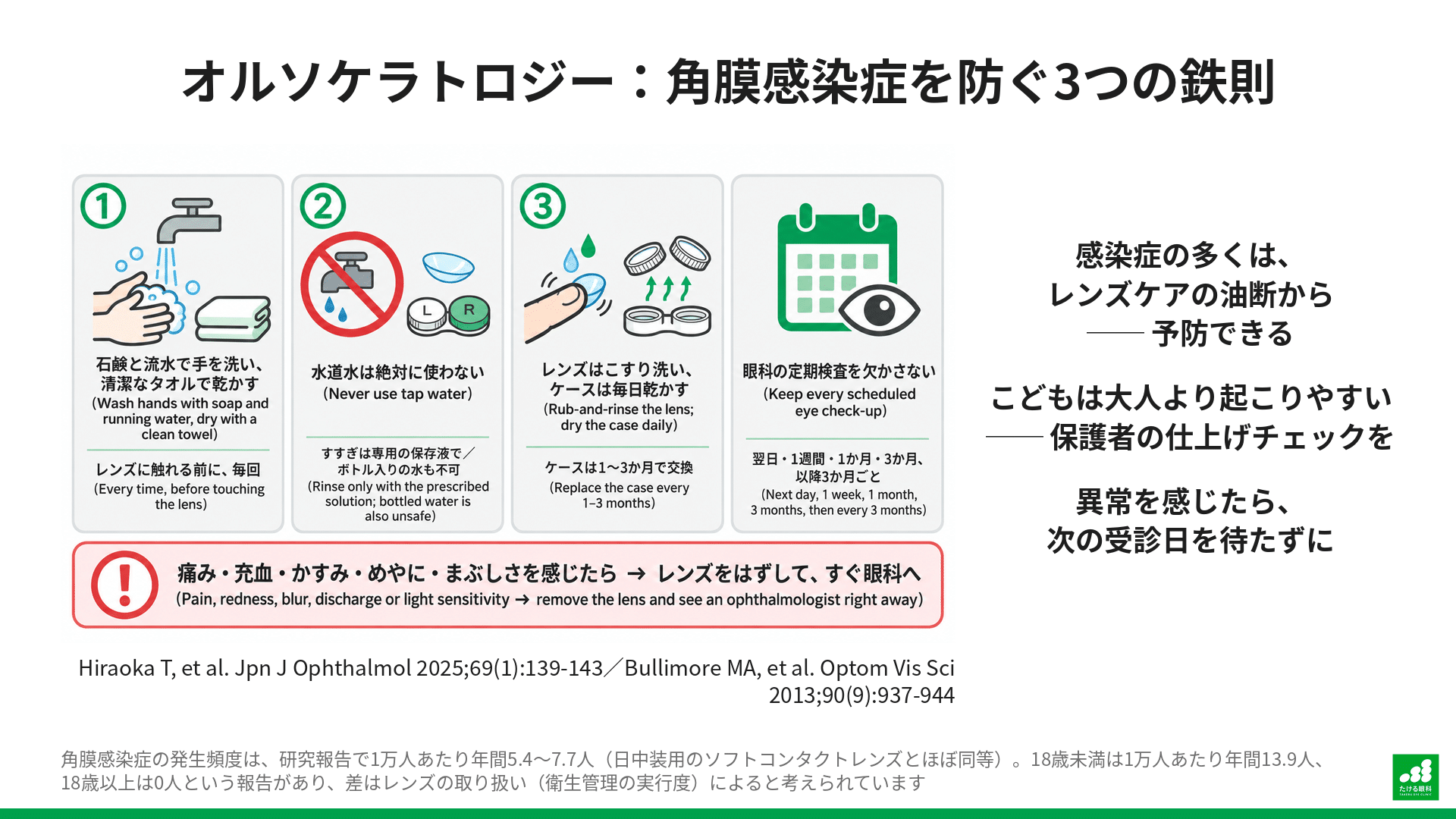
The “three iron rules” to prevent corneal infection
The secret to continuing orthokeratology safely is nothing special. It is to continue basic daily lens care every day without cutting corners.
Rule 1: Always wash your hands carefully before touching the lens
Before putting lenses in or taking them out, always wash carefully with soap and running water, including the pads of your fingers and between the nails, and dry completely with a clean towel. Handling lenses with wet hands carries the risk of Acanthamoeba in tap water attaching to them.
Rule 2: Thoroughly follow “no tap water”
For lenses and lens cases, never use tap water. This is the most important rule for preventing Acanthamoeba keratitis.⁸ The complacency of “just a little” can lead to a serious situation. Always use the dedicated storage solution or the care products you were instructed to use for rinsing lenses and cases.
Rule 3: Clean and manage the lens and case correctly
- Cleaning the lens
Lenses must be cleaned every day after removal. Put a few drops of cleaning/storage solution on the lens and rub both sides carefully with the pad of your finger (the Rub & Rinse method). If invisible protein and lipid deposits remain on the lens, bacteria easily multiply using them as “food.” Deposits, so to speak, provide a “home” where bacteria settle.⁹ By rubbing, this “home” can be physically stripped away. At our clinic, at regular examinations we observe the patient’s lenses under magnification with a microscope and check strictly whether such minute deposits remain. In this way, we confirm that daily lens care is being done correctly, and support you to continue treatment more safely. - Caring for the lens case
The lens case needs daily care just like the lenses. Completely discard the old solution inside, rinse with fresh storage solution, wipe off the moisture with a clean tissue, and let it air-dry naturally with the cap open. And always replace the lens case with a new one every 1 to 3 months.
Regular examinations at the eye clinic protect the safety of your eyes
Orthokeratology is not a treatment that ends with simply prescribing lenses. To ensure safety, regular examinations by an ophthalmologist are essential.
The purpose of regular examinations is not only to check that vision is being obtained properly. From a specialist viewpoint, we check the health of the eyes thoroughly: whether the shape of the cornea is changing appropriately with the lenses, whether the cornea is under strain such as scratches or oxygen deprivation, and whether an allergic reaction has occurred.
We also check the condition of the lens itself that the patient uses every day (presence of scratches, deposits, deformation), because the condition of the lens is directly linked to the safety of the eyes.
Visiting on the set schedule (for example: the next day, 1 week, 1 month, 3 months, and every 3 months thereafter) is an important commitment for continuing treatment safely. If you feel anything abnormal such as eye pain, redness, blurred vision, discharge or sensitivity to light, do not wait for your next appointment; stop wearing the lenses immediately and see an ophthalmologist promptly.
Summary
Orthokeratology is one effective option that brings comfortable daytime life without glasses and slows myopia progression in children.
Its safety rests on the foundation of “the user’s proper practice of lens care.” The risk of corneal infection certainly exists, but its frequency is low, and most of the causes that raise the risk come from improper lens care.
“Never use tap water,” “clean the lens and case correctly every day,” and “never skip regular examinations.”
Observing these basic rules every day leads to protecting your own eyes, and your child’s precious eyes, for the future.
References
- Hiraoka, T., Matsumura, S., Hori, Y., Kamiya, K., Miyata, K. and Oshika, T. (2025) ‘Incidence of microbial keratitis associated with overnight orthokeratology: a multicenter collaborative study’, Japanese Journal of Ophthalmology, 69(1), pp. 139-143.
- Bullimore, M.A., Sinnott, L.T. and Jones-Jordan, L.A. (2013) ‘The risk of microbial keratitis with overnight corneal reshaping lenses’, Optometry and Vision Science, 90(9), pp. 937-944.
- Kam, K.W., Yung, W., Li, G.K.H., Chen, L.J. and Young, A.L. (2017) ‘Infectious keratitis and orthokeratology lens use: a systematic review’, Infection, 45(6), pp. 727-735.
- Scanzera, A.C., Tu, E.Y. and Joslin, C.E. (2021) ‘Acanthamoeba Keratitis in Minors With Orthokeratology (OK) Lens Use: A Case Series’, Eye & Contact Lens, 47(2), pp. 71-73.
- Watt, K. and Swarbrick, H.A. (2005) ‘Microbial keratitis in overnight orthokeratology: review of the first 50 cases’, Eye & Contact Lens, 31(5), pp. 201-208.
- Liu, Y.M. and Xie, P. (2016) ‘The Safety of Orthokeratology–A Systematic Review’, Eye & Contact Lens, 42(1), pp. 35-42.
- Jung, S., Eom, Y., Song, J.S., Hyon, J.Y. and Jeon, H.S. (2024) ‘Clinical Features and Visual Outcome of Infectious Keratitis Associated with Orthokeratology Lens in Korean Pediatric Patients’, Korean Journal of Ophthalmology, 38(5), pp. 399-412.
- Van Meter, W.S., Musch, D.C., Jacobs, D.S., Kaufman, S.C., Reinhart, W.J., Udell, I.J. and American Academy of Ophthalmology (2008) ‘Safety of overnight orthokeratology for myopia: a report by the American Academy of Ophthalmology’, Ophthalmology, 115(12), pp. 2301-2313.e1.
- Butrus, S.I. and Klotz, S.A. (1990) ‘Contact lens surface deposits increase the adhesion of Pseudomonas aeruginosa’, Current Eye Research, 9(8), pp. 717-724.
- Yi, J., Sun, Y., Zeng, C., Kostoulias, X. and Qu, Y. (2023) ‘The Role of Biofilms in Contact Lens Associated Fungal Keratitis’, Antibiotics (Basel), 12(10), p. 1533.