![Takeru Eye Clinic | Takatori Shopping Street, Sawara-ku, Fukuoka City [Nishijin Station / Fujisaki Station]](https://takeru-eye.com/wp-content/uploads/2022/10/takeru_logo_for-WP-header.png)
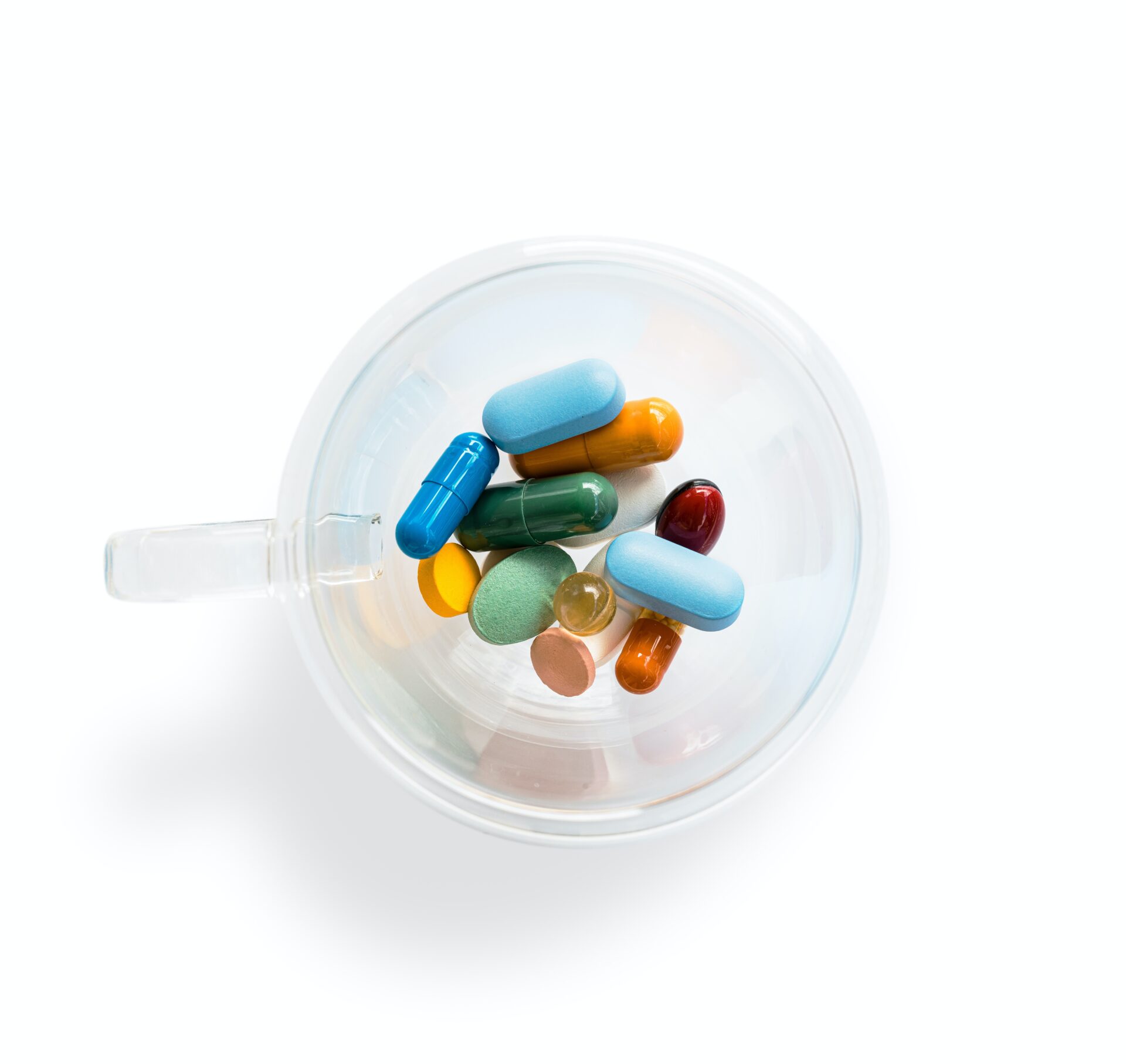
Some people diagnosed with glaucoma, or told they have ocular hypertension, have contraindicated drugs (medicines they cannot use or take).1。
You may be asked whether you have glaucoma when you see a doctor outside ophthalmology, or before tests and surgery.
In practice, most people have no problem.
Many people told they have glaucoma have “open-angle glaucoma.” In this case, many drugs are not contraindicated (though there are precautions for each drug).
Whether you have “angle-closure glaucoma”is what matters.2。
(Japanese reading: heisoku-gukaku ryokunaisho)
In the August 2019 revision of package inserts, the contraindication for drugs with anticholinergic action was narrowed from “glaucoma” as a whole to “angle-closure glaucoma”1. The basic approach is to know your own angle type and to ask your doctor or pharmacist whether you can actually use a given drug.
Open or closed? It is judged by the state of the angle, the drainage pathway for fluid in the eye
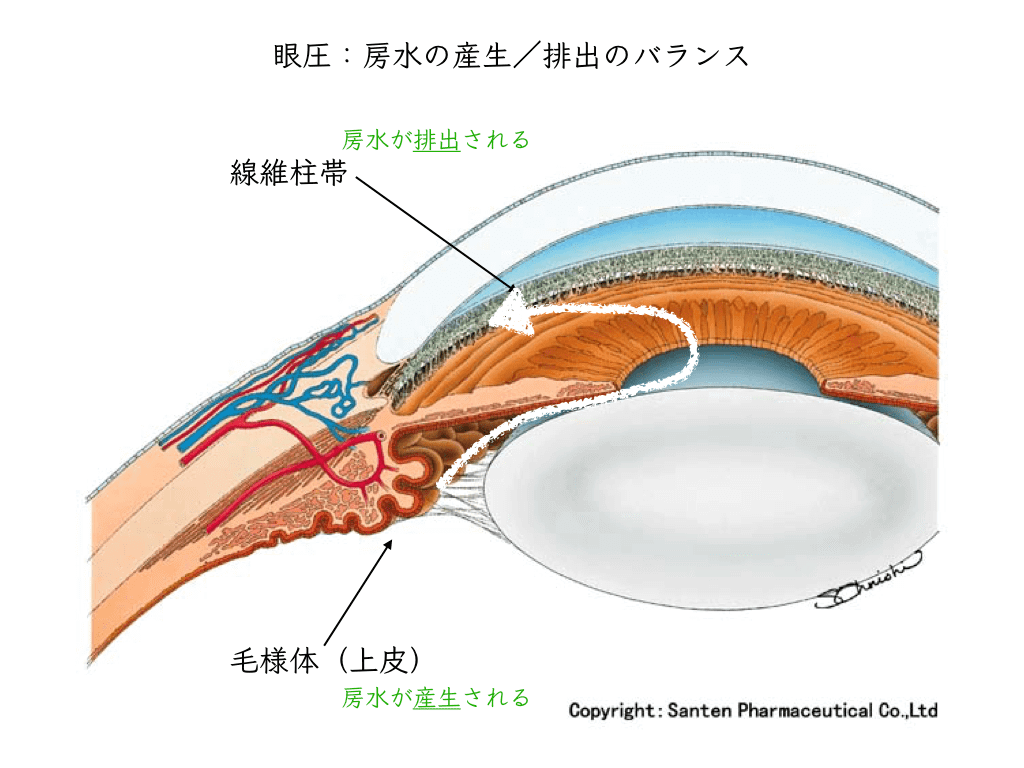
Inside the eye, the clear fluid called aqueous humor is made by the ciliary body and drains through the angle, located at the base of the iris (the colored part). The balance between production and drainage of aqueous humor determines eye pressure.
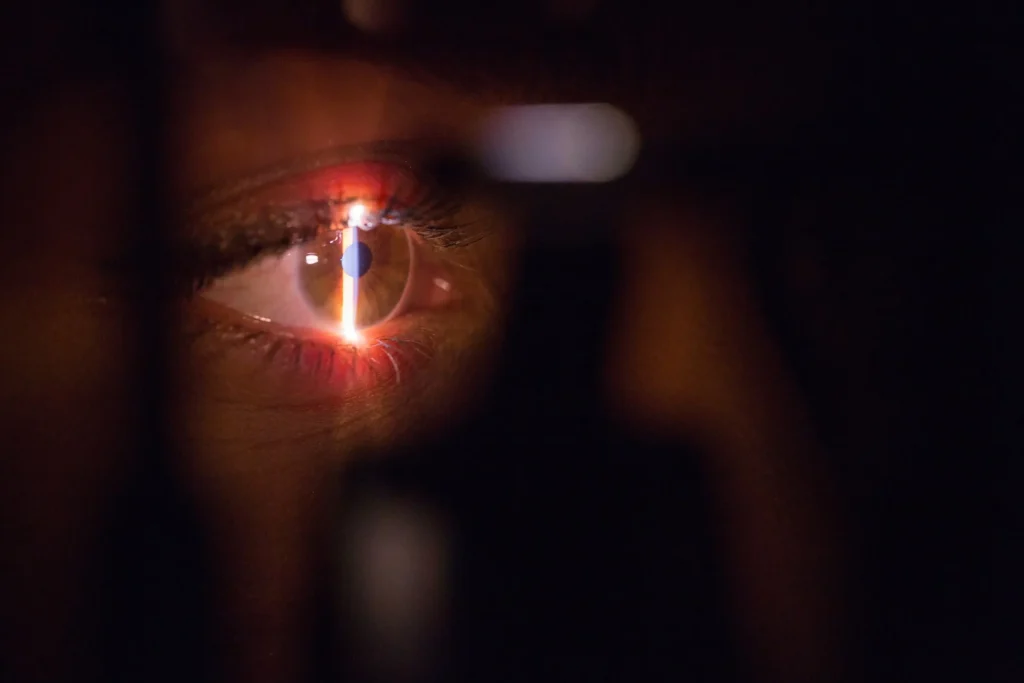
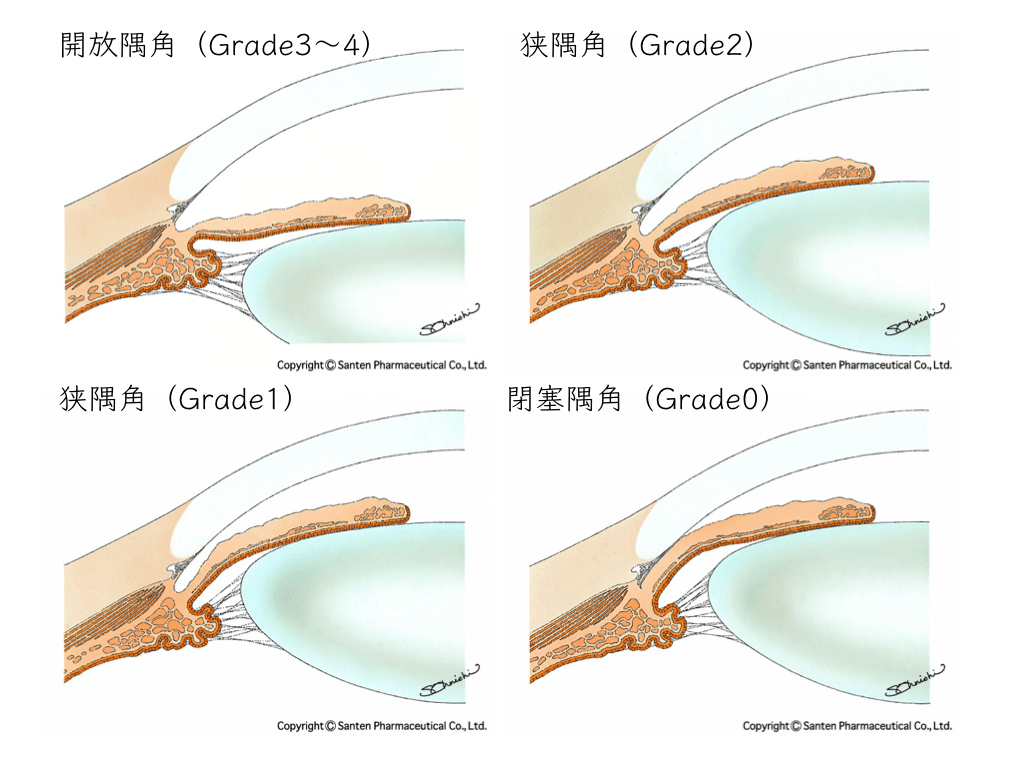
A state between an open angle and a closed angle is called a “narrow angle.”
A narrow angle also causes no symptoms.
The angle is like a drain outlet in a sink. In people whose drain outlet is narrow from the start, when the pupil dilates (mydriasis), the base of the iris blocks the outlet, the exit for aqueous humor closes, and eye pressure rises suddenly.
Drugs with anticholinergic action and sympathomimetic drugs act in the direction of dilating the pupil. In people with a narrow angle, they can trigger an acute glaucoma attack.
In open-angle glaucoma, on the other hand, where the angle is wide open, the outlet is not blocked even when the pupil dilates. The same drug does not cause an attack by the same logic, so the contraindications change depending on the type of angle.
Even after an explanation at the examination, it is hard to remember your own condition.
To make sure there is no problem with medicines, tests or surgery, we have started giving you a small card to stick in your medication notebook.

Types of glaucoma
In terms of drug restrictions, glaucoma (and ocular hypertension) can be divided into two broad groups based on the structure of the eye.
1. Open-angle glaucoma
- Primary open-angle glaucoma (in the broad sense)
- Normal-tension glaucoma
- Ocular hypertension
- Preperimetric glaucoma
Most people fall into this group.
In open-angle glaucoma, anticholinergic drugs and others are not uniformly contraindicated.
However, precautions differ by drug, so please do not stop or take medicines on your own; check with your doctor or pharmacist.
In the Tajimi Study of people aged 40 and over, the prevalence of glaucoma overall was 5.0%3,4. Of this, open-angle glaucoma (including normal-tension glaucoma) was 3.9% and primary angle-closure glaucoma 0.6%. In Japan, open-angle glaucoma is more common than angle-closure glaucoma. However, even a narrow angle or suspected primary angle closure that has not been diagnosed as glaucoma may call for drug restrictions.
In the package inserts, open-angle glaucoma falls under “use with caution (patients with specific backgrounds)”1. This does not mean the drug cannot be used; it means that the drug is prescribed after you tell the prescriber your angle type.
2. Angle-closure glaucoma
- Primary angle-closure glaucoma (PACG)
- Primary angle closure (PAC)
- Primary angle closure suspect (PACS)
Even if you have not been diagnosed with glaucoma, angle closure or an untreated narrow angle makes you subject to the contraindicated drugs2。
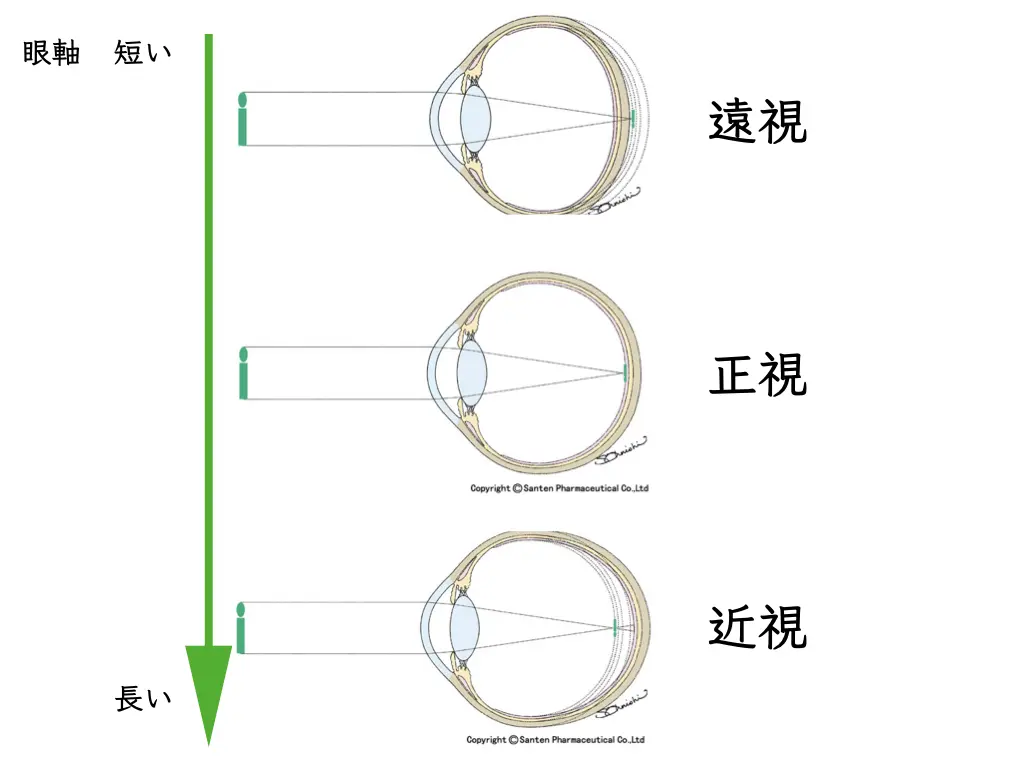
What to be careful about is knowing whether you have “good eyesight” (a tendency toward farsightedness). This does not mean that good vision is safe; whether the angle is narrow cannot be judged from uncorrected visual acuity alone.
People with “good eyesight” often have farsighted eyes, and may have the narrow-angle state described above5。
(= the drainage pathway for aqueous humor in the eye is relatively narrow)
If you use the drugs below, eye pressure may rise and cause an acute glaucoma attack.
* As needed, we follow patients with anterior segment OCT.
Classification is made with a slit-lamp microscope and gonioscopy5。
Other types include secondary glaucoma (uveitis; after cataract surgery, vitrectomy or corneal transplantation; steroids; neovascularization associated with diabetic retinopathy or retinal vein occlusion) and childhood glaucoma (formerly “developmental glaucoma”)5. Because handling differs by cause, we explain this at the examination.
For all glaucoma, we record the classification in the medical chart.
If anything is unclear, please ask at any time.
Drugs that are contraindicated or need caution in angle-closure glaucoma, and drugs that affect glaucoma (table)
✔ Anticholinergic action, sympathomimetic action, etc.
The following are examples of types of drugs; they do not mean that every product is contraindicated. Even within the same drug class, handling differs by ingredient, so the final judgment is made from each product’s package insert.
This was prepared by checking the package inserts (electronic package inserts posted by PMDA) as of September 3, 20266. It gives representative examples and does not cover every drug.
A drug not in the table is not necessarily safe. Likewise, a drug in the table cannot necessarily not be used.
Please consult your doctor or pharmacist for the final decision.
| Drug class / representative drugs | Package insert statement / type for which it is contraindicated | Why caution is needed |
|---|---|---|
| Antispasmodics (peptic ulcer drugs, for abdominal pain) Buscopan®(butylscopolamine) | Contraindicated: “patients with angle-closure glaucoma”; for open-angle, listed as a specific background → Angle-closure | Anticholinergic action dilates the pupil and closes the angle. Also used as premedication for endoscopy |
| Drugs for urination disorders (overactive bladder) Vesicare®(solifenacin) and other anticholinergic drugs | Contraindicated: “patients with angle-closure glaucoma” → Angle-closure | Anticholinergic action. “Acute glaucoma attack” is listed as a serious side effect |
| Antihistamines (first generation) Polaramine®(d-chlorpheniramine), diphenhydramine, clemastine | Contraindicated: “patients with angle-closure glaucoma”; for open-angle, listed as a specific background → Angle-closure | Anticholinergic action. Widely included in over-the-counter cold medicines, rhinitis medicines, cough medicines and motion-sickness medicines |
| Antihistamines (second generation) Allegra®(fexofenadine),Xyzal®(levocetirizine) and others | No mention of glaucoma → Not applicable | Weak anticholinergic action, and glaucoma is not mentioned in the package insert. Often chosen for hay fever |
| Antiparkinson drugs (anticholinergics) Artane®(trihexyphenidyl) | Contraindicated: “patients with angle-closure glaucoma”; for open-angle, listed as a specific background. Regular angle and eye pressure checks are desirable during use → Angle-closure | Anticholinergic action. Angle-closure glaucoma has been reported with long-term use |
| Antidepressants (tricyclic) Tryptanol®(amitriptyline) | Contraindicated: “patients with angle-closure glaucoma”; for open-angle, listed as a specific background → Angle-closure | Anticholinergic action |
| Antidepressants (SNRI) Cymbalta®(duloxetine) | Contraindicated: “patients with poorly controlled angle-closure glaucoma”; “patients with glaucoma or raised intraocular pressure” listed as a specific background → Angle-closure (poorly controlled) | Pupil dilation and rise in eye pressure have been reported |
| Anxiolytics and hypnotic sedatives (benzodiazepines) Depas®(etizolam) and others | Contraindicated: “patients with acute angle-closure glaucoma” → Acute angle-closure | Weak anticholinergic action |
| Antiarrhythmic drugs Rythmodan®(disopyramide) | Contraindicated: “patients with angle-closure glaucoma”; for open-angle, listed as a specific background → Angle-closure | Anticholinergic action |
| Angina drugs (nitrates) Nitropen®、Nitrol® | Contraindicated: “patients with angle-closure glaucoma” → Angle-closure | May raise eye pressure |
| Bronchodilators (inhaled anticholinergics) Spiriva®(tiotropium) | Contraindicated: “patients with angle-closure glaucoma.” Take care that the solution does not get into the eyes → Angle-closure | Even inhaled drugs can dilate the pupil and raise eye pressure if they get into the eyes |
| ADHD drugs Concerta®(methylphenidate),Strattera®(atomoxetine) | Contraindicated: “patients with angle-closure glaucoma” (for Concerta®, open-angle is listed as a specific background) → Angle-closure | Pupil dilation and rise in eye pressure due to sympathomimetic action |
| Mydriatics (ophthalmic eye drops) Midrin®-P(tropicamide and phenylephrine) | Contraindicated: “patients with glaucoma, or with predisposing factors for raised eye pressure such as a narrow angle or shallow anterior chamber” → Glaucoma in general and narrow angle (not limited to angle-closure) | A mydriatic used for examinations. Check the angle before using it ahead of a fundus examination |
| Vasoconstrictor eye drops Privina® eye drops(naphazoline) and over-the-counter eye drops containing a redness-relieving ingredient | Contraindicated: “patients with angle-closure glaucoma” → Angle-closure | Adrenergic action dilates the pupil |
| Corticosteroids(oral, eye drops, nasal, inhaled, topical) Predonine®(prednisolone) and others | Not contraindicated. “Patients with glaucoma” are listed as a specific background. Continued use can raise eye pressure and cause glaucoma (a serious side effect) → Caution regardless of type | “Steroid glaucoma,” in which resistance to the outflow of aqueous humor increases. If you use steroids, have your eye pressure checked regularly |
| Topiramate(antiepileptic; migraine prevention) Topina® | Not contraindicated. “Acute myopia with secondary angle-closure glaucoma” (most often within 1 month of starting) → Can occur even in people with a wide angle (secondary) | Swelling of the ciliary body moves the lens forward and closes the angle. If you have sudden loss of vision or eye pain, contact an eye doctor and your prescriber immediately. Whether to continue or stop is up to the prescriber |
Source: electronic package inserts of each drug (PMDA, checked September 3, 2026)6。
If, after taking a drug, you have sudden severe eye pain, headache, blurred vision, rainbow halos around lights, nausea or vomiting, or red eye, it may be an acute glaucoma attack. Contact an eye clinic or emergency medical facility immediately.
The cold medicines, cough medicines, motion-sickness medicines and low-blood-pressure drugs listed in the earlier article also need caution, because they contain one of the ingredients in the table above. The relevant ingredients are first-generation antihistamines, anticholinergics, sympathomimetics and benzodiazepines.

Can I take Loxonin®, Calonal® or Ibu®?
This is the most searched question about “drugs that cannot be used with glaucoma.”
Pain relievers and fever reducers such as loxoprofen (Loxonin®), acetaminophen (Calonal®) and ibuprofen have no anticholinergic action themselves, and glaucoma is not mentioned in their package inserts6. Loxonin® tablets and Loxonin® S containing loxoprofen alone are not contraindicated because of glaucoma.
The over-the-counter “Loxonin® S,” “Loxonin® S Plus,” “Loxonin® S Premium,” “Loxonin® S Premium Fine,” “Calonal® A” and “Tylenol® A” also carry no warning about glaucoma.
However, “Loxonin® Comprehensive Cold Medicine” is a different product. It contains an antihistamine ingredient (clemastine) and a sympathomimetic ingredient (dl-methylephedrine), and “glaucoma” is listed in its “consult before use” section.
Even under the same brand name, products called “cold medicine” or “rhinitis medicine” have different ingredients. Check the ingredient list on the back of the package.
* Calonal®: it has no anticholinergic action, so it is not contraindicated in glaucoma.
Over-the-counter drugs that need caution
The instructions of over-the-counter drugs have “Do not use” and “Consult before use” sections. If they say “people diagnosed with glaucoma,” the product may contain an ingredient with anticholinergic or sympathomimetic action.
These are examples checked as of September 2026.
| Type of over-the-counter drug | Product examples | Category in the instructions | Relevant ingredients |
|---|---|---|---|
| General cold medicines | Pabron® Gold A, Loxonin® Comprehensive Cold Medicine, etc. | Consult before use: “glaucoma” | Chlorpheniramine, clemastine (antihistamines), methylephedrine (sympathomimetic) |
| Cough medicines (antitussives and expectorants) | Shin-Bron® Liquid Ace, etc. | Consult before use: “glaucoma” | Chlorpheniramine, dihydrocodeine |
| Motion-sickness medicines (antivertigo drugs) | Travelmin® | Do not use“People diagnosed with glaucoma” | Diphenhydramine |
| Rhinitis medicines (oral) | Products combining a first-generation antihistamine with pseudoephedrine | Consult before use: “glaucoma” | Chlorpheniramine, pseudoephedrine |
| Fever reducers and pain relievers (examples with no mention of glaucoma) | Loxonin® S, Calonal® A, Tylenol® A, Ibu® A tablets, etc. | No mention of glaucoma | Not applicable |
| Redness-relieving eye drops | Products combining naphazoline and tetrahydrozoline | Consult before use: “glaucoma” (depending on the product) | Vasoconstrictor ingredient (pupil-dilating action) |
Source: package inserts of each over-the-counter drug (checked September 3, 2026)6。
“Consult before use” does not mean “cannot use”; it means telling your pharmacist your angle type and asking for advice. People with open-angle glaucoma can in many cases buy the product as it is by showing their glaucoma card.
People with angle-closure or an untreated narrow angle can feel safer choosing, together with a pharmacist, products with different ingredients (second-generation antihistamines, single-ingredient pain relievers, etc.).
After cataract surgery or laser iridotomy
Even with angle-closure or a narrow angle, once laser iridotomy or cataract surgery (lens removal) has been done, it is said that there are no restrictions on glaucoma-contraindicated drugs2。
. This is because when a thickened lens had been blocking the flow of aqueous humor, replacing it with a thin intraocular lens widens the angle. However, judgment changes depending on the drug and on the state of the angle after surgery, so check with your doctor.
Also, because the type can change over the years, it is recommended to check the state of the angle with an eye examination about once a year2。
Symptoms of an acute glaucoma attack, and what to do if one occurs
Using a contraindicated drug does not mean an attack will always occur. If one does, however, the optic nerve can be damaged within hours to days.
If the following symptoms appear after taking a drug or after a dilated examination, see an eye doctor the same day, or the emergency room at night.
- Severe pain in one eye (or both), pain deep in the eye, red eye
- Severe headache, nausea and vomiting (these may be mistaken for a headache or a stomach illness)
- Sudden blurred vision, loss of vision, or rainbow-like rings around lights (halos)
When you visit, please bring something that shows the names of the drugs you took (your medication notebook or the package of the over-the-counter drug).
Cost and insurance: angle tests and the glaucoma card
The slit-lamp microscope examination, gonioscopy, eye pressure test and anterior segment OCT needed to judge the angle are all available under insurance. They are done as part of care for glaucoma or suspected glaucoma.
There is no charge for issuing a glaucoma card. If you are a patient of Takeru Eye Clinic, please ask at your next visit.
When to see us
- Same day (urgent): Eye pain, headache, nausea or sudden blurred vision appeared after using a drug.
- Within the next few days: You have been told you have “glaucoma,” “suspected glaucoma” or a “narrow angle” but do not know your angle type. Another department told you to “have it checked at an eye clinic.” You do not have a glaucoma card.
- Check at a regular visit: People whose angle was last assessed several years ago or more. People aged 60 and over who are farsighted.
At Takeru Eye Clinic (Takatori Shopping Street, Sawara Ward, Fukuoka), we assess the angle and issue glaucoma cards as part of glaucoma care. If you are concerned, please feel free to ask anything at your examination.
Glaucoma symptoms, tests and treatment (Takeru Eye Clinic)|About reservations
Frequently asked questions (FAQ)
How can I check whether the medicines I am taking now are OK?
There are three ways to check.
(1) Take your medication notebook to the pharmacy and ask the pharmacist to check, telling them “my glaucoma type is ○○.”
(2) Look up the drug name in the PMDA package insert search and check whether “angle-closure glaucoma” or “open-angle glaucoma” is mentioned in the “2. Contraindications” and “9. Precautions for patients with specific backgrounds” sections.
(3) Have your angle type assessed at an eye clinic and make a glaucoma card.
Please do not stop medicines on your own judgment.
If I have open-angle glaucoma, can I take cold medicine?
In open-angle glaucoma, antihistamine and other ingredients in cold medicines are not uniformly contraindicated. However, precautions differ by product, so tell the pharmacist “I have open-angle glaucoma” and choose after checking the ingredients. People with angle-closure or a narrow angle need to choose products with different ingredients.
Do I need to be careful with over-the-counter drugs too?
Yes. General cold medicines, rhinitis medicines, cough medicines and motion-sickness medicines often contain first-generation antihistamines or sympathomimetic ingredients, and “glaucoma” is written in the “Do not use” or “Consult before use” section of the instructions. When you buy, tell the pharmacist or registered salesperson your angle type.
Can I take Loxonin® or Calonal® with glaucoma?
Single-ingredient loxoprofen, acetaminophen and ibuprofen have no mention of glaucoma in their package inserts. However, products that contain an antihistamine under the same brand name, such as “Loxonin® Comprehensive Cold Medicine,” have glaucoma in their “Consult before use” section. Check the ingredient list.
I have open-angle glaucoma, but when I said “glaucoma” I was not given the medicine.
Before the 2019 package insert revision, “glaucoma” as a whole was a contraindication, so judgments are sometimes still made with the knowledge of that time. Today, open-angle glaucoma is “use with caution.” If you stick in your medication notebook a glaucoma card showing your angle type as assessed at an eye clinic, the prescriber can judge on the spot.
What if I was only told “suspected glaucoma” or “narrow angle”?
For “suspected open-angle glaucoma (only a concern about the shape of the optic nerve),” there are usually no drug restrictions. On the other hand, a “narrow angle” or “primary angle closure suspect” is, if untreated, subject to the contraindicated drugs even if glaucoma has not been diagnosed. Check at an eye clinic which one applies to you.
If I have had cataract surgery, can I stop worrying?
If the angle has been opened by surgery, the restrictions are said to be lifted. However, it is reassuring to have the state of the angle after surgery checked once at an eye clinic and have your glaucoma card updated to “surgery done, no restrictions.”
Can I use hay fever medicines?
Second-generation antihistamines such as Allegra® (fexofenadine) and Xyzal® (levocetirizine) have no mention of glaucoma in their package inserts. Over-the-counter rhinitis medicines may contain first-generation antihistamines or pseudoephedrine, so check the ingredients.
Are steroid eye drops and inhalers also related to glaucoma?
Yes. Regardless of the type of angle, some people have a rise in eye pressure when steroids are used continuously (steroid responders). It occurs most often with eye drops, and has also been reported with oral, inhaled, nasal and topical (skin) steroids. If you have glaucoma and use steroids, tell the prescribing doctor that you have glaucoma and have your eye pressure measured regularly.
Why am I asked whether I have glaucoma before surgery or endoscopy?
Because the premedication for endoscopy (Buscopan®) and some anesthetic drugs include anticholinergics. For people with angle-closure, another drug (such as glucagon) is chosen. If you have a glaucoma card, the interview goes more smoothly.
I accidentally took a contraindicated drug. What should I do?
A single dose does not always cause an attack. Even if you have no symptoms, consult your prescriber or pharmacist before taking any more. If you have symptoms such as eye pain, headache, nausea, blurred vision or rainbow halos, go to an eye clinic or the emergency room immediately.

We believe that controlling myopia in children also leads to preventing glaucoma in the future (30 years later and beyond).

References and primary sources (checked: September 3, 2026)
- Ministry of Health, Labour and Welfare, Pharmaceutical Safety Division. Revision of the “Precautions for Use” in package inserts concerning the contraindication of “glaucoma” for drugs with anticholinergic action. June 18, 2019 (in Japanese). https://www.pmda.go.jp/files/000229974.pdf/ Same. Revision of “Precautions for Use” (102 products). August 5, 2019 (in Japanese). https://www.mhlw.go.jp/content/11121000/000534726.pdf
- Japan Ophthalmologists Association and Japan Glaucoma Society. Anticholinergic drugs and glaucoma (explanation of the glaucoma contact card). Revised June 2023 (in Japanese). https://gankaikai.or.jp/info/glaucoma_information_card.pdf
- Iwase A, Suzuki Y, Araie M, et al. The prevalence of primary open-angle glaucoma in Japanese: the Tajimi Study. Ophthalmology. 2004;111(9):1641-1648. https://doi.org/10.1016/j.ophtha.2004.03.029
- Yamamoto T, Iwase A, Araie M, et al. The Tajimi Study report 2: prevalence of primary angle closure and secondary glaucoma in a Japanese population. Ophthalmology. 2005;112(10):1661-1669. https://doi.org/10.1016/j.ophtha.2005.05.012
- Japan Glaucoma Society, Glaucoma Clinical Practice Guidelines Revision Committee. Glaucoma Clinical Practice Guidelines (5th edition) (in Japanese). Journal of the Japanese Ophthalmological Society. 2022;126(2):85-177. https://www.nichigan.or.jp/Portals/0/resources/member/guideline/glaucoma5th.pdf
- Pharmaceuticals and Medical Devices Agency (PMDA). Package inserts (electronic) for prescription and over-the-counter drugs: Buscopan tablets, Vesicare tablets, Polaramine tablets, Allegra tablets, Xyzal tablets, Artane tablets, Tryptanol tablets, Cymbalta capsules, Depas tablets, Rythmodan capsules, Nitropen sublingual tablets, Nitrol tablets, Spiriva Respimat, Concerta tablets, Strattera capsules, Midrin-P ophthalmic solution, Privina ophthalmic solution, Predonine tablets, Topina tablets, Loxonin S / S Plus / S Premium / S Premium Fine, Loxonin Comprehensive Cold Medicine, Calonal A, Tylenol A, Pabron Gold A, Shin-Bron Liquid Ace, Travelmin (checked September 3, 2026) (in Japanese). https://www.pmda.go.jp/PmdaSearch/iyakuSearch/
Revision history
- September 3, 2026: Stated that the August 2019 package insert revision narrowed the contraindication to “angle-closure glaucoma.” Added the table by drug class, the over-the-counter drug table and the FAQ. Added steroids, topiramate, ADHD drugs and handling after surgery. Corrected the old statement that “over-the-counter Loxonin contains an antihistamine” to “Loxonin Comprehensive Cold Medicine is a separate product.” Updated the reference to the Glaucoma Clinical Practice Guidelines, 5th edition. Deleted the old statement about visual field testing. Same day, after an external review, second edition: softened the wording on open-angle, added notes by drug class and a box on what to do in an acute attack, added the FAQ “If I have open-angle glaucoma, can I take cold medicine?”, added links to package inserts (KEGG MEDICUS) for representative drugs, and simplified the description of secondary and childhood glaucoma. Third edition: changed the table headings, deleted the estimate of “about 10%,” compressed the drug table into 3 columns, unified the wording on stopping medicines yourself, and displayed the last update date at the top.
- November 25, 2019: First published.


 ポチップ
ポチップ