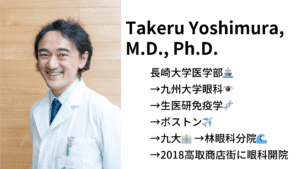
![Takeru Eye Clinic | Takatori Shopping Street, Sawara-ku, Fukuoka City [Nishijin Station / Fujisaki Station]](https://takeru-eye.com/wp-content/uploads/2022/10/takeru_logo_for-WP-header.png)

Preventive medicine in ophthalmology has become the center of my practice in Takatori.
Eye diseases often have no subjective symptoms.
Even while treating advanced eye disease, I keep in mind the importance of preventive medicine.
About the “Eye Dock” (comprehensive eye exam): early detection of eye diseases without subjective symptoms
Over the year I read a wide range of papers (I introduce them from time to time in the “Latest articles” section).
Based on the way of thinking in immunology, I build a treatment approach suited to the community.
Preventive medicine in ophthalmology: practice suited to the community (update)
We have finished this year’s consultations and it is now New Year’s Eve.
Many people helped us again this year. Thank you very much.
We listen to our patients and take time over each consultation.
○ Early detection of glaucoma (especially after age 40)
→ So that no visual field abnormality is noticed throughout life
About the “optic nerve” inside the eye (screening)
Early detection of glaucoma: how to self-check (three methods)
○ Myopia control in children (elementary to junior high school)
→ Preventing retinal disease and glaucoma decades later
Myopia control (prevention)
○ Early detection of amblyopia (from age 3 until before entering elementary school)
→ There is a time limit for developing the brain’s ability to process the image formed on the retina
“Amblyopia in children” can be detected early
The difference between “amblyopia” and “low vision”
○ Early detection of retinal disease associated with systemic disease (diabetes, especially after age 40)
→ Advances in medical devices now let us detect even subtle changes
OCT angiography (optical coherence tomography angiography)
○ Management of uveitis (it is often associated with systemic diseases such as Behçet’s disease, sarcoidosis, and rheumatoid arthritis)
→ Care and follow-up by a physician experienced in uveitis, in cooperation with the Kyushu University Ophthalmology uveitis clinic
We treat uveitis.
○ Quantifying and graphing eye strain (children to all ages)
→ The time spent looking at digital devices has become longer
Lost productivity from eye strain is a large loss
[The 20-20-20 rule] Keeping “digital eye strain” away with the Pomodoro technique
Blue light and digital eye strain
○ Allergic conjunctivitis / hay fever (children to all ages)
→ Lower productivity from itchy eyes
Early antihistamine eye drops suppress onset and progression to severe disease
Depending on symptoms and severity, we consider steroid and immunosuppressant eye drops
Evidence for “preventive treatment of hay fever (initial therapy)”
○ Corneal opacity after epidemic keratoconjunctivitis (“pink eye”)
→ Clouding of the black part of the eye can occur and sometimes remains for months to years
It is important to continue anti-inflammatory eye drops from the time symptoms are strong
Epidemic keratoconjunctivitis (“pink eye”): what to watch for after it heals
* Consultations in English are also available.
About the Takatori (Nishijin / Fujisaki) area of Sawara Ward:
• Characteristics of the population and the area:A “livable town”/ the old “temple town of Momiji Hachiman Shrine”
• Good transportation: easy to come and easy to cooperate with partner medical institutions
Patients come from Nishijin, Fujisaki, Takatori, Momochi, Shodai, Josai, Muromi, and other surrounding areas,
many on foot, by bicycle, or by public transportation.
(First-visit questionnaire results through December 2019: on foot 55%, bicycle 22%, subway 6%, bus 4%, private car 14%)
(1) Early detection of glaucoma
1 in 20 people aged 40 and over has glaucoma:
We always check the condition of the optic nerve in every patient who visits for any disease (an examination without dilating the pupil).
This year again, many people were found by chance to have (suspected) glaucoma.
We can find glaucoma at a very early stage because we can use excellent medical equipment.
“Cold hands and feet” and glaucoma: about Flammer syndrome
About the “optic nerve” inside the eye (screening)
Using OCT (optical coherence tomography), we measure the thickness of the optic nerve head and the retinal nerve fiber layer. At this point we judge whether glaucoma is suspected.
We make the judgment by combining the results of the tests needed, including evaluation of the angle (the drainage pathway of fluid in the eye) and visual field testing.
Glaucoma eye drops have advanced dramatically, and the image of glaucoma seems to be quite different from the old days.
I believe the basis of glaucoma treatment is to take appropriate action early to slow progression, so that no visual field symptoms appear over a lifetime.
When eye drops are judged no longer sufficient, surgery is considered: “glaucoma is not cured by surgery.”
Please do not worry excessively about the word “glaucoma.” We take time to explain each person’s condition and outlook.
(2) Children’s eyes (pediatric ophthalmology)
Our care is built on the following three pillars.
○ Congenital eye disease
Early detection from “something seems a little off” is important.
Follow-up of pediatric glaucoma, congenital cataract, strabismus, retinoblastoma, and retinopathy of prematurity
* When needed, we work mainly with Kyushu University Hospital Ophthalmology.
○ Amblyopia
It is sometimes not accurately detected at the 3-year-old checkup.
Starting treatment before entering elementary school is recommended.
○ Myopia
”I don’t want to wear glasses”: medical common sense has changed greatly compared with a few years ago.
→Myopia control (prevention)
Rising myopia and dry eye in elementary and junior high school students: introducing findings published this week
We examine children together with several certified orthoptists (ORT).
When needed, we also perform the classic refraction test that does not use machines (skiascopy / retinoscopy).
After a detailed evaluation with atropine and cycloplegic (cyclopentolate) eye drops, we also fit appropriate glasses.
Because the tests take time, we sometimes ask you to come in several times.
It is important not to miss the right timing for testing and treatment.
The work of orthoptists / pediatric ophthalmology and low vision
“Amblyopia in children” can be detected early
Myopia and refractive error:
With heavy use of digital devices, the myopic population is expected to grow further:
Together with homework and long hours of study, my impression is that many children have near-focusing (accommodation) problems.
Rising myopia and dry eye in elementary and junior high school students: introducing findings published this week
About myopia: an introduction to a planned NHK broadcast
“The myopia boom”
If myopia progresses to high myopia, the risk of developing glaucoma and retinal degeneration in adulthood rises (pathologic myopia).
“For a long time humanity was almost defenseless against the progression of myopia, but in the 21st century we have finally begun to obtain ways to fight it.”(Dr. Nozomi Kinoshita, Jichi Medical University,1from the paper above)
Evidence for myopia control has been shown one after another recently, and I have read papers from around the world (from PubMed).
We can now also show an evidence-based “myopia progression prediction graph.”
For myopia control (prevention), we introduce methods with sufficient scientific evidence and no risk of side effects.
Spending more time playing outdoors is very important.2。
Based on the results of the accommodation analyzer (Accommoref®), we use low-dose atropine eye drops.
It has also been confirmed that diluting it 100-fold leaves almost no side effects.3。
I practice hoping that the myopia will be milder by the time the child has grown up.
Myopia and refractive error in children
Orthokeratology4(treatment program)
We consider thorough explanations that take time to be important.
Orthokeratology – Takeru Eye Clinic | Takatori Shopping Street, Sawara Ward, Fukuoka
For people who are not candidates for orthokeratology, we recommend the multifocal contact lenses (EDOF) we introduced last week.5。
(3) Retinal disease and uveitis
Inflammatory eye diseases such as diabetic retinopathy, age-related macular degeneration, uveitis, and retinal vein occlusion,
and myopic macular degeneration (pathologic myopia), among others
With OCT angiography, we assess the state of the retinal blood vessels.
Added 2021.8.29: The following is now available.
» Advances in retinal imaging: ultra-widefield fundus photography
Advances in imaging established a field named “medical retina,” and compared with over ten years ago, fewer diseases now require surgery.
This is the field I have pursued with the most passion since my studies at Kyushu University and abroad.
When needed, we work mainly with Kyushu University Ophthalmology.
Retinal laser treatment / why we inject medication into the eye
Ocular inflammation and uveitis
(4) Dry eye and corneal disease
Dry eye is thought to involve a vicious cycle of the ocular surface tear film triggered by inflammation.
For people with symptoms, we perform fluorescein staining and explain the state of the surface of each eye.
About dry eye: from the Journal of the Japanese Ophthalmological Society
Corneal diseases such as herpetic keratitis, keratitis, and corneal ulcer require a great deal of knowledge of infectious disease and immunology.
Bacterial staining (Gram stain) is also used as an adjunct to diagnosis, and I connect that knowledge to how I use antibiotics and steroids.
We also handle keratoconus care and hard contact lens prescriptions.
Using images, I sometimes consult corneal specialists at a distance.
(5) Appropriate glasses and contact lens prescriptions after evaluating the state of focusing
The accommodation analyzer shows the state of the muscle that focuses the eye (the ciliary muscle).
Using glasses or contact lenses that do not fit often seems to lead to tired eyes and eye strain.
“People with good eyesight are more prone to presbyopia”
Blue light and digital eye strain
“Smartphone esotropia” (an inward turning of the eyes from too much smartphone use)
With the help of orthoptists (ORT), we prescribe glasses and contact lenses suited to each person’s life.
In contact lens care, we always evaluate the corneal endothelial cells.
After age 40, abnormalities of the optic nerve are also often found by chance (see (1) above).
Seeing sheet music clearly with contact lenses
The meaning of getting contact lenses at an eye clinic
(6) About cataract
With aging, everyone develops clouding of the lens (cataract).
Surgery is often not needed,but it is also important to treat before it becomes quite advanced.
After a detailed examination, we judge whether treatment is indicated and explain it.
Whether it causes inconvenience in daily life, and the person’s own awareness of it, is the most important thing.
When needed, we refer directly to a physician who specializes in surgery.
The Reiwa era
Introducing a machine that can explain the “quality of vision”
(7) Low vision clinic (by appointment)
Low vision is defined as “visual acuity of 0.05 or more and less than 0.3, measured with corrective glasses worn in both eyes” (World Health Organization, WHO).
Even outside that definition, for symptoms such as difficulty seeing or glare,
we introduce visual aids such as magnifiers, loupes (made by Eschenbach), tinted (shading) glasses, typoscopes, handheld electronic magnifiers, and monoculars.
So far we have introduced visual aids to people with retinitis pigmentosa, microphthalmia, Leber hereditary optic neuropathy, (advanced) glaucoma, and macular degeneration (people I have followed for a long time).
The difference between “amblyopia” and “low vision”
Creating a comfortable space where people can visit at any time,
and being grateful for our excellent staff and everyone who helps us.
Thank you, always.
Efforts to avoid keeping patients waiting / in-clinic system configuration
Beyond the diseases listed above,
I want to be involved in the eye health of everyone in the community, from babies to adults and the elderly.
Please feel free to consult us at any time, even about small things.
I will also keep updating my own knowledge.
We look forward to your continued support.
* Please also use the parking lot behind the Fine Garden Takatori premises.
* It is on a narrow one-way street and a little hard to find, so please feel free to call us to ask.
* We have also made a map ofnearby coin parking lots.
(Reference)
1. Nozomi Kinoshita. 2019. Special issue: Myopia. Prevention of myopia progression with combined orthokeratology and low-concentration atropine eye drops. Shikaku no Kagaku (The Science of Vision), Vol. 40, No. 4
2. Wu, Pei-Chang, Chen, C.-T., Lin, K.-K., Sun, C.-C., Kuo, C.-N., Huang, H.-M., Poon, Y.-C., Yang, M.-L., Chen, C.-Y., Huang, J.-C., Wu, Pei-Chen, Yang, I.-H., Yu, H.-J., Fang, P.-C., Tsai, C.-L., Chiou, S.-T., Yang, Y.-H., 2018. Myopia Prevention and Outdoor Light Intensity in a School-Based Cluster Randomized Trial. Ophthalmology 125, 1239–1250. https://doi.org/10.1016/j.ophtha.2017.12.011
3. Wu, P.-C., Chuang, M.-N., Choi, J., Chen, H., Wu, G., Ohno-Matsui, K., Jonas, J.B., Cheung, C.M.G., 2019. Update in myopia and treatment strategy of atropine use in myopia control. Eye 33, 3–13. https://doi.org/10.1038/s41433-018-0139-7
4. Lipson, M.J., Brooks, M.M., Koffler, B.H., 2018. The Role of Orthokeratology in Myopia Control: A Review. Eye & Contact Lens: Science & Clinical Practice 44, 224–230. https://doi.org/10.1097/ICL.0000000000000520
5. Sankaridurg, P., Bakaraju, R.C., Naduvilath, T., Chen, X., Weng, R., Tilia, D., Xu, P., Li, W., Conrad, F., Smith, E.L., Ehrmann, K., 2019. Myopia control with novel central and peripheral plus contact lenses and extended depth of focus contact lenses: 2 year results from a randomised clinical trial. Ophthalmic Physiol Opt 39, 294–307. https://doi.org/10.1111/opo.12621