![Takeru Eye Clinic | Takatori Shopping Street, Sawara-ku, Fukuoka City [Nishijin Station / Fujisaki Station]](https://takeru-eye.com/wp-content/uploads/2022/10/takeru_logo_for-WP-header.png)
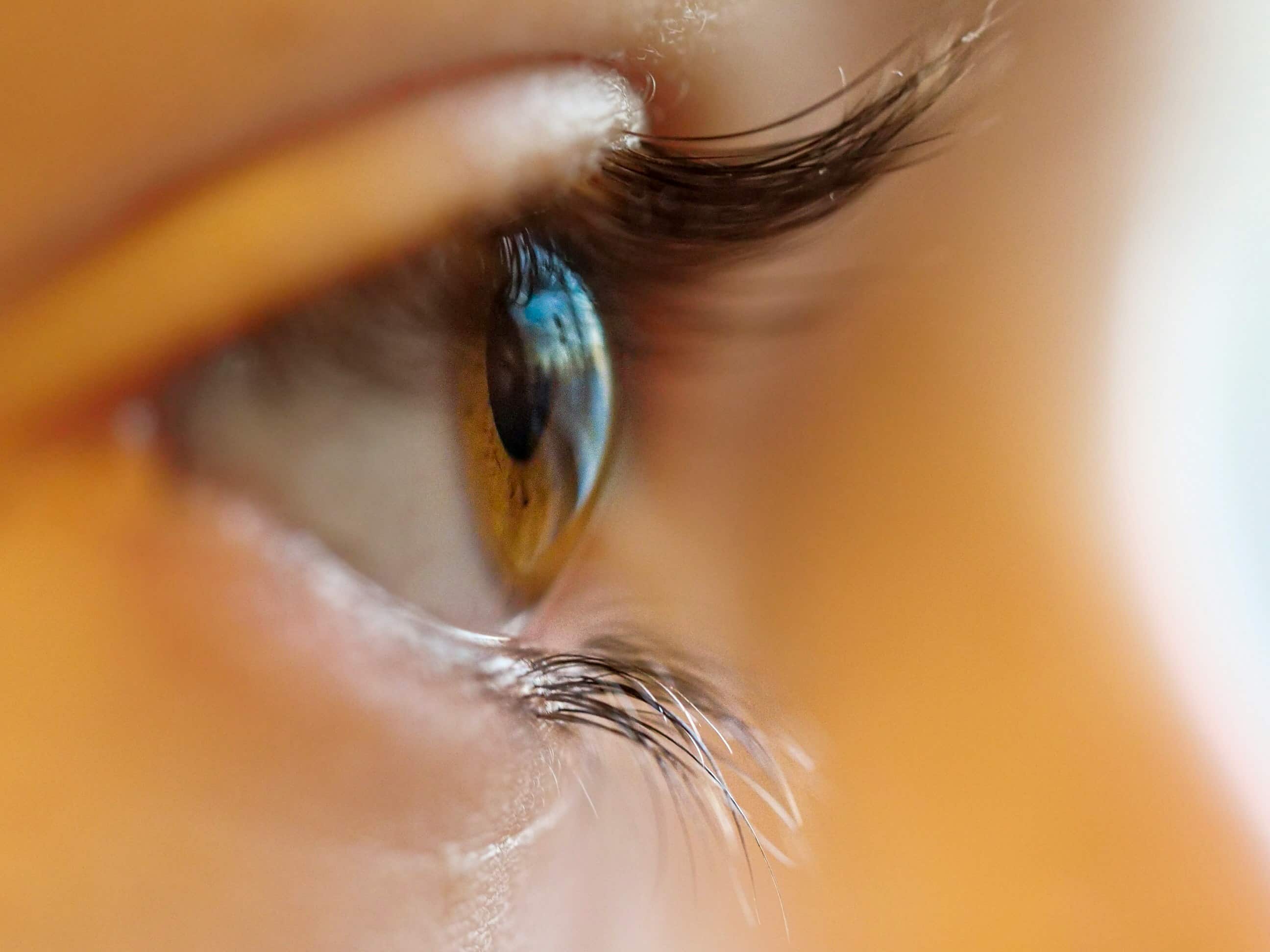
“Is it true that using contact lenses for many years will make my eyes worse in the future?”
Patients often ask me this in the examination room. Many people worry about present troubles such as redness and dry eye, but what we ophthalmologists are most concerned about, and consider most important, is actually the condition of the “corneal endothelial cells,” which almost no one is aware of.
Many of you may be hearing the term “corneal endothelium” for the first time.
Why is this cell, which declines quietly without pain and never returns once lost, so important, and why must it be checked closely at regular examinations? Let me explain the medical reasons.
A “fuel tank” that keeps the eye transparent
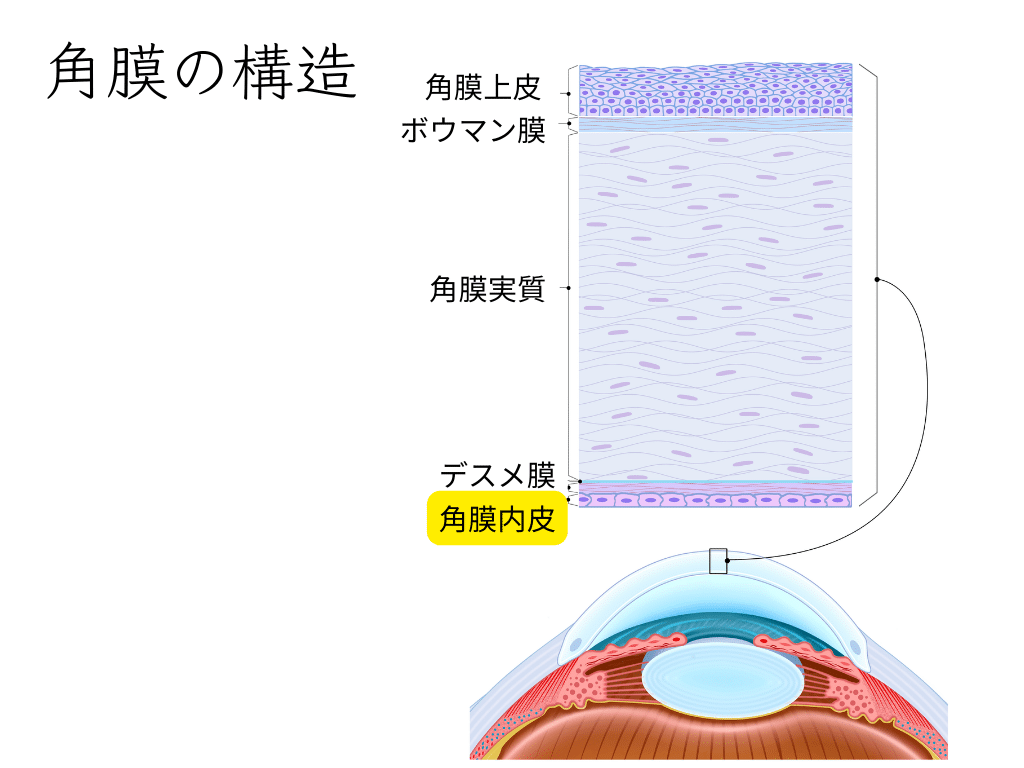
The cornea (the black part of the eye) must be transparent like a camera lens. To maintain this transparency, the “corneal endothelial cells” on the back surface of the cornea work as a pump that drains excess water.
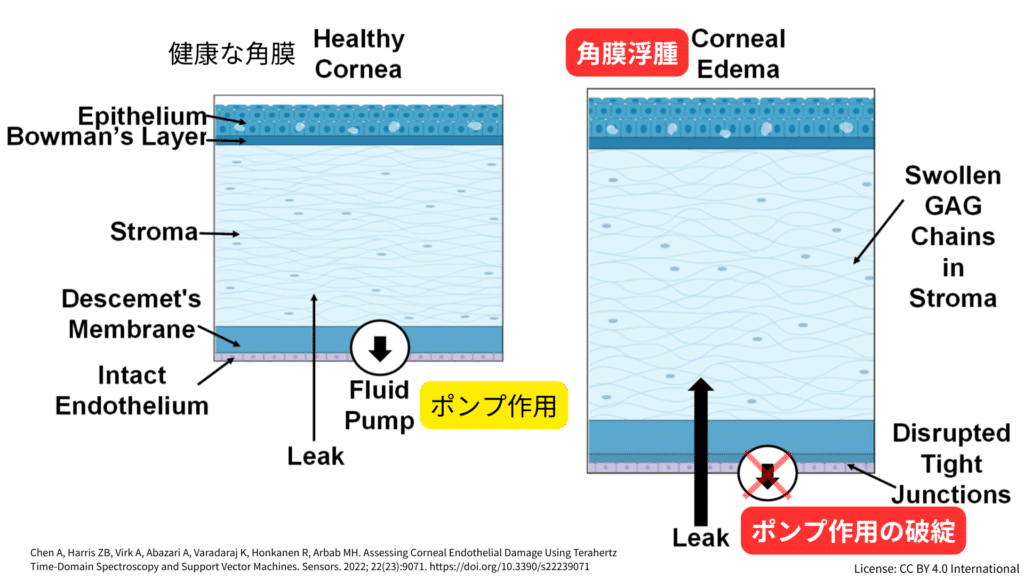
To put it simply, they are like a “tank holding a lifetime’s supply of fuel.”
These cells are most numerous at birth and decrease naturally little by little with age. Unfortunately, once they die, they never regenerate (divide).¹
The gauge of this fuel tank can go down, but it never goes up.
“Oxygen shortage” caused by contact lenses
Normally, the cornea breathes by taking in oxygen from the air. But when the cornea is covered with a contact lens, the oxygen supply inevitably decreases.
In particular, if you use lenses made of materials with low oxygen permeability, or repeatedly wear them for long hours or sleep in them, the cornea falls into a chronic “oxygen-deprived state (hypoxia).”
If this stress continues, the metabolism of the endothelial cells is disturbed, and in addition to the natural decrease with aging, an artificial decrease (a waste of fuel) is also accelerated.² ³
“The number hasn’t dropped, so it’s fine” is not the case
From here it gets a little technical, but it is a very important point.
When the number of cells decreases, the remaining surrounding cells spread out forcibly to fill the gaps. These states are called, in technical terms, as follows.
- Polymegathism: cells becoming uneven in size⁴
(Normal: 30% or less. At 35–40%, the corneal endothelial cells are assessed as unstable.) - Pleomorphism: the beautiful hexagonal shape breaking down⁵
(Normal: 60% or more. At 50% or less, long-term corneal endothelial damage is considered.)
In fact, it is not uncommon for such “decline in quality” to occur even when the cell density (number) is within the normal range. This is an early sign that the cornea is crying out under years of strain, and it has been reported that in long-term wearers these changes appear before a drop in cell density.⁴
Leaving a “savings account” for future surgery
You may think, “I can see now, so what’s the problem?”
But the true test of corneal endothelial cells comes when you are in your 60s or 70s and undergo “cataract surgery.”
Cataract surgery breaks up the clouded lens with ultrasound and aspirates it, and this procedure inevitably causes no small damage to the corneal endothelium.⁶
What if the cells’ “reserve capacity (savings)” has been used up through contact lens wear since youth?
In the worst case, the cornea cannot withstand the surgical damage and becomes cloudy white, a condition called “bullous keratopathy,” and there is even a risk that a corneal transplant is needed to regain vision.⁷
It is no exaggeration to say that choosing contact lenses now is directly linked to the safety of eye surgery decades from now.
Why we value the “endothelial examination”
To prevent such risks before they occur, when prescribing contact lenses we evaluate with “specular microscopy (corneal endothelial cell microscopy).”⁸
With general simple examinations, it is not rare for the visit to end with a visual acuity test alone. But that cannot capture changes in “cell quality,” and they are overlooked.
We want to put first, not merely prescribing lenses, but “protecting your future visual function.”
- Is the number (density) of cells sufficient?
- Are the cell shapes becoming irregular?
- Has the variation in size (coefficient of variation) increased?
We analyze these, and if signs of strain are seen, we may talk with you about changing to a silicone hydrogel material with high oxygen permeability or shortening wearing time.
It may seem “strict” at first glance, but all of this is our sincere wish to keep protecting your precious eyes for years to come.
In fact, it has been suggested that changing to high oxygen-permeable lenses reduces stress on the endothelium.⁹ ¹⁰
Summary: for your eyes 10 and 20 years from now
Contact lenses are very convenient medical devices, but if used incorrectly they can damage the corneal endothelium, the “silent organ.”
- Choose lenses with high oxygen permeability (silicone hydrogel)
- Keep to the wearing time and avoid forced continuous wear
- Have your endothelial cells checked regularly at an eye clinic
In particular, if you have used contact lenses for more than 10 years or wear them for long hours each day, I recommend checking the condition of the “corneal endothelial cells,” the asset of your eyes.
Having the right knowledge and facing your own eyes regularly leads to protecting your “power of sight” for life.
References
- Ono T, Mori Y, Nejima R, Iwasaki T, Miyai T, Miyata K. Corneal endothelial cell density and morphology in ophthalmologically healthy young individuals in Japan: An observational study of 16842 eyes. Sci Rep. 2021;11(1):18224. Published 2021 Sep 14. doi:10.1038/s41598-021-97776-5 https://pmc.ncbi.nlm.nih.gov/articles/PMC8440503/
- Liesegang TJ. Physiologic changes of the cornea with contact lens wear. CLAO J. 2002;28(1):12-27. https://pubmed.ncbi.nlm.nih.gov/11838985/
- Aljaberi HA, Rahmani S, Muhammad GA. Effect of soft contact lens wear on corneal endothelial cell characteristics. Cont Lens Anterior Eye. 2025;48(5):102441. doi:10.1016/j.clae.2025.102441 https://pubmed.ncbi.nlm.nih.gov/40383650/
- Mutwaly, Raghda Faisal Abdelfatah. “Corneal Endothelial Polymegathism and Pleomorphism Induced by Daily-Wear Soft Contact Lenses.” Cureus 16 (2024): n. pag. https://www.cureus.com/articles/319442-corneal-endothelial-polymegathism-and-pleomorphism-induced-by-daily-wear-soft-contact-lenses#!/
- Ono T, Sakisaka T, Nejima R, et al. Extended long-term effects of hard contact lens use on the corneal endothelium in healthy eyes: an observational study of 8604 eyes. Invest Ophthalmol Vis Sci. 2021. https://iovs.arvojournals.org/article.aspx?articleid=2780755
- Yang C, An Q, Zhou H, Ge H. Research progress on the impact of cataract surgery on corneal endothelial cells. Adv Ophthalmol Pract Res. 2024;4(4):194-201. Published 2024 Aug 8. doi:10.1016/j.aopr.2024.08.002 https://pmc.ncbi.nlm.nih.gov/articles/PMC11421245/
- Singh M, Mishra D, Sinha BP, Anand A, Singhal S. Corneal endothelial protection during manual small-incision cataract surgery: A narrative review. Indian J Ophthalmol. 2022;70(11):3791-3796. doi:10.4103/ijo.IJO_1048_22 https://pmc.ncbi.nlm.nih.gov/articles/PMC9907305/
- Rizzo GC, Di Grassi R, Ponzini E, Tavazzi S, Zeri F. Corneal Endothelial Microscopy: Does a Manual Recognition of the Endothelial Cells Help the Morphometric Analysis Compared to a Fully Automatic Approach? Vision. 2024; 8(4):64. https://doi.org/10.3390/vision8040064
- Hiu Yan Lam, Susie Jones, Nicola S Logan; Long-term impact of daily disposable hydrogel soft contact lens wear on corneal endothelium in children. Invest. Ophthalmol. Vis. Sci. 2024;65(7):6607. https://iovs.arvojournals.org/article.aspx?articleid=2799782
- Chiang, J. C. B., Tajbakhsh, Z., & Wolffsohn, J. S. (2024). The clinical impact of contact lens wear on neural structure and function of the cornea. Clinical and Experimental Optometry, 108(4), 408–418. https://doi.org/10.1080/08164622.2024.2401511 https://doi.org/10.1080/08164622.2024.2401511