![Takeru Eye Clinic | Takatori Shopping Street, Sawara-ku, Fukuoka City [Nishijin Station / Fujisaki Station]](https://takeru-eye.com/wp-content/uploads/2022/10/takeru_logo_for-WP-header.png)

We introduced a new instrument (July 17, 2026)
We switched to a new measuring device, the “OA-1,” which shows how many millimeters per year the axial length is growing (the speed of progression) as a slope, and lets us compare it with percentile curves for Japanese children (ages 4 to 15).
We introduced the optical coherence axial length measuring device “AL-Scan M” and the myopia management software “MV-1.”
- How far has the child’s myopia progressed?
- Is it away from the standard, and is it progressing faster or slower?
“What was your vision today?”
Uncorrected visual acuityis not a reliable measure of myopia progression.
Children have a strong ability to adjust focus, so uncorrected visual acuity fluctuates from one test to the next.
We sometimes use eye drops that cause glare, called “cycloplegics,” to measure the exact myopia power.
Another way to measure the degree of myopia progression is
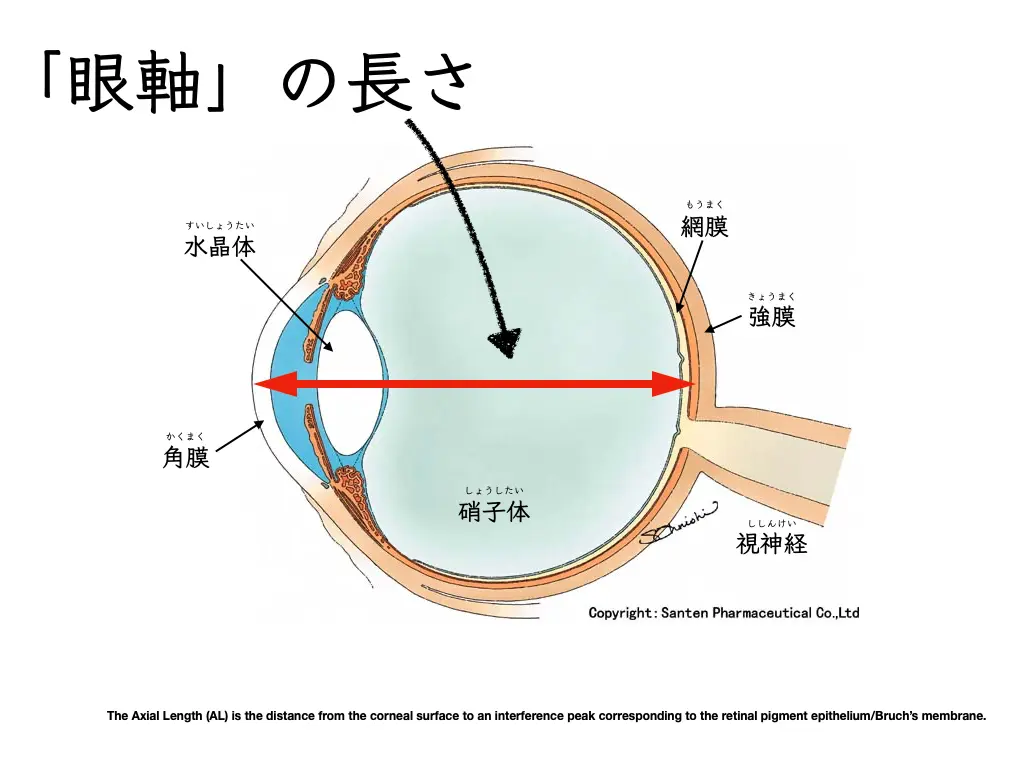
to measure the depth of the eyeball (theaxial length), which is important.
It can be measured instantly with a machine.
We measure the axial length every few months and plot it on a graph.
Until now, we entered the data by hand from a borrowed machine and made the graphs ourselves.
Now, by using NIDEK’s new machine “AL-Scan M” and the software “MV-1,”
- the child’s current degree of myopia
- and how fast the myopia is progressing compared with the standard
can be known.
Measuring the “Axial Length”: A Device for Managing Myopia Progression in Children
Myopia: Complications in Adulthood
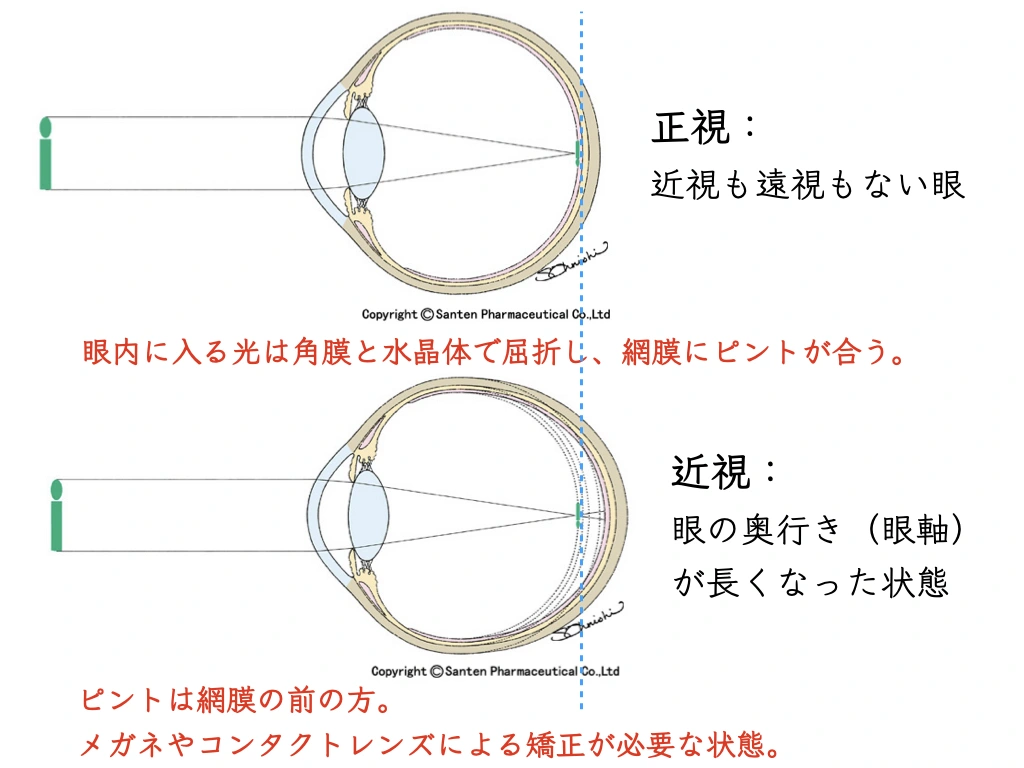
As a child grows taller,the axial lengthalso grows and myopia progresses.
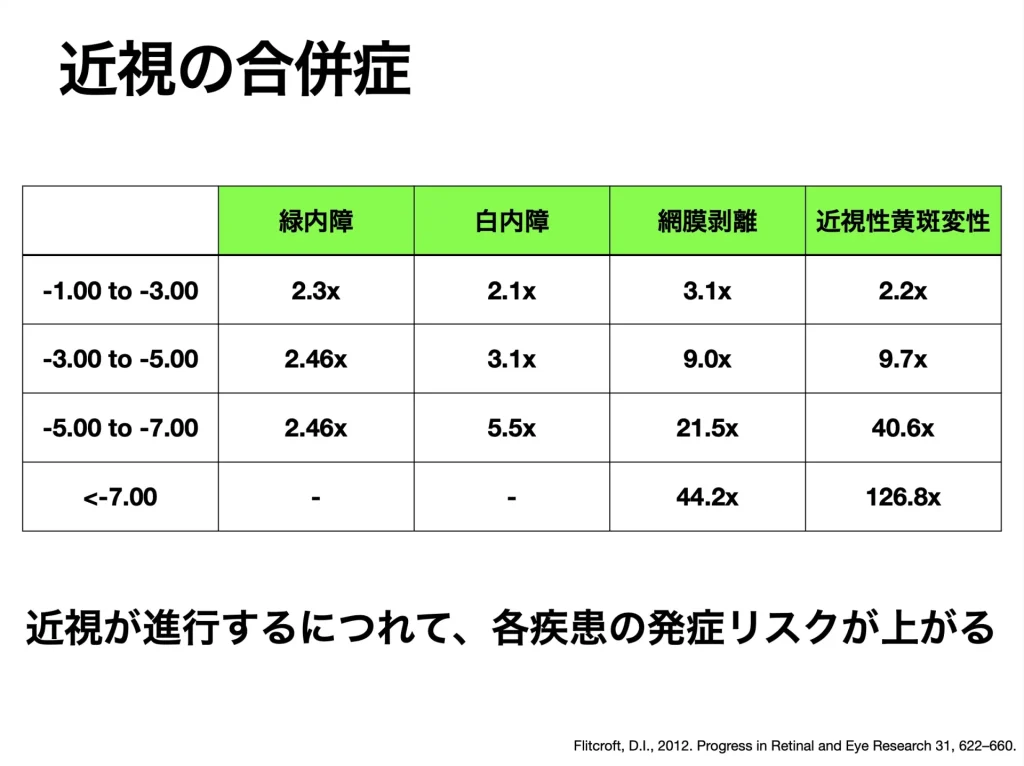
When children grow up and several decades pass, various diseases caused by myopia may appear.
A 2012 review summarized the complications of myopia.1。
And in a 2020 meta-analysis,
compared with emmetropia,
in high myopia of 6 D or more
・the risk of myopic maculopathy is 845 times higher
・retinal detachment is 12.6 times higher
・nuclear cataract is 2.87 times higher
and so on.
In addition, open-angle glaucoma is 2.92 times higher in moderate to high myopia (−3.00 D or less), and the risk of visual impairment with corrected visual acuity below 0.3 is about 5.5 times higher in moderate myopia and about 88 times higher in high myopia (all higher with older age, especially at 60 or over).2。
These diseases result in reduced corrected visual acuity.
(A state in which vision does not come out whatever lens is used or surgery is done.)
To prevent glaucoma, retinal detachment, myopic macular degeneration, and (early-onset) cataract:
keeping myopia from progressing as much as possible while the child is still young
is considered very important.3。
Two Indicators of Myopia Progression
How far has the child’s myopia progressed?
: there are two ways (indicators) to know accurately.
- Refraction (the eye’s power) after cycloplegic eye drops
- Axial length
Refraction (the eye’s power) after cycloplegic eye drops

An eye that is focusing strongly shows a stronger myopia power.
If glasses (or contact lenses) are prescribed as is, the prescription will be overcorrected.
: “glasses or contact lenses that are too strong”
Because children have a strong ability to adjust focus,
we sometimes carry out the test using cycloplegic drops such as Midrin® and Cyplegin®.
Midrin® leaves the eyes dazzled for 4 to 5 hours, and Cyplegin® for about 2 days.
The eye’s power after using a cycloplegic is an appropriate figure for judging the degree of myopia progression.
Axial length
Distance from the corneal epithelium to the retina:axial length
Measured instantly using an “optical coherence” mechanism.
The strength of myopia is proportional to the axial length.
The Degree of Myopia Progression: An Attempt to Create Standardized Graphs
Attempts are being made to standardize the degree of myopia progression.
A research group led by Dr. Tideman in the Netherlands measured the axial length of 12,386 people, mainly European children (children aged 6 to 15, plus about 2,957 adults aged 57 as a reference), and calculated standard (percentile) curves.4。
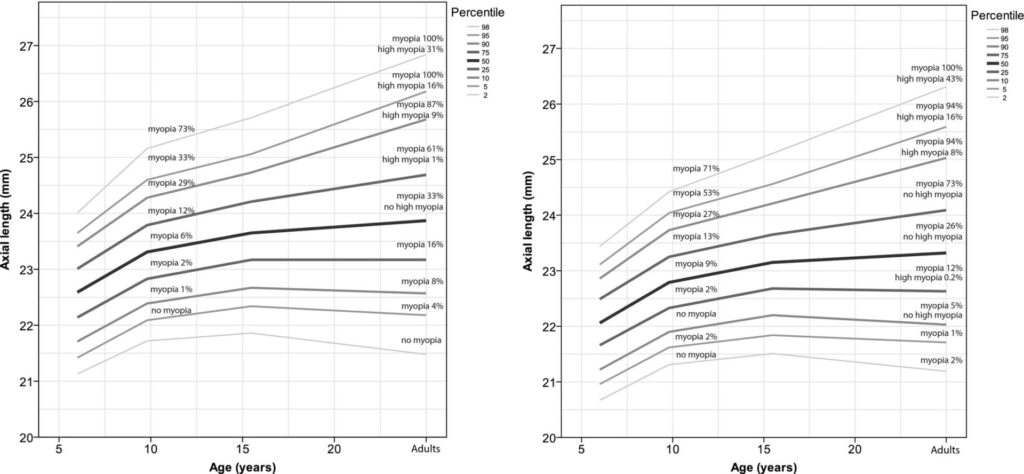
Age (horizontal axis) and axial length (vertical axis)
are shown as a graph for each age.
What the Myopia Progression Analysis Software MV-1 Can Do
The analysis software “MV-1” that comes with the axial length measuring device we introduced has
the research results of Dr. Tideman and colleagues4built in as data.
Axial length data obtained at each visit are then added to it.
Like a growth chart, it lets us see
・whether the child is away from the myopia standard
・whether myopia is progressing faster or slowing down
and so on.
Because the comparison group is European children, there are differences from Asians.
So it is best treated as a reference only.
We hand over the graph and share how things are progressing.
References
- Flitcroft, D.I., 2012. The complex interactions of retinal, optical and environmental factors in myopia aetiology. Progress in Retinal and Eye Research 31, 622–660. https://doi.org/10.1016/j.preteyeres.2012.06.004
- Haarman, A.E.G., Enthoven, C.A., Tideman, J.W.L., Tedja, M.S., Verhoeven, V.J.M., Klaver, C.C.W., 2020. The Complications of Myopia: A Review and Meta-Analysis. Investigative Ophthalmology & Visual Science 61, 49. https://doi.org/10.1167/iovs.61.4.49
- Tideman, J.W.L., Snabel, M.C.C., Tedja, M.S., van Rijn, G.A., Wong, K.T., Kuijpers, R.W.A.M., Vingerling, J.R., Hofman, A., Buitendijk, G.H.S., Keunen, J.E.E., Boon, C.J.F., Geerards, A.J.M., Luyten, G.P.M., Verhoeven, V.J.M., Klaver, C.C.W., 2016. Association of Axial Length With Risk of Uncorrectable Visual Impairment for Europeans With Myopia. JAMA Ophthalmol 134, 1355–1363. https://doi.org/10.1001/jamaophthalmol.2016.4009
- Tideman, J.W.L., Polling, J.R., Vingerling, J.R., Jaddoe, V.W.V., Williams, C., Guggenheim, J.A., Klaver, C.C.W., 2018. Axial length growth and the risk of developing myopia in European children. Acta Ophthalmologica 96, 301–309. https://doi.org/10.1111/aos.13603