![Takeru Eye Clinic | Takatori Shopping Street, Sawara-ku, Fukuoka City [Nishijin Station / Fujisaki Station]](https://takeru-eye.com/wp-content/uploads/2022/10/takeru_logo_for-WP-header.png)

“I heard that playing outside makes children less likely to become nearsighted. Why is that?”
In my myopia-control clinic, this is one of the hardest questions to answer among those I get from parents.
A large survey in Australia has shown that children who spend more time outdoors have less myopia1. It has also been confirmed in a randomized controlled trial in China that increasing outdoor time at school reduces the onset of myopia2. Multiple studies have shown that spending time outdoors reduces the onset of myopia.
So why does it work?
This time I write about the retinal mechanism that gets at that “why.” My own research started from ocular immunology, and the nerves of the retina are a somewhat distant field. For that reason, I followed the papers one by one and sorted out what is known from what is not.
The retina has cells that sense blur and apply the brakes
Scattered through the retina are a very small number of cells that release a substance called dopamine. In animal experiments, it has been shown repeatedly for more than 35 years that the dopamine released by these cells works as a “brake” that keeps the eyeball from elongating too much from front to back.
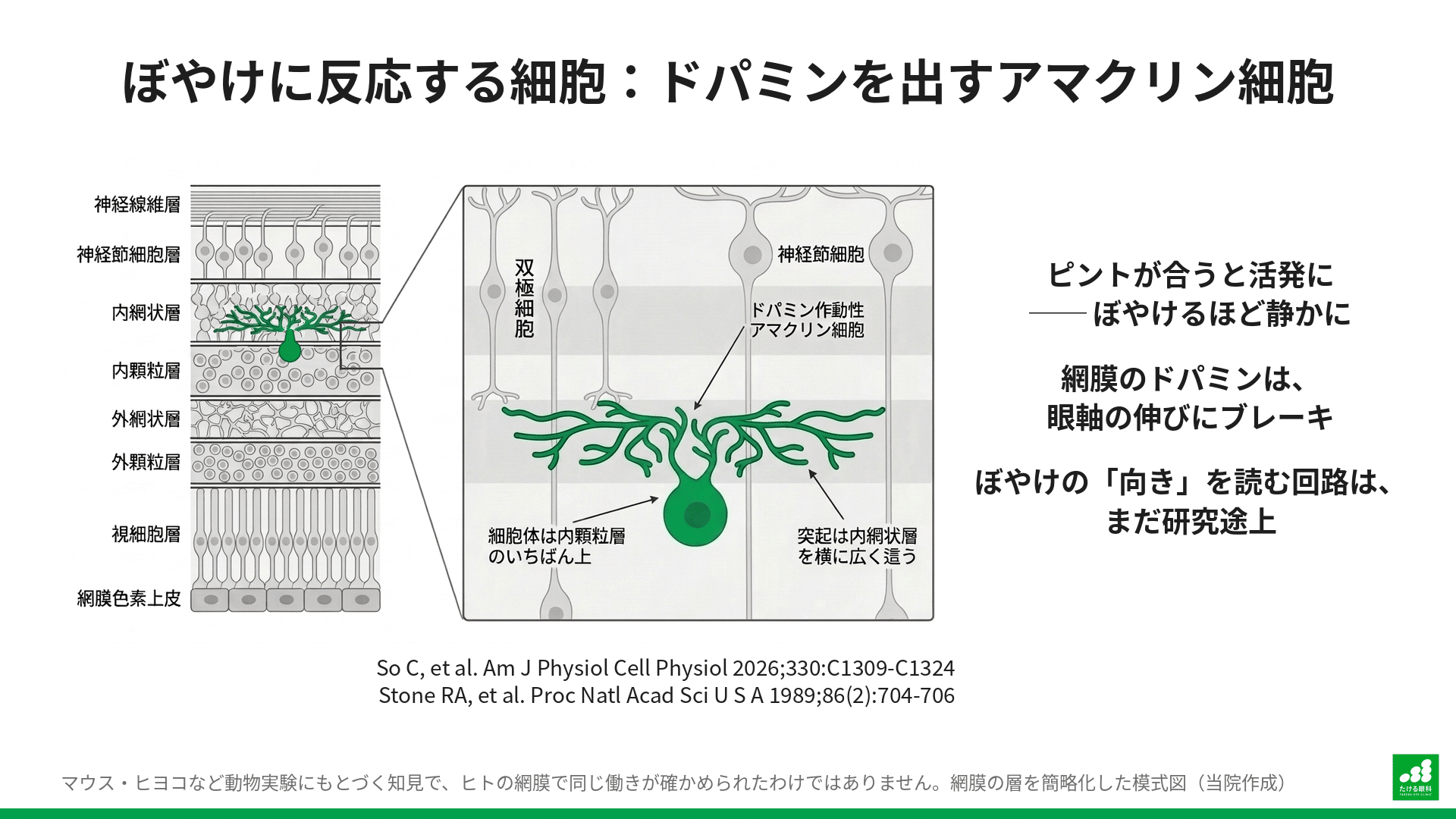
And in 2026, a study of the mouse retina reported that these cells “are most active when the image is in focus, and become quieter as the image becomes more blurred.” A concrete candidate has come into view for a cell that senses blur and changes the strength of the brake.
Animal experiments have shown that bright light affects the dopamine system of the retina and that dopamine is involved in regulating eye growth. This pathway is one of the hypotheses considered to explain why time spent outdoors reduces the onset of myopia. Whether the same mechanism works in humans has not yet been confirmed4,7,10–12. However, what outdoor play mainly does is work at the stage of “preventing myopia from developing”; its effect in stopping progression in children who already have myopia is not clear3。
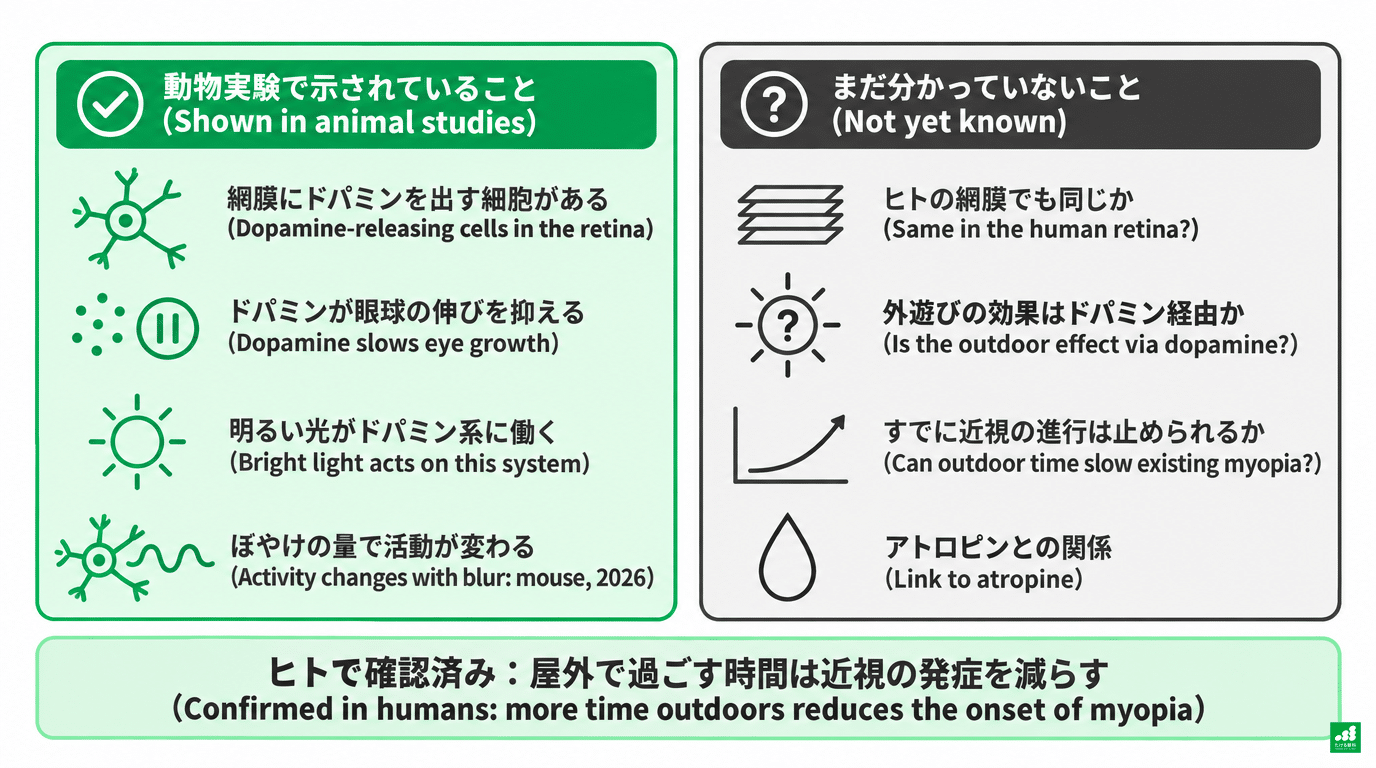
From here, I will explain in order.
The retina is not just “film”: the cells that release dopamine
The retina is often compared to the “film of a camera.” In the sense that cells that receive light are lined up, that is true.
But the retina is not just a membrane that receives light. It is also a “small computer” that processes the information from the light it receives on the spot, before sending it to the brain. Nerve cells in many layers adjust brightness and contrast and sort out the information that is needed.
Among those nerve cells is a group that releases dopamine. Technically they are called dopaminergic amacrine cells. They are very few in number and are sparsely distributed across the whole retina. On the other hand, because they extend thin processes widely and horizontally, the dopamine they release spreads gradually to the surroundings and acts on distant cells as well4。
📌 What is dopamine: in the brain it is known as a substance involved in “motivation” and “reward,” but in the retina it has a different job. Retinal dopamine is a “daytime switch” that increases during the day and decreases at night. It acts as the commander of adaptation to brightness, prioritizing circuits for discerning fine detail in bright environments and suppressing circuits for dark environments.4。
This “daytime switch” is also connected to the growth of the eye.
Dopamine is the “don’t elongate” signal: findings since 1989
In 1989, an experiment using chick eyes reported that when myopia was created by blurring vision, dopamine in the retina decreased. Furthermore, when a drug acting on dopamine receptors was given to the eye, only the front-to-back elongation of the eyeball was suppressed5。
In 1991, an experiment in monkeys was reported. Under conditions where myopia was created by covering one eye right after birth, in the 4 animals given eye drops of a dopamine receptor agonist (apomorphine), the elongation of the axial length was almost the same on the covered and uncovered sides (one animal is an exception because the uncovered eye did not develop normally). Of the 4 animals not given drops, 3 developed myopia of −3 to −7 D. On the other hand, 3 of the 4 animals given drops remained hyperopic6。
Retinal dopamine works as a “don’t elongate” signal for the eye. This idea has continued to be supported by many animal experiments since, in chicks, monkeys, mice, and others7。
Note that, more than 30 years after the first report, no drug acting on dopamine receptors has been approved as a myopia treatment for humans even now (as of September 2026). There are safety issues for the whole body and the eyes, and these remain at the animal-experiment stage. Rather than placing hope on a “drug that increases dopamine,” the “light” I discuss later is a means we can use right away.
New findings in 2026: active when in focus, quiet when blurred
In 2026, a group at the School of Optometry, Hong Kong Polytechnic University, published a study. It performed whole-cell recording in the mouse retina and, as a separate analysis, examined gene expression by single-cell RNA sequencing. In the retina of a myopia model, changes in expression were analyzed by cell type8。
There were two main findings.
One is that the cells that release dopamine were most active when an in-focus image was shown, and their activity was suppressed more the stronger the blur was. The way dopamine is released changes with the “amount” of blur. In other words, these cells are a candidate for adjusting the strength of the brake by changing their activity according to the degree of blur in the image.
The other is that, in the retina of lens-induced myopia mice, the expression of several dopamine pathway–related genes, including the D1 and D2 receptors, was reduced. This suggests that regulation of signaling on the receiving side may have changed, but it is not a result that directly confirms the function of the receptors or that the “brake circuit” as a whole has weakened8. The authors state, “restoring the dopamine signal may restore the normal response to blur and slow the progression of myopia.” This is a prospect from basic research and has not been established as a treatment for humans.
There are two things I would like to add here.
The first is that this study is a result in mice, and moreover in excised retina. Whether the same thing happens in the human retina is not yet known.
The second is that what these cells read is the “amount of blur,” and this study cannot say that they distinguish the “direction” of the blur. “Direction” here means whether the focus lies in front of the retina or behind it. It is thought that whether the eye grows or stops depends on the “direction” of the blur.The article on peripheral defocusexplains this. Which circuit in the retina reads that “direction” is still a matter of ongoing research.
Even so, animal experiments have shown that the regulation of eye growth has a mechanism that starts within the retina without going through the brain and proceeds locally. In chick experiments, when only a part of the retina was visually deprived with a translucent occluder, the eye wall corresponding to that region elongated locally9. Within the small computer that is the retina, who senses blur, and what do they release to tell the wall? The outline of the dopamine-releasing cell has come into view as one of those players — that is where things stand in 2026.
Relation to outdoor play: brightness increases dopamine
What we have discussed so far connects to outdoor play.
In the chick form-deprivation myopia model, 15,000 lux of light reduced myopia by about 60%. However, when spiperone, a dopamine D2-like receptor antagonist, was given together, this protective effect was no longer seen. Under these experimental conditions, the dopamine system is thought to have been involved in the effect of light10。
Where does the information about brightness reach the dopamine cells from? The retina has special ganglion cells (melanopsin cells) that sense brightness itself, not for seeing the shapes of things, and it is known that these cells send signals directly to the dopamine cells11. Myopia occurred more easily in mice in which this pathway did not work. When the raw material for dopamine was supplied to mice in which this pathway did not work, the degree of myopia was about halved12。
Put together as one picture, it looks like this.
Bright outdoor light → cells that sense brightness → cells that release dopamine → dopamine release ↑ → brake on axial elongation.
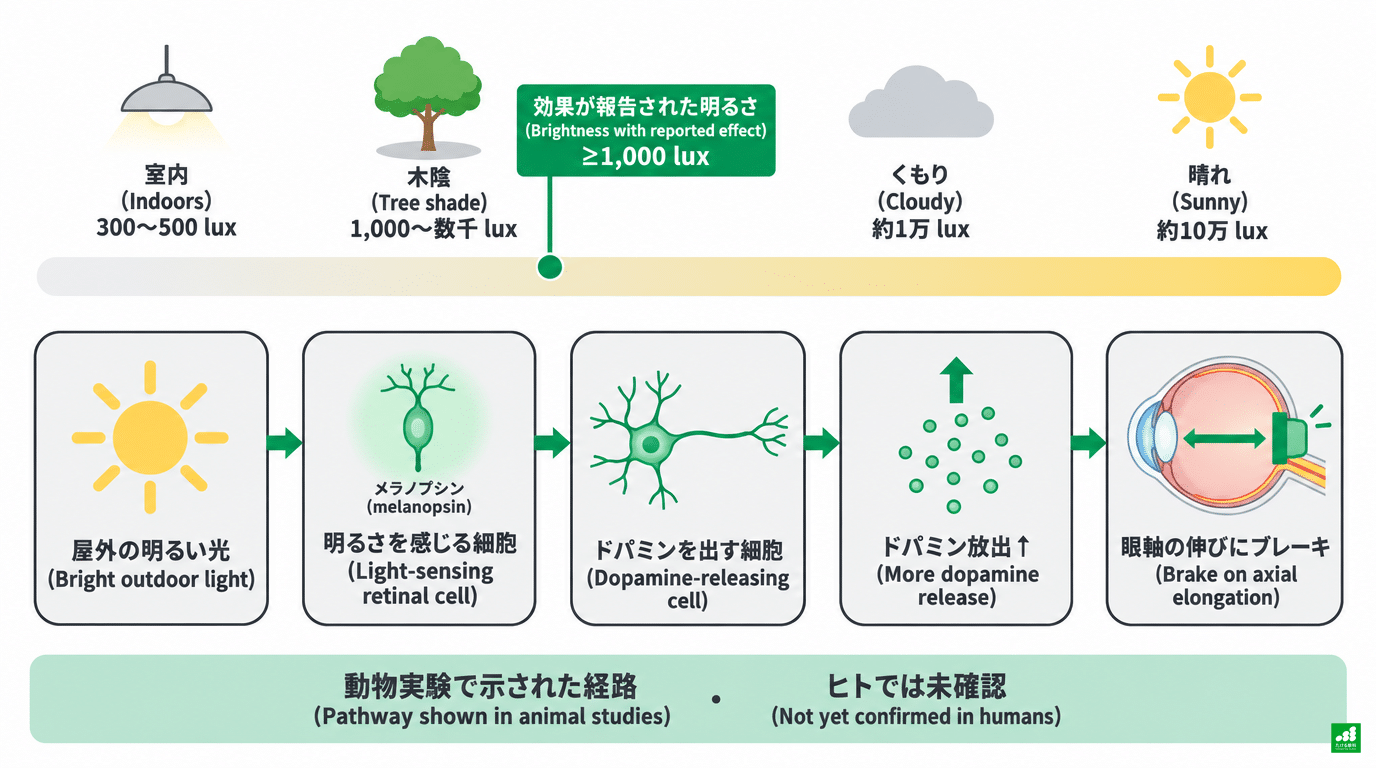
In the literature I checked this time, I could not find a study that directly confirmed that the myopia-preventing effect of outdoor time occurs through the dopamine pathway in the human retina. However, the effect of outdoor time itself has been confirmed in randomized controlled trials. In a trial of first-grade elementary school children in Taiwan, in classes where outdoor time at school was increased, the one-year progression of myopia was smaller at 0.35 D (0.47 D in classes where it was not increased), and axial elongation was also smaller at 0.28 mm (0.33 mm). Moreover, the authors concluded that the brightness at which an effect was seen was 1,000 lux or more, that midsummer direct sunlight is not necessary, and that hallways and tree shade are fine13。
📌 A guide to brightness: a sunny outdoor day is 100,000 lux, even a cloudy day is around 10,000 lux, and under tree shade or eaves it is 1,000 to several thousand lux. On the other hand, a school classroom or a living room at home, even if it feels bright, is only about 300 to 500 lux. The difference between outdoors and indoors is larger than we feel.
There is one thing I would like you to be careful about. In chick experiments, blue light, UV, and red light all increased dopamine release. On the other hand, it has been reported that it was the blue light and UV conditions under which myopia was less likely to develop14. Reading this as “so looking at devices with blue light is good” is a mistake. The authors themselves note that application to humans is limited, and looking at a screen does not reproduce exposure to outdoor light. I think that using a device that emits blue light to control myopia is not good.
There is one more thing I would like you to know about outdoor time. In an analysis pooling multiple studies, spending time outdoors clearly had an effect of preventing “becoming nearsighted,” but increasing time outdoors could not be confirmed to slow “the progression of an eye that has already become nearsighted”3. On the other hand, in the Taiwan trial mentioned earlier, an effect was reported even in children who already had myopia13, and results differ between studies on this point. Outdoor play is important for preventing myopia. However, the current assessment is that, in children whose myopia has already progressed, it is better not to expect outdoor play alone to stop the progression.
Relation to low-concentration atropine: probably related, but not the deciding factor
How is low-concentration atropine eye drops (Rejusea® Mini Ophthalmic Solution 0.025%) related to dopamine?
In chick experiments, it has been reported that high-dose atropine given into the vitreous increased dopamine release from the retina. However, this is not a result showing the action of low-concentration atropine eye drops in humans (Rejusea® Mini 0.025%)15,16。
. On the other hand, there is also a report that the myopia-controlling effect of atropine did not change even when a drug blocking dopamine receptors was given together. This means the change in dopamine may not be essential to the effect of atropine16。
To sum up, atropine increasing dopamine release has been observed in high-dose chick experiments, but whether that is the deciding factor in its effect is not known. My having told you that “the overall picture of the mechanism of action of atropine is not yet settled” reflects this state of the research. Even in light of the studies I checked this time, I did not need to change that explanation.
On receptors: honestly, the answer differs by animal
Dopamine receptors come in two families, D1-like and D2-like, and which one is responsible for the brake on myopia has long been debated among researchers7。
In chicks and tree shrews, many studies have reported that “stimulating D2 receptors applies the brake.” On the other hand, in mice, an almost opposite result has been reported: “D1 receptors act as the brake, and D2 receptors rather act to advance myopia”17,18. The reason given is that the retinal circuits differ between nocturnal mice with poor vision and diurnal birds.
There are no data showing which receptor is at work in humans. The broad framework that “dopamine is the brake” agrees across animal species, but beyond that, the finer mechanism gives different answers in different animals — that is where we stand now.
I used to do basic cytokine research in an immunology laboratory at Kyushu University. In immunology too, the same molecule often works in completely opposite ways depending on the situation. I tried not to assume “one molecule, one role,” and to write plainly that what is not known is not known. I kept that in mind this time as well.
Myopia Management at Takeru Eye Clinic (Takatori Shopping Street, Sawara-ku, Fukuoka)
When we begin myopia control, we always talk about outdoor play.
As a guide, we tell families to secure about 2 hours a day spent outdoors. It does not have to be under midsummer sun. Small accumulations are enough: taking a slightly longer route to and from school, going outside at recess, spending time in the shade of trees in a park. As explained above, the effect has been confirmed at a brightness of 1,000 lux or more. Even tree shade or eaves can provide about this much brightness, depending on conditions.
On top of that, for children whose myopia has already started, we do not rely on outdoor play alone, and we have families choose, in consultation with us, a treatment whose effect has been shown in human clinical trials. What we offer isorthokeratology、MiSight®, myopia-control glasses (MiYOSMART)、low-concentration atropine. Even when myopia has started, depending on age and how it is progressing, we sometimes just follow the course without treatment. Not every child needs treatment. How to choose a treatment is explained inthe article on shared decision-making with the child and family, and the change in how we think about myopia management is explained inthe article “Myopia in Children: Changing Times”.
Whichever method is chosen, we confirm its effect by the number calledaxial length. Every 3 months we measure the growth of axial length with an axial length measuring device. Looking at those numbers, we evaluate how myopia is progressing and how it responds to treatment.
What I would like to tell patients
The retina has a small number of cells that release dopamine, and animal experiments have repeatedly shown that this dopamine works as a brake that keeps the eyeball from elongating too much. A 2026 study reported in mice that these cells change their activity according to the degree of blur in the image, becoming quieter the more blurred it is.
Animal experiments have shown that bright light affects the dopamine system of the retina and that dopamine is involved in regulating eye growth. This pathway is one of the hypotheses considered to explain why time spent outdoors reduces the onset of myopia. Whether the same mechanism works in humans has not yet been confirmed4,7,10–12. On the other hand, that time spent outdoors reduces the onset of myopia has itself been shown in clinical trials2,3,13。
On the other hand,what has been confirmed for outdoor play is mainly the effect of “preventing myopia from developing.”For children whose myopia has already progressed, I think it is important to use outdoor play as the foundation, combine it with treatments whose effect has been shown, and confirm the result with the number called axial length.
If anything about myopia or outdoor play worries you, please speak to us at the visit.
References
- Rose KA, Morgan IG, Ip J, et al. Outdoor activity reduces the prevalence of myopia in children. Ophthalmology. 2008;115(8):1279-1285. https://doi.org/10.1016/j.ophtha.2007.12.019
- He M, Xiang F, Zeng Y, et al. Effect of time spent outdoors at school on the development of myopia among children in China: a randomized clinical trial. JAMA. 2015;314(11):1142-1148. https://doi.org/10.1001/jama.2015.10803
- Xiong S, Sankaridurg P, Naduvilath T, et al. Time spent in outdoor activities in relation to myopia prevention and control: a meta-analysis and systematic review. Acta Ophthalmol. 2017;95(6):551-566. https://doi.org/10.1111/aos.13403
- Witkovsky P. Dopamine and retinal function. Doc Ophthalmol. 2004;108(1):17-40. https://doi.org/10.1023/b:doop.0000019487.88486.0a
- Stone RA, Lin T, Laties AM, Iuvone PM. Retinal dopamine and form-deprivation myopia. Proc Natl Acad Sci U S A. 1989;86(2):704-706. https://doi.org/10.1073/pnas.86.2.704
- Iuvone PM, Tigges M, Stone RA, Lambert S, Laties AM. Effects of apomorphine, a dopamine receptor agonist, on ocular refraction and axial elongation in a primate model of myopia. Invest Ophthalmol Vis Sci. 1991;32(5):1674-1677. https://pubmed.ncbi.nlm.nih.gov/2016144/
- Feldkaemper M, Schaeffel F. An updated view on the role of dopamine in myopia. Exp Eye Res. 2013;114:106-119. https://doi.org/10.1016/j.exer.2013.02.007
- So C, Zhang T, Yang K, Wang J, Yan-Yin Tse D, Pan F. Defocus coding and transcriptomic remodeling in the mouse myopic retina. Am J Physiol Cell Physiol. 2026;330:C1309-C1324. https://doi.org/10.1152/ajpcell.00011.2026
- Wallman J, Gottlieb MD, Rajaram V, Fugate-Wentzek LA. Local retinal regions control local eye growth and myopia. Science. 1987;237(4810):73-77. https://doi.org/10.1126/science.3603011
- Ashby RS, Schaeffel F. The effect of bright light on lens compensation in chicks. Invest Ophthalmol Vis Sci. 2010;51(10):5247-5253. https://doi.org/10.1167/iovs.09-4689
- Zhang DQ, Wong KY, Sollars PJ, Berson DM, Pickard GE, McMahon DG. Intraretinal signaling by ganglion cell photoreceptors to dopaminergic amacrine neurons. Proc Natl Acad Sci U S A. 2008;105(37):14181-14186. https://doi.org/10.1073/pnas.0803893105
- Chakraborty R, Landis EG, Mazade R, et al. Melanopsin modulates refractive development and myopia. Exp Eye Res. 2022;214:108866. https://doi.org/10.1016/j.exer.2021.108866
- Wu PC, Chen CT, Lin KK, et al. Myopia prevention and outdoor light intensity in a school-based cluster randomized trial. Ophthalmology. 2018;125(8):1239-1250. https://doi.org/10.1016/j.ophtha.2017.12.011
- Wang M, Schaeffel F, Jiang B, Feldkaemper M. Effects of light of different spectral composition on refractive development and retinal dopamine in chicks. Invest Ophthalmol Vis Sci. 2018;59(11):4413-4424. https://doi.org/10.1167/iovs.18-23880
- Schwahn HN, Kaymak H, Schaeffel F. Effects of atropine on refractive development, dopamine release, and slow retinal potentials in the chick. Vis Neurosci. 2000;17(2):165-176. https://doi.org/10.1017/s0952523800171184
- Thomson K, Kelly T, Karouta C, Morgan I, Ashby R. Insights into the mechanism by which atropine inhibits myopia: evidence against cholinergic hyperactivity and modulation of dopamine release. Br J Pharmacol. 2021;178(22):4501-4517. https://doi.org/10.1111/bph.15629
- Huang F, Shu Z, Huang Q, et al. Retinal dopamine D2 receptors participate in the development of myopia in mice. Invest Ophthalmol Vis Sci. 2022;63(1):24. https://doi.org/10.1167/iovs.63.1.24
- Shu Z, Chen K, Wang Q, et al. The role of retinal dopamine D1 receptors in ocular growth and myopia development in mice. J Neurosci. 2023;43(48):8231-8242. https://doi.org/10.1523/JNEUROSCI.1196-23.2023